Tractor-Trailer Towing: What You Need to Know
Why Tractor-Trailer Towing Is Critical for Commercial Transport
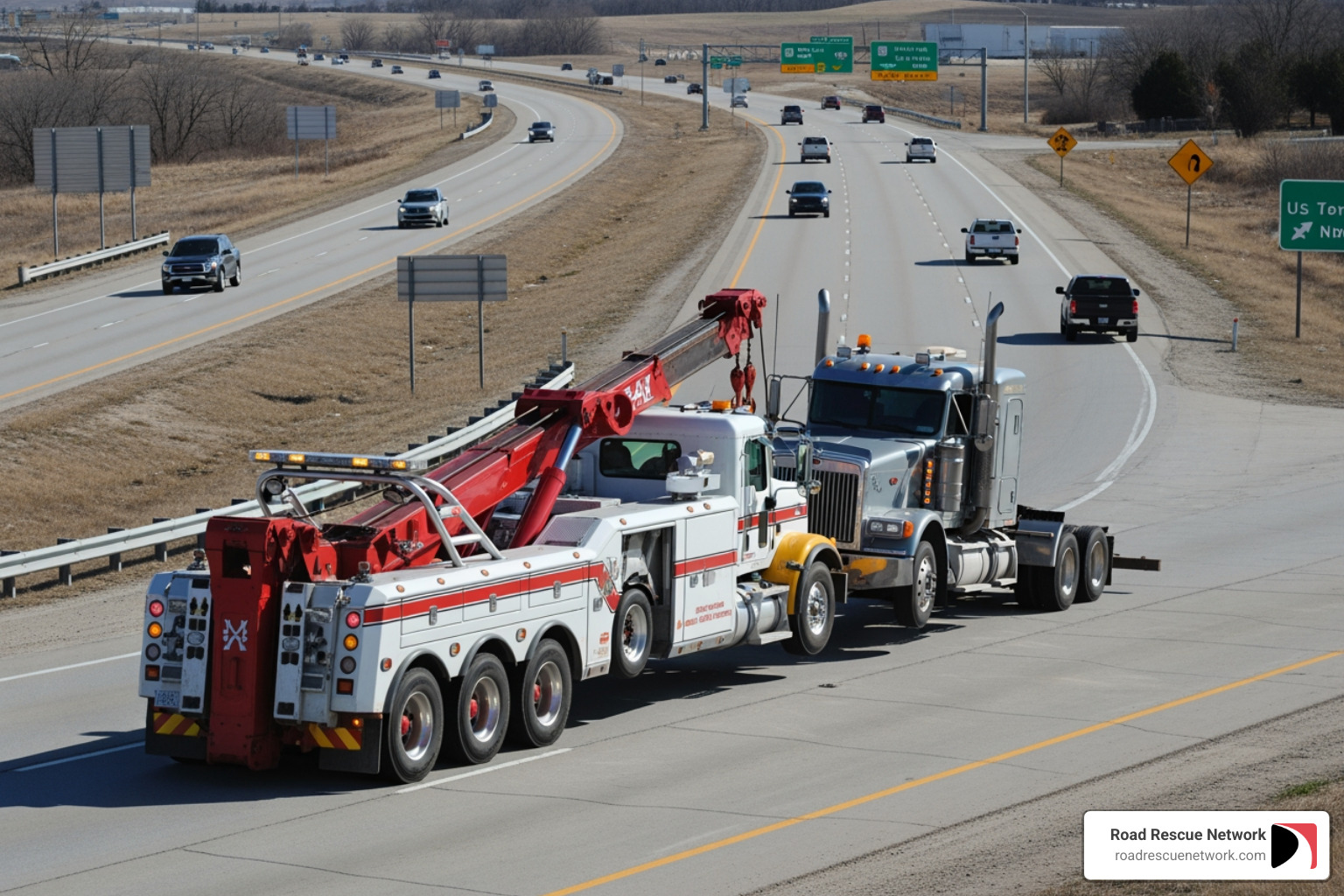
Tractor trailer towing is the specialized service for recovering a semi-truck, 18-wheeler, or other large commercial vehicle that has broken down or crashed. These massive vehicles, weighing up to 80,000 pounds, demand heavy-duty equipment, trained operators, and strict safety protocols that go far beyond standard roadside assistance.
Quick Answer: What You Need to Know About Tractor-Trailer Towing
- What it is: Professional recovery and transport of disabled semi-trucks using specialized heavy-duty equipment.
- When needed: Breakdowns, accidents, rollovers, jackknifes, or mechanical failures.
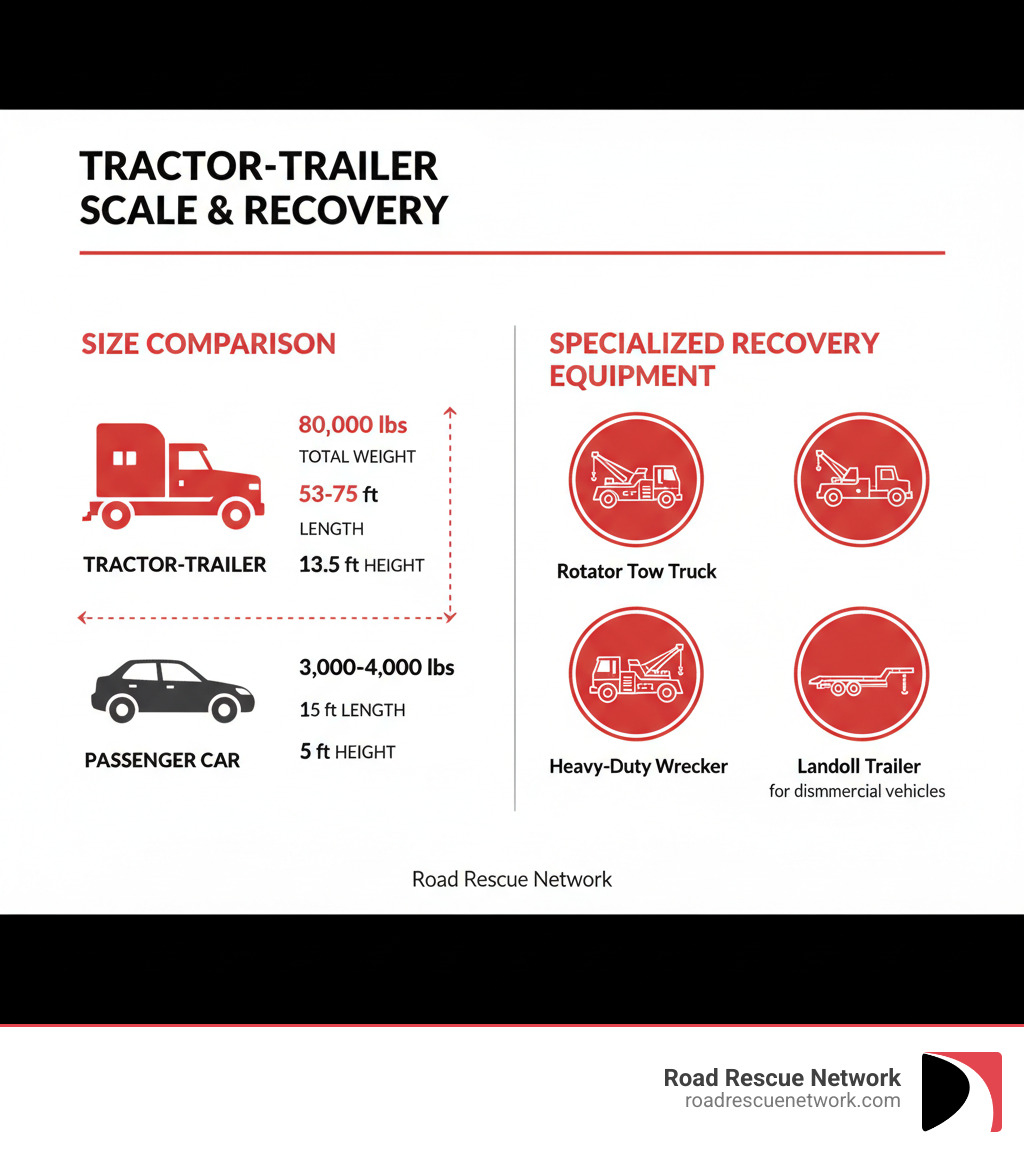
- Equipment used: Rotators, heavy-duty wreckers, Landoll trailers, and integrated tow trucks.
- Cost factors: Distance, vehicle weight, recovery complexity, and time of day.
- Key requirement: 24/7 availability with proper licensing (CVOR/USDOT) and insurance.
When incidents like rollovers occur, getting the right help fast is about preserving cargo, minimizing downtime, and protecting supply chains. Fully loaded rigs are ten times more likely to roll over than empty ones, making professional recovery essential.
I’m Byron Tarlton, founder of Road Rescue Network. With over two decades in the towing and transportation industry, I’ve seen how critical proper heavy-duty recovery is for keeping commercial vehicles—and the businesses that depend on them—moving.
Understanding Tractor-Trailer Towing: The Basics
When you hear tractor trailer towing, it’s important to understand this is a highly specialized field, distinct from standard car towing. We’re talking about moving disabled commercial trucks—also known as a “semitrailer”, “big rig”, or “eighteen-wheeler”. These vehicles are the workhorses of our economy, and when one goes down, it creates a significant ripple effect. Our job is to get these massive machines safely back on the move as quickly as possible, whether it’s a breakdown, a complex rollover, or a jackknife accident.
Why is Tractor-Trailer Towing Necessary?
Heavy-duty towing is essential during some of the most stressful moments in a trucker’s career.
- Mechanical failure is a top reason. When engines, transmissions, or other critical components fail on a 40-ton truck, professional help is the only option.
- Collision recovery requires specialized equipment and expertise to clear accident scenes safely, often in coordination with emergency responders.
- Cargo preservation is crucial. A trailer may carry thousands of dollars in goods, including perishable or time-sensitive shipments. Quick, professional towing protects the vehicle and its valuable contents.
- Minimizing downtime is vital for trucking companies, as every hour a truck is idle means lost revenue. Getting the rig to a repair facility quickly is a financial necessity. For more on these services, see our resources on heavy duty towing services in Mississippi.
- Weather-related incidents, such as trucks stuck in mud, sliding off icy roads, or overturning in high winds, require operators skilled in working in challenging conditions.
The Sheer Scale of the Job
The numbers illustrate why tractor trailer towing is so different. A fully loaded tractor-trailer can weigh up to 80,000 pounds (40 tons) and stretch over 18 meters (roughly 60 feet). Moving something of this scale requires specialized knowledge to avoid damage or creating a dangerous situation. You must know how to disconnect driveshafts, cage spring brakes, and rig the vehicle properly.
The safety risks are significant, as rollovers are a major cause of truck driver fatalities. Fully loaded rigs are ten times more likely to roll over than empty ones. Jackknife accidents, where a trailer folds against the tractor, can block entire highways and require precision and the right heavy-duty equipment to resolve. This is why this work demands skills and equipment far beyond what’s needed for passenger vehicles.
The Specialized Equipment for Heavy-Duty Towing
Tractor trailer towing requires specialized equipment built to handle incredible weight and size. Each machine serves a specific purpose, and deploying the right one is key to a safe, smooth recovery.
Heavy-Duty Wreckers and Integrated Tow Trucks
Heavy-duty wreckers are the backbone of any towing operation. These powerful machines are built with reinforced frames and massive hydraulic systems. Their key feature is the under-reach lift, which extends beneath the disabled truck’s axle or frame to lift it cleanly off the ground. This method protects the vehicle from damage and is ideal for standard breakdown towing, such as moving a tractor without its trailer after a mechanical failure.
Rotators: The Heavy-Lifting Champions
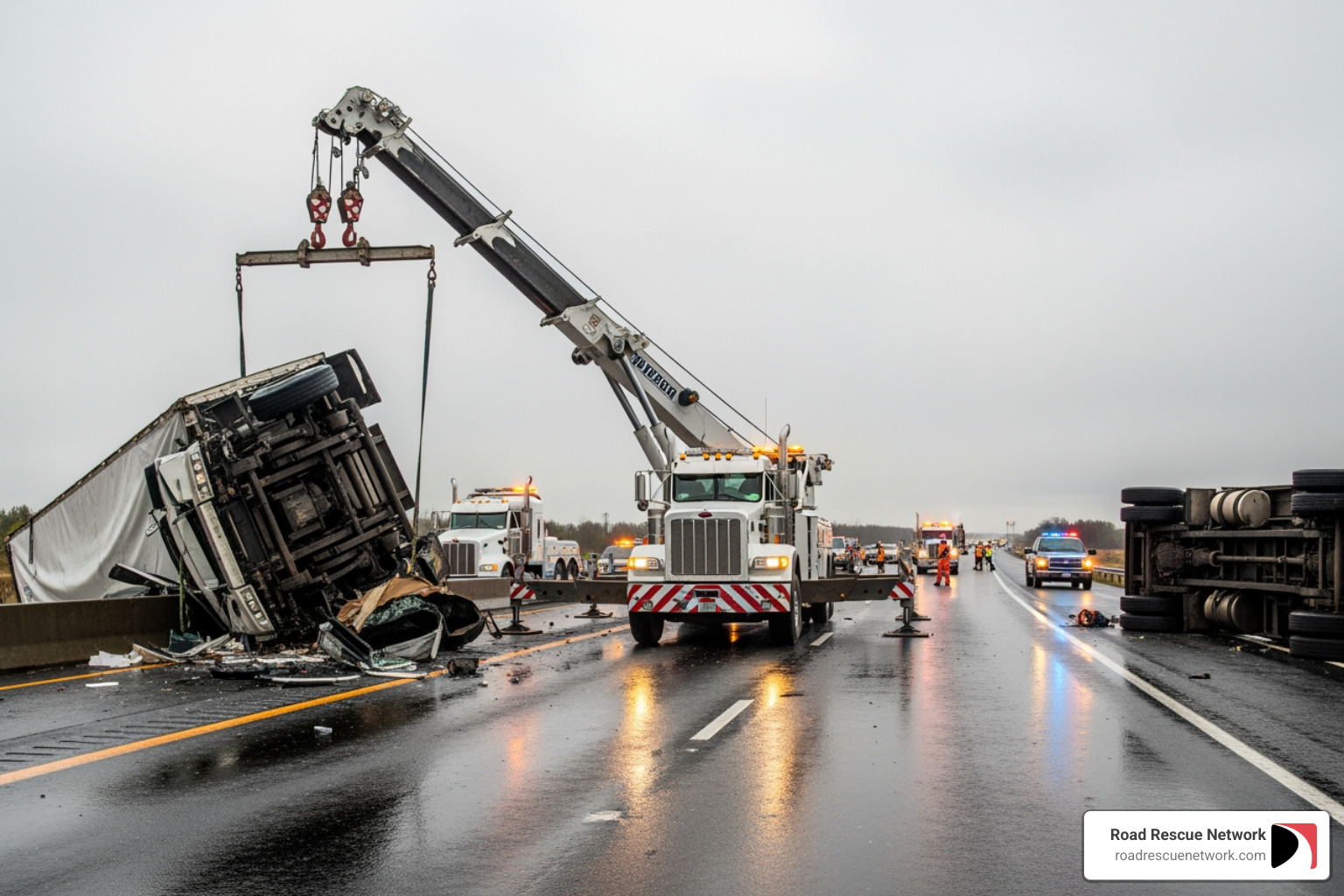
For complex recoveries, we use rotators. These are the heavy-duty champions for overturned trailers, vehicles in ditches, or trucks stuck in precarious positions. A rotator’s power lies in its 360-degree rotating boom, which functions like a mobile crane. This allows operators to perform complex lifts without repositioning the entire tow truck, which is critical on narrow shoulders or steep hills. Rotators are indispensable for serious accident scenes and rollovers, and our operators are extensively trained to use them safely. If you need this level of capability, learn more about heavy duty towing in Illinois.
Landoll & Lowboy Trailers for Transport
Sometimes, hauling a vehicle is a better option than towing it. Landoll trailers (sliding axle trailers) have a hydraulic bed that tilts to the ground, creating a gentle ramp. This is ideal for loading severely damaged tractors, heavy equipment, or entire trailers. We use them for load shifts and undecking services. Lowboy trailers feature a drop-deck design that sits very low to the ground, which is essential for hauling oversized or overweight loads while staying within legal height restrictions.
The Process and Challenges of Tractor-Trailer Towing
Tractor-trailer towing is a carefully coordinated effort, often under high-pressure conditions. We follow strict protocols to ensure safety and efficiency, because when a big rig goes down, the clock is ticking.
Step 1: Initial Assessment and Site Safety
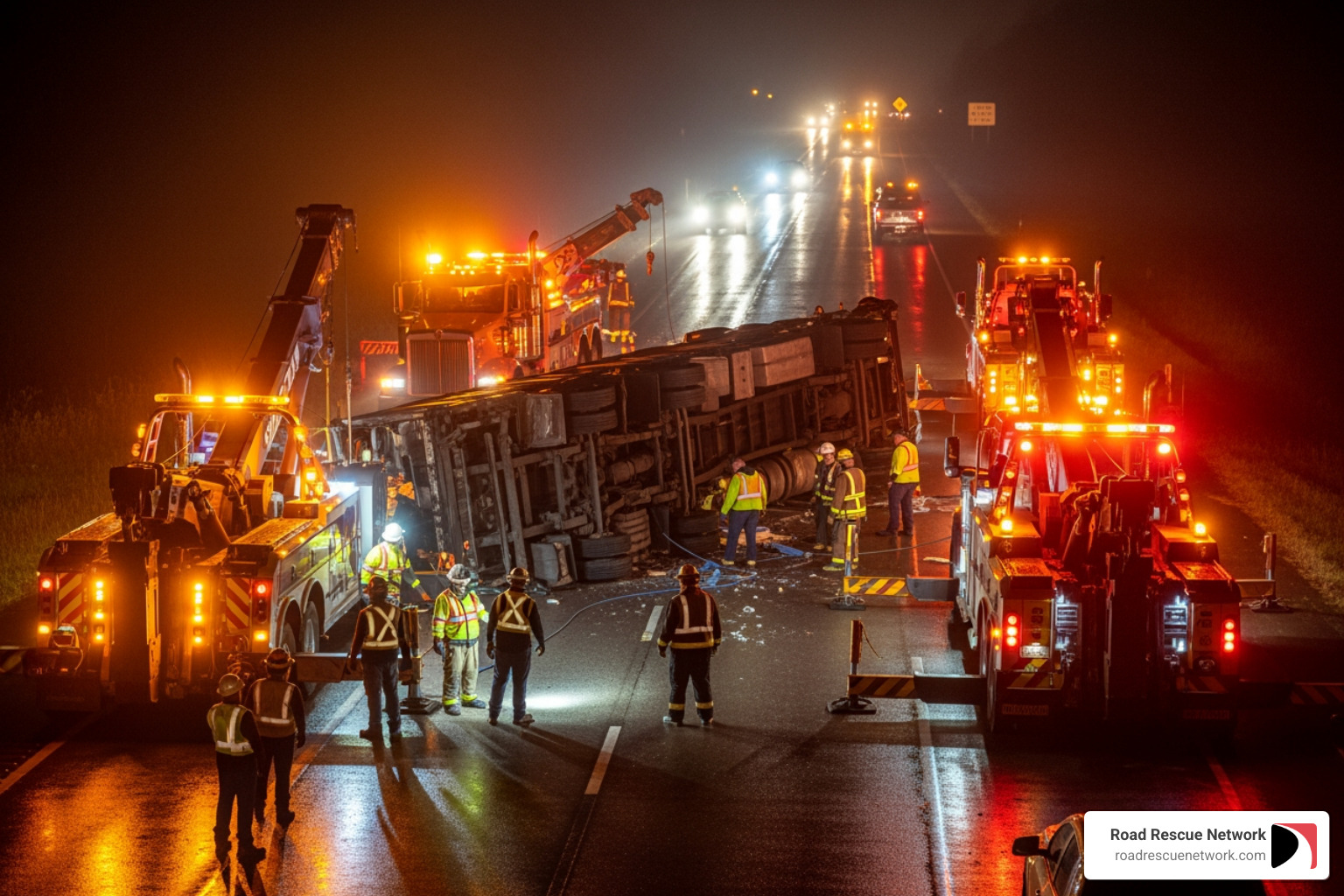
Upon arrival, our first priority is a rapid assessment and securing the scene. Operators evaluate the vehicle’s position, damage, cargo, and surrounding environment. Working with authorities, we establish traffic control with cones and flares to protect everyone and prevent secondary accidents. Hazard mitigation is next, addressing dangers like fuel leaks or spilled cargo, often in coordination with hazmat or environmental teams. The area is secured to keep unauthorized personnel at a distance before recovery work begins.
Step 2: Preparing the Tractor-Trailer for Towing
Once the scene is safe, technical preparation begins. This intricate process requires precision and specialized knowledge. To prevent transmission damage, we often disconnect the driveshaft. Another critical step is caging the spring brakes, which involves mechanically overriding the air brake system so the wheels can turn freely. Proper rigging techniques using chains and straps are used to create a secure connection to the truck’s frame or axles. If the trailer is loaded, we take extra care to secure the cargo and protect all vehicle components from further damage.
Step 3: Navigating Challenges in Tractor-Trailer Towing
Even with perfect preparation, tractor trailer towing presents unique challenges. The sheer weight of heavy loads (up to 80,000 pounds) requires immense power and an understanding of weight distribution. Difficult terrain like muddy ditches or soft shoulders often requires specialized extraction with rotators and winches. Our teams are equipped for diverse conditions, like those found during heavy duty towing in Montana. Adverse weather, such as rain, snow, or high winds, demands adapted techniques and extra caution. Throughout the process, preserving cargo value and working safely in high-traffic areas remain top priorities, requiring constant vigilance and coordination.
Services, Costs, and Legalities
When your tractor-trailer is down, you need a partner who understands the full scope of the recovery process to protect your cargo and get your business back on track.
Comprehensive Services Offered by Towing Companies
A professional tractor trailer towing company is a one-stop solution for commercial vehicle emergencies. Our services go beyond simple towing to solve problems day or night.
- 24/7 emergency towing for all commercial vehicles.
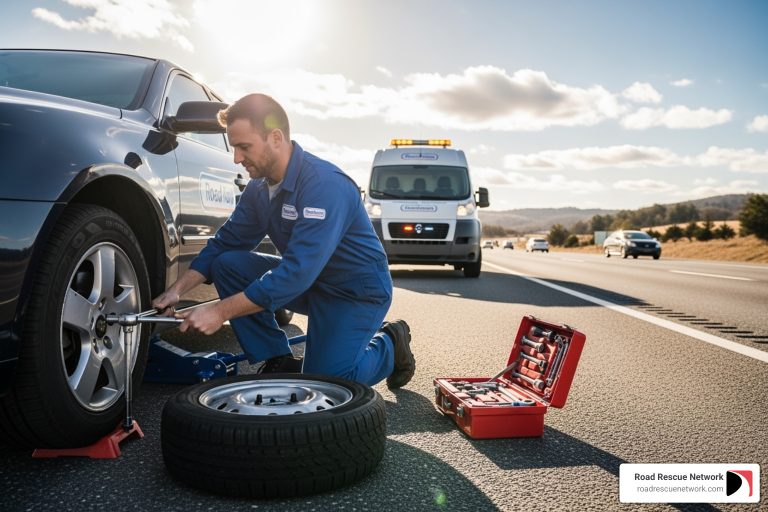
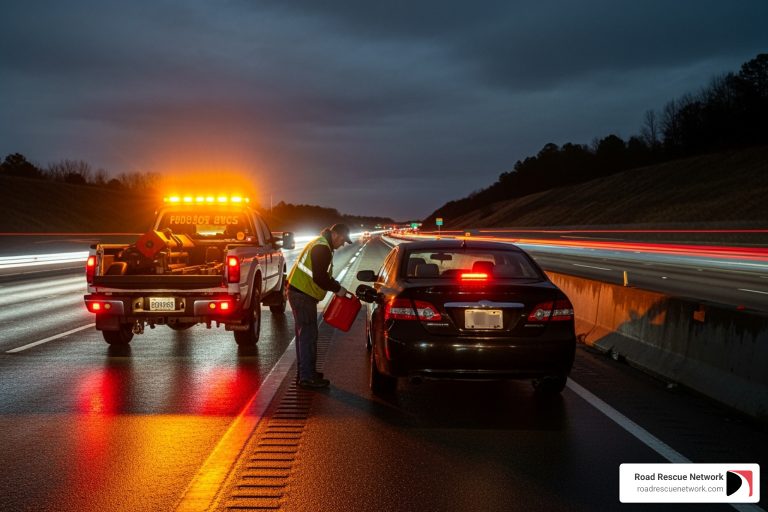
- Roadside assistance for minor issues like jumpstarts, tire changes, and fuel delivery.
- Load shifts and transfers to correct imbalances or move freight to another trailer.
- Winching and extraction to pull vehicles from mud, snow, or ditches.
- Accident recovery and salvage operations for managing complex scenes from start to finish.
- Undecking services to separate a tractor from its trailer.
For a closer look at services in your area, check out our page on heavy duty towing in West Virginia.
Factors Influencing the Cost of Tractor-Trailer Towing
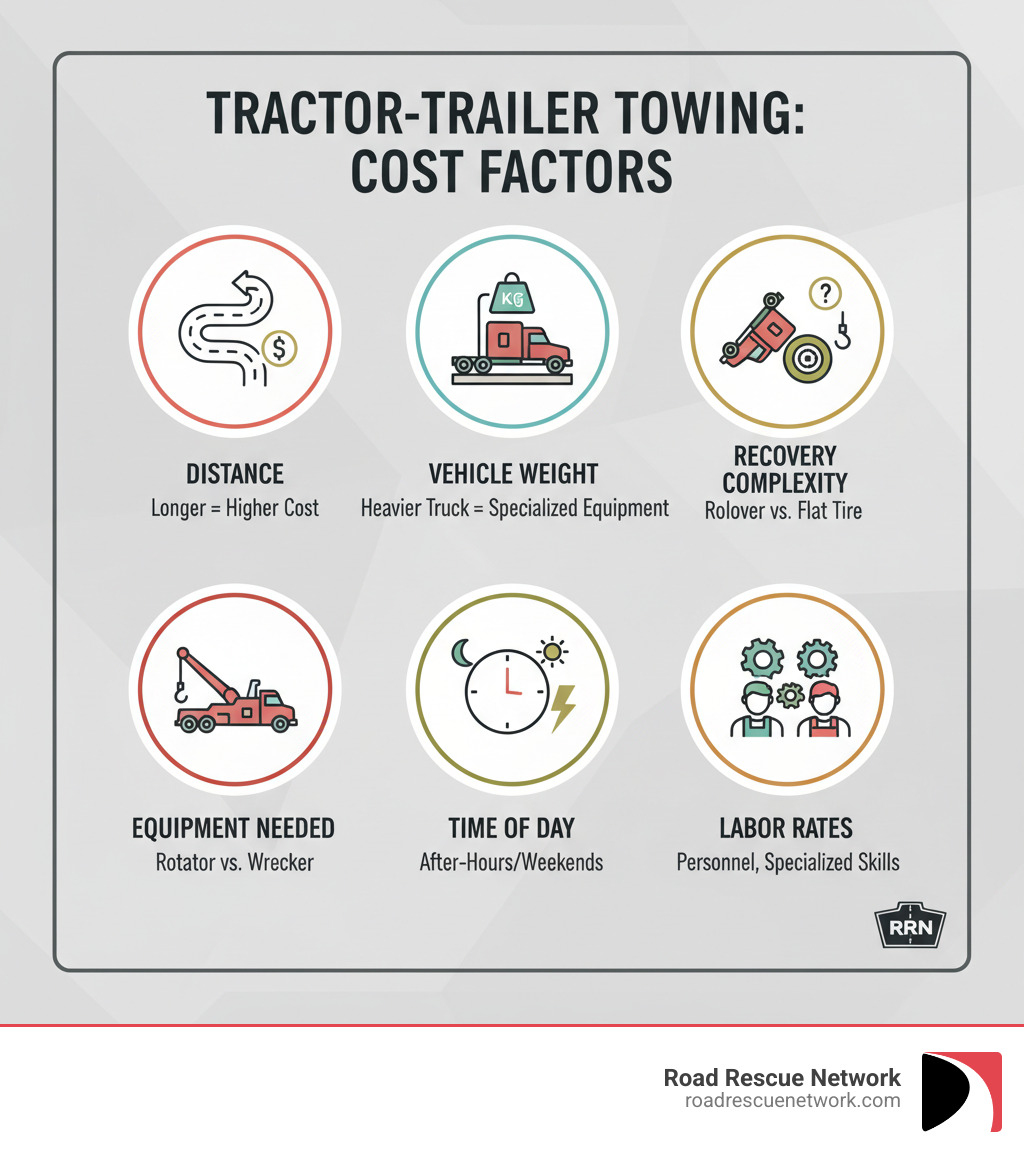
The cost of tractor trailer towing varies with each situation. Key factors include:
- Distance: The farther the tow, the higher the cost.
- Vehicle weight: A fully loaded 80,000-pound rig costs more to move than an empty one.
- Recovery complexity: A simple breakdown is less expensive than an overturned truck in a ditch.
- Equipment needed: A standard wrecker costs less than a rotator or Landoll trailer.
- Time of day: After-hours, weekend, and holiday services typically have higher rates.
- Labor and additional services: The number of operators and services like load transfers affect the final bill.
Reputable companies provide free estimates, and we accept Visa, Mastercard, Debit, and Cash.
Legal and Regulatory Considerations
Heavy-duty towing is governed by strict rules to ensure safety. Licensing and insurance are non-negotiable; a professional company must be fully licensed and carry comprehensive insurance to protect all parties. For interstate operations, CVOR/USDOT accreditation is critical. We also adhere to all federal and state weight and length regulations, such as the 80,000-pound gross vehicle weight limit. For more on these standards, see the Federal Size Regulations for Commercial Motor Vehicles. Navigating these rules, including those for cross-border towing, is part of our professional service.
Choosing the Right Heavy-Duty Towing Provider
When your livelihood is stranded, choosing the right heavy-duty towing provider is a critical decision. You need a partner with the urgency and expertise to handle your situation professionally.
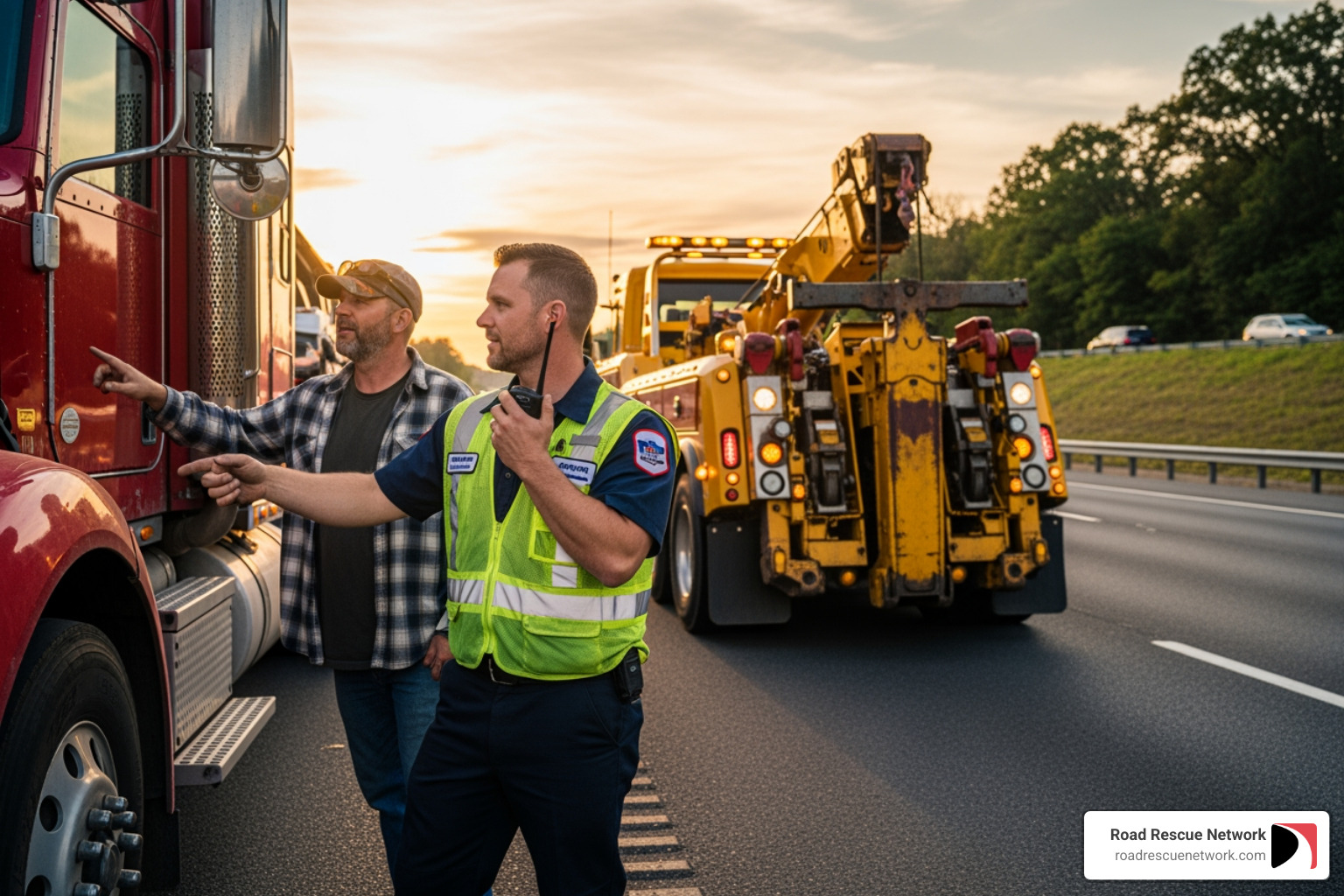
What to Look for in a Professional Towing Company
In a moment of crisis, focus on these key qualities:
- Experience and Reputation: A company with decades in the business has likely handled every scenario imaginable.
- Certifications: Credentials from organizations like WreckMaster and TRAA show a commitment to industry best practices.
- Proof of Insurance: Never work with a company that cannot provide proof of full licensing and insurance. This protects you from liability.
- 24/7 Availability: Breakdowns happen at all hours, and your towing provider must be ready to respond immediately.
- Service Area: A provider with a large coverage area offers consistent support. If you’re often in Texas, a partner with comprehensive heavy duty towing in Texas is invaluable.
- Right Equipment: Ensure the company has rotators, Landoll trailers, and heavy-duty wreckers capable of handling your specific needs.
How Companies Ensure Safety and Efficiency
Professional tractor trailer towing is built on a foundation of safety and efficiency. Reputable companies achieve this through:
- Operator Training: Operators undergo extensive training in heavy-duty recovery, rigging, and safety protocols.
- Equipment Maintenance: All equipment is subject to rigorous inspections and preventive maintenance to ensure it performs flawlessly under pressure.
- Safety Protocols: Strict guidelines are followed for every step, from securing the scene to executing the recovery, minimizing risk for everyone involved.
- Clear Communication: From dispatch to the operator on scene, you should receive transparent updates and realistic timeframes.
- Efficient Dispatching: Advanced GPS and resource management ensure the closest, best-equipped truck is sent to you quickly, minimizing downtime.
Road Rescue Network connects you with local professionals who meet these exact standards, treating every recovery with the urgency it deserves.
Frequently Asked Questions about Tractor-Trailer Towing
When your rig is down, you have questions. Here are answers to the most common concerns we hear during a tractor trailer towing emergency.
How much does it cost to tow a semi-truck?
There is no single price for a semi-truck tow. A simple breakdown tow on a highway might cost a few hundred dollars. However, a complex recovery, such as an overturned loaded trailer requiring a rotator and multiple operators, could cost several thousand dollars. The final bill depends on factors like distance, vehicle weight, the condition of the truck, the equipment needed, and the time of day. Always request a detailed quote upfront from any reputable company.
Can you tow a loaded tractor-trailer?
Yes. Towing loaded tractor-trailers is a critical part of our services. Professional heavy-duty towing companies have the equipment and expertise to handle fully loaded rigs safely. The process involves a careful assessment of the load to ensure it is secure and won’t shift. We manage the weight distribution and use specialized equipment like heavy-duty wreckers or Landoll trailers to transport the entire unit safely.
How long does a heavy-duty tow take?
While our goal is a quick response, often within 30 to 60 minutes, the total time for a recovery depends on the situation’s complexity.
- A simple breakdown can often be completed in an hour or two.
- A loaded trailer breakdown may take two to three hours due to the need to secure cargo.
- Accident recoveries and other complex scenarios, like an overturned semi or a truck in a ditch, can take anywhere from four hours to a full day.
We are committed to providing efficient service 24/7, but we will never rush a job at the expense of safety. We take the time needed to do the job right.
Conclusion
Tractor trailer towing is a critical service that keeps the lifeblood of our economy flowing. When a rig weighing up to 80,000 pounds goes down, the impact can ripple through entire supply chains.
This specialized service demands preparedness with the right heavy-duty equipment, from rotators to Landoll trailers. It requires professionalism from trained operators who understand rigging, load management, and safety protocols. Above all, safety is non-negotiable in every recovery to protect operators, drivers, and the public.
When your rig is down, getting the right help quickly is essential to minimize downtime and financial loss. The difference between a professional heavy-duty towing company and an inexperienced one can be significant.
Road Rescue Network provides that professional, fast, 24/7 service with no hidden fees, instantly connecting you with local rescuers. Our network of qualified providers stands ready to respond when you need them most.
For fast, reliable heavy-duty towing services, find a local rescuer in your area. We’re here to help keep you moving.