Beyond the Basics: Unpacking Heavy Duty Towing and Recovery
Understanding Heavy Duty Towing Service: What It Is and When You Need It
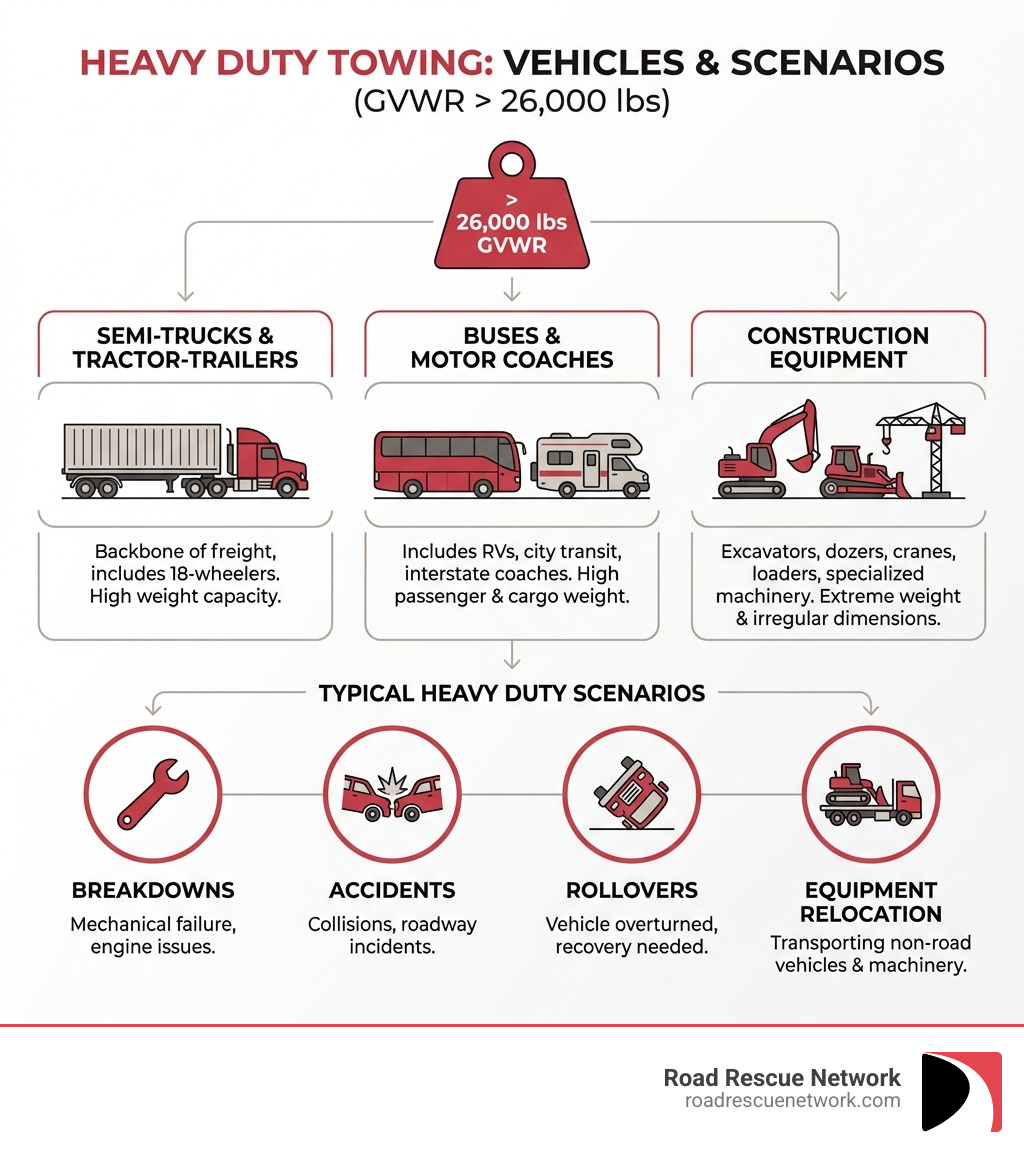
Heavy duty towing service is a specialized form of roadway recovery designed to move, transport, or extract large commercial vehicles and heavy equipment that standard tow trucks cannot handle. These services are critical for vehicles with a Gross Vehicle Weight Rating (GVWR) exceeding 26,000 pounds, including:
- Semi-trucks and tractor-trailers – the backbone of freight transport
- Buses and motor coaches – including RVs and city transit vehicles
- Construction equipment – excavators, cranes, dozers, and loaders
- Dump trucks and garbage trucks – loaded or unloaded
- Specialized machinery – military equipment, utility trucks, and agricultural gear
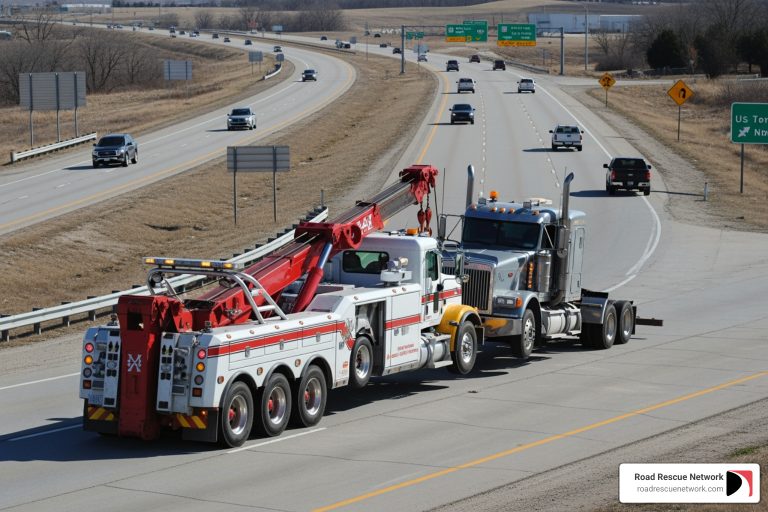
Heavy duty towing requires specialized equipment like rotators with 25-100 ton capacities, trained and certified operators, and 24/7 availability to clear roadways and restore traffic flow after breakdowns, accidents, or rollovers.
When a big rig slips off the roadside or a loaded dump truck breaks down on the highway, the consequences extend far beyond the driver. As noted in traffic incident management research, these situations can lead to “prolonged operational delays, road closures, and immense traffic” that ripple through transportation networks and local economies. A single disabled commercial vehicle can halt commerce and create significant safety hazards. That’s why heavy duty recovery isn’t just towing—it’s a coordinated operation involving specialized wreckers, rigorous safety protocols, and often collaboration with law enforcement and emergency services to manage the scene effectively.
I’m Byron Tarlton, founder of Road Rescue Network, and I’ve spent over two decades building systems that connect drivers with reliable heavy duty towing service providers across the country. Through Interstate Fleet Services and our nationwide dispatch network, I’ve witnessed how critical proper equipment and certified operators are when recovering vehicles ranging from 12 to 60 tons. This guide will dig into the specifics of what this service entails, what to look for in a provider, and how to be prepared when you need it most.
Heavy duty towing service terms to know:
What is Heavy Duty Towing and What Does It Involve?
When we talk about heavy duty towing service, we’re referring to a league of its own. It’s not just about hooking up a car and driving off; it’s about managing immense weight, complex machinery, and often, challenging recovery scenarios. The distinguishing factor lies primarily in the Gross Vehicle Weight Rating (GVWR) of the vehicle in distress. While light-duty towing handles passenger cars and small trucks (typically under 10,000 lbs GVWR) and medium-duty covers larger pickups, delivery trucks, and RVs (10,000 to 26,000 lbs GVWR), heavy-duty towing steps in for anything above 26,000 pounds. This often means vehicles that are the backbone of commerce and industry, where every minute of downtime can result in significant financial losses.
The types of vehicles that typically involve a heavy duty towing service are as diverse as the industries they serve:
- Semi-trucks and Tractor-Trailers: These giants of the highway, whether loaded or empty, are the most common clients for heavy-duty tow operators. Their size and weight require powerful equipment for safe handling.
- Dump Trucks and Garbage Trucks: Essential for construction and waste management, these vehicles are often heavy and operate in demanding environments, making them prone to situations requiring a robust towing solution.
- Buses and RVs: From city transit buses to luxury motorhomes, these large passenger vehicles can become stranded and need specialized care. For instance, towing an RV or bus requires special attention to bumpers and skirting to prevent additional damage, as highlighted by All Florida Towing. We offer Heavy Duty Towing California and Heavy Duty Towing Kansas for these types of large vehicles.
- Construction Equipment: Excavators, bulldozers, wheel-loaders, and cranes are incredibly heavy and often found in challenging terrains, making their recovery a true test of a heavy-duty tow service’s capability.
- Military Equipment: Specialized military vehicles also fall into this category, requiring highly capable and often discreet towing and recovery services.
These vehicles are not only heavy but also often have unique dimensions and recovery needs. This is why a versatile fleet, capable of handling vehicles ranging from 12 to 60 tons, is crucial, as noted by Eagle Towing.
Common Scenarios Requiring a Heavy Duty Tow
Life on the road, especially for heavy vehicles, is unpredictable. When the unexpected happens, a heavy duty towing service becomes indispensable.
Here are the common scenarios where someone would need these specialized services:
- Mechanical Breakdowns: The most frequent reason for a tow, a sudden engine failure, transmission issue, or tire blowout can leave a massive vehicle stranded. Unlike a car, a semi can’t be easily moved, requiring immediate assistance to clear the road and minimize downtime.
- Post-Accident Recovery: Accidents involving heavy vehicles are often complex and dangerous. Recovering a damaged semi-truck or bus from an accident scene requires careful planning, specialized equipment, and skilled operators to ensure safety, prevent further damage, and work in coordination with law enforcement.
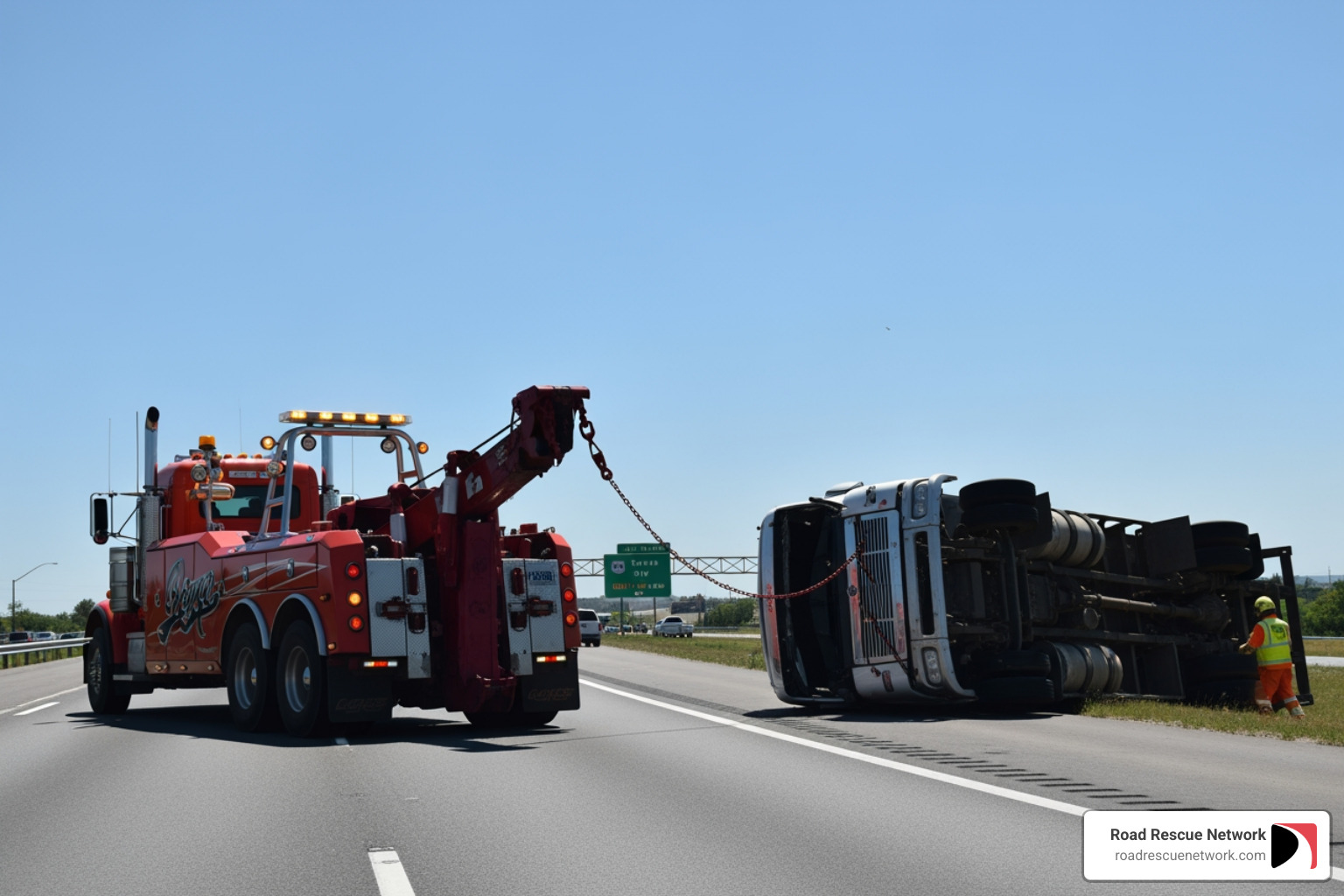
- Rollovers and Wrecks: When a heavy vehicle rolls over, it’s a critical situation that demands advanced recovery techniques. This often involves multiple heavy-duty wreckers, precise winching, and careful uprighting to prevent cargo spills and further structural damage. We provide Heavy Duty Towing Colorado to help with these challenging situations.
- Off-Road Recovery: Whether a big rig has slipped off the roadside into a ditch, a construction vehicle is stuck in mud, or an RV is mired in a soft field, off-road recovery demands powerful winches and strategic positioning to extract the vehicle safely without causing additional damage.
- Cargo Shifts and Load Transfers: Sometimes the vehicle itself isn’t damaged, but its cargo has shifted, making it unsafe to transport. Heavy-duty services can assist with load shifts, transfers, and even providing mobile loading docks to re-stabilize cargo, ensuring the load is secure for transport.
- Equipment Relocation: Beyond emergencies, businesses often need to move large, non-operational equipment from one location to another. This could be moving new machinery to a construction site or relocating abandoned equipment. Our network can facilitate this, much like FleetNet America’s partnerships with large driveaway companies for equipment relocation. We offer Heavy Duty Towing Texas for these kinds of needs.
These situations underscore why quick response times and 24/7 availability are not just conveniences, but necessities, helping to avoid prolonged road closures and ensure the swift and safe removal of vehicles and cargo.
The Mechanics of Recovery: Equipment, Technology, and Safety
The world of heavy duty towing service is a marvel of engineering and human skill. It’s a field where muscle meets precision, and where the right equipment in the right hands can turn a seemingly impossible recovery into a successful operation. The necessity for specialized equipment and highly skilled operators cannot be overstated. These aren’t your average tow trucks; they are powerful machines designed for immense tasks. Furthermore, the nature of these incidents—often emergencies—demands 24/7 availability from service providers. As the FHWA points out, Towing and Recovery operations are crucial for clearing roadways and restoring full capacity. We understand this urgency, which is why our network includes providers for Heavy Duty Towing Florida and other busy states.
Types of Heavy Duty Towing Equipment
The arsenal of a modern heavy duty towing service is impressive, featuring several types of specialized vehicles, each designed for specific tasks.
| Equipment Type | Capacity (Typical) | Best Use | Key Features |
|---|---|---|---|
| Rotator Wrecker | 25-100 tons | Complex recoveries, heavy lifting, precise positioning | A rotating boom and winch system, capable of 360-degree rotation, allows for lifting and recovery from difficult angles without repositioning the truck. Essential for rollovers and tight spaces. |
| Integrated Wrecker / Underlift Wrecker | 25-50 tons | General heavy-duty towing, long-distance transport, breakdowns | Features a powerful, integrated boom and an under-reach system that lifts the vehicle by its axles or frame, preventing damage to the suspension or bodywork during transport. |
| Sliding Axle / Landoll Trailer | Varies | Transporting disabled or exotic vehicles, equipment hauling | The entire trailer bed tilts and slides to the ground, creating a ramp for easy loading of vehicles that cannot be traditionally towed, such as buses, RVs, or construction machinery. |
| Support Vehicles | N/A | Scene support, cargo handling | Includes service trucks, forklifts, mobile cranes, and air cushion recovery systems to assist with complex recovery operations, load transfers, and spill containment. |
For any job, from a simple tow to a complex recovery, having the right equipment is key. Our network connects you with providers who have the right tools, including those for Heavy Duty Towing Arizona.
Advanced Techniques and Specialized Services
A professional heavy duty towing service goes far beyond just hooking up and driving away. Operators are trained in a variety of advanced techniques to handle any situation:
- Winching and Extraction: This involves using powerful winches and complex rigging setups to pull vehicles from mud, ditches, or up steep embankments. It requires a deep understanding of physics and leverage to execute safely.
- Underwater Recovery: A highly specialized service that involves retrieving submerged vehicles from bodies of water. This often requires coordination with dive teams and the use of specialized equipment like lift bags.
- Decking and Un-decking: A technique used to transport multiple tractor units. “Decking” involves stacking one tractor on the frame of another, while “un-decking” is the reverse. This is an efficient way to move multiple disabled trucks at once.
- Accident Scene Management: In the chaotic environment of an accident, recovery professionals play a vital role. They work with law enforcement to secure the scene, manage traffic, and clear the roadway efficiently. This can also include spill response for fuel or other fluids and cargo recovery and transport to salvage goods from a damaged trailer. We can connect you with services for these complex situations, including Heavy Duty Towing Louisiana.
The Role of Technology and Safety Protocols
Safety is the number one priority in any heavy-duty recovery. Modern towing companies use technology like GPS dispatching to ensure the closest appropriate truck is sent, reducing response times. On-board cameras and telematics can also be used to monitor the recovery process and ensure best practices are followed.
However, technology is only a tool; the most critical safety component is the operator. Reputable companies invest heavily in rigorous training and certification for their team. This ensures they understand the physics of lifting immense weight, can properly calculate rigging angles, and follow strict safety protocols to protect themselves, the public, and the casualty vehicle. Attempting a self-recovery or using an unqualified operator can lead to catastrophic equipment failure, further vehicle damage, or serious injury. For a safe and professional response, always rely on certified experts, like those available in Heavy Duty Towing New Jersey. The benefits of professional service far outweigh the risks of trying to cut corners.