
The Ultimate Guide to Car Door Lock Repair and Maintenance
Why Your Car Door Lock Matters More Than You Think
Car door lock problems can strike at the worst possible moment–when you’re running late, in an unfamiliar area, or dealing with extreme weather. Here’s what you need to know right now:
Quick Solutions for Common Car Door Lock Problems:
- Key won’t turn -> Try lubricating with graphite spray (never WD-40)
- Power locks not working -> Check your fuse box first, then key fob battery
- Locked out completely -> Call professional lockout service to avoid damage
- Key broken in lock -> Stop trying to remove it yourself–call a locksmith
- Lock frozen -> Use de-icer spray or warm (not hot) water on the key
A car door lock is your vehicle’s first line of defense against theft and unauthorized access. According to industry data, these mechanisms are designed to function tens of thousands of times over your vehicle’s lifetime. But wear from frequent use, dirt buildup, extreme temperatures, and attempted break-ins can all cause failures that leave you stranded or vulnerable.
Modern vehicles may offer four or five different ways to open doors–from traditional keys to keypads, key fobs, and smartphone apps. This complexity means more convenience when everything works, but also more potential points of failure. The good news is that many car door lock issues are preventable with basic maintenance, and most problems have straightforward solutions.
I’m Byron Tarlton, founder of Road Rescue Network, and I’ve spent over two decades in the roadside assistance and automotive service industry helping drivers solve urgent problems like car door lock failures. Whether you’re dealing with a jammed cylinder, a dead actuator, or a complete lockout, this guide will help you understand, troubleshoot, and fix the issue–or know exactly when to call for professional help.
Understanding Your Car’s Locking System
To effectively troubleshoot, you first need to know what you’re working with. Car door locks have evolved from simple mechanical tumblers to sophisticated electronic systems. Understanding these systems is the first step to diagnosing any issues.
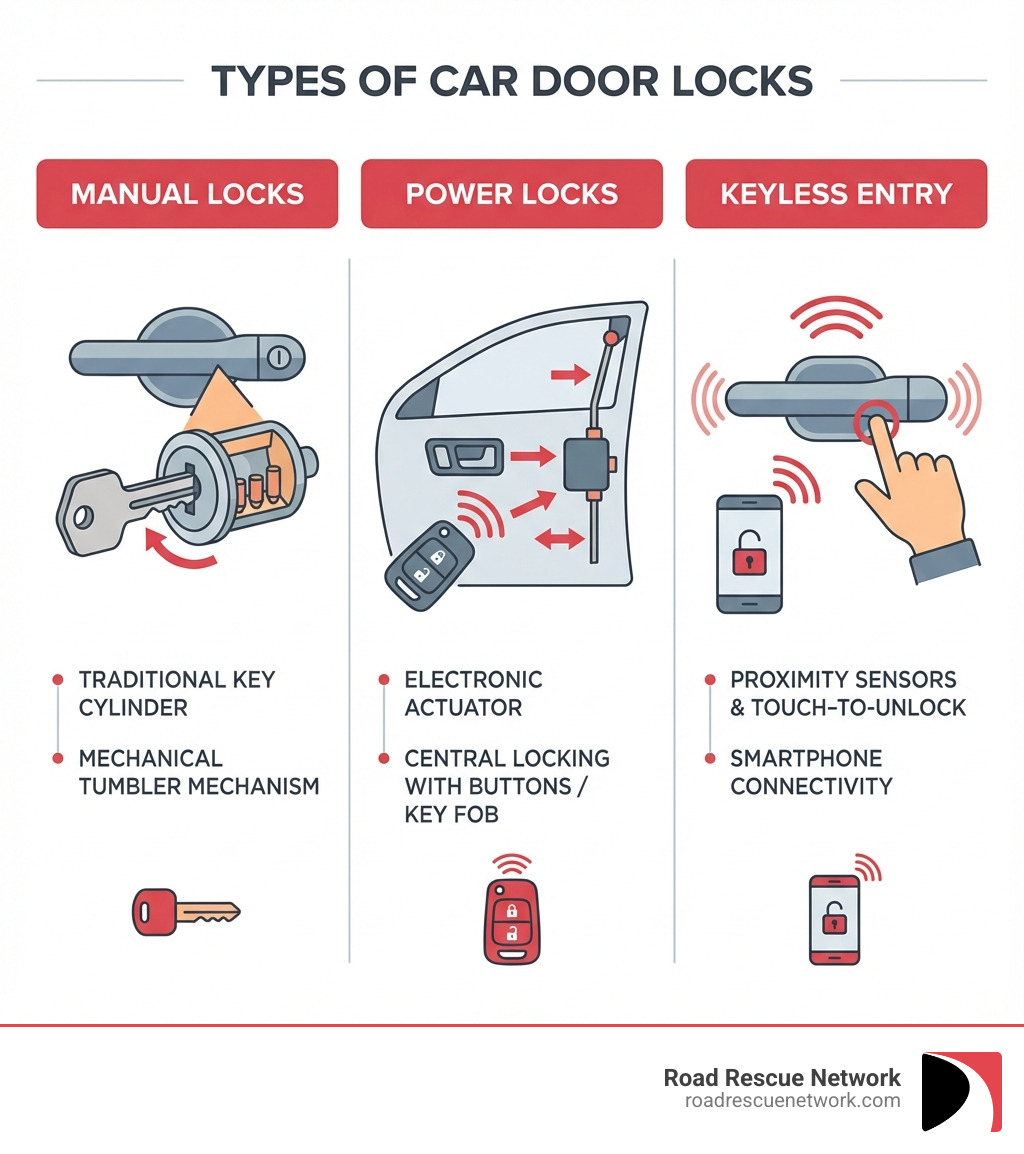
Types of Car Door Locks
When we talk about car door locks, we’re often referring to a variety of systems that have developed over the years to improve security and convenience.
- Manual Locks: These are the oldest and simplest form of car door lock. They rely on a physical key inserted into a lock cylinder, which then manipulates mechanical linkages inside the door to lock or open it. You might also find manual lock levers or buttons on the inside of the door. While robust, they offer less convenience than modern systems.
- Power Locks: A significant upgrade from manual systems, power locks allow us to lock and open doors with the push of a button, either inside the car or on a remote. The magic behind these is an electric motor (actuator) that does the mechanical work, replacing the need for a physical key turn for every door.
- Central Locking Systems: Often integrated with power locks, a central locking system means that when one door is locked or opened (either manually or with power), all other doors on the vehicle follow suit. This is a huge convenience feature, saving us from walking around the car to check each door.
- Keyless Entry Systems: These systems take convenience a step further. Instead of a physical key, we use a key fob that communicates wirelessly with the car. This allows for remote lock/open features, often from a distance. Some cars even include keypads on the door, like Ford’s SecuriCode Keyless Entry Keypad, allowing entry with a five-digit code without a physical key.
- Smart Locks: The latest evolution, smart locks integrate with modern vehicle technology and even our smartphones. Features like FordPass(R) App and Phone As Key(TM) allow us to lock or open our cars remotely using a mobile app or by simply touching the door handle with our phone nearby. This advanced connectivity can even prevent accidental lockouts, as seen with technologies like Wuling’s IoV.
How Modern Locking Mechanisms Function
The intricate dance of components that make up a modern car door lock system is fascinating.
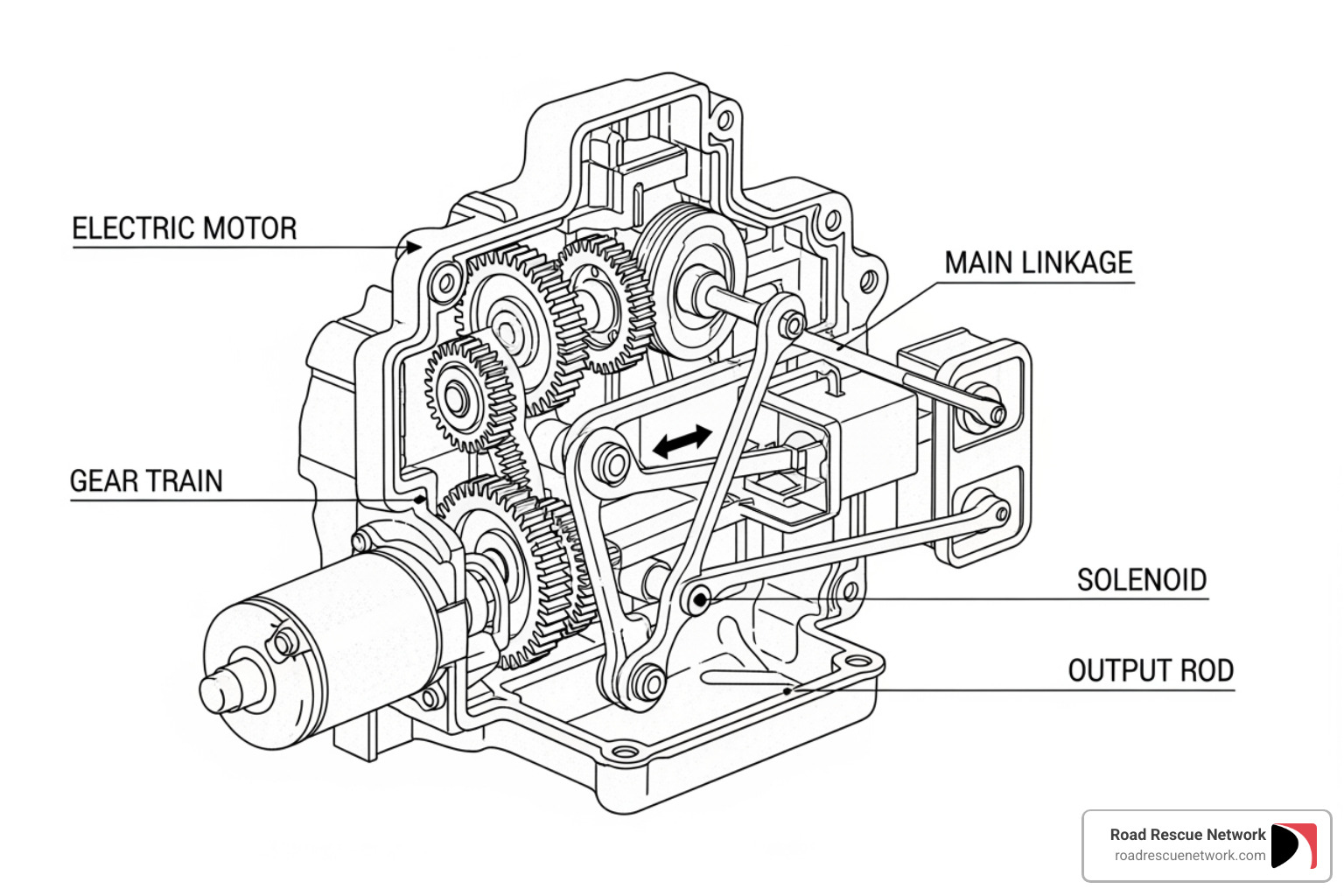
- Actuators: These are the unsung heroes of power locks. An actuator is essentially a small electric motor or solenoid assembly located inside each door. When we press a button (either inside the car or on our key fob), the actuator receives an electrical signal and physically moves the locking mechanism. This mechanism is designed for extreme reliability, intended to function tens of thousands of times over a car’s lifespan.
- Solenoids: Often part of the actuator, a solenoid is an electromagnetic device that converts electrical energy into linear mechanical motion. When current flows through it, it creates a magnetic field that pulls or pushes a plunger, which in turn operates the lock.
- Radio Frequency (RF) Signals: Our key fobs don’t just magically open the car. They send encrypted radio frequency signals to a receiver in the vehicle. The car’s computer verifies this signal, and if it’s legitimate, it then sends commands to the actuators to lock or open the doors.
- Key Fobs: These small, handheld devices are our primary interface for keyless entry and power locks. They contain a tiny radio transmitter and a unique electronic code. When we press a button, the fob sends its specific RF signal to the car. Some fobs also contain a physical key blade for manual entry in case of battery failure.
- Keypads and remote entry: Beyond the key fob, some vehicles offer keypads, typically on the driver’s side door, allowing us to enter a code to open the car. This provides an alternative entry method if our keys are lost or locked inside. Ford vehicles, for instance, often feature these SecuriCode keypads.
- Proximity Sensors: Advanced keyless entry systems use proximity sensors. These sensors detect when our key fob (or even our smartphone with features like Phone As Key(TM)) is within a certain range of the vehicle. This allows for “passive entry,” where we can simply touch the door handle to open the car without even pressing a button on the fob. Some systems will also automatically lock the car as we walk away.
Common Car Door Lock Problems and How to Spot Them
A malfunctioning car door lock is more than just an annoyance; it’s a security concern. Recognizing the early warning signs can prevent us from being stranded or worse. We should pay close attention to how our locks feel and sound.
Signs of a Failing Car Door Lock
Catching these symptoms early can often lead to simpler, less expensive repairs.
- Key is difficult to insert or turn: If our physical key feels stiff, grinds, or won’t turn smoothly in the lock cylinder, it’s a clear sign of trouble. This could be due to internal wear, dirt buildup, or even damage to the key itself.
- Lock doesn’t respond to key fob: We press the button on our key fob, but nothing happens. This might affect just one door or all of them. This often points to a dead fob battery, a problem with the car’s receiver, or a failing actuator.
- Grinding or buzzing noises from the door: When we try to lock or open the door, do we hear strange mechanical sounds? A grinding or buzzing noise often indicates that the door lock actuator is struggling or failing. It’s the sound of the little motor inside working overtime or breaking down.
- Doors lock or open randomly: This can be unnerving. If our doors seem to have a mind of their own, locking or opening without our input, it usually signals an electrical issue, a faulty sensor, or a problem with the central locking module.
- Interior lock switch is unresponsive: If the power lock button inside our car fails to operate the locks, it suggests an electrical fault, a problem with the switch itself, or a broader issue with the power lock system, potentially affecting the actuators.
Common Causes of Malfunctions
Car door locks are subjected to a lot of stress, and several factors can contribute to their eventual failure.
- Wear and Tear: Just like any mechanical part, constant use takes its toll. Our car door locks are activated tens of thousands of times over the life of a vehicle. This frequent movement can wear down internal components, leading to loose connections or mechanical fatigue.
- Dirt and Debris Buildup: Dust, sand, and even tiny bits of cement can accumulate inside the lock cylinder and mechanism. This grime can make it difficult for the key to fit properly, for tumblers to move, or for the actuator to operate smoothly. The research points out that a dirty lock can cause the key to no longer fit.
- Extreme Temperatures: Both extreme heat and freezing cold can wreak havoc on car door locks. Cold can cause lubricants to thicken or moisture to freeze, seizing up the mechanism. Heat can cause plastics to become brittle or electrical components to fail prematurely.
- Blown Fuse or Electrical Fault: Power locks and central locking systems rely on electricity. A blown fuse can instantly disable all power locks. Beyond fuses, frayed wires, corroded connections, or a failing control module can lead to intermittent or complete failure of the electrical locking system.
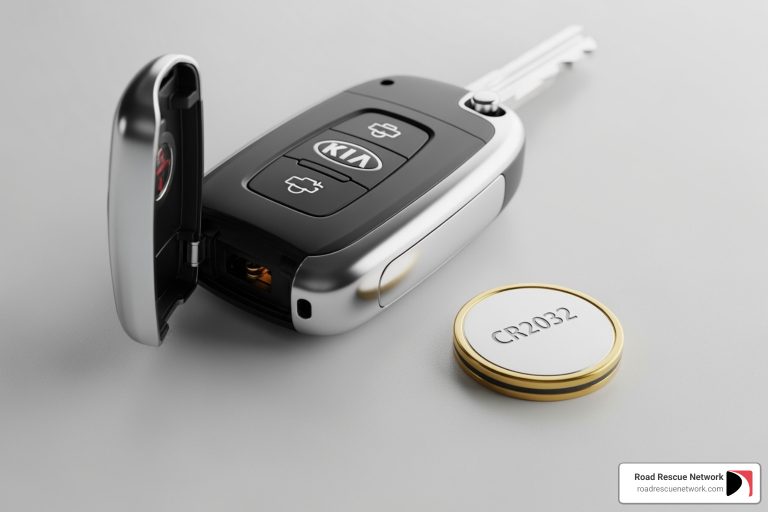
- Dead Key Fob Battery: This is one of the simplest and most common reasons for a keyless entry system to stop working. If the key fob battery dies, it can’t send the RF signal to the car, rendering the remote lock/open features useless. We should always keep a spare battery handy!
- Attempted Break-in Damage: Unfortunately, some lock failures are a result of malicious intent. An attempted break-in can physically damage the lock cylinder, internal linkages, or the door itself, leaving the lock inoperable or compromised.
- Poor Quality: While most manufacturers strive for durability, some car brands and models are known to have less robust lock components, leading to premature failure due to inherent poor quality.
How to Address Car Door Lock Issues: Troubleshooting and When to Call for Help
Some car door lock issues are surprisingly simple to fix, while others demand the expertise of a professional. Knowing the difference can save us time, money, and frustration. Here’s how we approach troubleshooting and when it’s best to call for assistance.
Simple DIY Troubleshooting Steps
Before we panic or call in the cavalry, there are a few basic checks we can perform ourselves.
- Test spare key: This is often the first and easiest step. If our primary key is worn, bent, or damaged, it might be the culprit. Trying a spare key immediately tells us if the issue is with the key or the lock mechanism itself.
- Replace key fob battery: If our remote isn’t working, a dead key fob battery is a very common cause. Most fobs are designed for easy battery replacement. This is a quick and inexpensive fix that often restores full functionality to our keyless entry system.
- Check the vehicle’s fuse box: For power lock issues affecting multiple doors, a blown fuse is a prime suspect. We can consult our car’s owner’s manual to locate the fuse box (often under the hood or dashboard) and identify the fuse for the door locks. A quick visual inspection can reveal if the fuse is blown, and replacing it is usually straightforward.
- Clean the lock cylinder with compressed air: If our physical key is stiff or won’t insert smoothly, dirt and debris might be blocking the tumblers. A blast of compressed air into the keyhole can dislodge this grime.
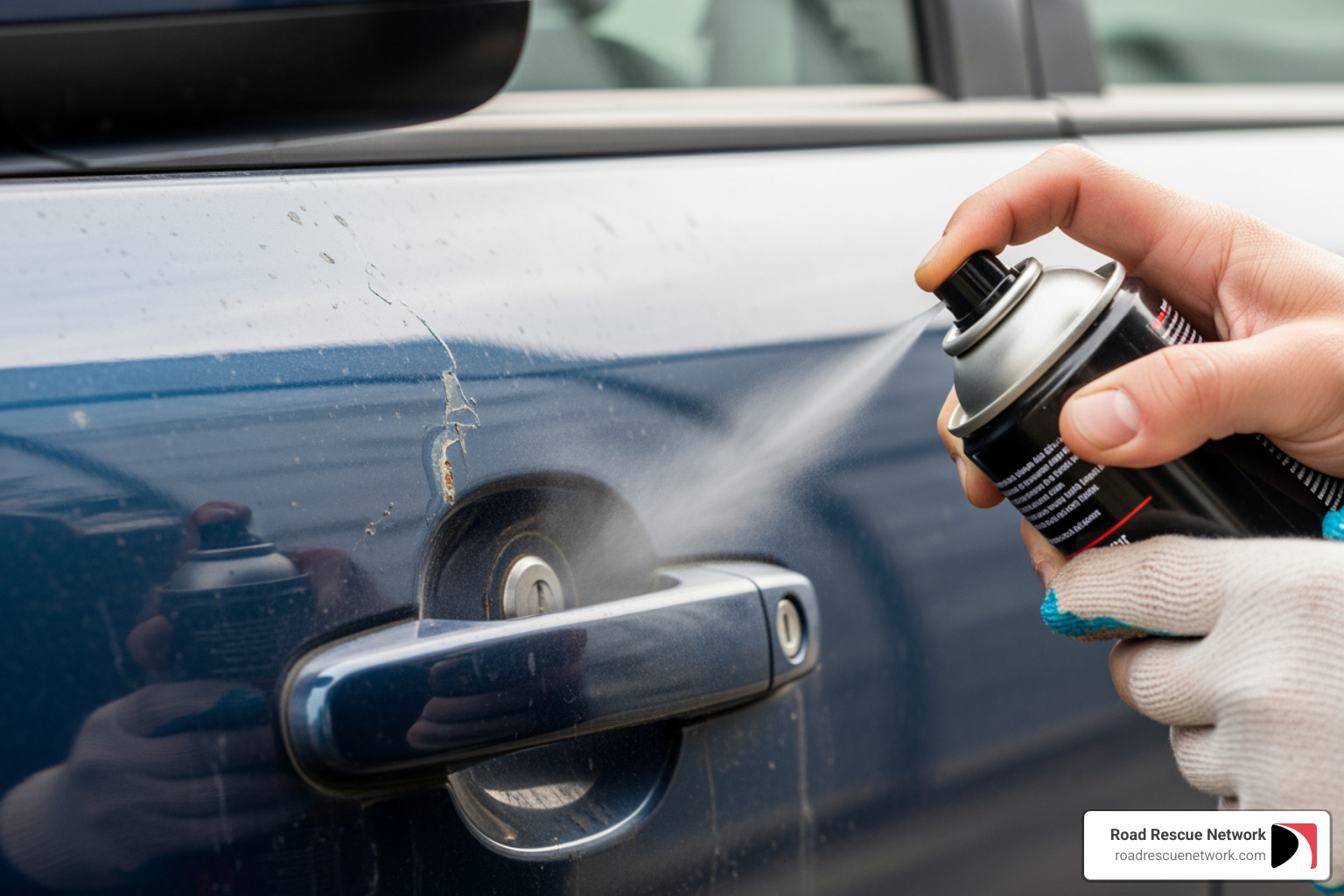
- Lubricate the lock with graphite spray: After cleaning, or if the lock feels sticky, applying a specialized graphite-based lock lubricant can do wonders. Never use oil-based lubricants like WD-40, as they can attract more dirt and gum up the mechanism over time.
When to Call a Professional
While we encourage safe DIY, some car door lock problems are beyond basic troubleshooting and require skilled hands.
- If the lock remains unresponsive after basic troubleshooting: If we’ve tried all the DIY steps and our lock still isn’t working, it’s time for professional diagnosis. This indicates a deeper mechanical or electrical problem that likely requires specialized tools and knowledge.
- If the key is broken in the lock: This is a delicate situation. Trying to extract a broken key ourselves can push it further in or damage the lock cylinder, turning a simple extraction into a costly replacement. A professional locksmith has the right tools to remove the broken piece without further damage.
- If electronic systems have failed completely: When our power locks, central locking, or keyless entry systems are completely dead, and a fuse check doesn’t resolve it, the problem could be a faulty actuator, wiring issue, or even a problem with the car’s computer system. Diagnosing and repairing these complex electronic issues is best left to experts.
- To avoid damaging the door, window, or weather stripping: Attempting to force a stuck lock or gain entry into a locked car without the right tools can easily lead to expensive damage to our vehicle’s body, glass, or seals. Professionals are trained to access locks without causing collateral damage.
- For fast, damage-free entry: If we’re locked out and need to get back into our car quickly and safely, a professional roadside assistance service or locksmith is our best bet. Road Rescue Network specializes in these situations with 24/7, membership-free service, connecting you instantly with local rescuers in major metros like New York, Los Angeles, Houston, and many more, so you can get back on the road without a scratch.
Locked Out? What to Do When Your Car Door Won’t Open
Being locked out of our car is a frustrating experience that can quickly turn a good day bad. While the immediate impulse might be to force our way in, damaging our vehicle trying to get in is worse. We need to know our options, from cautious DIY attempts to calling for professional help.
Safe Methods to Try Before Calling for Help
If we find ourselves locked out, there are a few non-destructive methods we can cautiously attempt, depending on our car’s make and model. However, it’s crucial to understand the risks.
- Using a string or shoelace (for certain lock types): This method only works on older cars with specific types of interior door lock knobs (the kind that pull straight up). By tying a slip knot in a string, we can try to feed it through the top of the door frame and maneuver the knot around the lock knob to pull it up. This requires a lot of patience and isn’t effective on modern flush-mounted locks.
- Using a slim plastic wedge: A plastic wedge can be carefully inserted into the top corner of the door frame to create a tiny gap. This gap can then be used to insert a long, thin tool (like a coat hanger) to reach the interior lock button or handle. This method carries a risk of damaging the door frame or paint if not done carefully.
-
Cautions and risks of DIY methods: Many online guides suggest using tools like rulers, hangers, ropes, screwdrivers, or iron rods to open a locked car door. While these methods exist, we at Road Rescue Network strongly advise extreme caution. Using these tools without proper knowledge and experience can easily lead to:
- Damaged paint or weather stripping: Scratching the finish or tearing the rubber seals is common.
- Bent door frames: Applying too much force can warp the door, leading to wind noise and water leaks.
- Broken window glass: Especially if using rigid tools or attempting to pry the window.
- Damage to internal wiring or lock mechanisms: Forcing tools into the door can sever wires or break delicate linkages, turning a lockout into a costly repair.
- Accidental airbag deployment: In rare cases, tampering with door mechanisms can inadvertently trigger safety systems.
The Wuling blog post mentions methods like using a ruler, hanger, rope, screwdriver, or iron stalk. While these are presented as ways to open a locked car door without breaking it, they come with significant risks if not performed by a skilled individual. We recommend these only as last resorts if no professional help is available, and always with the understanding that damage is possible.
Why Choose Road Rescue Network for Lockout Service
When we’re locked out, the safest and most efficient solution is often to call for professional help. This is where Road Rescue Network comes in.
- Fast, damage-free entry: Our priority is to get you back into your vehicle quickly, without causing any damage. Our technicians use specialized tools and techniques designed for safe and non-destructive entry. We understand the urgency and stress of a lockout, and our goal is to provide a smooth, hassle-free experience.
- 24/7 availability: Lockouts don’t stick to business hours. That’s why we’re available around the clock, every day of the year. Whether it’s the middle of the night or a holiday, we’re here to help.
- Professional technicians with the right tools: Our team consists of experienced professionals who are trained in the latest lockout techniques for all types of vehicles. We arrive equipped with the correct tools to handle everything from traditional manual locks to complex electronic systems.
- Local service in your area: With a wide network of service providers, we can quickly dispatch help to your location. Whether you’re in Salem OH, Gettysburg PA, Fort Gibson OK, Besslen ID, Laurel MD, Irons MI, North Windham ME, Rockhurst NY, Comstock Northwest MI, or any of our many other service areas, we can connect you with a local rescuer fast. We pride ourselves on offering reliable lockout services across numerous cities and states, including major metropolitan areas like New York, Los Angeles, Houston, Phoenix, and Philadelphia, ensuring that help is always just a call away.
Frequently Asked Questions about Car Door Locks
Why did my power door locks suddenly stop working?
This is a common and frustrating issue! The most frequent culprits behind suddenly unresponsive power car door locks are a blown fuse, a faulty relay, or a failed door lock actuator or solenoid. We always recommend starting with the simplest fix: checking the fuse. Our vehicle’s owner’s manual will show us the location of the fuse box (usually under the dashboard or hood) and which fuse controls the door locks. If the fuse appears intact, the problem likely lies with the electrical components within the doors themselves, such as the wiring or the actuator. These more complex issues often require professional diagnosis and repair.
Can I use one key for all my car’s locks if I replace one?
Absolutely! If we need to replace a car door lock cylinder due to damage or wear, a professional locksmith can “re-key” the new cylinder to match our existing ignition and trunk key. This means we won’t end up carrying multiple keys for the same car, which is a great convenience. It’s often more cost-effective than replacing all the locks. We at Road Rescue Network can help connect you with qualified professionals for re-keying services in your local area.
Is it cheaper to repair or replace a car door lock?
The cost-effectiveness of repairing versus replacing a car door lock really depends on the specific problem. Simple issues, like a dead key fob battery or a lock that just needs lubrication, are very cheap and easy to fix. However, if a major mechanical or electronic component, such as the door lock actuator, has failed, replacement is often the only viable option. In many scenarios, particularly with complex electronic locks found in modern vehicles, repairing the internal mechanism can be significantly more affordable than replacing the entire assembly. For luxury brands like Porsche, Mercedes, and BMW, where replacement parts can be very expensive, repair is often the preferred route. We can help you assess the situation and determine the best, most cost-effective solution for your specific car door lock issue.
Conclusion: Keep Your Vehicle Secure and Accessible
Our car door lock is a critical component for both our convenience and the security of our vehicle. By understanding how these intricate systems work, performing regular maintenance, and knowing when to call for professional help, we can prevent most major issues and ensure our car remains safe and accessible. Defects in car locks can lead to a range of problems, from a key no longer responding to the ignition lock seizing. Regular cleaning and lubrication can go a long way in prolonging the life of our locks.
If we ever find ourselves in a lockout situation, or dealing with a persistent car door lock malfunction, and need fast, reliable assistance without the risk of damaging our vehicle, the professionals at Road Rescue Network are available 24/7. We’re here to get you back on your way quickly and safely, connecting you with local experts who can provide damage-free entry and expert repairs.
Get Immediate Lockout Assistance in Your Area

2 Comments
Comments are closed.