Car Lockout Catastrophe: Your Ultimate Guide to Getting Back In
When You’re Staring at Your Keys Through the Window
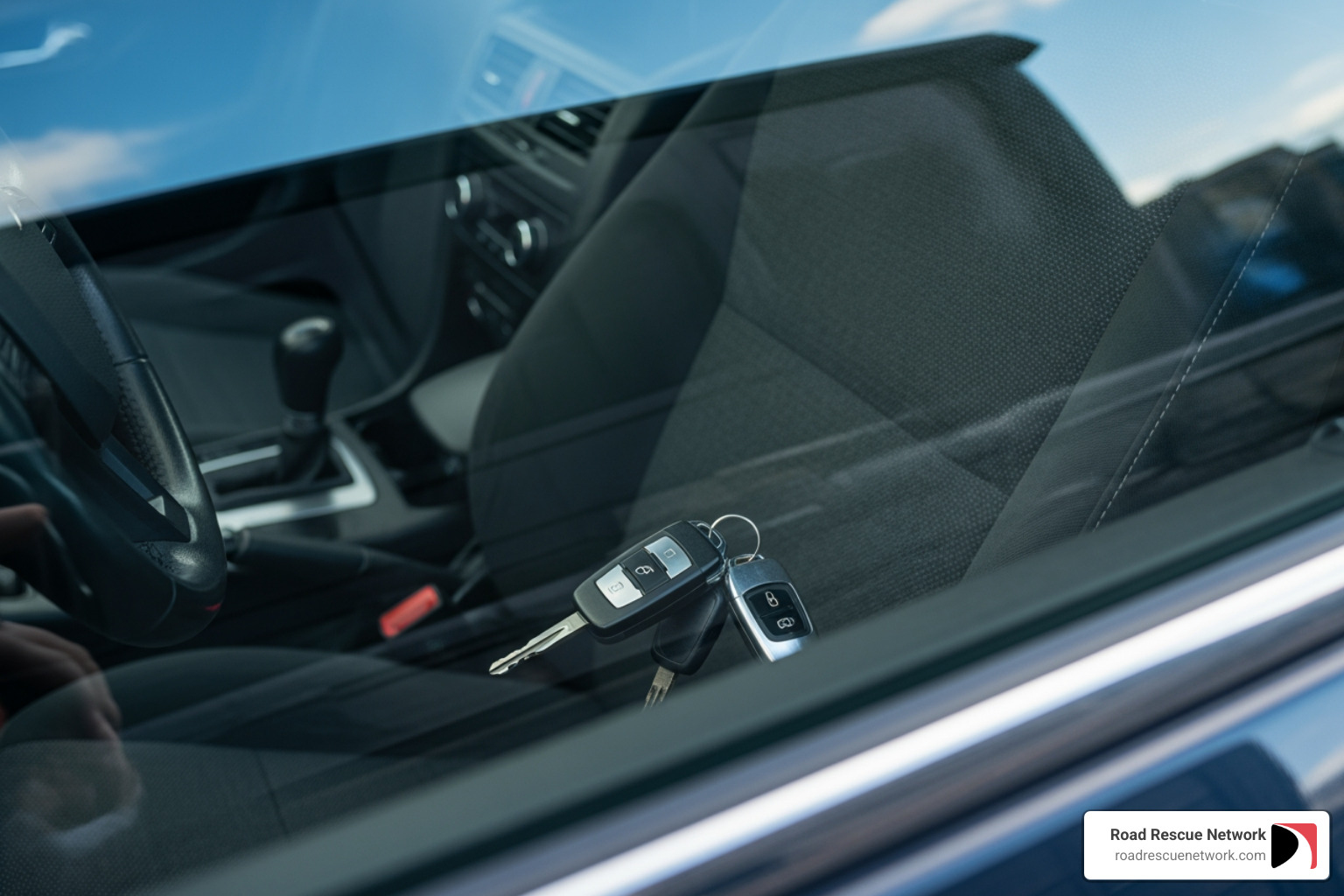
Locked keys in car situations happen to millions of drivers every year. If you need to get back in right now, here’s what to do:
- Stay calm and check all doors – Sometimes one door remains open uped
- Call a professional lockout service – Road Rescue Network offers 24/7 assistance with no membership fees
- Use your manufacturer app – Many newer cars can be open uped remotely
- Contact roadside assistance – If you have coverage, this service is often included
- Call 911 only for emergencies – When a child, pet, or vulnerable person is locked inside
You’re not alone in this frustrating moment. The American Automobile Association reports that it receives calls from more than 4,000,000 locked-out motorists every year. In 2024 alone, 10% of all AAA roadside service calls were for vehicle lockouts.
The good news? Getting back into your car is usually faster and easier than you think. Modern lockout services can have you back on the road in minutes, and many solutions don’t require breaking windows or damaging your vehicle.
This guide walks you through your best options, what they cost, and how to prevent this from happening again. We’ll cover when to call professionals, when it’s truly an emergency, and why those DIY methods you’ve seen online often cause more problems than they solve.
I’m Byron Tarlton, and through Road Rescue Network, I’ve helped thousands of drivers across Florida, Texas, Arizona, and Indiana resolve locked keys in car emergencies quickly and affordably. After 25+ years in the roadside assistance industry, I’ve seen every lockout scenario imaginable and know exactly what works.
Quick Locked keys in car definitions:
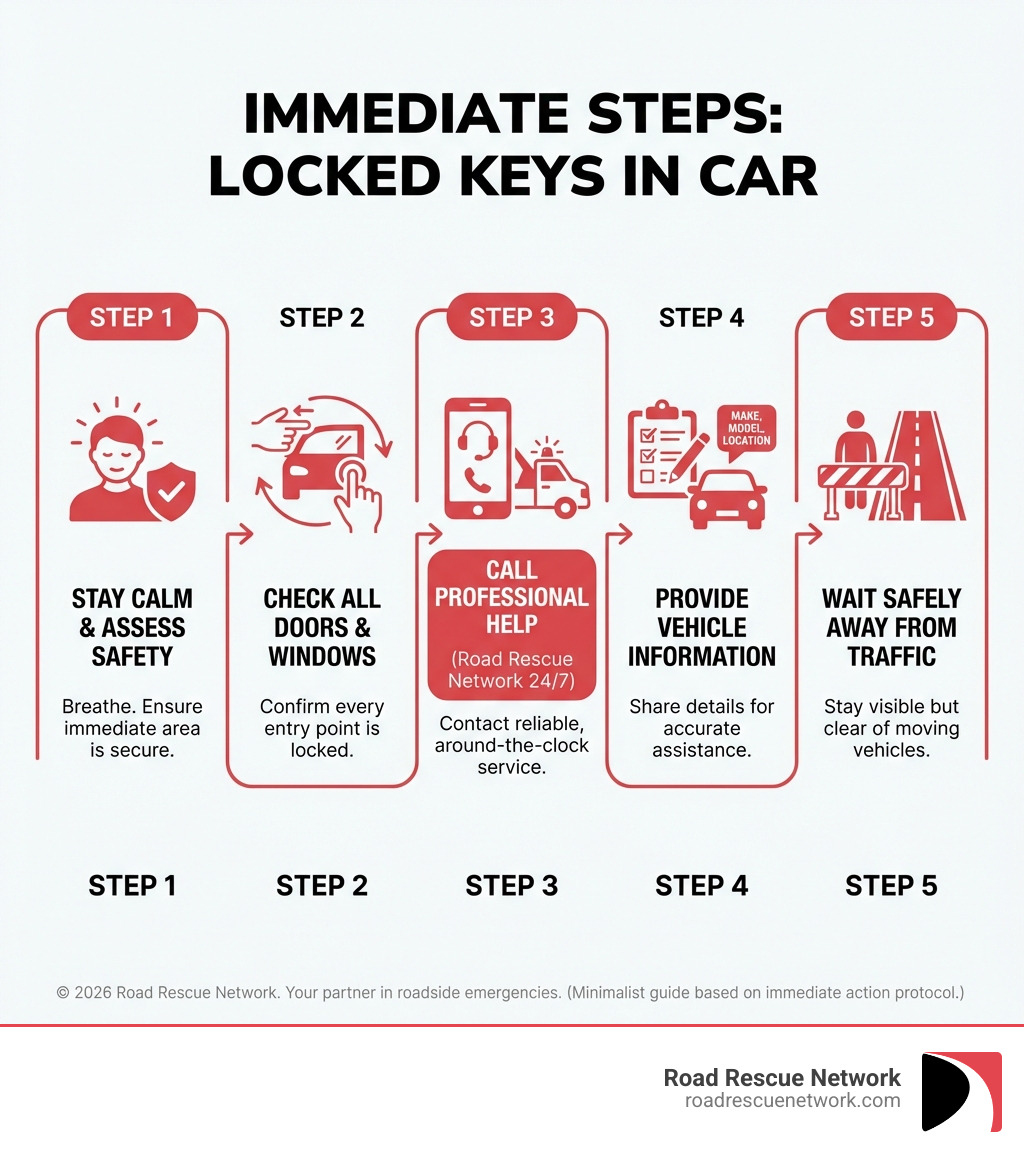
First Steps: What to Do Immediately When You’ve Locked Keys in Your Car
It’s a familiar scenario: you close the car door, hear that dreaded “thunk,” and then realize your keys are staring back at you from the driver’s seat. Our first advice? Don’t panic! We know it’s easier said than done, but staying calm is the most important step. A clear head helps you assess the situation and avoid costly mistakes.
Once you’ve taken a deep breath, take a moment to assess your immediate surroundings and personal safety. Are you in a well-lit area? Is traffic heavy? Your safety is paramount. If you feel unsafe, we’ll discuss emergency services in a bit.
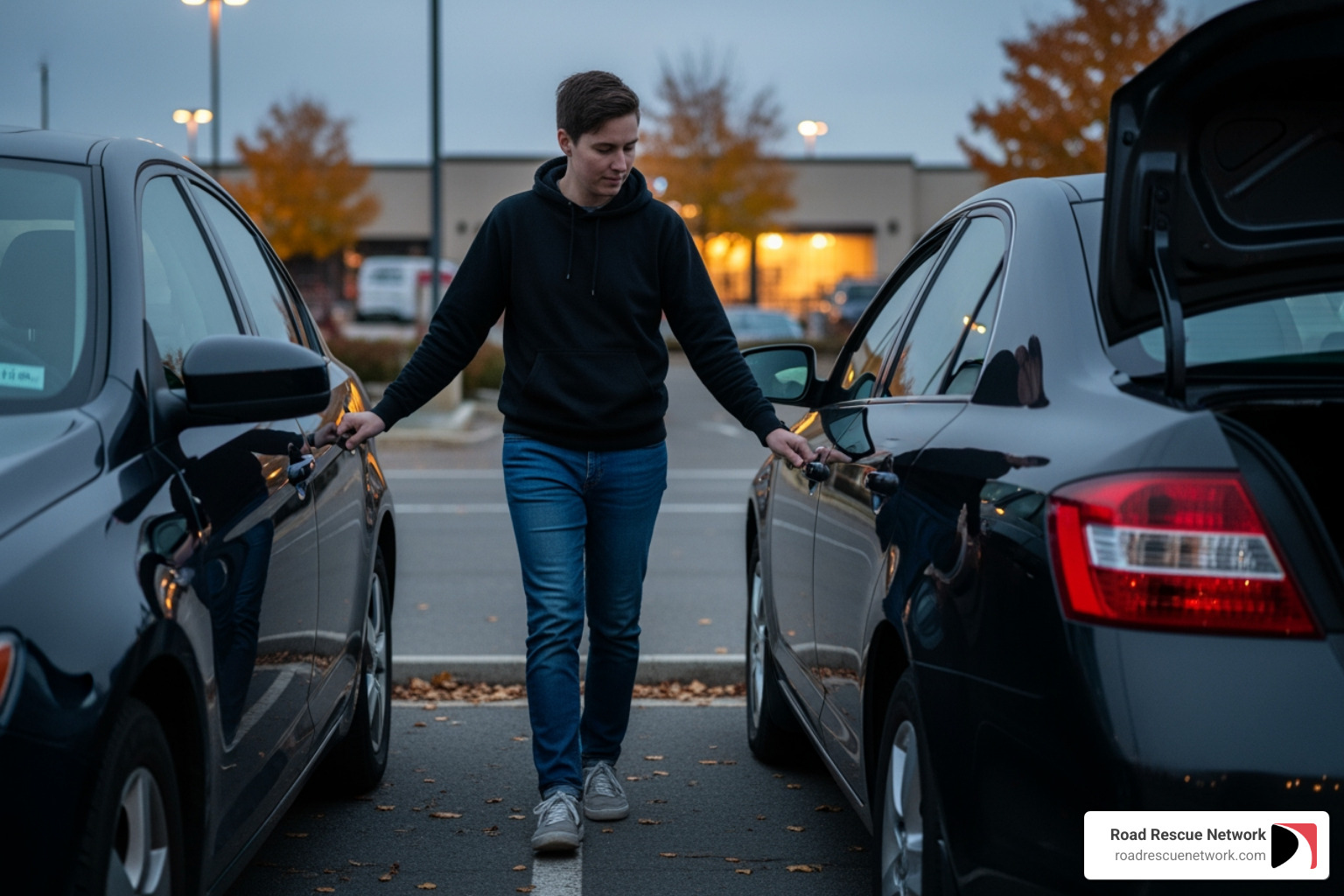
Next, it’s time for a thorough check of your vehicle. We’ve seen countless times where a driver assumes all doors are locked, only to find one that’s ajar. Walk around your car and try every single door, including the passenger side and any rear doors. Don’t forget the trunk! Sometimes, especially with older models, the trunk might be open uped even if the cabin doors aren’t.
Finally, think about spare keys. Do you have a spare hidden somewhere safe outside your car? Perhaps a trusted friend, family member, or neighbor has a copy. If so, a quick call could be your fastest solution. If they’re nearby, they might be able to bring it to you. If not, don’t worry, we have plenty of other solutions.
Information You’ll Need for Assistance
When you do call for professional lockout assistance, having certain information ready will speed up the process significantly. We recommend having these details handy:
- Vehicle make and model: For example, “2018 Ford F-150” or “2020 Honda Civic.”
- Year: The precise year helps rescuers prepare with the right tools.
- VIN (Vehicle Identification Number): This unique 17-character code is usually found on the driver’s side dashboard (visible through the windshield) or on the driver’s side door jamb. It’s crucial for verifying ownership and vehicle specifics.
- Your exact location: Be as specific as possible – street address, nearest cross-streets, landmarks, or even mile markers on highways.
- Proof of ownership: This could be your driver’s license, vehicle registration, or insurance card. Rescuers will need to verify you own the vehicle before attempting to open up it, for your security and theirs.
Who to Call: Your Professional Lockout Solutions
When your keys are locked in car, you have several options, ranging from professional services to a few risky DIY attempts. Our goal at Road Rescue Network is to connect you with the fastest, safest, and most reliable solution. Let’s compare the options so you can make an informed decision.
| Service Provider | Cost | Speed | Damage Risk | Best For |
|---|---|---|---|---|
| Road Rescue Network | Transparent, no hidden fees (varies by location and complexity) | Typically fast, on-demand dispatch (often within 15-30 min) | Very low | Quick, safe, 24/7, no-membership lockouts in cities like Phoenix, Chicago, Houston, Orlando, and across our covered areas. |
| Locksmith | $50 – $250 (typical range) | Varies, can be fast in urban areas | Low | When other services aren’t an option, or for complex/older locks. |
| Roadside Assistance (e.g., AAA) | Membership fee + potential service fee (often covered) | Varies, can be fast for members | Low | Existing members with lockout coverage. |
| Car Dealership | Potentially high, especially for after-hours | Slow, often requires towing and appointment | Very low | Key replacement, not typically for immediate lockout service. |
| Police (non-emergency) | Free (but not always available/equipped) | Varies, low priority for non-emergencies | Medium | Non-emergency situations where you need assistance but not immediate entry. |
Road Rescue Network: Your Fast, Reliable Solution
At Road Rescue Network, we understand that when your keys are locked in car, you need a solution, and you need it now. That’s why we pride ourselves on offering 24/7 lockout service with no membership fees. You only pay for the service you need, exactly when you need it. We instantly connect you with local rescuers who are equipped to safely and efficiently open up your vehicle. Our network covers a vast number of locations, ensuring help is never far away.
Whether you’re locked out in the sunny streets of Lockout Service in Florida, the busy heart of Lockout Service in Texas, the vibrant communities of Lockout Service in Arizona, or the friendly towns of Lockout Service in Indiana, we’ve got you covered. We’re also available in major metropolitan areas like New York, Los Angeles, Chicago, Houston, Phoenix, Philadelphia, San Antonio, San Diego, Dallas, Jacksonville, Fort Worth, San Jose, Austin, Charlotte, Columbus, Indianapolis, San Francisco, Seattle, Denver, Oklahoma City, Nashville, Washington, El Paso, Las Vegas, Boston, Detroit, Louisville, Portland, Memphis, Baltimore, Milwaukee, Albuquerque, Tucson, Fresno, Sacramento, Atlanta, Mesa, Kansas City, Raleigh, Colorado Springs, Omaha, Miami, Virginia Beach, Long Beach, Oakland, Minneapolis, Bakersfield, Tulsa, Tampa, Arlington, Aurora, Wichita, Cleveland, New Orleans, Henderson, Honolulu, Anaheim, Orlando, Lexington, Stockton, Riverside, Irvine, Corpus Christi, Newark, Santa Ana, Cincinnati, Pittsburgh, Saint Paul, Greensboro, Jersey City, Durham, Lincoln, North Las Vegas, Plano, Anchorage, Gilbert, Madison, Reno, Chandler, St. Louis, Chula Vista, Buffalo, Fort Wayne, Lubbock, St. Petersburg, Toledo, Laredo, Port St. Lucie, Glendale, Irving, Winston-Salem, Chesapeake, Garland, Scottsdale, Boise, Hialeah, Frisco, Richmond, Cape Coral, Norfolk, Spokane, Huntsville, Santa Clarita, Tacoma, Fremont, McKinney, San Bernardino, Baton Rouge, Modesto, Fontana, Salt Lake City, Moreno Valley, Des Moines, Worcester, Yonkers, Fayetteville, Sioux Falls, Grand Prairie, Rochester, Tallahassee, Little Rock, Amarillo, Overland Park, Columbus, Augusta, Mobile, Oxnard, Grand Rapids, Peoria, Vancouver, Knoxville, Birmingham, Montgomery, Providence, Huntington Beach, Brownsville, Chattanooga, Fort Lauderdale, Tempe, Akron, Glendale, Clarksville, Ontario, Newport News, Elk Grove, Cary, Aurora, Salem, Pembroke Pines, Eugene, Santa Rosa, Rancho Cucamonga, Shreveport, Garden Grove, Oceanside, Fort Collins, Springfield, Murfreesboro, Surprise, Lancaster, Denton, Roseville, Palmdale, Corona, Salinas, Killeen, Paterson, Alexandria, Hollywood, Hayward, Charleston, Macon, Lakewood, Sunnyvale, Kansas City, Springfield, Bellevue, Naperville, Joliet, Bridgeport, Mesquite, Pasadena, Olathe, Escondido, Savannah, McAllen, Gainesville, Pomona, Rockford, Thornton, Waco, Visalia, Syracuse, Columbia, Midland, Miramar, Palm Bay, Lakewood, Jackson, Coral Springs, Victorville, Elizabeth, Fullerton, Meridian, Torrance, Stamford, West Valley City, Orange, Cedar Rapids, Warren, Hampton, New Haven, Pasadena, Kent, Dayton, Fargo, Lewisville, Carrollton, Round Rock, Sterling Heights, Santa Clara, Norman, Columbia, Abilene, Pearland, Athens, College Station, Clovis, West Palm Beach, Allentown, North Charleston, Simi Valley, Topeka, Wilmington, Lakeland, Thousand Oaks, Concord, Rochester, Vallejo, Ann Arbor, Broken Arrow, Fairfield, Lafayette, Hartford, Arvada, Berkeley, Independence, Billings, Cambridge, Lowell, Odessa, High Point, League City, Antioch, Richardson, Goodyear, Pompano Beach, Nampa, Menifee, Las Cruces, Clearwater, West Jordan, New Braunfels, Manchester, Miami Gardens, Waterbury, CT, Provo, UT, Evansville, IN, Richmond, CA, Westminster, CO, Elgin, IL, Conroe, TX, Greeley, CO, Lansing, MI, Buckeye, AZ, Tuscaloosa, AL, Allen, TX, Carlsbad, CA, Everett, WA, Springfield, IL, Beaumont, TX, Murrieta, CA, Rio Rancho, NM, Temecula, CA, Concord, NC, Tyler, TX, Davie, FL, South Fulton, GA, Peoria, IL, Sparks, NV, Gresham, OR, Santa Maria, CA, Pueblo, CO, Hillsboro, OR, Edison, NJ, Sugar Land, TX, Ventura, CA, Downey, CA, Costa Mesa, CA, Centennial, CO, Edinburg, TX, Spokane Valley, WA, Jurupa Valley, CA, Bend, OR, West Covina, CA, Boulder, CO, Palm Coast, FL, Lee’s Summit, MO, Dearborn, MI, Green Bay, WI, St. George, UT, Woodbridge, NJ, Brockton, MA, Renton, WA, Sandy Springs, GA, Rialto, CA, El Monte, CA, Vacaville, CA, Fishers, IN, South Bend, IN, Carmel, IN, Yuma, AZ, Burbank, CA, Lynn, MA, Quincy, MA, El Cajon, CA, Fayetteville, AR, Suffolk, VA, San Mateo, CA, Chico, CA, Inglewood, CA, Wichita Falls, TX, Boca Raton, FL, Hesperia, CA, Daly City, CA, Clinton, MI, Georgetown, TX, New Bedford, MA, Albany, NY, Davenport, IA, Plantation, FL, Deltona, FL, Federal Way, WA, San Angelo, TX, Tracy, CA.
Roadside assistance coverage, often an optional add-on to auto insurance policies, typically includes lockout services. However, terms and coverage limits can vary significantly. While we at Road Rescue Network are not an insurance provider, our service is designed to be compatible with most insurance and roadside assistance plans, providing a hassle-free solution when you need it most.
When to Contact Emergency Services
We often get asked: “Should I call 911 if my keys are locked in car?” The answer is almost always no, unless there’s an immediate, life-threatening emergency.
- Child or pet locked inside: This is the most critical scenario. If a child, a vulnerable person, or a pet is locked inside a car, especially on a hot day, call 911 immediately. Temperatures inside a car can rise rapidly, creating a dangerous situation. Emergency services are trained and equipped to handle these situations with urgency. The police might even break a window if necessary, choosing the smallest side window farthest from the occupant.
- Unsafe location: If you find yourself locked out in a dangerous or remote area where you feel your safety is compromised, calling 911 is appropriate. They can send an officer to secure the scene while you wait for lockout assistance.
- Vehicle running in an enclosed space: If your car is running in a garage or another enclosed space, and you’re locked out, there’s a risk of carbon monoxide poisoning. This warrants an immediate 911 call.
For non-emergency situations, police officers today are often not equipped or authorized to assist with car lockouts, especially for newer models. While they used to carry “slim jims,” many modern vehicles have complex electronic locking systems that these tools can’t bypass without causing significant damage. If you call the police for a non-emergency lockout, they will likely advise you to contact a locksmith or roadside assistance, and you’ll still be responsible for the cost. Always use a non-emergency number for your local police department if you’re not in a life-threatening situation but need guidance.
The DIY Dilemma: Opening up Your Car Yourself
The internet is full of “hacks” for how to get your keys out of a locked car using household items. While these methods might seem tempting, especially in a moment of frustration, we strongly advise against them. The risks of damaging your vehicle far outweigh the potential (and often unlikely) reward, particularly with modern cars.
DIY Methods for Older Cars
For cars from a bygone era, with simpler locking mechanisms, some DIY methods might have had a slim chance of success. However, even then, they were risky.
- Shoelace trick: This involves tying a slipknot in a shoelace, wiggling it through the top of the door frame, and attempting to snare the lock button. It’s often more frustrating than effective.
- Wire coat hanger method: Straightening a coat hanger and trying to hook the interior door handle or open up button is a classic movie trope. In reality, it’s incredibly difficult, often leading to scratched paint and damaged weather stripping.
- Slim jim tool: This is an L-shaped tool designed to slide between the window and weatherstripping to manipulate the locking mechanism. While professionals use specialized versions, a makeshift one can cause severe damage to internal wiring or airbags.
- Inflatable wedge tool: This involves using an inflatable bag to create a small gap between the door and the car frame, then using a rod or coat hanger to reach the open up button. Again, without proper training, this risks bending the door frame or damaging paint.
We cannot stress this enough: these methods are not recommended. What seems like a quick fix can easily turn into a much more expensive repair bill.
The Risks of DIY for Locked Keys in Car
The differences in lockout procedures for older vs. newer vehicles are vast, and this is where DIY attempts become particularly dangerous.
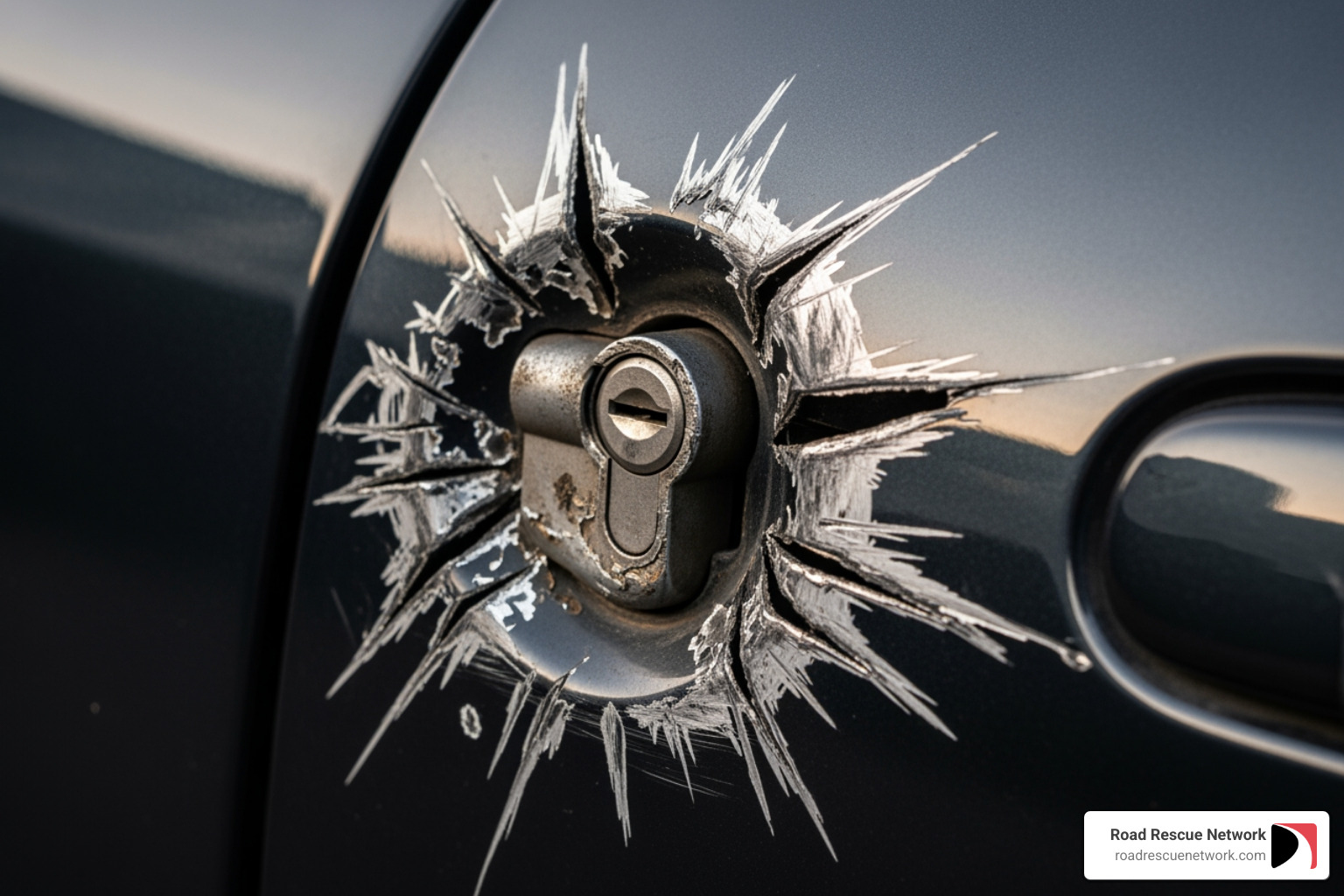
- Damage to door seals and weather stripping: Prying open a door or forcing tools through gaps can permanently bend the door frame or tear the rubber seals, leading to wind noise, water leaks, and costly repairs.
- Scratching paint: Even a slight slip with a metal hanger or slim jim can leave unsightly scratches on your car’s exterior, diminishing its appearance and resale value.
- Damaging internal wiring: Modern cars are packed with electronics, including sensitive wiring for power windows, locks, and side mirrors, all located within the door panel. A slim jim, for instance, can easily sever these wires, leading to expensive electrical issues.
- Airbag deployment risk: Believe it or not, some DIY methods, especially those involving tools inserted into the door, can accidentally trigger side-impact airbags, which is a dangerous and extremely expensive mistake.
- Ineffectiveness on modern electronic locks: Newer vehicles are designed to prevent lockouts if the key is detected inside the cabin. Many have sophisticated electronic locking systems that are impervious to traditional “jimmying” or coat hanger tricks. Power locks are often recessed or feature anti-tampering designs that make them inaccessible to amateur attempts. Lockouts dropped from 13% for cars manufactured in 2007 to below 10% for cars manufactured in or after 2017, largely due to these advanced security features.
In short, attempting to “break into” your own car can quickly escalate a minor inconvenience into a major repair. It’s almost always safer and more cost-effective to call a professional.
Prevention is Key: How to Avoid Future Locked Keys in Car Incidents
We’ve all been there, and we understand the frustration. But what if we told you that many locked keys in car incidents are entirely preventable? By leveraging modern technology and adopting a few simple habits, you can significantly reduce your chances of experiencing this particular headache again.
Leveraging Technology to Prevent Lockouts
Modern vehicles have come a long way, and many are designed with features specifically to prevent you from locking your keys inside.
- Smart key fobs and proximity keys: These advanced key systems are often designed to prevent the car from locking if the key fob is detected inside the vehicle. If you have a car with keyless entry and push-button start, you might notice your car beeps at you if you try to lock it with the key still inside. However, even these systems aren’t foolproof; a dead key fob battery or a key placed in a specific “blind spot” in the car could still lead to a lockout.
- Manufacturer apps: Many car manufacturers now offer smartphone apps that act as a remote key fob. These apps allow you to lock, open up, and even start your car from virtually anywhere. Popular examples include:
- myChevrolet for GM vehicles
- Hyundai Blue Link®
- NissanConnect®
- Toyota App
- MySubaru via STARLINK
- Ford also offers a dedicated app for remote open up, as well as a keyless entry code on some models. If you have a Ford, you can check their guide on Unlocking Your Vehicle for specifics.
We highly recommend setting up and familiarizing yourself with your car’s manufacturer app as soon as you get a new vehicle. It’s a fantastic backup!
- Aftermarket keyless entry systems: If your older vehicle doesn’t have these features, you can look into installing an aftermarket keyless entry system. These can provide the convenience of remote locking and open uping, offering an extra layer of prevention.
Simple Habits to Avoid Locked Keys in Car
Technology is great, but sometimes the simplest solutions are the best. Incorporating these habits into your routine can make a huge difference:
- Always use your key fob to lock: Instead of manually pushing the lock button inside the car, step out and use your key fob or the exterior door button. This ensures you have the keys in hand.
- Develop a “keys in hand” routine: Make it a habit to physically touch or see your keys before you close the car door. Whether it’s jingling them, putting them in your pocket, or placing them in a designated spot, this small action can prevent many lockouts.
- Use a carabiner or lanyard: Attach your keys to your belt loop, purse, or backpack with a carabiner or lanyard. This makes them harder to accidentally leave behind.
- Get yourself a spare key for your car: This is perhaps the most practical prevention method. Keep a spare key at home, with a trusted friend or family member, or even in your wallet if it’s a slim mechanical key. For modern cars with transponder chips, getting a spare made can be more complex and costly, but it’s an invaluable backup. You can consult your insurance provider or automotive resources for more information on car key replacement.
- Replace key fob batteries regularly: A dying key fob battery can prevent your car from recognizing the key, potentially leading to a lockout even if the key is technically with you. Pay attention to warnings and replace batteries proactively.
Frequently Asked Questions about Car Lockouts
We’ve covered a lot, but here are some of the most common questions we hear about locked keys in car situations.
How much does it cost to open up a car?
The cost to open up a car varies significantly based on several factors:
- Type of service: Calling a professional locksmith typically ranges from about $50 to $250. Towing services that offer lockout assistance can also fall within this range.
- Time of day: After-hours or emergency calls often incur higher fees.
- Vehicle complexity: Newer vehicles with advanced security systems might be more expensive to open up than older models.
- Your location: Costs can vary geographically.
At Road Rescue Network, we offer transparent pricing without hidden fees. We aim to provide affordable solutions, connecting you with local rescuers who can give you an upfront cost estimate. Dealerships are generally not the go-to for immediate lockout services and can be quite expensive, often requiring towing and key replacement, which can cost $200 and up for a new key, or even several hundred dollars for higher-end models.
Does car insurance or roadside assistance cover lockouts?
Yes, vehicle lockout service is almost always a covered event for roadside assistance programs. However, it’s important to understand a few things:
- Optional add-on: Roadside assistance is typically an optional add-on to your standard auto insurance policy, not usually included in basic coverage. If you have it, great! If not, you might consider adding it for future peace of mind.
- Membership services: Auto clubs like AAA offer lockout services as part of their membership benefits. In 2024, 10% of their calls were for lockouts, highlighting how common this service is.
- Coverage limits: Always check your specific policy or membership details for “lockout service” coverage limits. Some may cover the full cost, while others have a maximum reimbursement amount.
If you’re unsure, call your insurance provider or roadside assistance provider to confirm your coverage.
When is it an emergency to be locked out of your car?
We touched on this earlier, but it bears repeating because safety is always our top priority. A locked keys in car situation becomes an emergency if:
- A child, a vulnerable person, or a pet is locked inside: This is the most critical scenario. Temperatures inside a closed vehicle can become life-threatening in minutes, even on moderately warm days. Do not hesitate to call 911 immediately.
- You are in an unsafe or remote location: If you’re stranded in an area where you feel threatened, or if it’s very late at night and you’re alone in a remote spot, calling 911 is appropriate to ensure your personal safety.
- The vehicle is running in an enclosed space: If your car is running in a garage or another enclosed area, and you’re locked out, there’s a risk of carbon monoxide poisoning. Call 911 immediately.
For all other situations, while frustrating, it’s not a 911 emergency. Professional lockout services like Road Rescue Network are your best bet for quick and safe entry.
Conclusion
Getting your keys locked in car can be a stressful and inconvenient experience, but it doesn’t have to ruin your day. We’ve explored immediate steps to take, who to call, and crucially, why attempting DIY solutions often leads to more problems than they solve. From checking every door to leveraging smart car technology, you now have a comprehensive guide to steer this common mishap.
Professional help is almost always the safest and most efficient route. At Road Rescue Network, we’re dedicated to getting you back on the road quickly and safely, without the hassle of memberships or hidden fees. Our 24/7 service connects you instantly with local, reliable rescuers across our extensive network, including major cities and states like New York, Los Angeles, Chicago, Houston, Phoenix, and many more.
So, the next time your keys are playing hide-and-seek inside your car, stay calm, skip the coat hanger, and give us a call. We’re here to help you get back in and on with your day.
If you need immediate lockout assistance in Indiana or anywhere nationwide, contact us now!](https://roadrescuenetwork.com/lockout/indiana/hindustan-in/)