
Don’t Get Stuck: The Ultimate Guide to Flat Tire & Auto Tyre Repair Services Near You
That Sinking Feeling – What To Do When You Get a Flat
Auto tyre repair is a service that fixes punctures and damage to your vehicle’s tires, typically through professional patching and plugging methods when the damage is within repairable limits.
Quick Answer: When You Need Auto Tyre Repair:
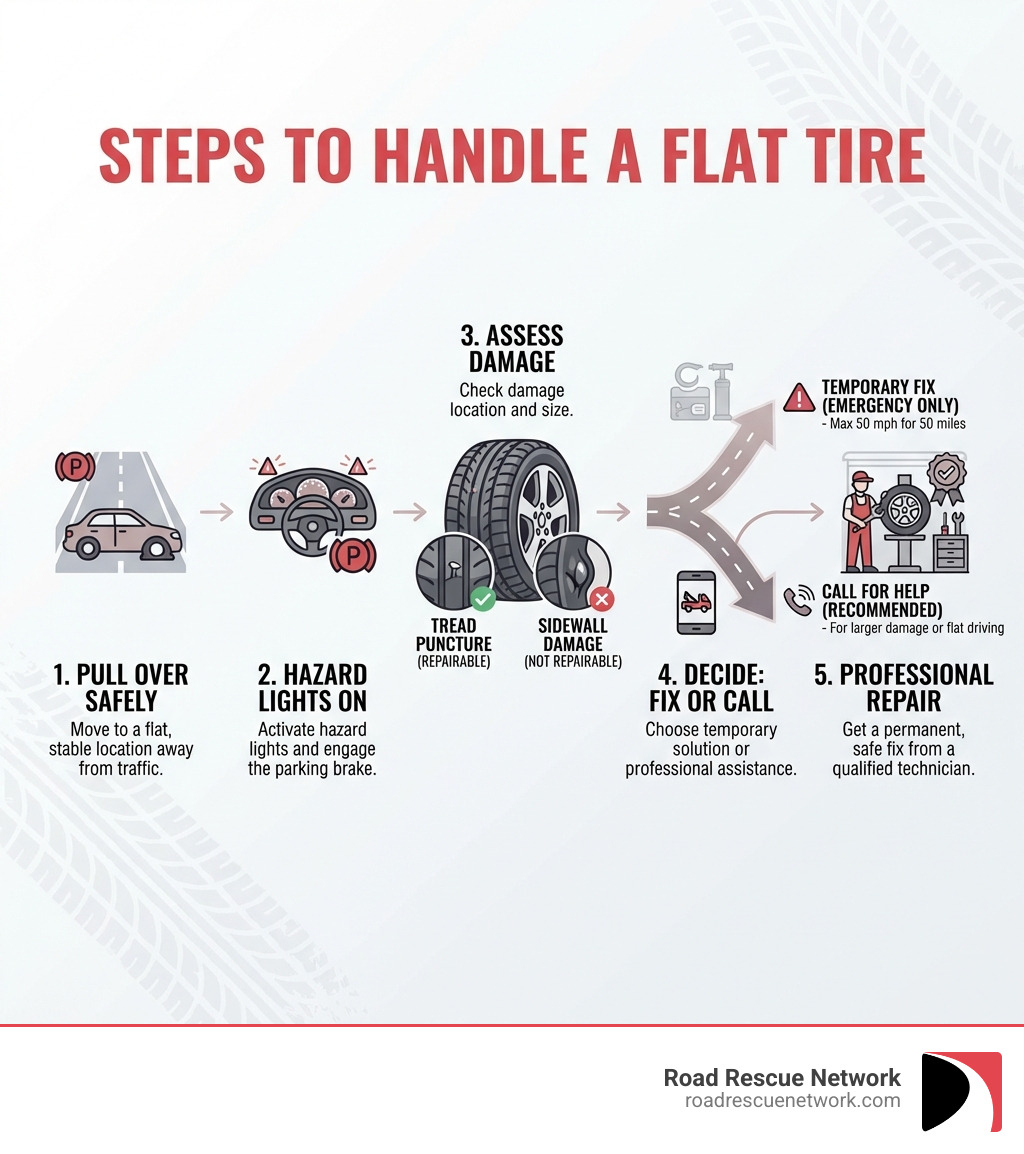
- Pull over safely – Move to a flat, stable location away from traffic
- Turn on hazard lights and engage the parking brake
- Assess the damage – Check if the puncture is in the tread (repairable) or sidewall (not repairable)
- Call for professional help – If the puncture is larger than 1/4 inch or you’ve driven on it flat
- Use a temporary repair kit only if necessary to reach a garage (max 50 mph for 50 miles)
Signs You Have a Flat or Damaged Tire:
- Car pulls to one side while driving
- Steering wheel vibration or wobbling
- Tire Pressure Monitoring System (TPMS) warning light
- Visible bulge or bubble on the tire sidewall
- Hissing sound from the tire
- Noticeable loss of tire pressure
It has happened to most of us. You’re on your way to the store or driving home from work and you hit some sort of debris in the road, puncturing your tire, and leaving you with a flat. That moment of realization – the steering feels off, the car starts pulling to one side, or you hear that telltale thump-thump-thump – creates instant stress.
The good news? Most tire punctures in the tread area can be safely and permanently repaired by a professional, usually in under an hour. The key is knowing when a tire can be fixed versus when it needs replacement, and understanding the difference between a temporary patch that gets you to a garage and a proper auto tyre repair that restores your tire to full safety.
The bad news? Driving on a flat tire – even for a short distance – can cause internal damage that makes the tire unrepairable. And those quick-fix plugs or sealant kits? They’re temporary solutions at best, and potentially dangerous if used as permanent fixes.
I’m Byron Tarlton, founder of Road Rescue Network, and I’ve spent over two decades in the roadside assistance and fleet services industry helping drivers handle tire emergencies. Through years of coordinating thousands of auto tyre repair calls, I’ve seen what works, what doesn’t, and what keeps you safe on the road.
Repair or Replace? How to Assess Your Damaged Tire
When you find yourself with a damaged tire, the first question is always: can it be repaired, or does it need to be replaced? This isn’t just a matter of convenience or cost; it’s a critical safety decision. Our goal at Road Rescue Network is to help you understand the criteria for repairability, so you can make an informed choice or confidently speak with a professional.
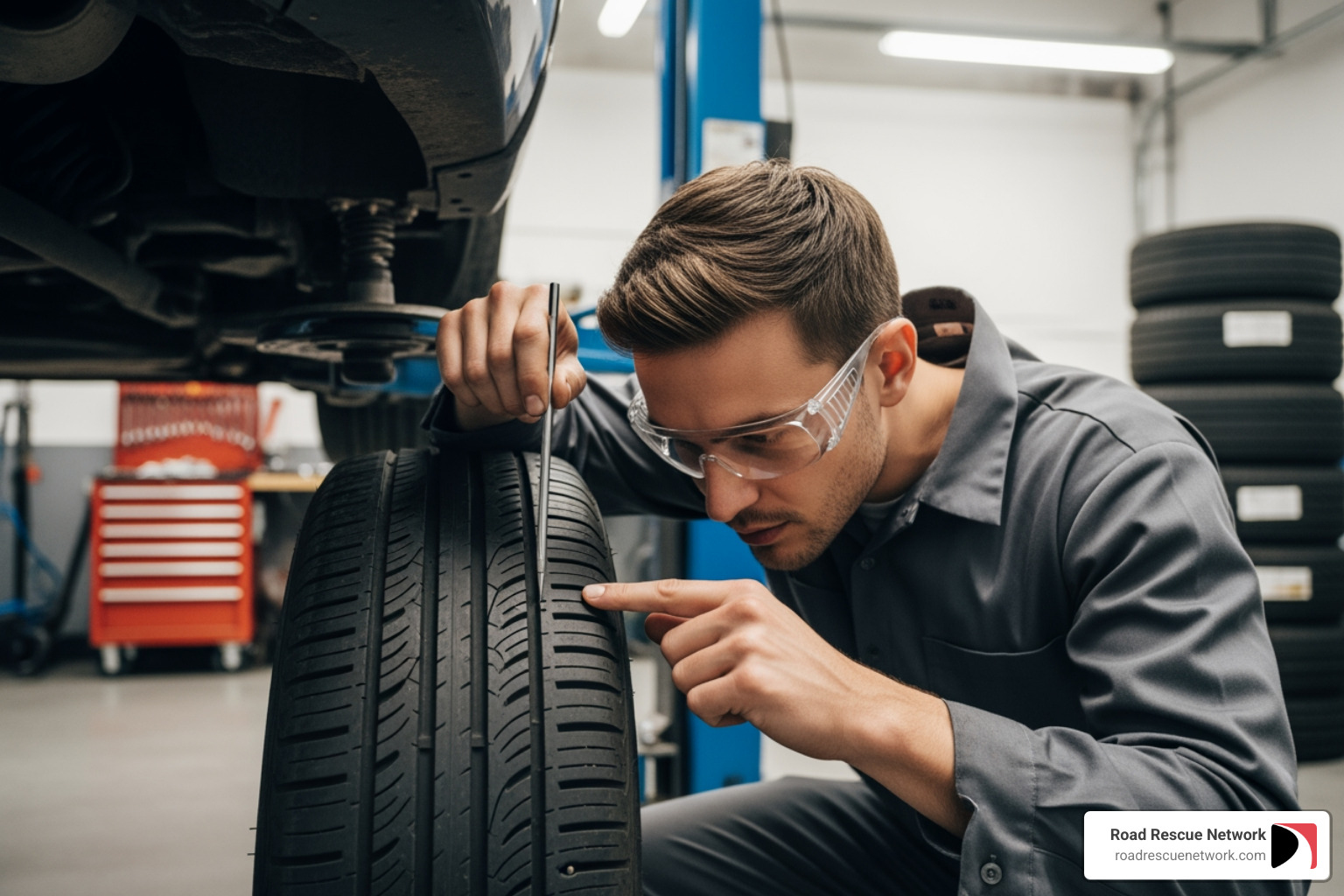
Determining repairability often starts with a quick self-assessment, but it should always culminate in a professional inspection. A tire may look fine from the outside, but internal damage from hitting a pothole or driving on it while flat can compromise its structural integrity. That’s why professional technicians always remove the tire from the wheel for a thorough internal and external inspection.
Identifying Repairable Damage
Not all tire damage is created equal. The location and size of the puncture are the most crucial factors in determining if an auto tyre repair is possible.
- Puncture Location: The golden rule is that repairs are generally limited to the tire’s tread area. This is often referred to as the “crown” of the tire, which is the center section of the tread, roughly 1 to 1.5 inches in from each shoulder. Manufacturers designate specific areas of the tread as repairable. If the damage is within this central zone, there’s a good chance for repair.
- Puncture Size Limit: The industry standard, as recommended by the U.S. Tire Manufacturers Association (USTMA) and the Tire Industry Association (TIA), states that the maximum repairable injury size for passenger and light truck tires is 1/4 inch (or 6mm) in diameter. If your puncture is larger than this, it’s typically considered non-repairable.
- Minimum Tread Depth: A tire must also have sufficient tread depth remaining to be safely repaired. Tires worn down to less than 1/16 inches (or 2/32nds of an inch) are usually beyond repair and need replacing, regardless of the puncture. This is because a tire with minimal tread won’t provide adequate grip, especially in wet conditions, even after a perfect repair.
When a Tire is Beyond Repair
Understanding when a tire cannot be repaired is just as important as knowing when it can. Attempting to repair a non-repairable tire is a significant safety risk. Here’s a list of scenarios where your tire typically needs replacement:
- Sidewall Puncture: Damage to the sidewall is almost always irreparable. The sidewall flexes constantly during driving, and a repair in this area would be under immense stress, making it unsafe. The USTMA and TIA guidelines explicitly state that the sidewall and shoulder of a tire cannot be repaired.
- Shoulder Puncture: Similar to the sidewall, the shoulder of the tire (the area between the tread and the sidewall) is also a high-flex zone and generally cannot be safely repaired.
- Sidewall Bulge or Bubble: If you see a noticeable bubble or bulge on the sidewall, it indicates internal damage to the tire’s structure, likely from impacting a curb, pothole, or other road hazard. This tire is a blowout waiting to happen and must be replaced immediately.
- Large Cuts or Irregular Damage: Punctures larger than 1/4 inch (6mm) in diameter, or jagged cuts caused by road debris, typically cannot be repaired.
- Internal Damage from Driving on a Flat: This is a critical point. Even if the external puncture appears small, driving on a flat or severely underinflated tire can cause severe internal damage. This includes mottling, chattering of the inner rubber, or dislocation of the tire’s internal structure (carcass), making it unsafe to repair. Our technicians will always remove the tire to check for this hidden damage.
- Overlapping Repairs or Multiple Punctures: If there are existing repairs that overlap, or if multiple injuries are too close together or directly across from each other, the tire’s integrity is compromised, and it should be replaced.
- Damage to the Bead: The bead is the part of the tire that seals against the wheel rim. Any damage to this area means the tire cannot form a safe seal and must be replaced.
- Excessive Wear: As mentioned, tires worn down to less than 1/16 inches of tread depth are not repairable, even if the puncture would otherwise be fixable.
Special Considerations for Different Tire Types
Modern vehicles come with various tire technologies, each with unique repair considerations.
- Run-Flat Tires: These tires have reinforced sidewalls that allow you to drive for a limited distance (typically up to 50 miles at speeds up to 50 mph) after a puncture, even with no air pressure. While some run-flat tires can be repaired, the criteria are often stricter, and they generally require specialized inspection to ensure the sidewall wasn’t damaged during the run-flat period. Many manufacturers recommend replacement after any puncture, especially if the tire was driven on while flat. If a slow puncture on a run-flat tire is repaired, it can no longer function as a run-flat and should be replaced soon.
- Self-Sealing Tires: These tires have an internal sealant lining that automatically seals small punctures in the tread area. They can generally be repaired like standard tires, provided the puncture is within the repairable zone and size limits.
- Acoustic Foam Tires: Designed with a foam layer inside to reduce road noise, these tires can also typically be repaired like standard tires. The foam usually doesn’t interfere with a proper patch-plug repair.
Regardless of your tire type, when in doubt, always seek professional advice. Our certified technicians are trained to assess these specific tire constructions and determine the safest course of action.
Understanding Your Auto Tyre Repair Options
When you experience a flat or damaged tire, you typically have two main paths: a temporary fix to get you to safety, or a permanent, professional auto tyre repair. Understanding the difference is crucial for your safety and your wallet.
Temporary vs. Permanent Auto Tyre Repair
- Temporary Fixes: These are designed to get you off the side of the road and to a service center. They are not meant to be long-term solutions.
- Tire Sealant Kits/Aerosol Inflators: Many newer cars come equipped with these instead of a spare tire. They typically involve injecting a liquid sealant and air into the tire. While convenient, they are limited. Sealants are usually effective only for small punctures (generally less than 1/4 inch or 4mm) in the tread area. If your puncture is in the sidewall, or a rip in the tread, these kits are unlikely to work.
- Speed and Distance Limitations: If you use a sealant kit, you must adhere to strict limitations – typically a maximum speed of 50 mph and a maximum distance of 50 miles. This is not a permanent fix, and the tire almost always needs to be removed, inspected, and likely replaced by a professional after using a sealant. Sealants can also mask larger damage, and some can even cause corrosion to steel belts or damage TPMS sensors.
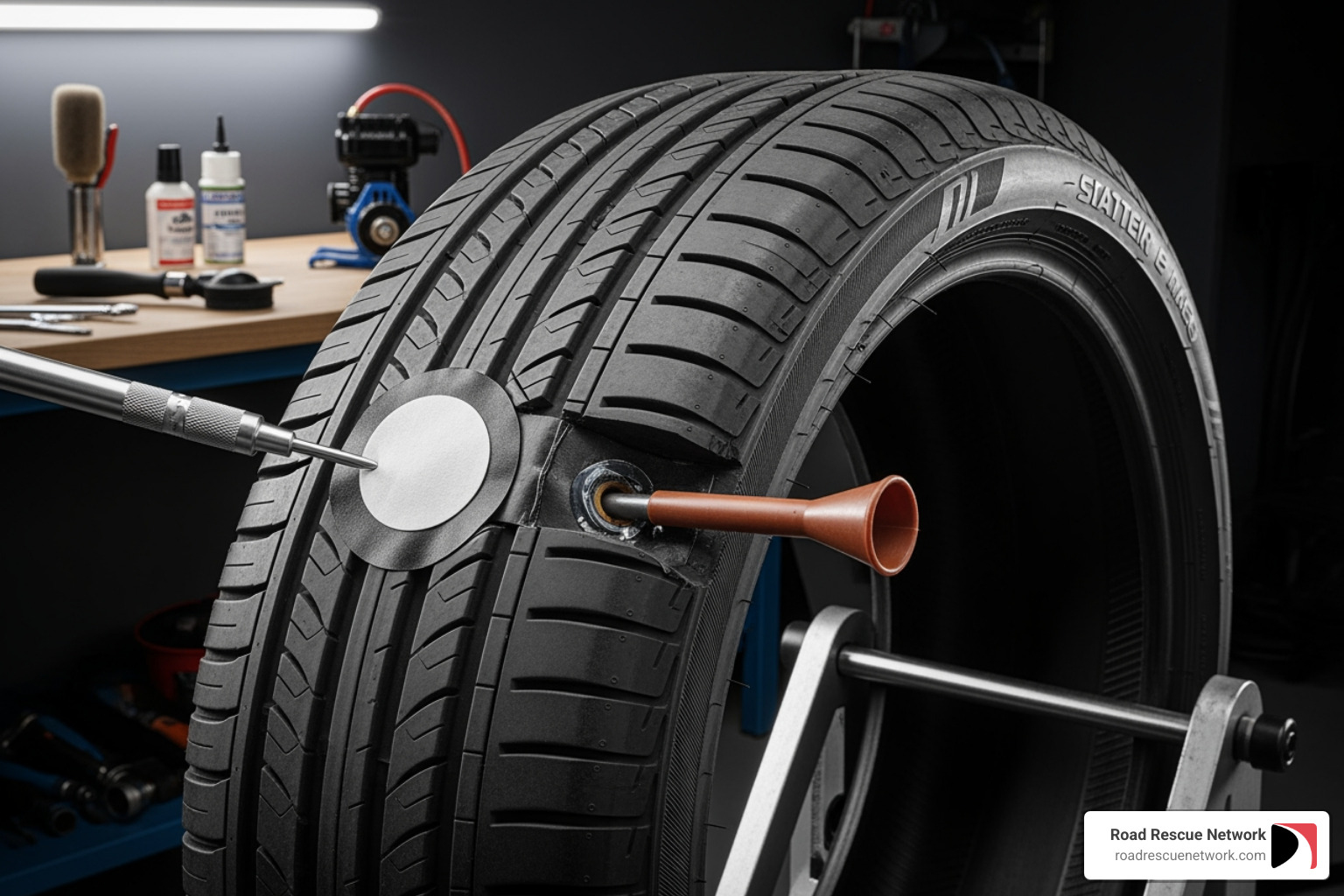
- Permanent Repairs: The only safe and permanent auto tyre repair involves a professional patch-plug combination, performed from the inside of the tire.
- Patch-Plug Combination: As recommended by the U.S. Tire Manufacturers Association (USTMA), a proper repair uses both a rubber stem (plug) to fill the puncture channel and a patch to seal the inner liner of the tire. This ensures both a watertight seal and structural integrity. The “mushroom” repair method, where a combined patch and plug unit is pulled through the puncture, is considered the most qualitative approach.
- Professional Service: This type of repair requires specialized tools and expertise. Our tire technicians remove the tire from the wheel, thoroughly inspect it internally and externally, prepare the puncture site, and then apply the patch-plug combination. This comprehensive approach is what differentiates a safe, lasting repair from a temporary one.
The Dangers of DIY and Improper Repairs
While a temporary fix might seem appealing, understand the risks associated with improper or DIY repairs, especially using external tire plugs.
- Risks of Tire Plugs (External): A common sight at auto parts stores, external tire plugs are sticky, expandable objects pushed into the tire from the outside. While they might stop the air leak, they are a quick fix and can give a false sense of security. The USTMA and TIA strongly advise against using external plugs as a standalone repair because they don’t involve taking the tire off the wheel for an internal inspection. This means potential internal damage (like from driving on a flat) goes unnoticed. Plugs can fail over time, create trapped air between tread layers, and potentially lead to tread separation, posing a serious safety hazard.
- Limitations of Sealants: As mentioned, sealants are temporary. Relying on them as a permanent solution is dangerous. Some sealants can corrode steel belts over time, and they don’t address potential internal structural damage. Additionally, cleaning sealant out of a tire can be a messy and time-consuming job for a technician, sometimes making a repair more difficult or impossible.
- Potential TPMS Sensor Damage: The chemicals in some sealants can damage your Tire Pressure Monitoring System (TPMS) sensors, leading to costly replacements.
- Industry Repair Standards: To ensure safety, all proper auto tyre repair must adhere to the strict guidelines set by the U.S. Tire Manufacturers Association (USTMA) and the Tire Industry Association (TIA). These standards dictate what types of damage are repairable, where they can be repaired on the tire, and the methods that must be used. You can review the Industry repair standards from the USTMA for more detailed information.
- Legal Requirements: While specific state laws vary, generally, any tire repair should meet these national industry standards. Improper repairs could lead to unsafe driving conditions, and in some cases, liability issues if an accident occurs. This is why we always recommend professional service.
The Professional Auto Tyre Repair Process
When you bring your vehicle to a professional for auto tyre repair, you’re investing in safety and expertise. Here’s what a proper repair process entails:
- Demounting the Tire: The first and most crucial step is to completely remove the tire from the wheel. This allows for a comprehensive inspection that cannot be performed while the tire is mounted.
- Internal and External Inspection: Our technicians will carefully examine both the inside and outside of the tire for any hidden damage, such as punctures, cuts, bulges, or signs of internal structural damage from underinflation or impacts. This is where a professional can identify if the tire was driven on while flat, rendering it irreparable.
- Removing Damaged Material: The puncture area is carefully cleaned and prepared. Any foreign objects are removed, and the damaged rubber around the puncture is trimmed and buffed smooth.
- Filling the Puncture: A rubber stem (the “plug” part of the patch-plug combination) is inserted from the inside of the tire, through the puncture channel, filling the void.
- Sealing the Inner Liner: A patch is then applied to the inner liner around the puncture from the inside. This creates an airtight seal, preventing air from escaping and moisture from entering the tire’s internal structure.
- Remounting and Balancing: Once the repair is complete, the tire is carefully remounted onto the wheel. It is then properly inflated to the manufacturer’s recommended pressure and precision-balanced to ensure smooth, safe driving.
- Role of a Technician: A trained and certified technician is indispensable in this process. They possess the knowledge to identify complex damage, apply the correct repair techniques, and ensure the repair adheres to all safety standards. Their expertise is what guarantees your repaired tire is safe for the road. You can find more details on TIA recommended practices.
- Typical Repair Time: A proper auto tyre repair, including inspection, repair, remounting, and balancing, typically takes around 60-90 minutes. While it might seem longer than a quick plug, this thorough process ensures your safety and the longevity of your tire.
Cost vs. Convenience: Making the Right Financial Choice
Deciding between repairing a damaged tire and replacing it often boils down to a balance of cost, convenience, and long-term value. While a new tire might seem like a straightforward solution, a professional auto tyre repair can be a significantly more economical and environmentally friendly option when feasible.
Repair vs. Replacement Costs
The financial decision between repair and replacement can vary widely based on the type of damage, your tire’s condition, and regional pricing. However, tire repair is almost always an affordable and inexpensive option compared to replacement, saving you a substantial amount of money.
Here’s a general comparison to help you weigh your options:
| Feature | Tire Repair (Professional Patch-Plug) | Tire Replacement (New Tire) |
|---|---|---|
| Average Cost | $25 – $75 per tire (estimate) | $100 – $300+ per tire (depending on type, brand, vehicle) |
| Time | 60 – 90 minutes | 30 – 60 minutes (per tire, including mounting/balancing) |
| Longevity | Lasts for the remaining life of the tire | Full lifespan of a new tire |
| Cost Factors | Puncture size, location, labor rate | Tire brand, type (all-season, performance, run-flat), size, installation, balancing, valve stem, disposal fees |
| Benefits | Cost-effective, extends tire life, eco-friendly | Full tread depth, new warranty, peace of mind (if repair isn’t an option) |
| Drawbacks | Only possible for specific damage types | Higher upfront cost |
Repair Cost Factors: The primary factors influencing repair cost are the labor involved and the materials used for the patch-plug combination. Our roadside assistance partners offer competitive pricing for these services.
Replacement Cost Factors: Replacing a tire involves the cost of the new tire itself, which can range from budget-friendly options to premium performance or specialized tires (like run-flats). Additionally, you’ll pay for mounting, balancing, a new valve stem, and an environmental disposal fee for your old tire.
While a tire repair might seem like a small investment, it can significantly extend the life of an otherwise healthy tire, saving you the expense of a full replacement. We believe in providing you with the safest and most economical solution for your auto tyre repair needs.
Frequently Asked Questions about Tire Repair
We understand you might have more questions about auto tyre repair. Here are some of the most common inquiries we receive:
How long does a professionally repaired tire last?
A properly performed auto tyre repair by a professional technician, using the recommended patch-plug method, is designed to last for the remaining legal tread life of the tire. If the tire was not driven on while flat and suffered no internal damage, a professional repair should not reduce its lifespan or performance. Essentially, a well-repaired tire is just as reliable as it was before the puncture, for as long as its tread and overall condition remain safe.
Can you repair a tire with a nail in it?
Yes, often you can! If you have a nail or screw in your tire, it can usually be repaired, provided the puncture meets the standard criteria: it must be in the tread area (not the sidewall or shoulder), and the damage must be 1/4 inch (6mm) or less in diameter.
Crucially, do not remove the nail yourself! Leaving the object in place often helps to maintain some air pressure and prevents the hole from expanding or causing further internal damage. It also helps the technician quickly locate the source of the leak. Instead, bring your vehicle to a professional as soon as possible for a thorough inspection and proper auto tyre repair.
Is it safe to drive on a tire repaired with a DIY kit?
Driving on a tire repaired with a DIY sealant kit or external plug is only safe as a temporary measure, and with significant limitations. These kits are designed to get you to a service center, not as a permanent fix.
- Low Speed, Short Distance: Most sealant kits specify a maximum speed of 50 mph and a maximum distance of 50 miles. Exceeding these limits can compromise the temporary seal and lead to dangerous situations.
- Not a Permanent Fix: DIY repairs like sealants or external plugs do not allow for the critical internal inspection needed to detect hidden damage from driving on a flat or impact. Without this inspection, you could be driving on a structurally compromised tire, risking a blowout.
- Professional Inspection Required: After using a DIY kit, it is absolutely essential to have the tire professionally inspected, repaired (if possible), or replaced as soon as you reach a safe location.
We strongly advise against relying on these temporary solutions for anything other than an emergency to reach a qualified service provider. Your safety is paramount.
Conclusion: Get Back on the Road Safely and Quickly
Experiencing a flat tire is never a pleasant surprise, but with the right knowledge and access to professional help, it doesn’t have to ruin your day. Understanding the nuances of auto tyre repair, from recognizing repairable damage to avoiding the pitfalls of improper fixes, is key to keeping you and your vehicle safe on the road.
We’ve explored the industry standards that guide safe tire repairs, emphasizing the critical difference between temporary roadside fixes and permanent, professional solutions. The safest and most reliable auto tyre repair involves a thorough internal inspection and a proper patch-plug combination performed by a certified technician.
At Road Rescue Network, we’re dedicated to getting you back on the road safely and quickly. Our network of local rescuers provides fast, on-demand roadside assistance for car emergencies like flat tires, with no memberships or hidden fees. Whether you’re in New York, Los Angeles, Houston, Chicago, Phoenix, Philadelphia, or any of our many service locations across the country, we’re just a tap away. When a flat tire strikes, don’t get stuck. Get fast, on-demand tire change service now. We’re here to connect you with local experts who can assess your tire, provide temporary assistance, or facilitate a tow to a repair shop, ensuring your journey continues with peace of mind.