Don’t Get Stuck with Bad Service: Honest Reviews of Motorcycle Roadside Assistance
Why Every Motorcyclist Needs to Read This Before Choosing Roadside Assistance
Motorcycle roadside assistance reviews reveal a troubling pattern: riders paying for peace of mind often find themselves stranded for hours, hit with unexpected fees, or watching the wrong type of tow truck arrive. Here’s what real riders report about the most popular providers:
| Provider | Common Praise | Common Complaints |
|---|---|---|
| AAA | Fast response (20-30 min) in some areas | Coverage confusion, may require Plus/RV tier, regional denial of service |
| AMA | Motorcycle advocacy included | Denies coverage for collisions (even deer strikes), sends wrong equipment |
| HOG/Manufacturer Plans | Brand-specific perks | 5+ hour waits, bikes damaged during loading, app glitches |
| Insurance Add-ons | Low cost ($10-15/year) | “Specialty vehicle” fees up to $100, cumbersome web forms, 2+ hour waits |
No one wants to find themselves stuck by the side of the road—and especially not if you’re on a motorbike. One rider’s 1985 Honda lost power on an uphill stretch. Progressive’s roadside assistance quoted a two-hour wait and then added a $100 “specialty vehicle” fee. A direct call to a local tow company? $145 and the truck arrived in under 30 minutes.
The reality is that most roadside assistance plans aren’t built for motorcycles. They’re optimized for cars, leaving riders to deal with long delays, wrong equipment, and fine print that excludes the very situations you need help with most.
This guide breaks down real motorcycle roadside assistance reviews from riders who’ve been there. We’ll compare the major providers—AAA, AMA, HOG, and insurance add-ons—and show you what actually works when your bike won’t start, you’ve got a flat tire miles from anywhere, or you’re stranded after dark.
I’m Byron Tarlton, founder of Road Rescue Network, and I’ve spent over two decades in the towing and roadside assistance industry, watching riders get burned by plans that promise help but deliver headaches. I created this comparison of motorcycle roadside assistance reviews to help you avoid the pitfalls I’ve seen and find real solutions that work when you need them most.
Related content about motorcycle roadside assistance reviews:
The Harsh Reality: Common Issues with Motorcycle Roadside Assistance
When we dig into motorcycle roadside assistance reviews, a pattern of frustration quickly emerges. Riders often face a unique set of challenges that general roadside assistance plans simply aren’t equipped to handle. These common issues can turn an already stressful breakdown into a truly miserable experience.
One of the most frequently cited problems is long wait times. Imagine being stranded on a highway near Los Angeles, CA, or a quiet road outside Phoenix, AZ. While a direct call to a local towing company might bring help in under half an hour, as one rider experienced for $145, a major provider’s built‑in roadside assistance estimated a wait time of at least two hours due to heavy callout volume. We’ve even seen reports of riders waiting over four hours for a scooter incident, or brand-affiliated towing leaving a rider stranded for over five hours. This isn’t just an inconvenience; it can be a safety concern, especially if you’re in an isolated area or after dark.
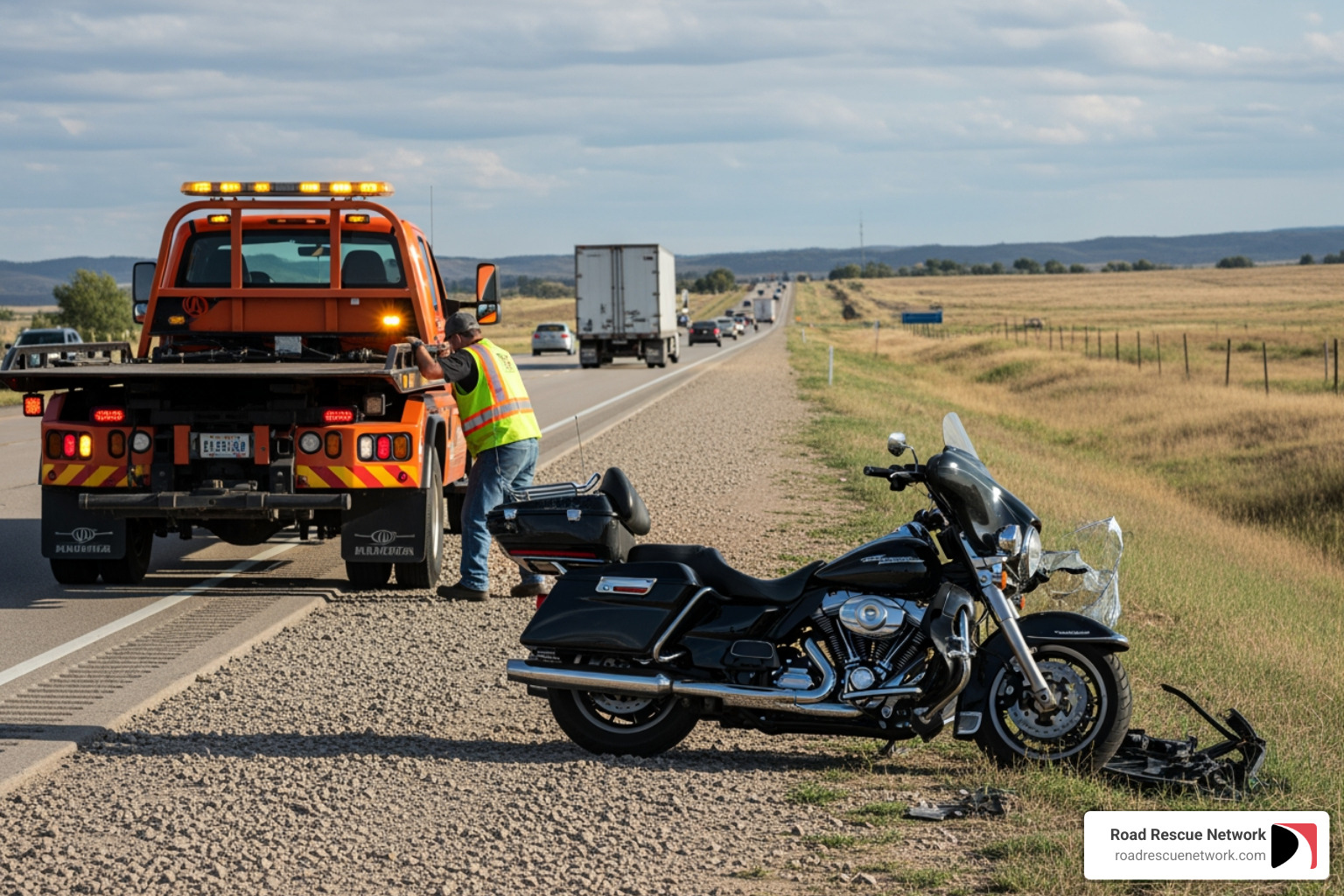
Another significant issue is the arrival of incorrect tow trucks. Motorcycles require specialized towing equipment, typically a flatbed truck with proper tie-downs to prevent damage. Yet, we frequently hear stories of providers sending standard hook-and-chain tow trucks or vehicles not equipped to safely transport a motorcycle. One user reported a motorcycle roadside assistance service sending a tow truck that could not carry a motorcycle, while another brand-affiliated towing service arrived with a flatbed but refused to tow the motorcycle, stating they would cause damage. In the worst cases, we’ve seen reports of bikes being dropped on their side while loading. This not only delays service but can also lead to costly damage to your prized possession.
Coverage denial is another bitter pill for riders who’ve paid for peace of mind. Instances abound where roadside assistance providers refuse service based on technicalities. For example, one user reported a plan refusing service for a deer encounter, classifying it as a “collision” rather than a “breakdown.” Even trusted names in roadside assistance sometimes cannot or will not provide service in certain areas, suggesting the rider call the police instead. We’ve also heard of motorcycle club-based assistance being unable to verify a customer’s coverage, despite years of paid membership, or telling a member their upgraded membership didn’t include motorcycle coverage.
Then there are the hidden fees. Some low-cost insurance add-ons, for instance, have charged an extra $100 fee for motorcycle towing, calling it a “specialty vehicle,” on top of the already low annual premium. This unexpected cost can be a real shock when you’re already in a difficult situation.
Finally, dispatcher incompetence or outdated technology can plague the service experience. Some assistance processes require customers to fill out a web form via a phone link. This can be problematic without internet access, which is often the case when you’re stranded. Brand- or club-based apps have also had issues with things like incorrect default states and limited service options. Many users report that most roadside assistance tows (other than large auto clubs) are dispatched through third-party call centers, which are frequently described as incompetent, leading to further delays and miscommunications.
These common pitfalls highlight why a careful look at motorcycle roadside assistance reviews is so crucial. We need to be prepared for these realities. If you’re in a bind and need a light duty tow, you can always find More info about light duty towing services.
Why Motorcycles Are “Special”
The core of many of these problems lies in how roadside assistance providers categorize motorcycles. For many, a motorcycle is a “specialty vehicle,” a designation that can lead to extra fees and service limitations. Unlike a car, a motorcycle cannot simply be hooked up and dragged to a repair shop. It requires careful handling, often necessitating a flatbed tow truck to prevent damage to the bike’s frame, suspension, or fairings. This specialized equipment isn’t always readily available, especially in less populated areas.
The risk of damage during towing is a major concern for riders. Our bikes are not just transportation; they are often passions and significant investments. A careless tow can result in scratched paint, bent handlebars, or even structural damage. Furthermore, unlike cars, motorcycles have fewer “on-site repair” options for many common breakdowns. A dead battery might get a jump, but a flat tire often means a tow, as changing a motorcycle tire on the side of the road is far more complex and dangerous than with a car. This specialized need often goes unaddressed by general roadside assistance plans.
When your motorcycle needs specific care, understanding the different types of towing services is important. For larger or heavier bikes, or if you’re in a tricky spot, you might need More info about medium duty towing services.
The Reimbursement Runaround
Even when a service is eventually rendered, the process can be far from smooth. Many providers, especially with lower-tier plans or in situations where their contracted network fails, will ask you to pay for the tow upfront and then seek reimbursement. This can be a significant financial burden, especially for an unexpected $200-$300 tow bill.
The reimbursement process itself can be a bureaucratic nightmare. It often involves submitting paperwork, waiting weeks or even months for a response, and then potentially receiving only partial reimbursement. One user reported a club-based towing plan offering reimbursement up to $250 for a $270 tow, leaving them out of pocket for the difference. Another rider noted that some insurance roadside assistance add-ons required “paperwork hoops” for reimbursement after a tow exceeding a certain amount. This “reimbursement runaround” adds another layer of stress and frustration to an already difficult situation, highlighting that the “peace of mind” promised by these services is often conditional.
The Big Four: A Head-to-Head Comparison Based on Motorcycle Roadside Assistance Reviews
Navigating the landscape of motorcycle roadside assistance reviews means looking closely at the major ways riders get coverage. Here, we compare the “Big Four” categories of providers: auto clubs, rider organizations, brand/manufacturer plans, and insurance add-ons, based on what riders like us are actually experiencing.
Auto Clubs: The Familiar Giants
Large auto clubs are household names in roadside assistance, but when it comes to motorcycles, reviews are decidedly mixed. Many riders report positive experiences, with trucks arriving within 20-30 minutes for a tow in cities like San Diego, CA, or Portland, OR. However, the biggest point of confusion and frustration for riders often revolves around coverage. Membership generally follows the driver (meaning you’re covered in any car you’re driving or riding in), but motorcycle coverage isn’t always a given.
Many members on mid-tier plans have been surprised to find their membership did not include motorcycle coverage. To ensure motorcycle coverage, riders often need to upgrade to a higher tier, such as an RV-level plan or a specific motorcycle add-on. Even with these upgrades, challenges can arise. One user reported their coverage for towing a boat on a trailer was denied because the boat was on the trailer, showcasing how specific wording can affect service. Another user found service unavailable in a rough neighborhood near St. Louis, MO, and was instead advised to call the police.
Despite these issues, big auto clubs are often seen as a reliable option due to their extensive networks of contracted tow companies. However, the quality of service can vary by region or the specific tow company contracted. For additional motorcycle safety resources and tips on preparing for breakdowns, the Motorcycle Safety Foundation offers valuable guidance for riders.
Here’s a quick comparison of these categories of providers:
| Feature | Auto Clubs | Rider Organizations | Brand / Manufacturer Plans | Insurance Add-ons |
|---|---|---|---|---|
| Annual Cost (approx.) | $50-$100+ (depending on tier/add-on) | $49-$109 (for higher tiers) | Included with membership/bike | $10-$20 |
| Tow Radius | 5-200 miles (tier dependent) | Varies, often 35-100 miles | Varies, often to nearest dealer | Varies, often 15-100 miles |
| Motorcycle-Specific | May require specific add-on/tier | Explicitly for motorcycles | Explicitly for brand motorcycles | Often generic, may incur extra fees |
| Response Time | Mixed, 20-30 min to 4+ hours | Mixed, 30 min to 2+ hours or no-show | Mixed, 30 min to 5+ hours | Mixed, 30 min to 2+ hours |
| Key Pros | Covers driver, large network, discounts | Motorcycle advocacy, specific coverage | Brand loyalty, community | Very low annual cost |
| Key Cons | Coverage confusion, regional issues | Breakdown vs. collision debate, wrong equipment | Long waits, damage reports, app issues | Hidden “specialty” fees, web forms, delays |
Rider Organizations: For Riders, By Riders?
National rider organizations are prominent voices for motorcyclists, and their roadside assistance is often touted as a “for riders, by riders” solution. However, our dive into motorcycle roadside assistance reviews reveals that even these groups aren’t immune to issues.
A major point of contention is the breakdown vs. collision debate. One user reported a plan refusing service for a deer encounter, classifying it as a “collision” rather than a “breakdown.” This distinction can leave riders stranded even if their bike is mechanically sound but undrivable due to minor accident damage. We’ve also heard of some plans refusing jump starts, only offering to tow the motorcycle, which can be an unnecessary step for a simple battery issue. And, like other providers, rider-organization plans have been known to send tow trucks that were not equipped to carry a motorcycle, leading to frustrating delays.
Despite these frustrations, many memberships do offer benefits beyond roadside assistance, such as political lobbying for motorcyclists’ rights, publications, and community opportunities. For many, this broader mission makes the membership worthwhile, even if the roadside assistance has its flaws.
Brand & Manufacturer Plans: Loyalty Tested
Owners of brands like Harley-Davidson, BMW, and others often turn to manufacturer- or club-based roadside assistance, sometimes included with a new bike. These brand-specific plans are designed to cater to their loyal customers, but motorcycle roadside assistance reviews show that loyalty doesn’t always guarantee stellar service.
Brand-affiliated towing, in particular, has garnered significant criticism. We’ve seen reports of riders being left stranded for over five hours, with no tow truck showing up. In other cases, a service arrived with a flatbed but refused to tow the motorcycle, stating they would cause damage. Perhaps most alarming are reports of bikes being dropped on their side while loading. These experiences highlight a concerning lack of proper training or equipment among some contracted tow operators.
Manufacturer-specific plans also have their quirks. While some roadside assistance reps have impressed riders by suggesting simple fixes over the phone, brand-club apps have had issues with state selection defaults and limited service options. One customer even reported that their membership-based roadside assistance could not verify coverage, despite the rider paying for it for six years. The towing service initially declined a tow request, stating they do not tow motorcycles, despite coverage having been purchased. While they eventually offered reimbursement, it was only up to $250 for a $270 tow.
Insurance Add-Ons: The Budget Option’s True Cost
Many motorcycle insurance policies offer roadside assistance as an affordable add-on, often costing around $10-$15 per year. This seems like a great deal, but as motorcycle roadside assistance reviews reveal, the “budget option” often comes with a hidden cost: frustration.
The low annual fee can be quickly overshadowed by hidden specialty fees. Some riders have reported being charged an extra $100 for motorcycle towing, with their bike classified as a “specialty vehicle.” This unexpected charge can negate any perceived savings.
Another common complaint is the cumbersome service request process. Some insurance-based roadside programs require customers to fill out a web form via a phone link. This becomes problematic if you’re stranded without internet access or a low phone battery, a common scenario during a breakdown.
Long wait times are also a frequent issue. While some riders describe their insurance roadside assistance experiences as positive on the rare occasions they used them, others have reported waiting at least two hours for a tow truck. These delays can be particularly challenging when you’re far from home or in an unfamiliar area.
Despite these issues, some insurance-based plans do offer valuable benefits like trip interruption coverage. One rider’s roadside coverage helped with a hotel bill under this benefit, which can be a lifesaver if a breakdown forces an overnight stay. However, even here, “paperwork hoops” for reimbursement are often required.
For those who run out of fuel, a common breakdown scenario for motorcyclists, knowing about fuel delivery services can be a game-changer. Find More info about fuel delivery services.
How to Choose the Right Plan: A Rider’s Checklist
Choosing the right roadside assistance plan for your motorcycle can feel like navigating a minefield of fine print and mixed reviews. But with the right checklist and understanding, we can make an informed decision and hopefully avoid getting stuck with bad service.

Key Factors for Your Motorcycle Roadside Assistance Reviews
When sifting through motorcycle roadside assistance reviews and comparing plans, consider these crucial factors:
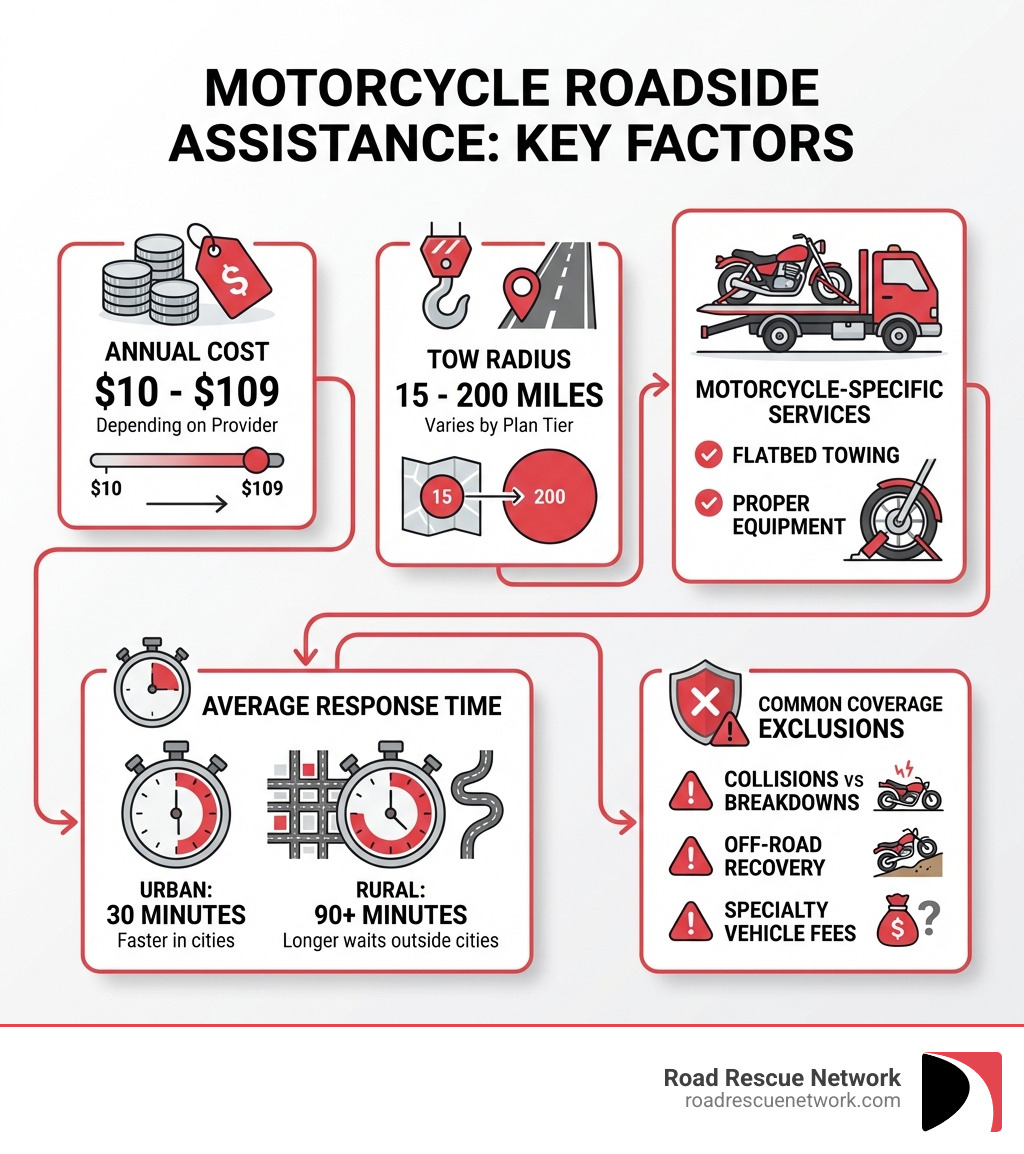
- Cost vs. Value: A low annual fee might seem attractive, but if the service is unreliable or comes with hidden charges, it offers little value. We’ve seen low-cost add-ons hit riders with an extra $100 “specialty vehicle” fee. Sometimes, paying a bit more upfront for a plan with better service and a longer towing radius pays off in the long run.
- Towing Radius Limits: This is perhaps the most critical factor for motorcyclists, especially those who tour. Many basic plans have very short towing limits (e.g., 15 miles). Higher-tier auto club plans can offer up to 100–200 miles. Brand plans may tow only to the nearest brand dealership, which might be hundreds of miles away or closed. Ensure the towing radius aligns with your typical riding distances.
- Motorcycle-Specific Equipment Guarantee: This is non-negotiable. Your motorcycle needs a flatbed tow and proper tie-downs. Ask providers if they guarantee this, as many simply dispatch generic tow companies. Reports of riders getting ill-equipped trucks and even dropped bikes highlight this critical need.
- Trip Interruption Coverage: If you travel far from home, this can be incredibly valuable. Some insurance-based roadside assistance includes coverage that can reimburse hotel or meal expenses if a breakdown leaves you stranded overnight.
- Service Call Limits: Most plans have limits on how many service calls you can make per year (e.g., three per year for some plans) or even within a certain timeframe (e.g., one service per 72 hours). Understand these limits to avoid being caught off guard.
Reading the Fine Print: Exclusions and Loopholes to Watch For
The devil is often in the details, and roadside assistance plans are no exception. Pay close attention to these common exclusions and loopholes:
- Accident vs. Breakdown Clauses: This is a major point of frustration. As one rider found, a plan refused service for a deer encounter, classifying it as a “collision” rather than a “breakdown.” Many plans only cover mechanical breakdowns, leaving you without assistance if your bike is undrivable due to minor accident damage.
- Off-Road Limitations: For adventure riders, this is crucial. Some policies mention towing only within a short distance of the road and exclude towing from “roads not regularly maintained, sand beaches, open fields.” If your ride takes you off the beaten path, most standard plans won’t follow.
- Coverage for Trailers: Be aware if you ever tow a motorcycle trailer or carry a bike on a trailer. One rider’s RV-level coverage for towing a boat on a trailer was denied because the boat was on the trailer. This level of specificity can be frustrating.
- Tire Change vs. Tow-Only for Flats: A flat tire on a motorcycle often means a tow, as on-the-spot changes are rare. However, some plans might only offer a tow when a simple jump start or minor fix is needed, as one rider experienced when they were refused a jump start and only offered a tow.
- Motorcycle Tire Repair: Changing a motorcycle tire on the side of the road is difficult and often requires specialized tools. If you get a flat, it’s usually a tow. For more general information on mobile tire repair, you can check out More info about mobile tire repair services.
Your Backup Plan: When Roadside Assistance Fails
What happens when your chosen roadside assistance provider lets you down? According to countless motorcycle roadside assistance reviews, having a backup plan is not just smart, it’s essential.
- DIY Repair Kit: Carry a basic toolkit, tire repair kit (for tubeless tires), and maybe even a small air pump. Sometimes, a flat can be temporarily fixed, or a loose connection tightened, getting you to the next town.
- Pre-Saving Local Tow Numbers: When traveling, especially through less-populated areas, consider looking up and saving numbers for local motorcycle-friendly tow companies. As one rider found, a direct call to a local company brought help in under 30 minutes, compared to a two-hour wait from their official provider. This bypasses the often-incompetent large dispatch services used by many plans.
- The On-Demand Alternative: This is where we come in. Road Rescue Network offers an on-demand roadside assistance solution designed to cut through the common frustrations. Our USP is fast, 24/7 service with no memberships or hidden fees. You only pay when you need us. We instantly connect you with local rescuers equipped for the job, including motorcycle towing. This pay-per-use model means you avoid annual fees for a service you might rarely use, and you get direct dispatch to a local professional without the runaround. Whether you’re in New York, NY, or San Antonio, TX, our network is ready.
It’s also worth noting that some riders turn to community-based efforts or simply rely on the kindness of strangers when traditional roadside assistance fails. Community “bikers helping bikers” concepts are a testament to the strong community spirit among riders, but they are not guaranteed solutions. Testimonials and rider forums can be a good way to gauge service quality and learn from real-world experiences.
Conclusion: The Best Roadside Plan is Being Prepared
After sifting through countless motorcycle roadside assistance reviews, one truth becomes abundantly clear: the “set it and forget it” approach to roadside assistance rarely works for motorcyclists. We’ve seen the common issues—from agonizingly long wait times and the arrival of ill-equipped tow trucks to frustrating coverage denials and hidden fees. Auto clubs, rider organizations, brand plans, and even insurance add-ons, while offering some benefits, frequently fall short of rider expectations due to their car-centric models, bureaucratic problems, and reliance on often underpaid, generic tow contractors.
The gamble of subscription services, where you pay annually for a service that might fail you when you need it most, is a risk many riders are no longer willing to take. The importance of transparency and motorcycle-specific care cannot be overstated. Our bikes are not cars; they require specialized handling and understanding.
This is precisely why we believe in the power of on-demand solutions. With Road Rescue Network, you’re not locked into a membership that may or may not cover your specific needs. Instead, you get immediate access to qualified local rescuers, dispatched directly to your location, with no hidden fees and a clear understanding of what’s being provided. We’re here to offer a solution that prioritizes efficiency and motorcycle-specific expertise, so you can get back on the road safely and quickly.
Don’t get stuck with bad service. Get informed, be prepared, and choose the right help when you need it. Because the open road should be about freedom, not frustration.
Get reliable motorcycle towing now.