Everything You Need to Know About Long Distance Semi Truck Towing
When Your Rig Goes Down Miles From Home: What You Need to Know About Long Distance Semi Truck Towing
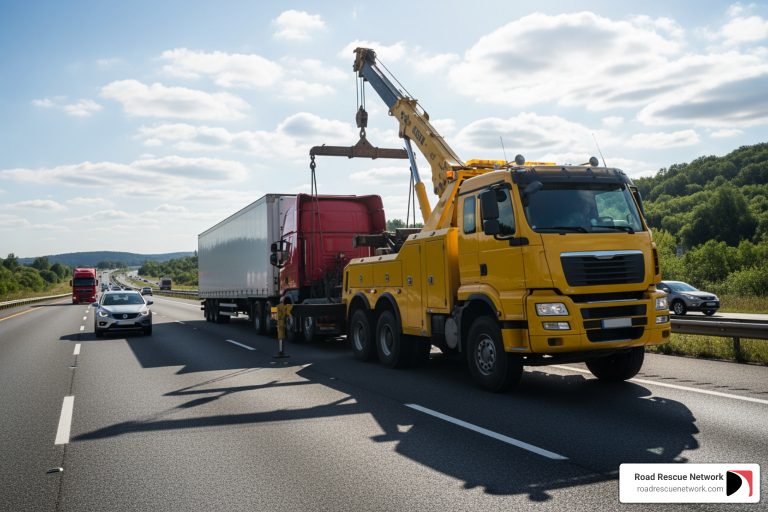
Long distance semi truck towing is the specialized process of moving a disabled or non-operational Class 7 or Class 8 commercial truck across hundreds — or even thousands — of miles using heavy-duty recovery equipment.
Here’s a quick breakdown of what it involves:
| Topic | Quick Answer |
|---|---|
| What it is | Moving a disabled semi truck long distances using wreckers, lowboys, or RGN trailers |
| When you need it | Engine failure, collision, transmission breakdown, fleet relocation |
| Equipment used | Heavy-duty wreckers, Landoll trailers, lowboy trailers |
| Typical cost | ~$3.50–$4.00 per mile + permits (can total $8,000+ for 1,000 miles) |
| Key regulations | DOT/FMCSA compliance, oversize/overweight permits required per state |
| Who to call | A licensed, 24/7 heavy-duty towing provider with interstate experience |
Not all tow jobs are the same. Pulling a sedan off a highway shoulder is nothing like recovering an 80,000-pound Class 8 truck and hauling it across state lines. The equipment is more specialized, the logistics are more complex, and the stakes — for your truck, your cargo, and your timeline — are much higher.
Whether you’ve just had a catastrophic engine failure in the middle of nowhere or you need to relocate a rig to a repair facility two states away, understanding how this process works can save you time, money, and serious headaches.
I’m Byron Tarlton, founder of Road Rescue Network, and I’ve spent decades working in towing and logistics — building the operational and digital infrastructure that connects drivers with reliable long distance semi truck towing services across the country. In the sections below, I’ll walk you through everything: equipment, costs, regulations, safety, and how to choose the right provider.
Learn more about long distance semi truck towing:
Understanding Long Distance Semi Truck Towing and When It’s Necessary

When we talk about long distance semi truck towing, we aren’t just talking about a quick pull to the nearest exit. We are talking about state-to-state transport that requires meticulous planning. This service becomes necessary when a truck cannot be repaired on the roadside and needs to reach a specific terminal, a specialized dealership, or its home base in a city like Houston, TX or San Antonio, TX.
Common reasons for these long hauls include catastrophic mechanical failures or business relocations. For instance, if you are operating in Nesquehoning, PA and your engine throws a rod, you might decide that towing the unit back to your primary mechanic is more cost-effective than paying “street rates” at an unknown shop in another state.
Common Scenarios for Long-Haul Recovery
In our experience, a few specific nightmares usually trigger the call for a long-distance tow:
- Catastrophic Engine or Transmission Failure: When the “heart” of the truck stops, and a simple roadside fix isn’t possible.
- Differential Failure: If the rear ends lock up, the truck isn’t going anywhere under its own power.
- Collision Recovery: After an accident, a truck may be structurally sound enough to tow but legally or mechanically unfit to drive.
- Brake System Collapse: If the air system or mechanical brake components fail beyond immediate repair, specialized towing is the only safe way to move the unit.
- Fleet Relocation: Sometimes, companies need to move assets between hubs—say, from Red Hill, KY to a new facility in the Midwest—and towing is the most efficient way to move non-running units.
Specialized Equipment for Long Distance Semi Truck Towing
You can’t move an 80,000-pound Class 8 vehicle with a standard tow truck. The equipment required for long distance semi truck towing is massive and expensive. A single heavy-duty wrecker can cost upwards of $500,000. This high entry cost is why specialized companies in hubs like Southern California charge premium rates—they are essentially moving a small building on wheels.
The most common tools of the trade include:
- Heavy-Duty Wreckers: These use underlifts to grab the front or rear axle of the semi.
- Rotators: These are essentially cranes on a truck chassis, used for complex recoveries where a truck has tipped or left the roadway.
- Landoll Trailers: These trailers feature a hydraulic “sliding axle” that allows the entire trailer bed to tilt to the ground, making it easy to winch a non-running truck on top.
- Lowboy/RGN Trailers: Removable Gooseneck (RGN) trailers are ideal for very tall or heavy trucks, as they sit lower to the ground to clear bridges. If you are moving equipment in Deer Creek, OK, these are often the go-to for oversized loads.
The Step-by-Step Process of Long Distance Semi Truck Towing
The process begins long before the wheels start turning. When we coordinate a tow, we follow a strict protocol to ensure safety:
- Assessment & Dispatch: We gather details on the truck’s weight, height, cargo status, and mechanical condition.
- Load Securement: The truck is attached via high-tensile chains and winches. If it’s on a trailer, it’s strapped down to DOT standards.
- Mechanical Preparation: This often involves disconnecting the driveshaft to prevent transmission damage during the tow.
- Suspension Adjustments: For trucks with air rides, we may need to deflate the bags to lower the height for bridge clearance.
- Compliance Check: Before hitting the road in places like Summitville, IA, the operator must ensure all lights work and weight distribution is legal.
Wreckers vs. RGN and Lowboy Trailers
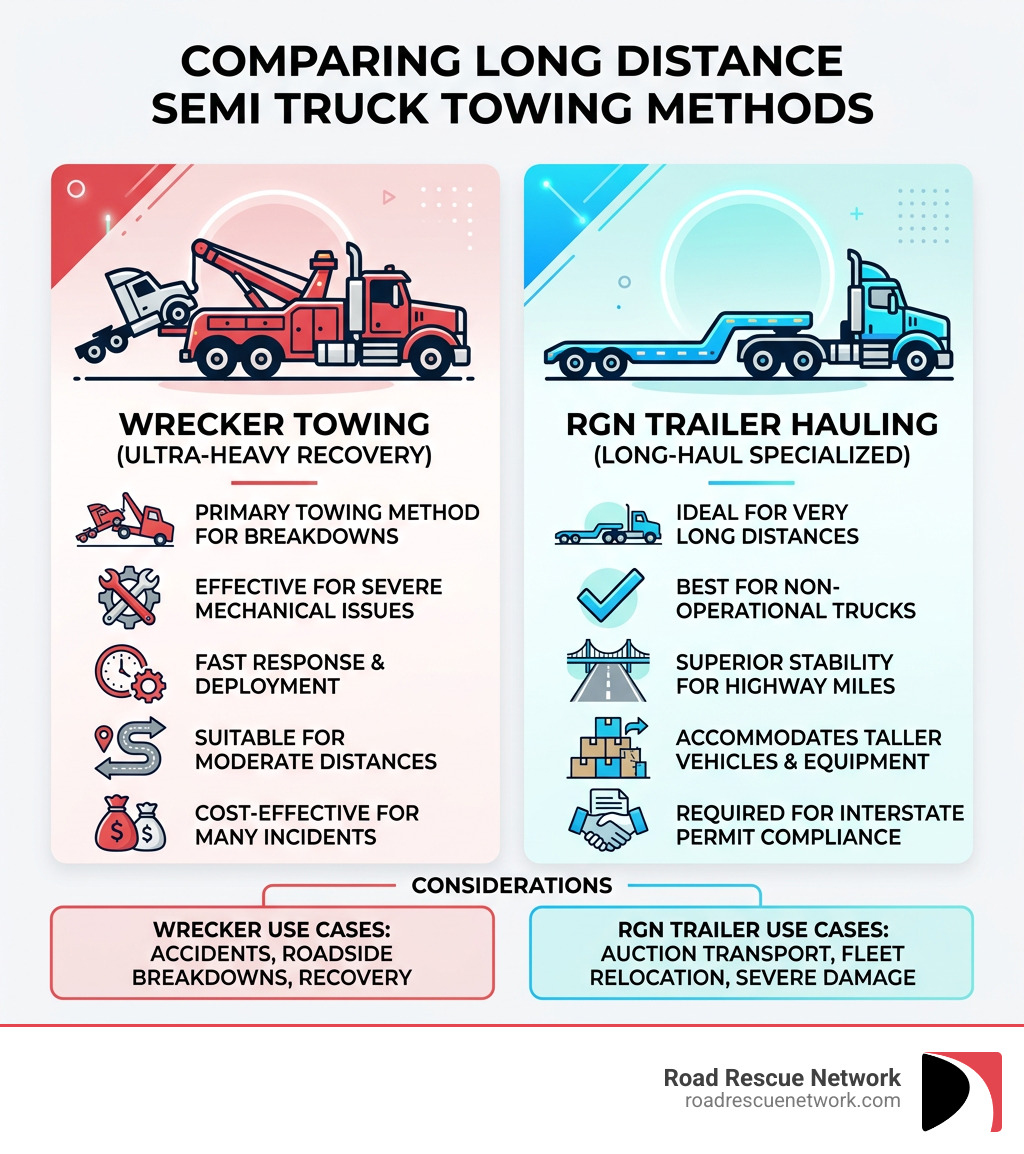
Choosing between a wrecker and a trailer haul often comes down to cost and “backhaul” availability.
| Feature | Heavy-Duty Wrecker | RGN / Lowboy Trailer |
|---|---|---|
| Best For | Breakdowns, quick hookups | Non-operational units, oversized height |
| Cost | Often higher per mile (one-way) | Can be lower if a backhaul is found |
| Height Clearance | Higher (truck stays on ground) | Lower (truck sits on trailer deck) |
| Permits | Standard overweight | Often requires “oversized” permits |
In areas like Elmira Crossroads, NC, trailer hauling is frequently preferred for distances over 500 miles because trailers can often find a return load, whereas a wrecker usually returns empty, doubling your effective cost.
The Technical Process: Front vs. Back Towing and Safety
There is a technical debate in the industry: tow from the front or the back? Both have pros and cons.
Front Towing (The Standard):
- Pros: Better aerodynamics; less risk of damaging fiberglass fairings.
- Cons: You must drop the driveshaft or pull the axles to avoid destroying the transmission. For certain transmissions like the Volvo I-Shift, failing to do this can void warranties or cause total failure.
Rear Towing:
- Pros: No need to mess with the driveshaft.
- Cons: The steering wheel must be perfectly secured (usually with high-quality ratchet straps), and the front “stop” signs or hoods must be latched tightly. If towed backward, wind can catch the hood and rip it off—a common disaster we see in Haworth, NJ and other high-wind areas.
Managing Air Brakes, Suspension, and Lights
A semi truck’s brakes are designed to lock up if there is no air pressure. To tow one long distance, we have to “cage” the brakes or provide an external air source.
- Air Tank Connection: Most operators connect a “jumper” line from the tow truck to the disabled truck’s air tanks to release the spring brakes.
- Wireless Tow Lights: We use wireless light bars mounted to the rear of the towed unit to ensure turn signals and brake lights are visible to other drivers in Rock Valley, IA.
- Suspension Deflation: High-roof sleepers often sit too tall on a trailer. Deflating the air suspension can gain those critical 3-4 inches needed to clear a low bridge.
Essential Safety Measures and Load Securement
Safety isn’t just about chains; it’s about protecting the asset. For modern trucks with aerodynamic fairings, we often use C-clamps or specialized padding to prevent the towing equipment from cracking expensive fiberglass. In Millers, AR, securing the hood latches and cab extensions is a top priority to prevent parts from flying off at highway speeds.
Costs, Regulations, and Logistics of the Long Haul
How much does long distance semi truck towing cost? It’s not cheap. Research shows that for a 1,000-mile haul, you might see quotes around $4.00 per mile for the truck itself, plus another several thousand for permits.
Factors Affecting Long Distance Semi Truck Towing Costs
Several variables can make your invoice grow faster than a speeding ticket:
- Mileage: The primary driver of cost.
- Permits: If the truck is oversized (over 13’6″ high) or overweight, state permits in places like Urbana, AR can cost $400 to $1,000 per state.
- Fuel Surcharges: As diesel prices fluctuate, so does the cost of the tow.
- Specialized Equipment: Using a 75-ton rotator instead of a standard wrecker will significantly increase the rate.
- Wait Time: If the tow driver has to wait for you to clear cargo or paperwork, they usually charge by the hour.
Navigating DOT Regulations and Interstate Permits
Crossing state lines-from Lebec, CA to Bristol Ferry, RI-requires strict FMCSA compliance. Every state has different rules for axle load distribution. A professional company must plan the route to avoid “no-truck” zones and low-clearance bridges, which are common in older East Coast cities. For a general overview of federal safety requirements that affect commercial vehicle moves, see the Federal Motor Carrier Safety Administration.
Choosing a Reliable Provider and Avoiding Risks
When your livelihood is on the back of a truck, you can’t afford an amateur. Choosing a provider in Redden, DE or Cordell, MI requires checking their credentials:
- 24/7 Availability: Breakdowns don’t happen at noon on a Tuesday.
- Insurance Coverage: Ensure they have “on-hook” insurance that covers the full value of your truck and cargo.
- Equipment Rating: Make sure their wreckers are rated for Class 8 loads.
Risks of Improper Towing and Preventive Maintenance
The risks of hiring the “cheap guy” are massive. Improperly securing a steering wheel can lead to a “death wobble” that flips both trucks. Failing to pull an axle can fry a $20,000 transmission in less than 50 miles.
We always tell our clients in Halfway House, CA that the best way to avoid a $5,000 tow bill is preventive maintenance. Regularly checking your driveline, cooling system, and suspension can prevent the catastrophic failures that lead to long-distance recovery needs.
Frequently Asked Questions about Long Distance Semi Truck Towing
Is towing a semi truck cheaper than hauling it on a trailer?
Usually, no. Because wreckers often have to return empty (one-way), you pay for the round trip. RGN trailers can often find “backhauls” (a load to carry on the way back), which can lower the overall price. However, wreckers are often faster to dispatch for emergency breakdowns.
How do towing companies handle air brakes during a long-distance tow?
Operators typically use “brake buddies” or connect the tow truck’s air system directly to the disabled truck’s air dryer or tanks. This provides the constant pressure needed to keep the spring brakes from engaging and locking the wheels.
What permits are required for state-to-state semi truck towing?
This depends on the state. Generally, you need an “Oversize/Overweight” (OSOW) permit if the combined setup exceeds legal dimensions. For interstate travel, companies must also comply with IFTA (fuel tax) and IRP (registration) requirements for the towing vehicle.
Conclusion
At Road Rescue Network, we understand that needing long distance semi truck towing is one of the most stressful days a driver or fleet manager can have. Our mission is to provide on-demand, 24/7 reliability without the hidden fees or membership traps that slow you down. From the busy corridors of Detroit, MI to the rural stretches of the Midwest, we connect you with the heavy-duty experts who can get your rig home safely.
When the road gets tough, you need a partner who knows the heavy-duty industry inside and out. Don’t leave your Class 8 investment to chance—trust the professionals who prioritize safety and transparency.