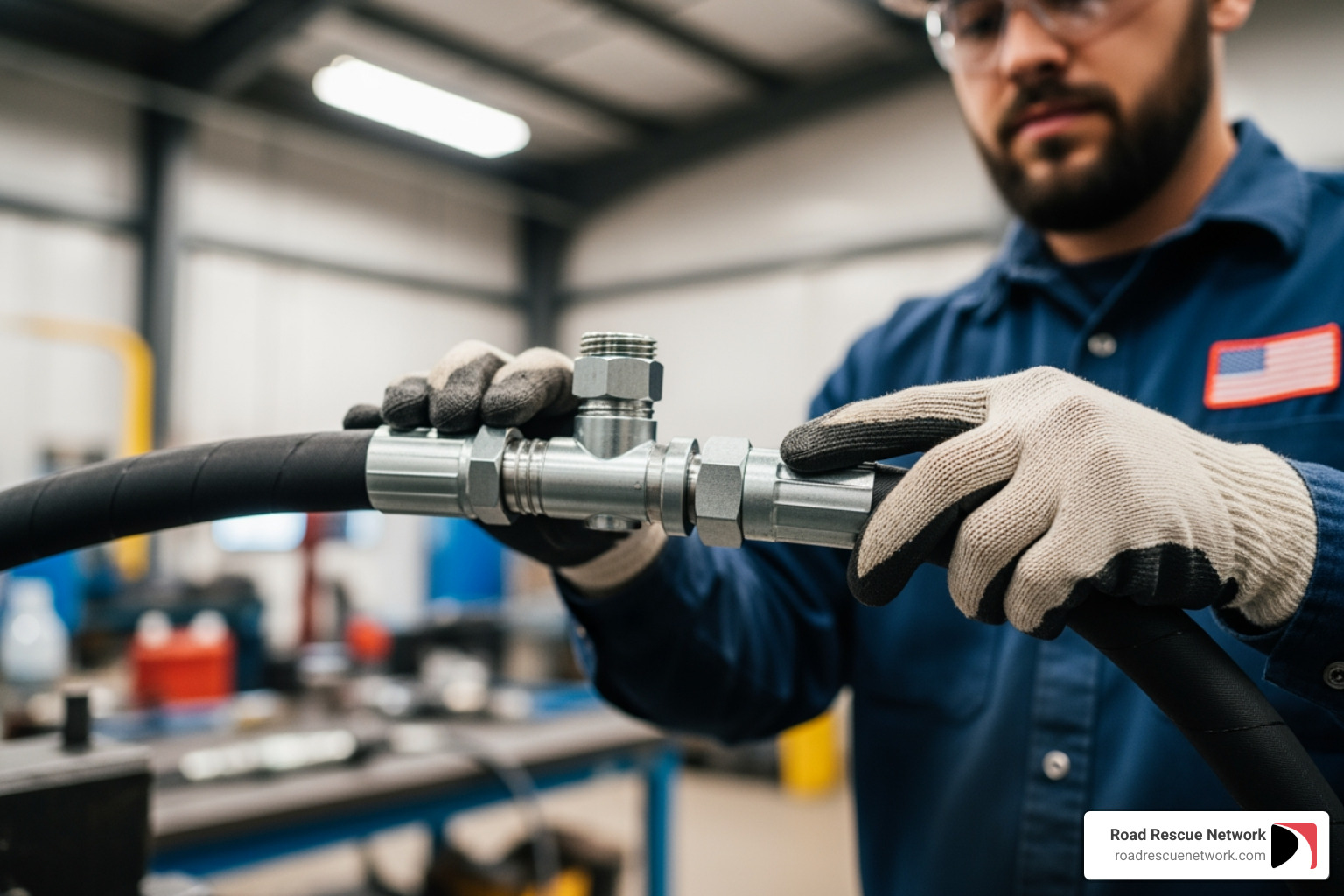
The Tight Spot: How to Seal Hydraulic Fittings
Why Sealing Hydraulic Fittings Correctly Can Save Your System — and Your Safety
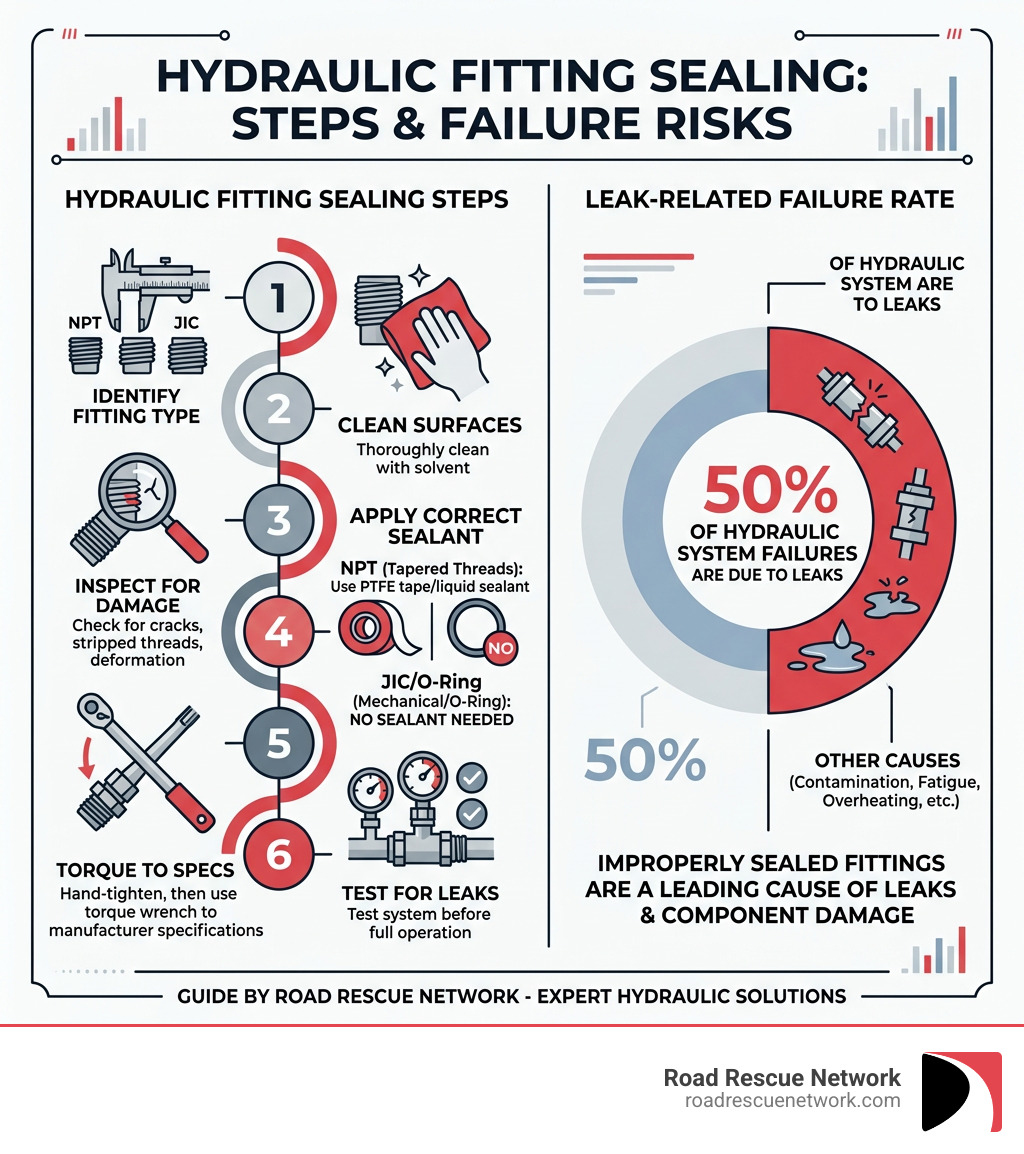
Knowing how to seal hydraulic fittings is one of the most critical skills in hydraulic system maintenance. Here’s a quick answer:
How to seal hydraulic fittings (quick summary):
- Identify your fitting type — NPT, JIC, ORFS, ORB, etc.
- Clean the threads or sealing surfaces thoroughly with solvent
- Inspect for damage — replace cracked, stripped, or deformed parts
- Apply the correct sealant — PTFE tape or liquid sealant for NPT tapered threads; no sealant needed for JIC or O-ring fittings
- Hand-tighten first, then torque to manufacturer specs
- Test for leaks before returning the system to full operation
Hydraulic leaks are not just a nuisance — they’re a leading cause of system failure. In fact, hydraulic leaks account for up to 50% of all hydraulic system failures. A single improperly sealed fitting can cause fluid loss, pressure drops, contamination, and in serious cases, catastrophic equipment failure or injury.
The challenge is that there’s no one-size-fits-all answer. Different fitting types seal in completely different ways. Using the wrong sealant — or any sealant at all in the wrong place — can make things worse, not better.
This guide breaks it all down in plain language, step by step.
I’m Byron Tarlton, founder of Road Rescue Network — with over two decades of hands-on experience in fleet services, hydraulic systems, and roadside equipment repair, I’ve seen what improper sealing does to hydraulic lines in the field. Understanding how to seal hydraulic fittings correctly is something our team deals with in real-world, high-pressure situations every day, and this guide reflects that experience.
Understanding Fitting Types and Sealing Mechanisms
Before you grab a wrench, we need to talk about what you’re actually holding. If you try to seal a JIC fitting the same way you seal an NPT fitting, you’re going to have a bad day (and a messy floor). Hydraulic fittings generally fall into three categories: tapered threads, mechanical joints (flares), and O-ring seals.
| Fitting Type | Sealing Method | Sealant Needed? | Common Use |
|---|---|---|---|
| NPT/NPTF | Tapered Thread Interference | Yes (Tape or Dope) | North American Industrial |
| JIC (37° Flare) | Metal-to-Metal Cone | No (Lubricate only) | Mobile Equipment/Agricultural |
| ORFS | O-Ring Face Seal | No (O-ring does the work) | High-Vibration/High-Pressure |
| ORB | O-Ring Boss (Straight Thread) | No (O-ring does the work) | Manifolds and Valve Bodies |
For a deeper dive into these parts, check out this detailed guide on fitting identification.
How to identify the type of hydraulic fitting
Identifying a fitting isn’t always as easy as a quick glance. We recommend using a thread pitch gauge and calipers for accuracy. First, determine if the thread is tapered or straight. If the diameter gets smaller toward the end, it’s tapered (like NPT). If it stays the same, it’s straight (like ORB or JIC).
Next, look at the “seat” or the end of the fitting. Does it have a 37-degree cone? That’s likely a JIC. Is there a groove for an O-ring on a flat face? That’s an O-Ring Face Seal (ORFS). Knowing whether you’re working with Metric or Imperial (SAE) threads is also vital—they might look similar, but forcing a Metric fitting into an SAE port will strip the threads instantly.
All-metal vs O-ring seals
All-metal fittings, like the JIC flare or BSPT threads, rely on the physical deformation or tight fit of metal surfaces to stop leaks. These are rugged but can be sensitive to over-tightening.
O-ring seals, such as ORFS or ORB, are generally superior for high-vibration environments. They use materials like NBR (Nitrile) or Buna-N to create a flexible barrier. Because the O-ring does the sealing, the threads only serve to hold the connection together, meaning these fittings are less prone to leaking after multiple reassemblies.
How to Seal Hydraulic Fittings: A Step-by-Step Guide
Ready to get to work? Whether you are in Houston, TX or Phoenix, AZ, the process for how to seal hydraulic fittings remains the same. Safety is our first priority.
Preparation and cleaning
We can’t stress this enough: cleanliness is next to godliness in hydraulics. Even a tiny speck of dirt can create a leak path or damage a pump.
- System Shutdown: Ensure the machine is off and locked out.
- Pressure Release: Move control levers to bleed off residual pressure. Never crack a fitting under pressure.
- Clean Surfaces: Use a lint-free cloth and a quick-dry solvent to remove old grease, oil, and debris from both male and female threads.
- Inspection: Look for burrs, nicks, or flattened threads. If a JIC flare has a visible scratch across the sealing surface, throw it away. It will never seal.
Proper tightening and torque specifications
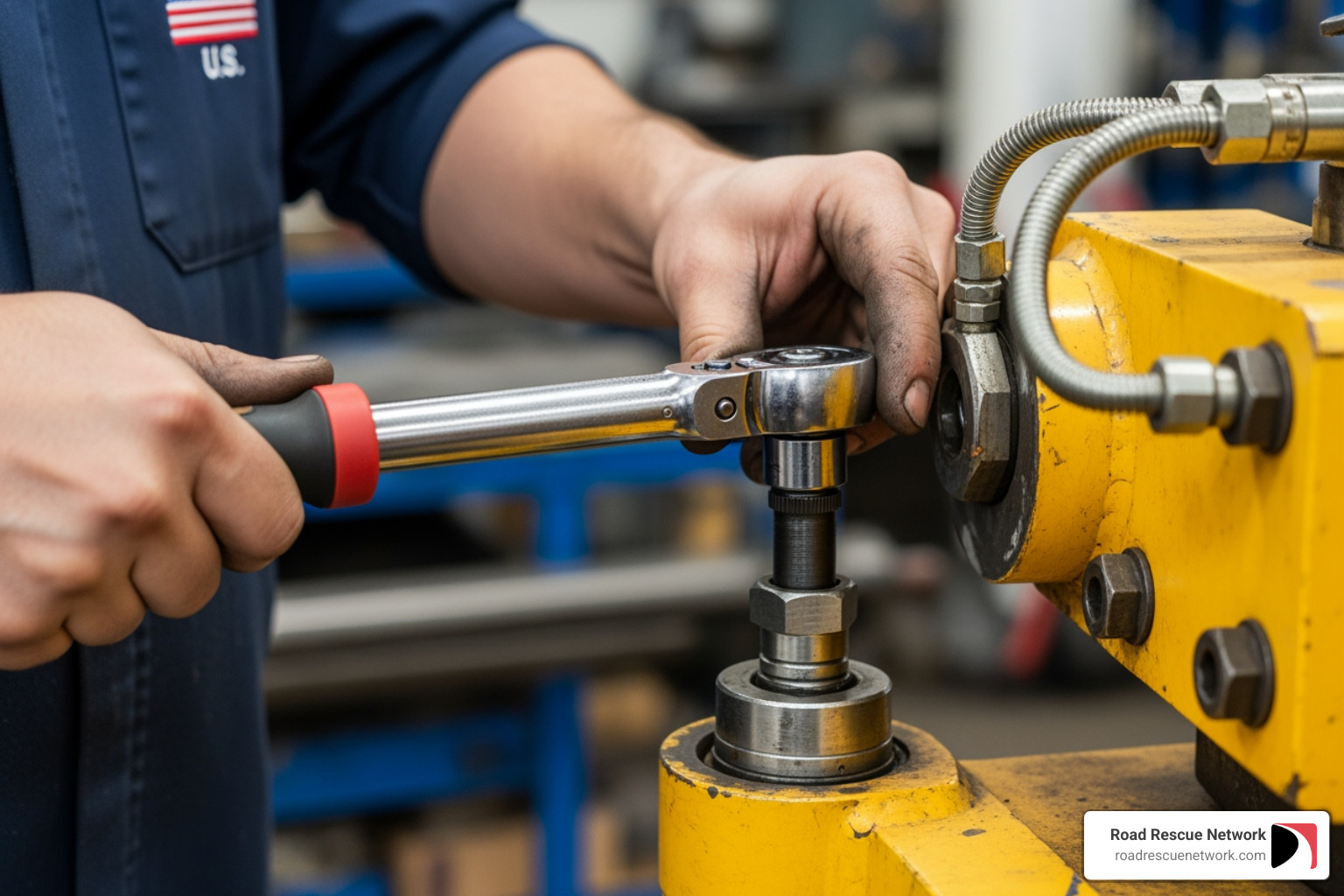
Most people tighten “until it feels right,” but that’s how fittings get cracked. A 1/2″ hydraulic connection typically requires about 50 lb-ft of torque, while a larger 3/4″ connection might need closer to 80 lb-ft.
Over-tightening is actually more dangerous than under-tightening because it can permanently deform the metal or crush an O-ring. If you’re dealing with a leak that just won’t quit, follow these step-by-step leak repair instructions to diagnose the root cause before you keep cranking on the wrench.
How to seal hydraulic fittings with O-rings
When working with O-ring Boss (ORB) or Face Seal (ORFS) fittings, the O-ring is your best friend.
- Lubricate: Always lightly coat the O-ring with clean hydraulic fluid before installation. This prevents it from getting pinched or “nibbled” as you tighten the nut.
- Seat the Ring: Ensure the O-ring is sitting flat in its groove.
- Compression: You only need enough torque to compress the O-ring. Once the metal surfaces bottom out, the seal is made.
Choosing the Best Sealant for Hydraulic Fittings
If you are working with tapered threads (NPT), you need a sealant to fill the microscopic gaps in the thread crests.
When to use Teflon tape (PTFE)
Teflon tape is a classic, but it’s controversial in the hydraulic world. We only use it on NPT threads.
- Application: Wrap the tape clockwise (following the thread direction) so it stays tight as you screw the fitting in.
- The Golden Rule: Start the tape two threads back from the end of the fitting. If the tape overhangs the end, it can shred and send plastic bits into your valves or pumps, causing a massive system blockage.
Liquid sealants vs Thread dope
For high-pressure systems (up to 10,000 psi), we prefer liquid anaerobic sealants. Unlike “dope,” which stays soft, anaerobic sealants cure in the absence of air when confined between metal threads.
Products like Loctite 545 are specifically designed for hydraulics because they contain no fillers that could clog the system. You can find more details on these in the Loctite 545 technical specifications. They offer excellent vibration resistance and don’t shred like tape.
Common Mistakes: Why Hydraulic Fittings Leak
Even pros make mistakes. Here are the most common reasons we see for leaks in the field:
- Mismatched Threads: Trying to force an NPT fitting into a BSPT port. They look almost identical but have different thread pitches.
- Vibration Loosening: In high-vibration machinery, fittings can “back off” over time if not torqued correctly.
- Thermal Expansion: As the system heats up, metals expand. A seal that worked at 40°F might fail at 180°F.
The dangers of overtightening
We’ve seen it a hundred times: a small leak starts, and someone grabs a bigger wrench. Overtightening can strip threads, crack the female port, or permanently crush the flare. Once the metal is deformed, it’s ruined. This is especially dangerous in high-pressure lines where a cracked fitting can lead to a “fluid injection” injury—which is a medical emergency.
Resealing vs Replacement
Can you reuse a fitting? It depends. O-ring fittings can usually be resealed just by replacing the O-ring. However, metal-to-metal fittings like JIC flares take a “set” once tightened. If you disassemble them, the male flare is often slightly deformed. For the most reliable seal, we recommend replacing the male fitting if the system is being overhauled.
Frequently Asked Questions about Sealing Hydraulic Fittings
Should I use sealant on JIC or flared fittings?
No. JIC and other flared fittings are designed for metal-to-metal contact. The seal happens at the 37-degree flare, not the threads. Adding tape or dope to the threads can actually prevent the flare from seating properly, causing a leak. At most, a drop of oil on the threads can help the nut spin smoothly.
Can I use Teflon tape on high-pressure systems?
Technically yes, but only on NPT threads. However, we strongly recommend liquid anaerobic sealants for anything over 3,000 psi. Tape has a tendency to shred under high-pressure pulses, which can lead to valve failure. If you must use tape, ensure it is the thicker “yellow” gas-rated tape or apply it very carefully starting two threads back.
How do I stop a leak without over-tightening?
If a fitting is leaking, don’t just tighten it. Disassemble it, clean the threads, and inspect the seat. If it’s an O-ring fitting, replace the O-ring. If it’s NPT, clean off the old sealant and apply a fresh bead of liquid anaerobic sealant. Proper alignment is also key—if the hose is pulling on the fitting at an angle, it will never stay sealed.
Conclusion
Mastering how to seal hydraulic fittings is the difference between a machine that works and a machine that sits in a puddle of expensive oil. By identifying your fittings correctly, cleaning your surfaces, and using the right sealants (or none at all!), you ensure your system stays efficient and safe.
At Road Rescue Network, we understand that sometimes a leak happens at the worst possible time—like on a job site in Dallas, TX or a busy highway in Charlotte, NC. While we specialize in on-demand roadside assistance for tires and jumpstarts, we know that keeping your equipment running is your top priority. For those in specific regions needing specialized help, you can find emergency hydraulic hose services in Dunnegan, MO.
Stay safe, keep it clean, and don’t forget the torque wrench!