Don’t Get Stranded: The Ultimate Guide to Jump Starting Your Motorcycle
Why Knowing How to Jump Start a Bike Can Save Your Ride
Knowing how to jump start a bike is an essential skill for any rider. Hearing that dreaded click instead of your engine roaring to life can ruin a ride, but it doesn’t have to leave you stranded.
Quick Guide: Jump Start Your Motorcycle in 4 Steps
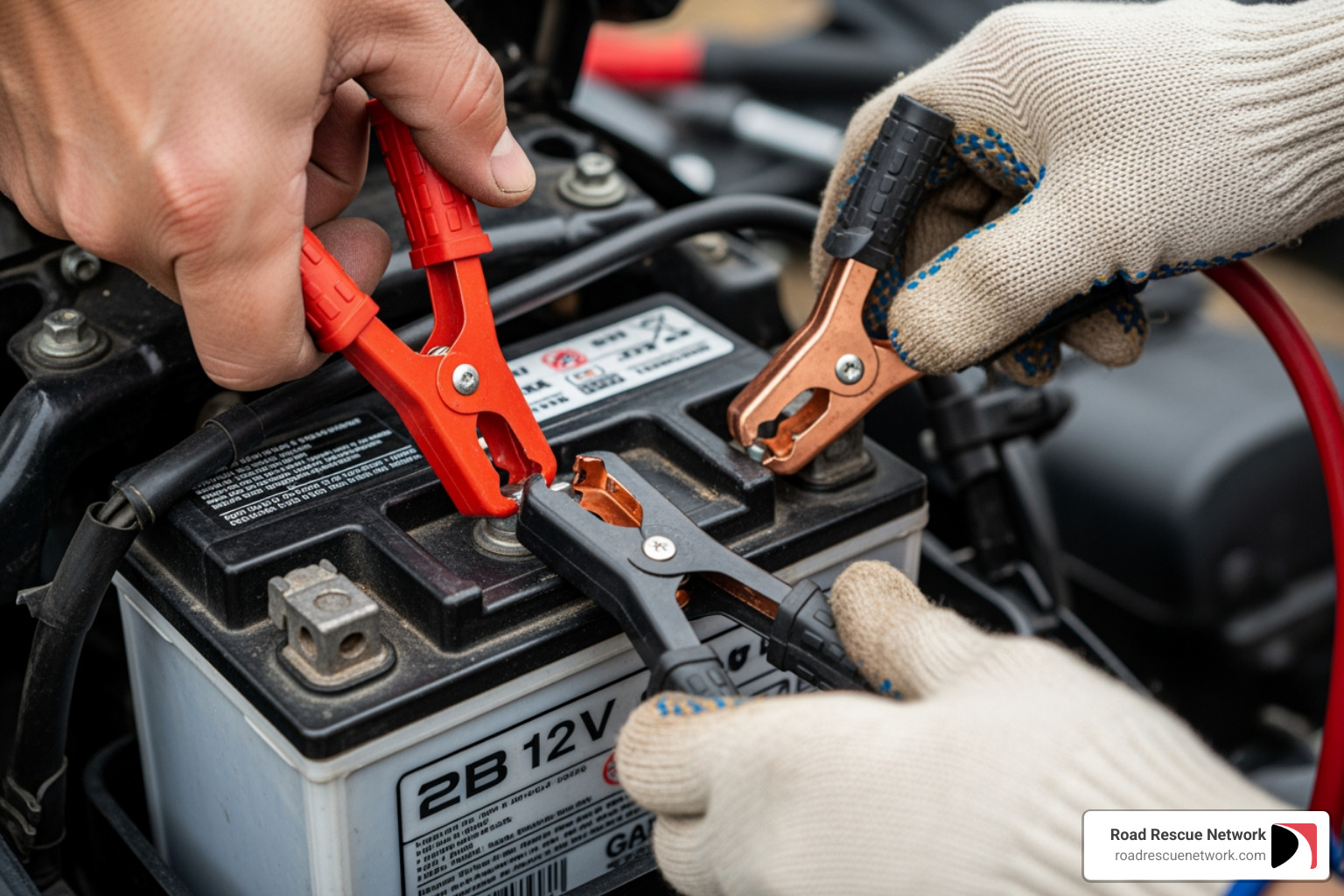
- Connect the positive (red) cable to the positive terminal on the dead battery, then to the positive terminal on the good battery.
- Connect the negative (black) cable to the negative terminal on the good battery, then to an unpainted metal surface on your motorcycle’s frame (not the battery).
- Start the donor vehicle (if it’s a car, keep its engine OFF), then start your motorcycle.
- Disconnect cables in reverse order and ride for at least 15-30 minutes to recharge.
A dead battery is often caused by leaving accessories on, an aging battery, or extreme temperatures. While jump-starting is straightforward, it’s crucial to follow the correct procedure to avoid damaging your motorcycle’s sensitive electronics.
I’m Byron Tarlton, founder of Road Rescue Network. With decades of experience in roadside assistance, I’ve seen what works—and what doesn’t—when you need to jump start a bike in a real-world situation. This guide will give you the confidence to get back on the road safely.
Before You Jump: Diagnosis and Safety First
Before grabbing jumper cables, it’s crucial to perform a quick diagnosis and prioritize safety. Not every no-start is a dead battery, and improper jump-starting can be dangerous.
Why Your Motorcycle Battery Dies
Understanding the common causes can help prevent future headaches:
- Accessory Drain: Leaving on devices like GPS units, phone chargers, or heated gear can deplete the battery.
- Short Trips: Frequent short rides may not give the alternator enough time to fully recharge the battery.
- Lack of Use: Batteries naturally self-discharge. A bike that sits for weeks without a trickle charger will lose its charge.
- Charging System Failure: A faulty stator or rectifier/regulator can prevent the battery from charging while you ride. If the bike dies again shortly after a jump, this is a likely culprit.
- Battery Age: Batteries have a limited lifespan of a few years and eventually lose their ability to hold a charge.
- Temperature Impact: Extreme cold reduces a battery’s capacity, while extreme heat accelerates its degradation.
Signs of a Failing Battery: Look for dim headlights, a slow engine crank, or a rapid clicking sound instead of a start. A healthy 12V battery should read 12.4-12.6V. A reading of 11.9V or below means it needs immediate replacement.
Critical Safety Precautions
Safety is paramount when working with electrical systems.
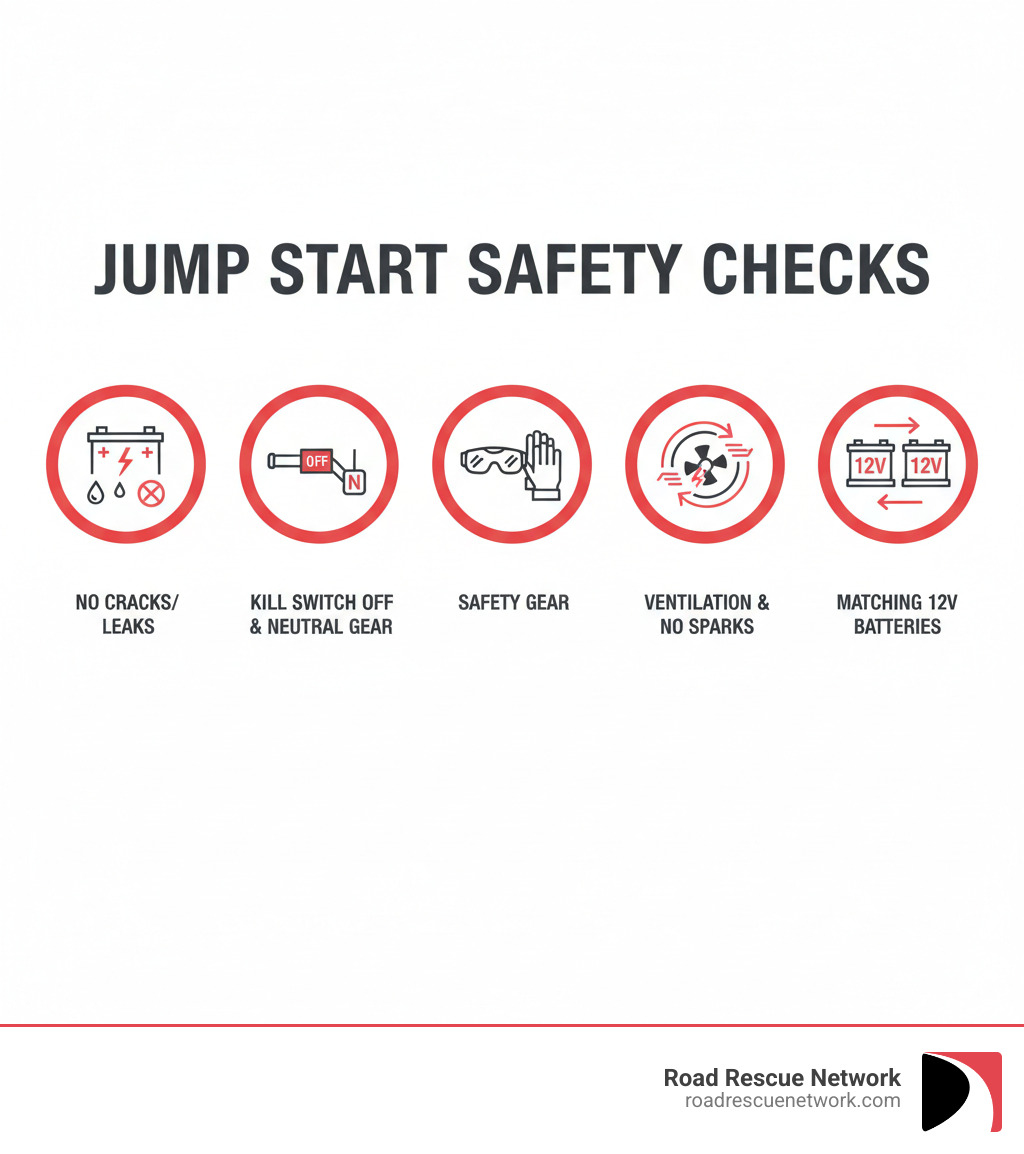
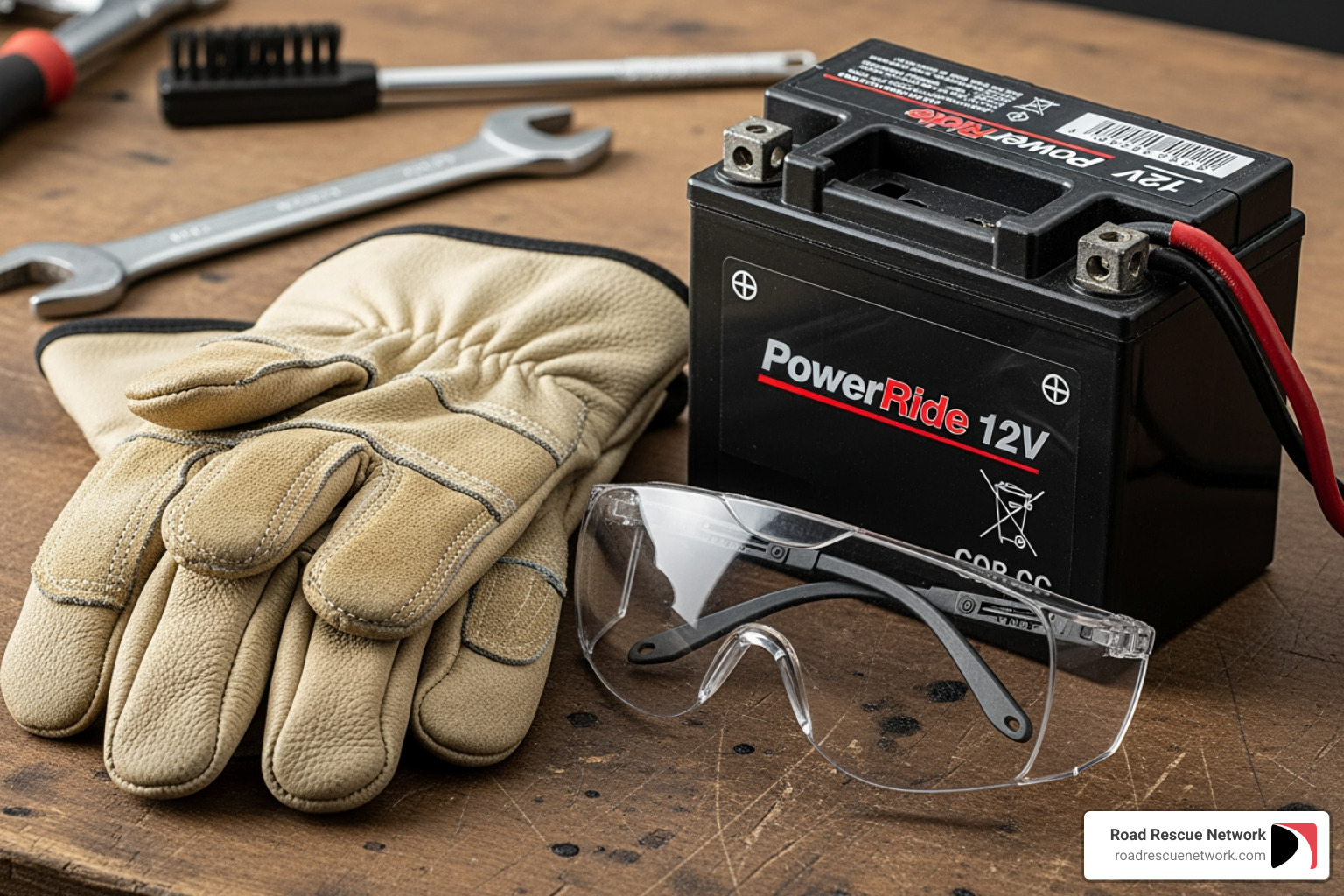
- Wear Gloves and Glasses: Protect your hands and eyes from corrosive battery acid and potential sparks.
- Check for Fuel Leaks: Sparks near fuel vapors are a serious fire hazard.
- Ensure Good Ventilation: Batteries can emit flammable hydrogen gas. Always work in an open area.
- No Smoking or Sparks: Keep all flames and sparks far away from the battery.
- Verify Voltage: Confirm both the dead and donor batteries are 12V systems. Never jump a 12V system with a 24V source.
- Read Owner’s Manual: Your motorcycle’s owner’s manual has specific jump-starting instructions. For broader safety education, check out resources from the Motorcycle Safety Foundation.
- Rule Out Other Issues: Before jumping, check the simple things: kill switch in the “run” position, bike in neutral, and kickstand up (if your bike has a safety switch).
How to Jump Start a Bike: 3 Proven Methods
You’ve confirmed the battery is the problem. Now it’s time to jump start your bike. You’ll need a set of jumper cables (10- to 6-gauge with smaller clips are ideal for bikes) and a donor vehicle or a portable jump starter. First, locate your motorcycle’s battery, which is usually under the seat or a side panel, and ensure you can access the terminals.
Method 1: Using a Car to Jump Start Your Bike
A common myth is that a car battery is “too powerful” and will fry your motorcycle’s electronics. This is false if you follow one critical rule: keep the car’s engine OFF. Your motorcycle’s starter only draws the amperage it needs (around 150 amps), regardless of the car battery’s larger capacity. The real danger is the high voltage from a running car’s alternator, which can damage your bike’s sensitive components. So, leave the car off.
- Position the car close to the bike without them touching. Ensure both are 12-volt systems.
- Attach the red (positive) cable to the positive (+) terminal of the dead motorcycle battery, then to the positive (+) terminal of the car battery.
- Attach the black (negative) cable to the negative (-) terminal of the car battery.
- Attach the other end of the black cable to an unpainted, solid metal part of your motorcycle’s frame, away from the battery. This grounds the circuit and prevents sparks near the battery.
- Let the batteries sit connected for a minute to transfer a surface charge.
- Try to start your motorcycle. If it doesn’t start, wait another minute before trying again. Do not crank for more than a few seconds at a time.
- Once the bike starts, let it run for a moment, then disconnect the cables in the exact reverse order: black from the frame, black from the car, red from the car, and red from your motorcycle.
If you’re in Texas and need professional help, check out our jump start services in Texas for fast assistance.
Method 2: Using Another Motorcycle
Using another bike is an ideal scenario. The electrical systems are similar, reducing risk.
- Position the donor motorcycle close to yours, but not touching.
- Start the donor motorcycle and let it run for a few minutes. This ensures its battery is fully charged and the charging system is active.
- Connect the cables: red cable to the positive terminal of your dead battery, then to the positive on the donor battery. Connect the black cable to the negative terminal of the donor battery, then to an unpainted metal part of your bike’s frame.
- Let the bikes run while connected for 3-5 minutes to transfer power.
- Try starting your motorcycle.
- Once it starts, let both bikes run for another minute before disconnecting the cables in reverse order.
Riders in New York can find dedicated support through our jump start services in New York.
Method 3: Calling a Professional Jump Start Service
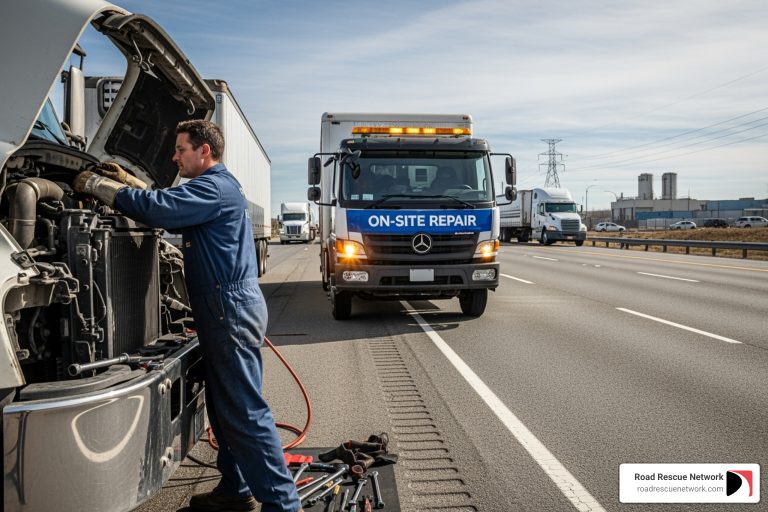
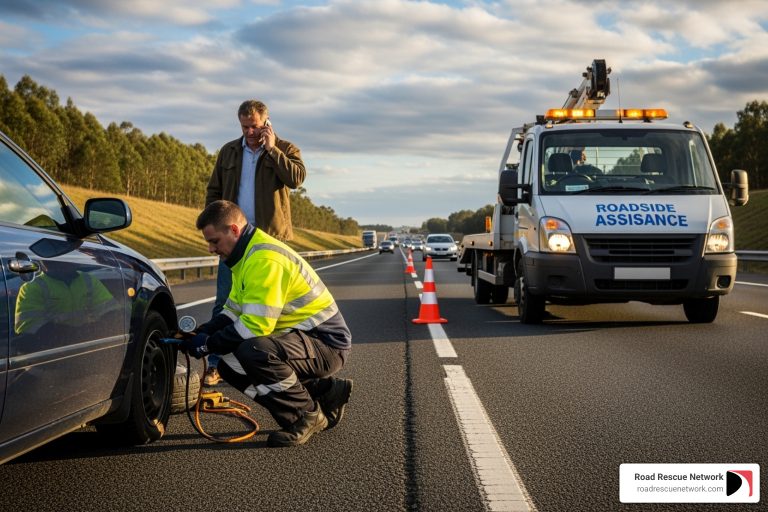
Sometimes, the safest and smartest choice is to call a professional. This is the best option if you’re in an unsafe location, lack the right tools, or suspect a deeper electrical problem.
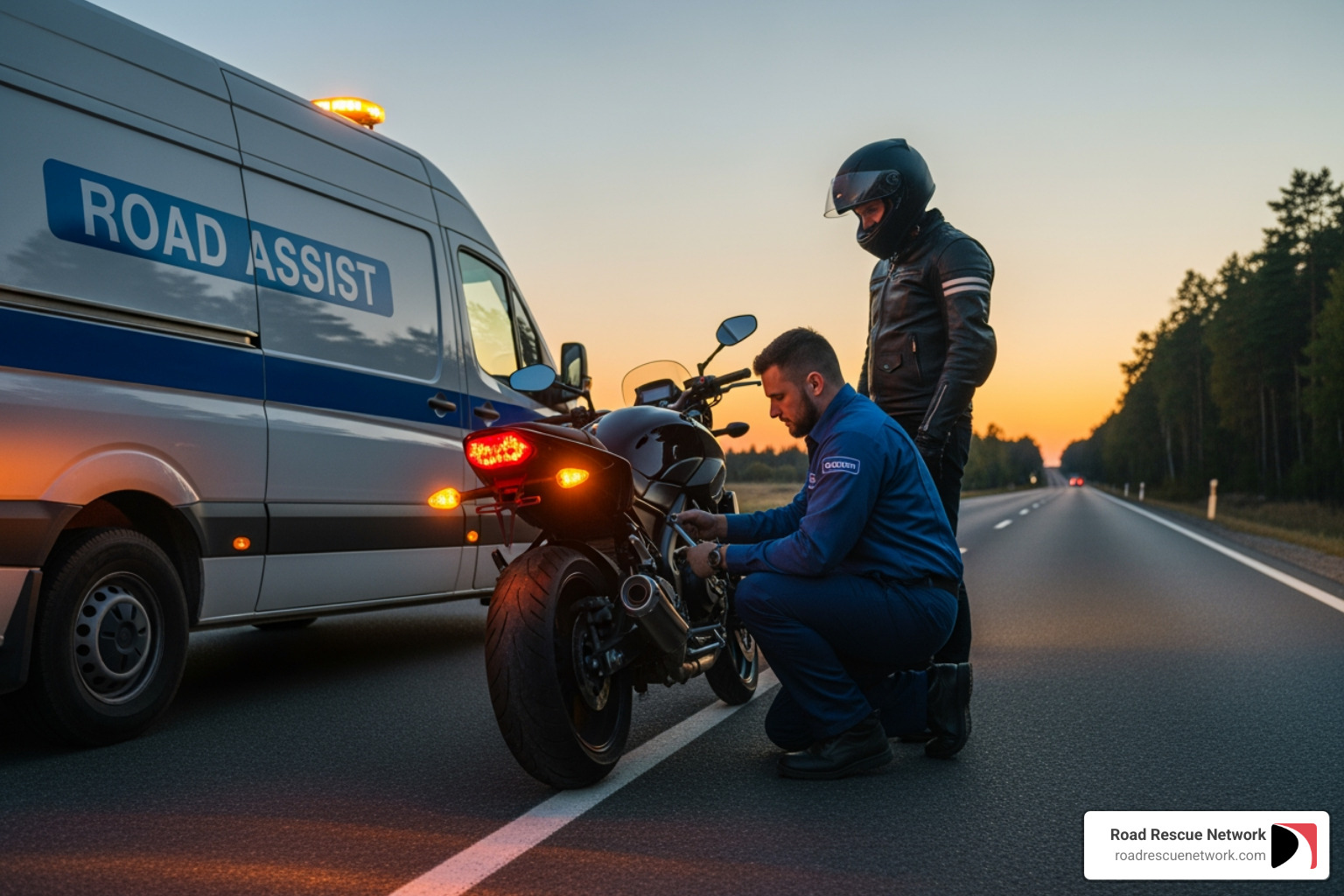
This is the safest and most reliable method, especially if you’re unsure about the process. Call for help if you’ve tried jumping and it failed, or if you notice signs of battery damage like leaks or swelling.
At Road Rescue Network, we provide fast, 24/7 roadside assistance across hundreds of cities nationwide, with no memberships or hidden fees. Our network instantly connects you with a local professional equipped to handle your jump start bike situation safely and efficiently.
Don’t hesitate to reach out when you need help. Get professional jump start help now.
After the Jump: What’s Next?
Your motorcycle is running, but a successful jump start bike procedure is just the first step. Your battery needs a proper recharge, and you need to determine why it died.
How Long to Ride to Recharge the Battery
Aim for at least 15 to 30 minutes of continuous riding after a jump start. This gives your motorcycle’s charging system (the stator) time to replenish the battery. Highway speeds are better than stop-and-go city traffic, as higher, consistent RPMs generate more electricity for faster charging.
For bikes that are parked more than ridden, a battery tender is a wise investment. This motorcycle-specific trickle charger maintains an optimal charge level without overcharging, which can significantly extend your battery’s life and prevent future dead battery headaches.
Battery Maintenance and Replacement
Once home, it’s time to assess your battery’s health. A jump start is a temporary fix for a deeper issue.
| Condition | Signs of a Weak Battery | Signs of a Dead Battery |
|---|---|---|
| Lights | Dim headlights, weak dashboard lights | No lights at all, or very faint flicker |
| Engine Cranking | Slow, sluggish cranking sound | No crank, just a single “click” or rapid clicking |
| Starter Response | Engine struggles to turn over | No response from starter button |
| Voltage Reading | 12.0V – 12.3V (decreased lifespan) | 11.9V or below (immediate replacement needed) |
| Reliability | May start intermittently, especially in cold weather | Fails to start consistently, even after short periods |
Keep battery terminals clean from corrosion using a wire brush to ensure a good connection. If you have an older flooded lead-acid battery, periodically check the fluid levels and top up with distilled water, always wearing safety gear.
When should you replace the battery? If your bike dies again shortly after a jump and a long ride, the battery likely can’t hold a charge. A battery that has been deeply depleted may never fully recover. Use a multimeter to test it: a reading of 11.9V or below after resting means it’s time for a replacement. Don’t risk getting stranded again—replace a failing battery for peace of mind.
Troubleshooting and Alternatives
If your bike still won’t start after a jump attempt, it’s time to troubleshoot. A failed jump often indicates a problem beyond a simple drained battery.
What to Do If the Jump Fails
- Check Your Connections: A loose clamp is a common reason for failure. Ensure all cable connections are firm and the ground connection is on clean, bare metal.
- Inspect Battery Terminals: Corrosion (a white or greenish crust) can block the electrical current. Carefully clean the terminals with a wire brush if you see any buildup.
- Check the Main Fuse: A power surge could have blown the main fuse, cutting all power to the bike. Check your fuse box (usually near the battery) for a blown fuse.
- Consider Deeper Issues: If the battery seems fine but the bike won’t start, you could have a faulty starter motor, a bad safety switch (kill switch, side stand), or a failing charging system component.
- Check the Fuel: It sounds obvious, but in the heat of the moment, it’s easy to forget. Make sure you have gas in the tank.
Alternative Method: How to Bump Start Your Motorcycle
If you have a manual transmission bike and no jumper cables, you can try bump starting (or push starting). This method works best on older, carbureted motorcycles. Modern bikes with electronic fuel injection (EFI) need some battery power to run the fuel pump, so it may not work if the battery is completely dead.
- Turn the ignition on and put the bike in neutral.
- Get the bike rolling to a jogging pace (a downhill slope helps).
- Pull in the clutch, shift into second gear, and then quickly release the clutch while sitting down hard on the seat for traction.
- If the engine catches, immediately pull the clutch in and give it some throttle to keep it running.
Caution: Only attempt this in an open space where you feel confident and balanced. Don’t risk it on a busy road.
When to Call for Professional Help
Knowing when to call a professional is a sign of good judgment. Call for help if:
- Jump starts repeatedly fail.
- You see smoke or smell something burning.
- You don’t have the right tools.
- You’re in an unsafe location.
In these cases, the safest bet is to contact a service like Road Rescue Network. We provide fast, reliable jump start bike services across the country, including jump start services in Florida.
Frequently Asked Questions about Jump Starting a Motorcycle
Here are answers to the most common questions we get from riders.
Can using a car battery damage my motorcycle?
No, as long as the car’s engine is OFF. Your motorcycle only draws the amperage it needs. The real danger is the higher voltage from a running car’s alternator, which can damage your bike’s electronics. Always match 12V systems and keep the donor car’s engine off.
What’s the most important safety step when connecting jumper cables?
Connecting the final negative (black) clamp to an unpainted metal part of the dead bike’s frame, away from the battery. This grounds the circuit and ensures any potential sparks happen far from the flammable hydrogen gas that batteries can emit, preventing a possible explosion.
How do I know if I need a new battery or if it just needs a charge?
After a successful jump, ride for at least 30 minutes at highway speeds. Let the bike sit for a few hours. If it fails to start again, the battery can no longer hold a charge and needs to be replaced. A load test at a repair shop can give you a definitive answer, but a battery that repeatedly fails is unreliable and should be replaced.
Conclusion
You now have the knowledge to confidently handle a dead motorcycle battery. We’ve covered safety, the three main jump-starting methods, and what to do after your bike is running. Being prepared means knowing how to jump start a bike and also knowing when to call for help.
Sometimes, DIY isn’t the safest or best option due to your location, a lack of tools, or a more complex electrical problem. That’s why Road Rescue Network offers fast, 24/7 service with no memberships or hidden fees. We connect you with local professionals to get you back on the road quickly and safely.
Ride with the confidence that comes from being prepared. Get professional roadside assistance now and keep our number handy for when you need it most.