Jump Start Your Car Like a Pro: A Quick and Easy Guide
Why Knowing How to Jump Start a Car Is Essential
Knowing how to jump start car is a practical skill that can save you time and stress when a dead battery leaves you stranded. With the right tools and sequence, you can be moving again in minutes.
Here’s what you need to jump-start a car:
- Jumper cables (4-6 gauge, 16-20 feet long)
- Another vehicle with a working battery
- Safety gear (gloves and eye protection)
- Basic knowledge of battery terminals (positive + and negative -)
The quick process:
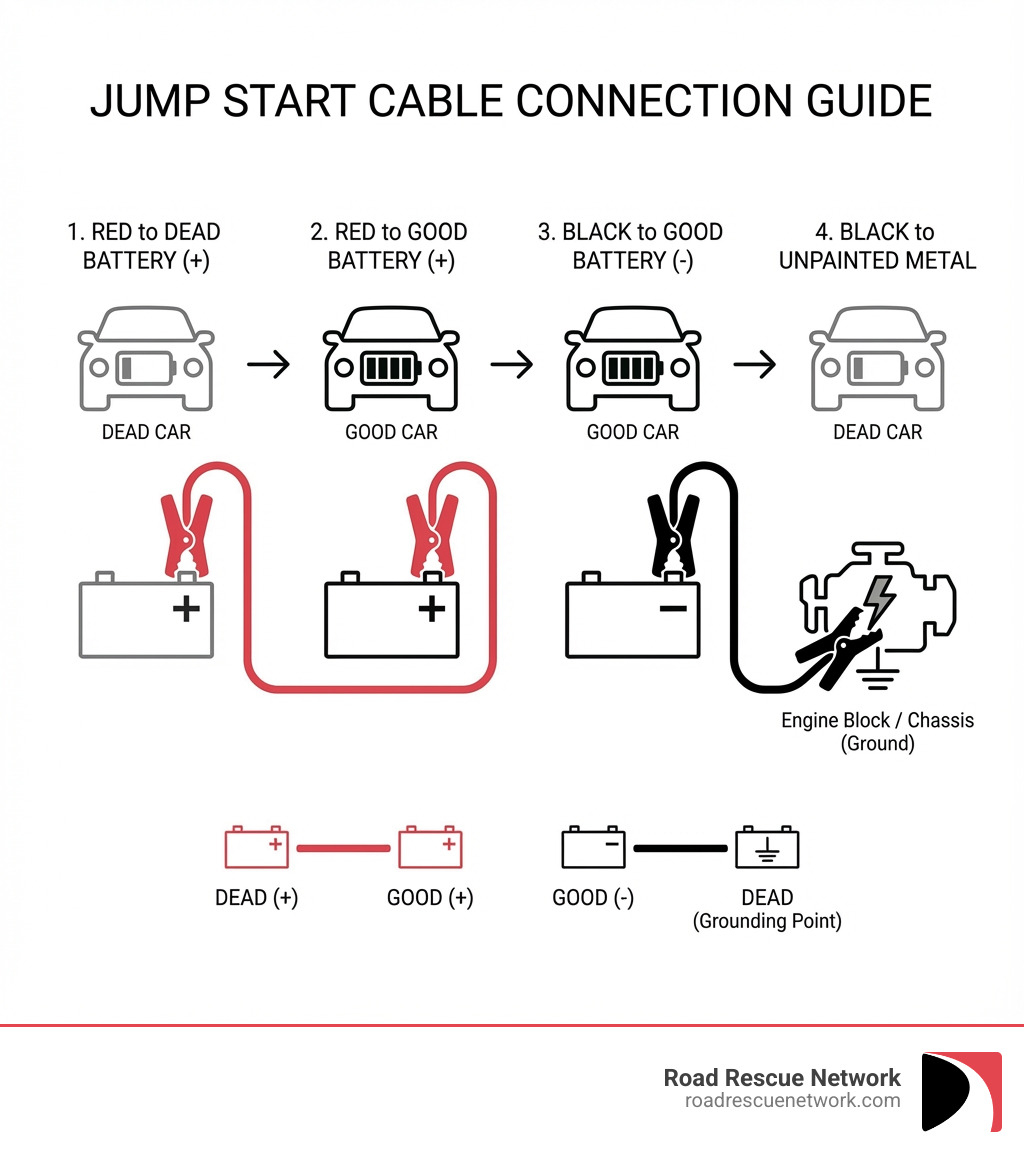
- Connect red cable to dead battery’s positive (+) terminal
- Connect other red cable to working battery’s positive (+) terminal
- Connect black cable to working battery’s negative (-) terminal
- Connect other black cable to unpainted metal surface on dead car
- Start working vehicle, wait 5 minutes, then start dead vehicle
- Disconnect cables in reverse order
Common dead-battery clues include a clicking sound at start, dim headlights, or flickering dash lights. A new battery can cost about $250+, and a starter motor around $750 at a dealership, so knowing how to jump-start can spare you immediate expenses and delays.
Safety matters. Wrong connections can harm electronics, create sparks near hydrogen gas, or cause injury. Modern cars with stop-start systems, hybrids, or trunk-mounted batteries add complexity, but the basic method still applies.
This guide gives you the steps, key safety tips, and simple troubleshooting so you know when to try again—and when to call a pro.
I’m Byron Tarlton, founder of Road Rescue Network. After two decades helping stranded drivers, I’ll show you the safest, most reliable way to jump start car without risking damage.
Before You Begin: Safety First and Essential Gear
Before you connect cables, a brief prep ensures a smooth and safe jump start car experience.
What You’ll Need to Jump-Start a Car
- Jumper Cables: Non-negotiable; quality matters.
- A Working Vehicle: Or a portable jump starter (covered later).
- Safety Gloves: Protect against heat, sharp edges, and acid.
- Eye Protection: Shields from sparks or corrosive battery acid.
- Your Owner’s Manual: Vital for battery/jump-point locations and car-specific steps.
Key Safety Precautions to Take
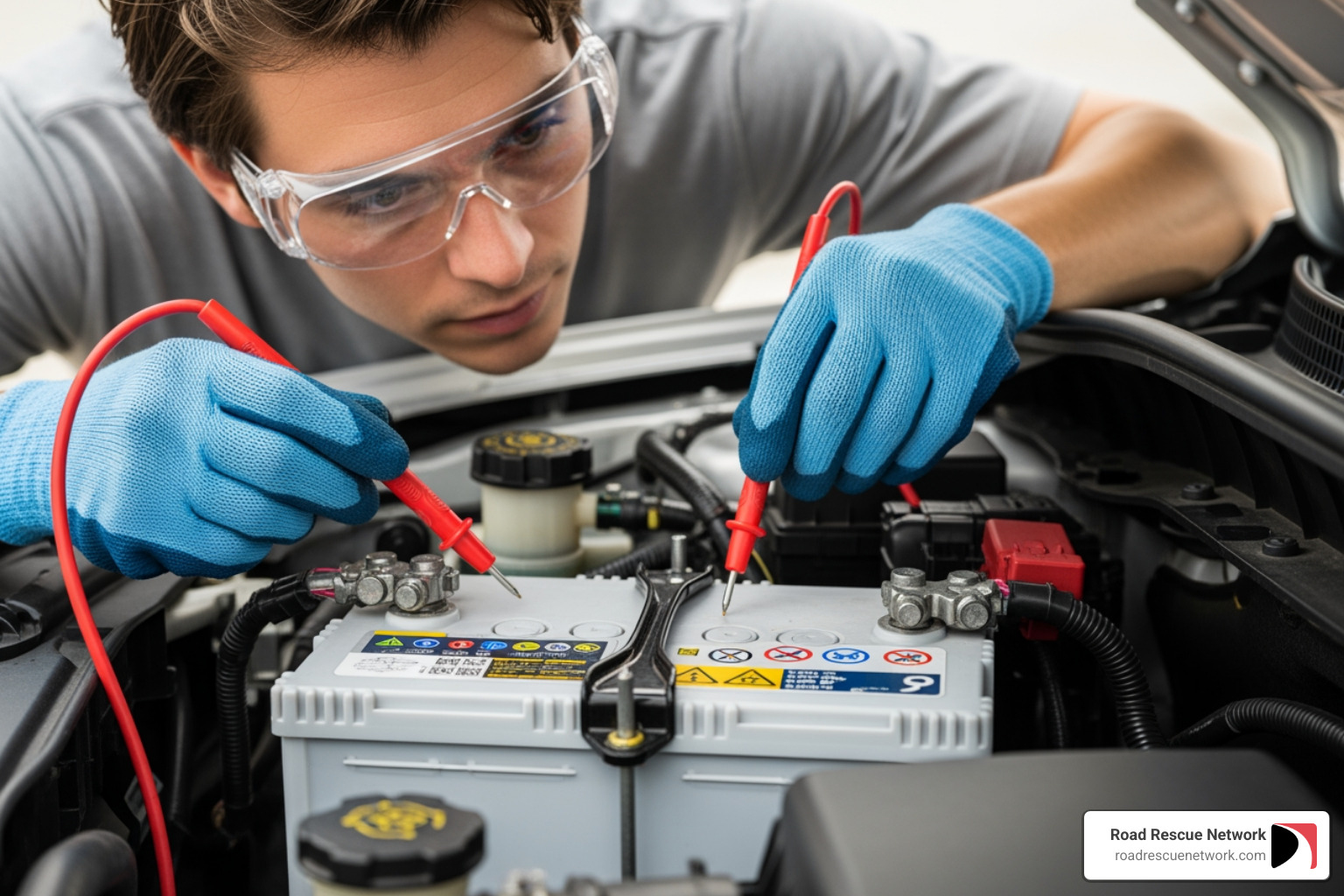
- Inspect the Batteries: If either shows cracks, leaks, or bulging, do NOT jump-start.
- Frozen Battery Warning: If the battery is frozen, do not jump-start. Let it thaw or seek help.
- Ventilation: Work outside or in a well-ventilated area to disperse hydrogen gas.
- No Smoking or Sparks: Keep flames and ignition sources away from batteries.
- Turn Off Both Cars and Accessories: Prevent surges; switch off lights, HVAC, and radios.
- Engage Parking Brakes: Set brakes; automatics in PARK, manuals in NEUTRAL.
- Consult Your Owner’s Manual: Especially for modern cars, hybrids, and EVs. See the Roadside Emergencies section of your Owner’s Manual.
Choosing Good Quality Jumper Cables
- Wire Gauge: 4- or 6-gauge for most cars; avoid thin 10-gauge on larger vehicles.
- Length: 16-20 feet offers flexibility without cars touching.
- Copper vs. Aluminum: Copper conducts best; CCA is acceptable if well made.
- Clamps: Strong springs, solid bite, good insulation.
- Insulation: Thick, flexible, and free from cracks/frays.
- Polarity Markings: Clear red (+) and black (-) markings.
A quality set of cables is one of the most valuable tools in any roadside kit.
The Step-by-Step Guide to Jump Start a Car
Now that you’re prepared, follow these steps to jump start car safely and effectively.
Step 1: Position the Vehicles and Prepare the Batteries
This setup ensures safe, efficient power transfer.
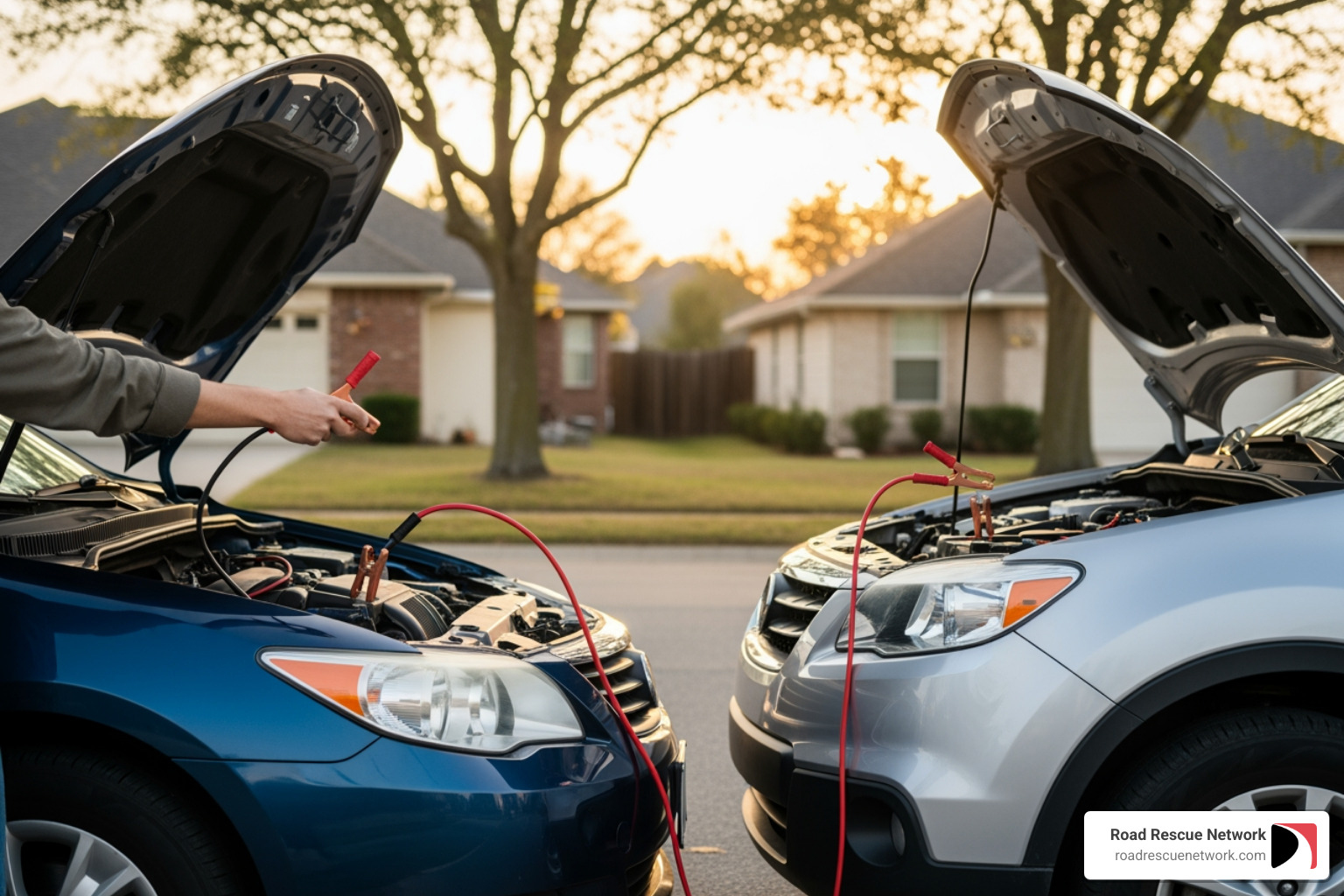
- Park Close, But Not Touching: Hood-to-hood or side-by-side so cables reach comfortably.
- Engage Parking Brakes and Turn Off Engines.
- Turn Off All Electronics in both vehicles.
- Open Hoods and Locate Batteries or remote jump points (often capped red/black).
- Identify Positive (+) and Negative (-) Terminals.
- Clean Corroded Terminals for solid metal-to-metal contact.
Step 2: How to Correctly Connect Jumper Cables
Incorrect connections can cause sparks or damage. Use this exact order:
- Red to DEAD Positive (+): Clamp to the dead battery’s positive terminal.
- Red to GOOD Positive (+): Clamp to the booster battery’s positive terminal.
- Black to GOOD Negative (-): Clamp to the booster battery’s negative terminal.
- Black to Unpainted Metal on DEAD Car (Ground): Clamp to a large, unpainted metal surface on the dead car’s engine/frame—away from the battery and moving parts.
For a visual, see this guide to connecting jumper cables.
Step 3: Starting the Engines and Disconnecting Safely
- Start the Working Vehicle: Let it idle 5–10 minutes to charge the dead battery.
- Try to Start the Dead Vehicle: If it doesn’t start, wait a few more minutes and try again. Avoid cranking longer than 10 seconds.
- Disconnect Cables in Reverse Order:
- Black from DEAD Car Ground
- Black from GOOD Battery
- Red from GOOD Battery
- Red from DEAD Battery
- Turn Off the Assisting Car after all cables are removed.
After the Jump: What’s Next and Troubleshooting
Your car is running, but you’re not done yet. You still need to ensure the battery recharges and know how to troubleshoot if the jump-start wasn’t successful.
How Long to Run Your Car to Recharge the Battery
After a successful jump-start, your car’s battery is still largely depleted. It needs time to recharge.
- Drive for at least 20-30 minutes: To allow your car’s alternator to adequately recharge the battery, you should drive your car for at least 20 to 30 minutes. Some sources even recommend longer, up to an hour.
- Highway speeds are best: Driving at highway speeds or consistently above idle will allow the alternator to work more efficiently at charging the battery. Avoid short trips immediately after a jump, as they won’t provide enough time for a full recharge.
- Alternator function: Your alternator is responsible for generating electricity to power your car’s electrical systems and recharge the battery while the engine is running. If your battery dies again shortly after a jump-start, it could indicate a problem with your alternator, meaning it’s not charging the battery effectively.
Troubleshooting: Why Won’t My Car Jump Start?
If your car still won’t jump start car, here are common issues and troubleshooting steps:
- Clicking Noise (Starter Issue): If you hear a rapid clicking sound when you try to start your car, but the engine doesn’t turn over, it often indicates a problem with the starter motor, not just a dead battery. A starter motor replacement can cost around $750 at a dealership service center.
- Electrical Systems Work, But No Start (Ignition Switch, Fuse): If your car’s interior lights, radio, and dashboard lights all work, but the engine won’t crank or turn over, the issue might be with the ignition switch, a blown fuse, or the starter itself. An ignition switch replacement can cost around $500.
- Car Dies Immediately After Jump: If your car starts but then dies almost immediately after disconnecting the cables, it suggests the battery is not holding a charge, or the alternator isn’t working to keep it charged. The battery might be completely dead and beyond a simple recharge.
- Double-Check Cable Connections: Loose or corroded connections are a common culprit. Ensure all clamps are firmly attached to clean, metal surfaces.
- Completely Dead Battery: If the battery is very old or severely discharged, it might not accept a charge from a jump-start. In this case, it needs to be tested and likely replaced. A new battery can cost $250 or more.
If your car repeatedly fails to start after multiple jump attempts, or if you suspect a more serious mechanical issue, it’s best to call for professional assistance.
Common Causes of Car Battery Failure
Understanding why batteries fail can help prevent future incidents.
- Leaving Lights or Accessories On: This is the classic reason for a dead battery. Leaving headlights, interior lights, or the radio on when the engine is off can quickly drain the battery.
- Frequent Short Trips: If you only drive short distances, your alternator doesn’t have enough time to fully recharge the battery after starting the engine, leading to a gradual discharge over time.
- Extreme Heat or Cold: Both extreme temperatures can impact battery life. Heat can cause battery fluid to evaporate, while cold reduces a battery’s cranking power. A battery’s electrolyte liquid is susceptible to freezing when discharged.
- Old Battery: Car batteries typically last 3-5 years. Beyond this lifespan, their ability to hold a charge diminishes significantly.
- Faulty Alternator: As mentioned, a malfunctioning alternator won’t properly recharge the battery, leading to repeated dead battery issues.
- Loose or Corroded Battery Terminals: Loose connections prevent efficient power transfer, and corrosion can create resistance, hindering both charging and starting.
Regular battery inspection and testing, especially after three years, can help you catch these issues before you’re stranded.
Special Cases and Advanced Scenarios
While the basic steps to jump start car are universal, modern vehicles and different types of cars present unique considerations.
How to Jump Start Car Models with Hidden Batteries
Many newer vehicles, especially those with advanced electronics or designed for optimal weight distribution, don’t have their 12-volt battery easily accessible under the hood.
- Batteries in Trunk or Under Seats: It’s common to find batteries located in the trunk, under the back seat, or even in the floorboard. This is particularly true for high-tech gasoline-electric hybrids and vehicles with stop-start features.
- Remote Jump-Start Terminals Under the Hood: Even if the main battery is hidden, most vehicles will have designated remote jump-start terminals under the hood. These are typically marked with a red cap for the positive (+) connection and a black post or bolt for the negative (-) connection.
- Always Check the Owner’s Manual: This cannot be overstressed. Your owner’s manual will clearly indicate the location of your battery or, more importantly, the correct remote jump-start points. Using the wrong points can cause serious electrical damage.
Jump-Starting Hybrid and Electric Vehicles (EVs)
Hybrid and electric vehicles have specific considerations when it comes to jump-starting.
- 12-Volt Auxiliary Battery: Both hybrids and EVs have a conventional 12-volt auxiliary battery. This small battery powers the car’s accessories, lights, and most importantly, the computer systems that “wake up” the high-voltage propulsion battery. It’s this 12-volt battery that you’ll be jump-starting, not the large high-voltage battery that powers the drivetrain.
- Different Procedures for Hybrids: While the 12-volt battery in a hybrid can be jump-started similarly to a traditional car, the location of this battery and its jump-start points can vary greatly. Again, consult your owner’s manual for specific instructions.
- Never Use an EV to Jump-Start Another Car: An important distinction: you can jump-start an EV’s 12-volt battery using a gas-powered car or a portable jump starter, but you should never attempt to jump-start another vehicle using an EV. Their 12-volt systems are not designed to provide the high current needed for another car’s starter, and doing so can damage the EV’s delicate electronics.
- When to Call for Help: If your hybrid or EV won’t start, consult your owner’s manual and if you’re unsure or uncomfortable, contact a professional jump start car service like Road Rescue Network for assistance. We have the expertise to safely handle these specific vehicle types.
Potential Risks and Other Vehicle Types
Even with proper procedures, there are inherent risks, and some vehicles have unique requirements.
- Risk of Damaging Electronics: Modern cars are packed with sensitive electronics (ECUs, infotainment systems, sensors). Improper jump-starting, such as connecting cables incorrectly or creating voltage spikes, can potentially fry these expensive components. This is why some in the auto industry advise caution when boosting modern vehicles.
- Voltage Spikes: Rapid connection or disconnection of cables can create voltage spikes, which are harmful to vehicle electronics. Following the reverse disconnection order helps mitigate this.
- Can a motorcycle be jump-started with a car? Yes, a motorcycle can generally be jump-started with a car, but extreme caution is advised. The car’s battery has a much higher amperage capacity, and if the car’s engine is running at high RPMs, it could potentially overcharge or damage the motorcycle’s smaller battery or electrical system. It’s best to ensure the car’s engine is off when connecting and disconnecting, and only let it run for a short period.
- Lower amperage risk: For motorcycles, using a portable jump starter designed for smaller engines is often a safer alternative.
- For motorcycles, consult your owner’s manual or contact a professional jump start service like Road Rescue Network. We can ensure the process is done safely and correctly, avoiding potential damage.
Frequently Asked Questions about Jump-Starting
We hear many questions from drivers about jump start car procedures. Here are some of the most common ones.
What are the risks of connecting jumper cables incorrectly?
Connecting jumper cables incorrectly poses several significant risks:
- Sparks and Hydrogen Gas Explosion: Reversing polarity (connecting positive to negative or vice-versa) will cause a large spark. Batteries emit highly flammable hydrogen gas, and a spark can ignite this gas, leading to a battery explosion.
- Damage to the Vehicle’s Computer (ECU): Modern cars have complex onboard computers (Engine Control Units or ECUs) that are highly sensitive to electrical surges. Incorrect connections can send damaging voltage spikes through the system, potentially frying the ECU, which is an extremely expensive repair.
- Damage to the Charging System: The alternator and other components of the charging system can also be damaged by incorrect jump-starting, leading to further electrical issues.
- Potential for Battery Acid Burns: If a battery explodes, it can spray corrosive sulfuric acid, causing severe chemical burns to skin and eyes. This is why eye protection and gloves are non-negotiable.
Can I jump-start my car in the rain?
Yes, it is generally safe to jump start car in the rain, but you should take extra precautions:
- Low Voltage System: The 12-volt system in a car is relatively low voltage and typically won’t cause electrocution from rainwater alone.
- Extra Care with Connections: Ensure your hands and the cable clamps are as dry as possible. Water can increase the chance of short circuits if the clamps accidentally touch or if there’s damaged insulation.
- Stand Clear of Sparks: While unlikely if done correctly, the presence of water could theoretically exacerbate any sparks that occur. Always stand clear and avoid unnecessary contact with metal parts.
- Avoid Puddles: Do not stand in deep puddles while jump-starting, as this could increase electrical conductivity.
How many times can you jump-start a car before replacing the battery?
If you find yourself needing to jump start car more than once or twice within a short period (a few weeks to a month), it’s a very strong indicator that your battery is failing or there’s an underlying problem with your car’s charging system (like a faulty alternator).
A battery that repeatedly needs a jump-start is usually at the end of its life and can no longer hold a sufficient charge. Continuing to jump-start it can put a strain on your vehicle’s electrical system and the booster car’s battery. At this point, it’s highly recommended to have your battery tested professionally. Most auto parts stores offer free battery testing. If the battery is deemed faulty, replacing it is the most reliable solution.
Conclusion: When to Call for Professional Help
Knowing how to jump start car is a valuable skill that can save you time and stress during a roadside emergency. We’ve walked you through the essential items, critical safety precautions, and a detailed step-by-step procedure to get your vehicle running again. We’ve also covered important post-jump steps, troubleshooting common failures, and special considerations for modern, hybrid, and electric vehicles.
However, sometimes the problem is more complex than a simple dead battery. If the jump-start fails after multiple attempts, if your battery appears damaged or frozen, or if you’re simply unsure about performing the task safely, it’s always best to call for professional assistance. Attempting to force a jump-start on a faulty battery or with incorrect procedures can lead to costly damage to your vehicle’s electronics or even personal injury.
For fast, 24/7 assistance without a membership or hidden fees, services like Road Rescue Network are here to help. We instantly connect you with local rescuers who can provide a professional jump start car service, ensuring your vehicle is handled safely and efficiently. Don’t risk damaging your vehicle or your safety.
Get professional jump start service in Pennsylvania