Locked Out? Your Guide to Getting Back in Your Car
When Panic Strikes: Understanding Car Lockouts
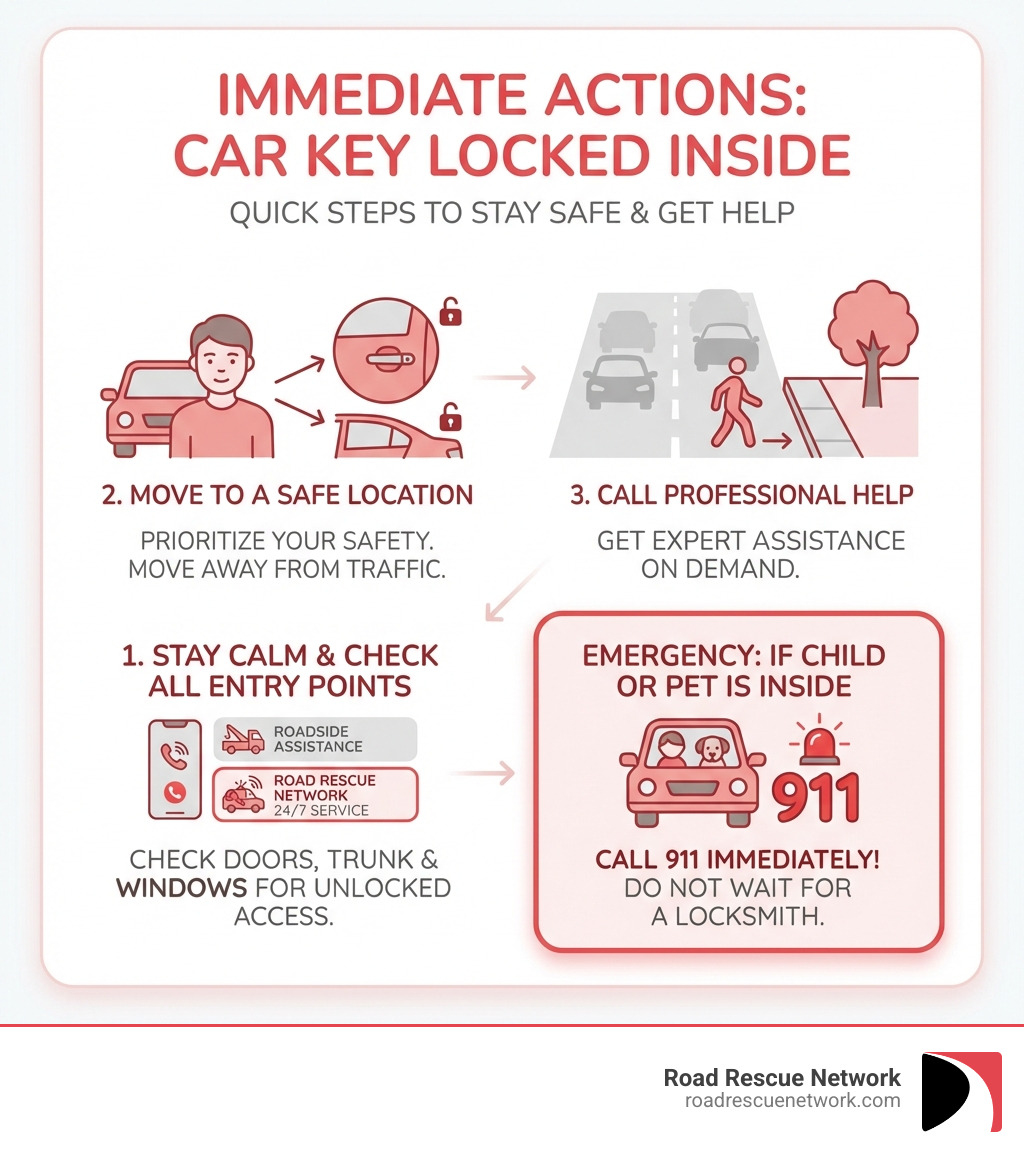
Car key locked inside your vehicle? Here’s what you need to know right now:
Immediate Actions:
- Stay calm and check all doors, trunk, and windows; one may be opened
- Assess safety; move away from traffic if needed
- Call for help; roadside assistance, a locksmith, or Road Rescue Network for 24/7 on-demand service
- Use your phone; check if your car’s manufacturer app can open up remotely
- Emergency only; if a child or pet is inside, call 911 immediately
Typical Cost: $50-$250 for professional locksmith service
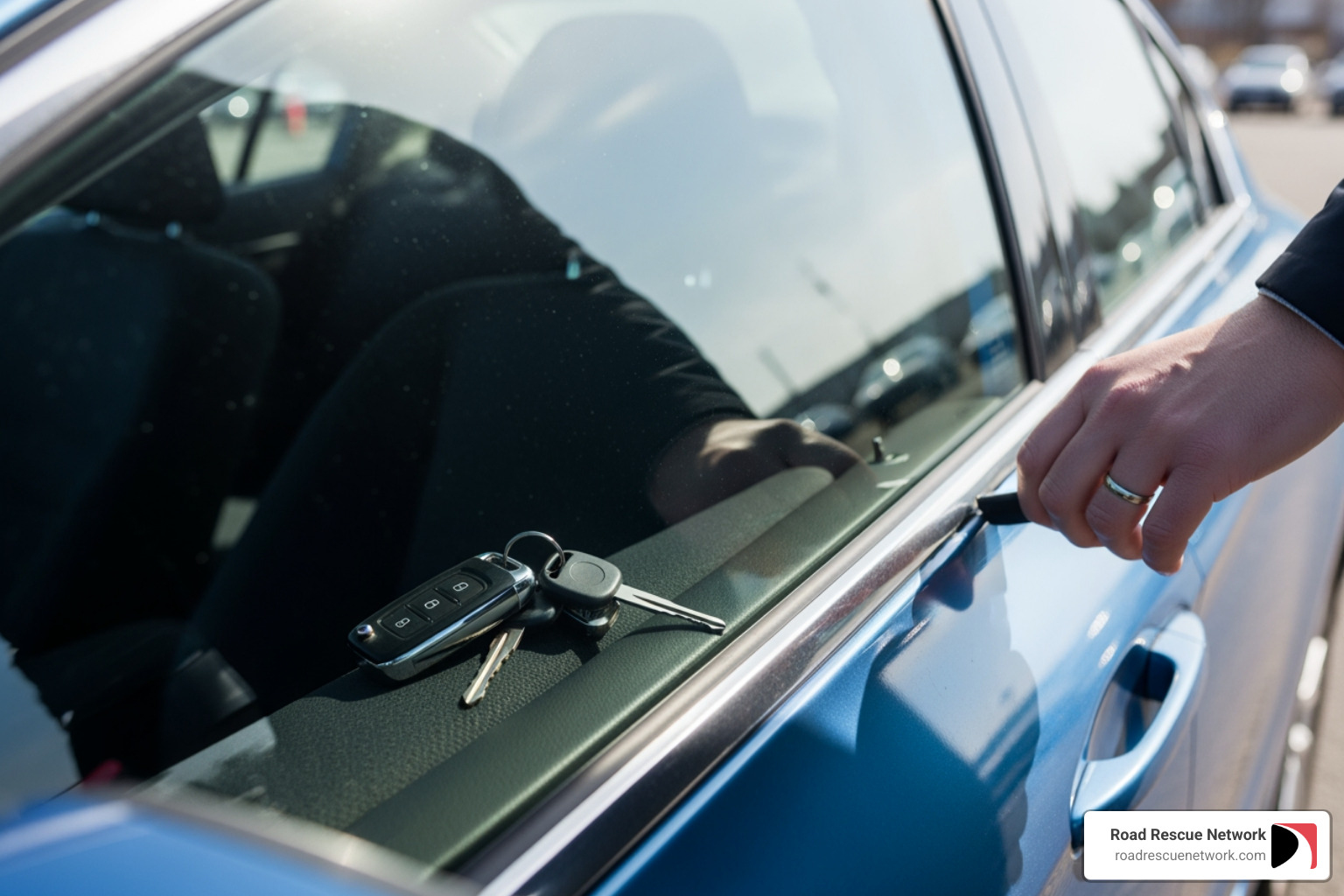
It’s a heart-sinking moment. You close the car door, hear the lock click, and realize your keys are still inside, maybe on the seat, maybe dangling from the ignition. You’re not alone. The American Automobile Association receives over 4 million calls from locked-out motorists every year. In 2024 alone, 10% of all AAA roadside service calls were for vehicle lockouts.
The good news? This common problem has multiple solutions, and you can often get back in your car quickly without breaking a window or causing damage.
Modern cars with keyless entry and push-button start have reduced lockout frequency, especially for vehicles manufactured after 2017, but lockouts still happen. Dead key fob batteries, electronic system failures, or simple human error can leave anyone stranded.
I’m Byron Tarlton, founder of Road Rescue Network, and I’ve spent over two decades in the roadside assistance and towing industry. Through my work coordinating thousands of emergency responses, including countless car key locked situations, I’ve learned what works, what doesn’t, and how to get drivers back on the road as quickly and safely as possible.
Car key locked vocab explained:
First Steps: What to Do Immediately
When you realize your car key locked itself inside your vehicle, the first thing to do is take a deep breath. Panic is a natural reaction, but it can cloud your judgment and lead to hasty decisions that might cause more harm than good. Our priority is to get you back into your car safely and efficiently.
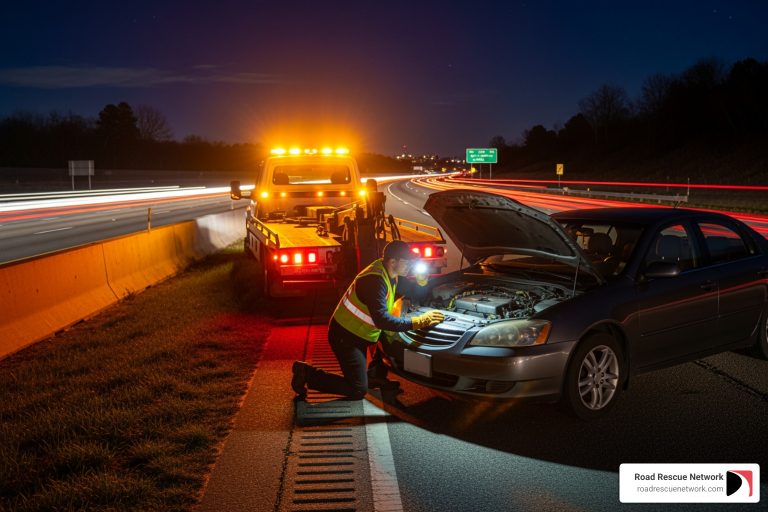
First, stay calm and assess your surroundings for safety. If you’re parked in a busy area, on the side of a highway, or in a location where you feel uneasy, your immediate safety is paramount. Move away from traffic or find a well-lit, populated spot if possible, especially if you anticipate a wait for assistance.
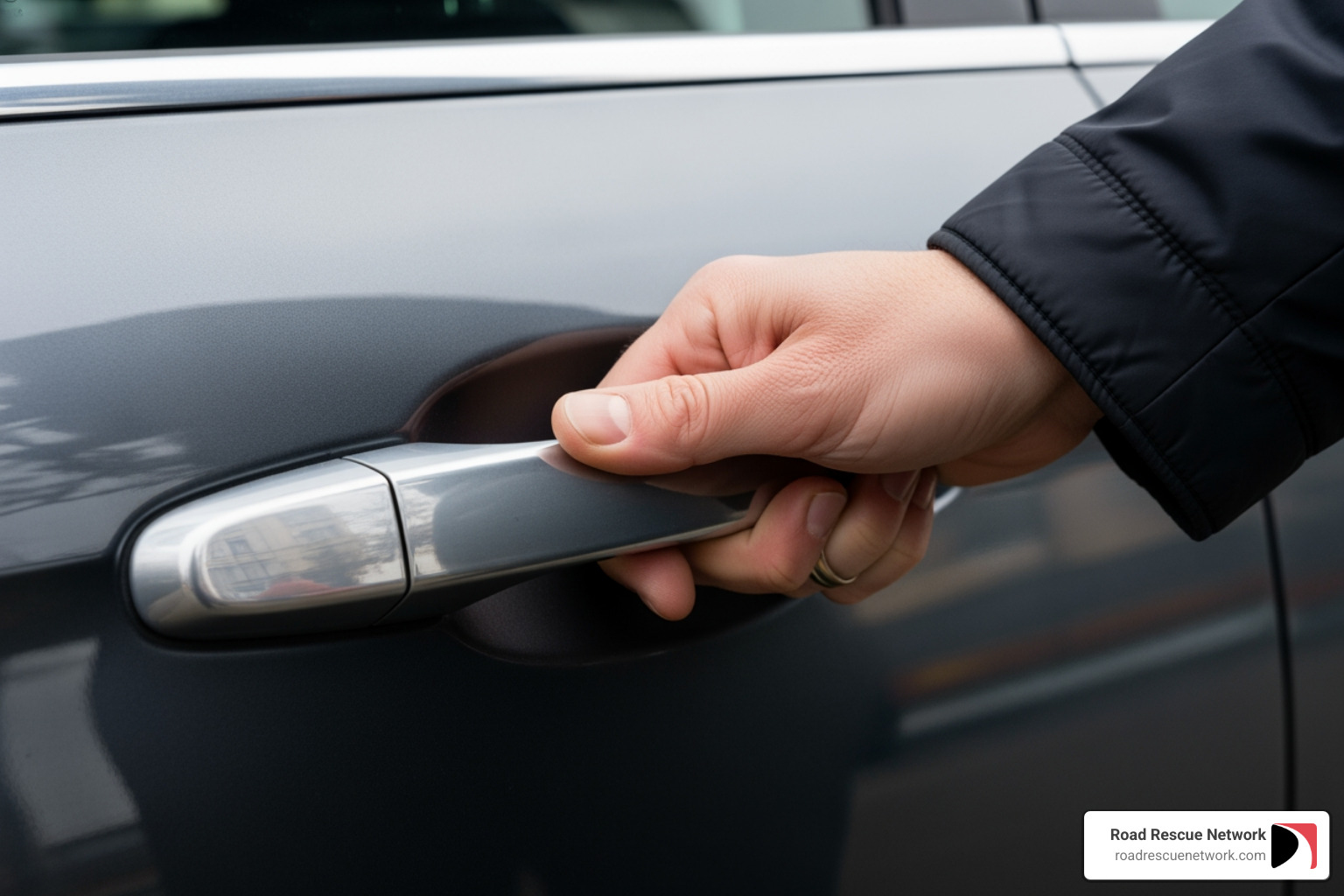
Next, conduct a thorough check of your vehicle. It might sound obvious, but in the stress of the moment, we can overlook the simplest solutions. Walk around your car and try every single door: front and back, driver’s side and passenger’s side. Don’t forget the trunk! Sometimes, a door might not have fully latched, or the trunk may still be open, offering an easy way in. A partially open window, even just a crack, could also be your solution. We’ve seen countless times where drivers, in their haste, find a slightly ajar window after a quick check.
Special Emergency: Child or Pet Locked Inside
If a child or pet is locked inside your vehicle, especially on a warm day, this immediately escalates from an inconvenience to a critical emergency. This is not a situation for DIY attempts or waiting patiently. Call 911 immediately. Heatstroke can occur rapidly in a closed car, even on days that don’t seem excessively hot, and it can be fatal.
When you call 911, clearly state that a child or pet is locked in the car. Follow the dispatcher’s instructions carefully. They will guide you on the best course of action and dispatch emergency services, such as the police or fire department, who are equipped to handle such dire situations. In these cases, breaking a window may be necessary. If you must break a window, choose one furthest from the occupant to minimize the risk of injury from glass shards, and use a window-breaking tool if available. The safety of the child or pet far outweighs the cost of a window replacement.
Your Options for Getting In: Professional vs. DIY
Once you’ve assessed the situation and ensured immediate safety, it’s time to consider your options for getting back into your car. We generally categorize these into professional services and DIY methods.
Calling for Professional Help
For most car key locked scenarios, professional help is the safest and most reliable route. It minimizes the risk of damage to your vehicle and ensures a quick resolution.
-
Roadside Assistance: Many drivers have roadside assistance through their auto insurance, a national auto club, or even as part of their new car warranty. Lockout services are almost always a covered event for roadside assistance programs. If you have this coverage, it’s often the most cost-effective solution. Just remember that response times can vary depending on your location and the provider’s current call volume.
-
Automotive Locksmiths: These specialists are experts in car entry and key systems. They have specialized tools and knowledge to open up almost any vehicle without causing damage. A locksmith can often not only open your car but also cut and program a new key if your original is lost or damaged.
-
Road Rescue Network lockout services: We provide fast, on-demand help 24/7, connecting you instantly with local rescuers who can assist with your car key locked situation. Our USP is that we offer service with no memberships or hidden fees, making it a straightforward option when you need help quickly. We operate in numerous cities across the country, ensuring you can get assistance when you need it. For instance, whether you’re locked out in California, Texas, Florida, or Arizona, we’re ready to dispatch help. We also offer services in New York, Ohio, Massachusetts, Colorado, Michigan, and many more states where we have a presence.
DIY Methods and Their Risks
While the idea of a clever DIY trick to get into your car might seem appealing, especially if you’re feeling a bit MacGyver-esque, we strongly advise against it for modern vehicles.
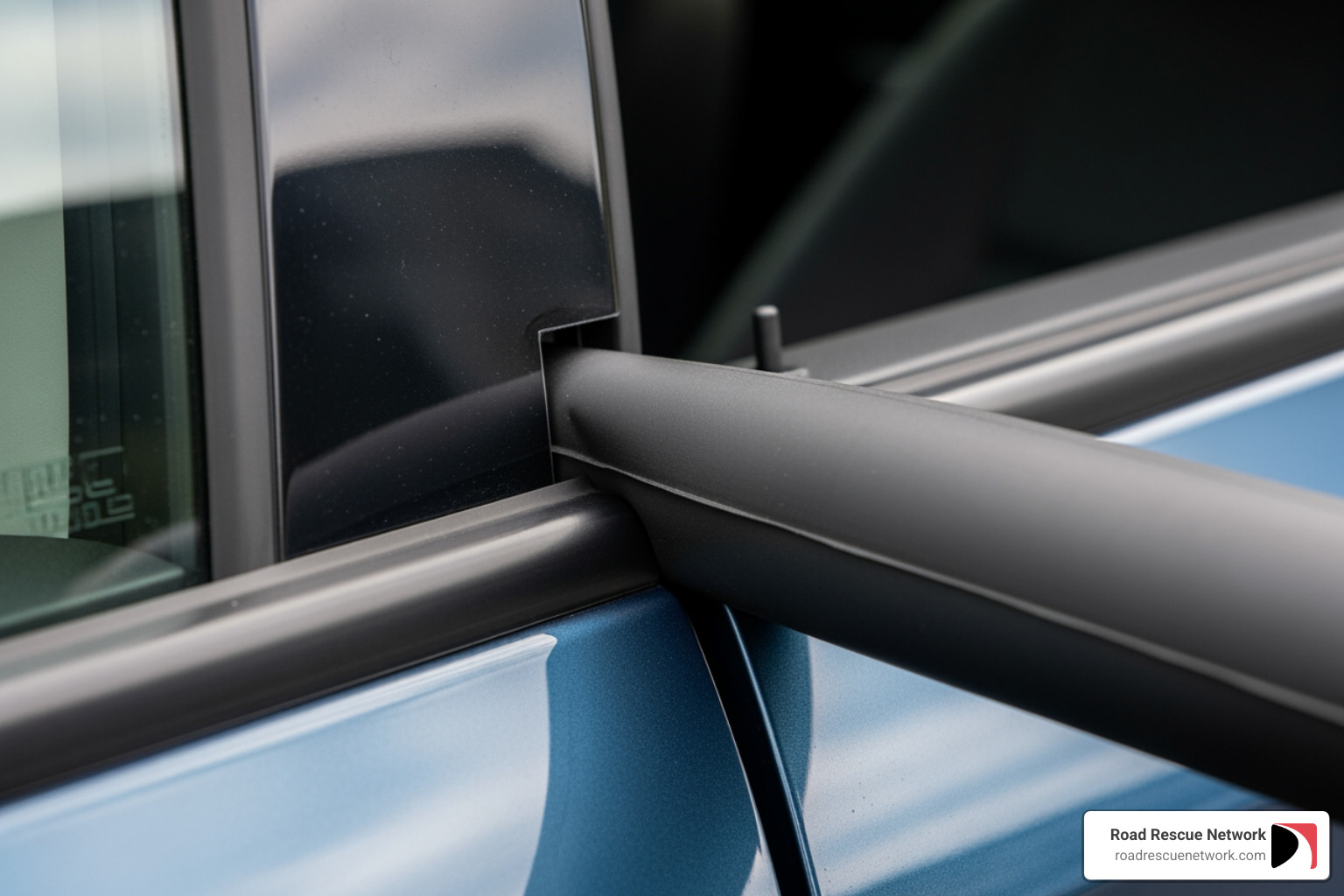
Methods like the shoelace trick, the coat hanger method, or trying to pry open the door with a wedge are largely ineffective on newer cars. Modern car manufacturers incorporate anti-theft guards inside door shells that prevent slim jims from reaching lock components. The “good ol’ slim jim” is largely ineffective on modern vehicles. Even if you manage to create a small opening with an inflatable wedge, manipulating the internal mechanisms without specific tools can be incredibly difficult.
The downsides of attempting these DIY methods are significant:
- High risk of expensive damage: You could easily scratch your paint, bend the door frame, tear weather stripping, or damage sensitive internal lock mechanisms and wiring. This can lead to costly repairs that far outweigh the expense of a professional lockout service.
- Low success rate: Modern car security systems are designed to thwart these types of entry. What might have worked on a 1980s sedan is unlikely to succeed on a 2020s SUV.
- Anti-theft features: Attempting to force entry can sometimes trigger alarms or even disable certain vehicle functions, making the situation worse.
In short, while patience is key (pun intended!), it’s generally best to leave the physical opening to the professionals.
Using Technology to Open up Your Car
Modern vehicles often come with sophisticated technology that can be a lifesaver in a car key locked situation.
-
Manufacturer apps: Many car brands offer companion apps for smartphones that allow you to remotely lock, open up, start, or even locate your vehicle. Examples include myChevrolet, Hyundai Blue Link, NissanConnect, Toyota App, and MySubaru via STARLINK. If you have a relatively new car, check if your manufacturer offers such an app and if you’ve already set it up. These apps can act as a remote key fob, providing a convenient solution when your physical keys are out of reach.
-
Keyless entry and push-button start features: These systems are actually designed to prevent lockouts. Many cars won’t allow you to lock the doors if the key fob is detected inside the vehicle. This is a fantastic feature that has contributed to the decrease in lockout calls for newer cars.
However, even modern technology isn’t foolproof:
- Dead key fobs: If your key fob’s battery dies while inside the car, the car might not detect it, potentially allowing you to lock yourself out.
- Dead car batteries: If your car’s main battery is dead, its electronic locking systems, including remote open uping via an app, may not function.
- System glitches: Like any technology, these systems can occasionally malfunction, leading to an unexpected lockout.
Always ensure your key fob batteries are fresh and consider setting up your manufacturer’s app as a backup as soon as you get a new vehicle.
The Cost and Coverage When Your Car Key is Locked In
Getting your car key locked inside can be a stressful experience, and naturally, one of the first questions that comes to mind is, “How much is this going to cost me?”
How Much Does It Cost to Open up a Car?
The cost to have a professional open up your car can vary, but it typically ranges from about $50 to $250. This range can be influenced by several factors:
- Time of day: Emergency services during off-hours, late nights, weekends, or holidays often incur higher fees.
- Vehicle model: Luxury vehicles or those with more complex locking mechanisms might cost more to open up due to the specialized tools and expertise required.
- Location: Prices can vary by geographic region, with services in major metropolitan areas like New York, Los Angeles, or Chicago potentially being on the higher end of the spectrum.
- Severity of the situation: If the keys are simply on the seat versus deeply embedded in a hard-to-reach area, it might affect the time and effort involved.
While towing services or car dealerships can also assist, they might be more expensive or have longer wait times compared to a dedicated locksmith or roadside assistance provider focused solely on open uping.
Does Insurance or Roadside Assistance Cover Lockouts?
The good news is that many drivers already have coverage for lockout services, often without realizing it.
- Roadside Assistance Plans: Services from national auto clubs, or our own Road Rescue Network, are specifically designed to handle lockout situations. Vehicle lockout is almost always a covered event for roadside assistance plans, though exact terms and coverage limits may vary. This is a major reason why millions of motorists call such services annually.
- Auto Insurance Add-ons: Many auto insurance providers offer roadside assistance as an optional add-on to your policy. This can be a cost-effective way to ensure you’re covered for lockouts, flat tires, jumpstarts, and other common roadside emergencies. Always check your policy or call your insurance agent to confirm your coverage.
- Manufacturer Warranty Coverage: If you have a newer vehicle, it might come with roadside assistance included as part of its basic warranty period. This coverage often extends to lockouts. Check your owner’s manual (if it’s not locked inside the car with your keys!) or contact your dealership to inquire.
For peace of mind, we recommend understanding your coverage before an emergency strikes.
What Information to Have Ready When You Call
When you call for assistance, whether it’s a locksmith, your roadside assistance provider, or Road Rescue Network, having certain information ready will help us dispatch help to you quickly and efficiently.
Here’s what you’ll typically need to provide:
- Your exact location (street address, cross streets, or specific landmarks). A precise location helps us find you faster.
- Vehicle make, model, and year. This helps the professional bring the right tools.
- Vehicle Identification Number (VIN). This is often found on your dashboard (visible through the windshield) or on your driver’s side door jamb.
- Proof of ownership (driver’s license, vehicle registration, or insurance card). Professionals need to verify you own the vehicle before open uping it.
- A clear description of the situation (e.g., “keys on the driver’s seat,” “keys in the trunk,” “key fob battery dead inside the car”).
Having this information readily available will streamline the process and get you back into your car sooner.
Prevention is Key: How to Avoid Future Lockouts
Nobody wants to experience the frustration of a car key locked situation, especially not repeatedly! The best solution is prevention. Most lockouts happen due to simple oversight, distraction, or rushing.
Common culprits include:
- Distraction: Getting caught up in a phone call, talking to a passenger, or juggling too many things.
- Rushing: Trying to get somewhere quickly and forgetting to grab your keys.
- Auto-lock features: Some cars automatically lock after a short period, catching unaware drivers off guard if keys are left inside.
Developing a routine is one of the most effective ways to prevent lockouts. Make it a habit to check for your keys every single time you leave your vehicle. Always taking your keys with you, even if you’re just stepping out for a second, can save you a lot of hassle.
The Spare Key Strategy
A spare key is your best friend in a lockout scenario.
- Making a spare key: If you only have one key, invest in a duplicate. While modern key fobs can be expensive to replace (which can average several hundred dollars for a new key and fob, including programming), it’s a small price to pay for peace of mind compared to being stranded.
- Keeping a spare with a trusted friend or family member: This is a highly recommended strategy. Leave a spare key with someone who lives or works nearby and can easily bring it to you if you get locked out.
- Pros and cons of a magnetic key box: Hiding a spare key in a magnetic box on the exterior of your vehicle seems convenient, but it comes with risks. Magnetic boxes can fall off due to bumps or vibrations, and they can be easily found by thieves, compromising your vehicle’s security. We generally advise against this method due to security concerns and the potential for loss.
- Valet keys: Some vehicles come with a valet key, which is a basic key that can open doors and start the car but won’t open the glove compartment or trunk. This can be a useful spare to keep with someone or in a very secure, subtle spot.
When Your Car Key Isn’t Just Locked Inside, But Lost
What if your car key locked incident is actually a lost key situation? This is a different, often more complex, problem.
- Steps for a lost key: First, retrace your steps. Think about where you might have last had them. Check your pockets, bags, and the immediate vicinity.
- Cost of replacement keys and fobs: If your keys are truly lost, you’ll need a replacement. The average cost to replace keys and a fob is several hundred dollars, depending on the vehicle’s make and model. This includes not just cutting the key but also programming the fob to work with your car’s immobilizer system.
- Calling a locksmith for a new key: Automotive locksmiths can often cut and program new keys on-site, even without the original. They have specialized equipment to read your car’s lock and create a new key.
- Key fob programming: Modern car keys and fobs often require reprogramming of vehicle electronics, including alarms and immobilizers. This is a task best left to professionals (locksmiths or dealerships) who have the necessary diagnostic tools.
Frequently Asked Questions about Car Lockouts
We’ve covered a lot, but let’s address some common questions we hear regarding car key locked situations.
When should you call the police for a car lockout?
Generally, you should only call the police or fire department for a car lockout in emergency situations. This primarily includes when a child or pet is locked inside the vehicle, especially in extreme weather, or if you are in an unsafe location and feel your personal safety is at risk.
For non-emergency lockouts, the police may not be able or allowed to assist. Officers, while they used to provide assistance with a slim jim, often cannot help with newer models due to complex locking mechanisms and anti-theft systems. If they do respond to a non-emergency, they will likely call a tow service or locksmith for you, which would be at your expense. For non-emergency inquiries in areas like Kansas City, we recommend using non-emergency Kansas City Police contact numbers.
What are the risks of trying to break into your own car?
Attempting to break into your own car can carry significant risks and downsides. While it might seem like a quick fix, it often leads to more problems and expenses than simply calling a professional.
The primary risk is the high potential for expensive damage. You could:
- Damage your car’s paint, leading to costly touch-ups or repainting.
- Bend or warp your door frame, affecting the seal and potentially causing wind noise or water leaks.
- Tear or stretch weather stripping, which protects your car’s interior from the elements.
- Break internal lock mechanisms or electrical wiring, leading to complex and expensive repairs.
Breaking a car window, while sometimes necessary in an emergency, also comes with its own set of dangers. It can cause damage to the car paint, shower the inside of your car with tiny shards of glass, and leave you without a window until you can secure a replacement. Additionally, breaking a window may be challenging without a window-breaking tool. We often find that the cost of replacing a window far exceeds the cost of a professional lockout service.
How do modern keyless entry systems affect a car key locked situation?
Modern keyless entry systems and push-button starts are largely designed to prevent lockouts. Many of these systems feature smart sensors that detect if the key fob is inside the vehicle and will prevent the doors from locking. This is why lockouts are less frequent for cars manufactured in or after 2017, compared to older models.
However, these systems are not infallible. A car key locked situation can still occur if:
- The key fob battery is dead: If the fob’s battery dies while inside the car, the vehicle might not detect its presence, allowing you to lock the doors.
- The car battery is dead: A dead car battery renders the electronic locking system inoperable, meaning remote open uping via an app or even the fob itself might not work.
- System malfunction: Like any electronic system, glitches or failures can happen, causing the car to lock unexpectedly with the keys inside.
In these instances, open uping the car may require specialized tools or software that only professionals possess, making many traditional DIY methods obsolete. This further emphasizes why professional assistance is often the best course of action for modern vehicles.
Get Back on the Road Without the Wait
Realizing your car key locked itself inside your vehicle is never fun, but it doesn’t have to ruin your day. We’ve learned that the most important steps are to stay calm, thoroughly assess your situation, and know your options for getting help. Prevention, through habits like always taking your keys and having a spare, is truly the best solution to avoid this common headache altogether.
When an unexpected lockout does happen, you have reliable options. For fast, reliable help without a membership, Road Rescue Network provides on-demand lockout services 24/7. We connect you with local rescuers quickly, getting you back on the road with minimal hassle.
Don’t let a locked key keep you stranded. Get immediate roadside assistance in Green Valley, AZ or any of our other service areas today!