Power Up Your Ride: Replacing Your High Pressure Hose with Ease
Understanding High Pressure Hose Replacement: The Foundation of Safe Cleaning
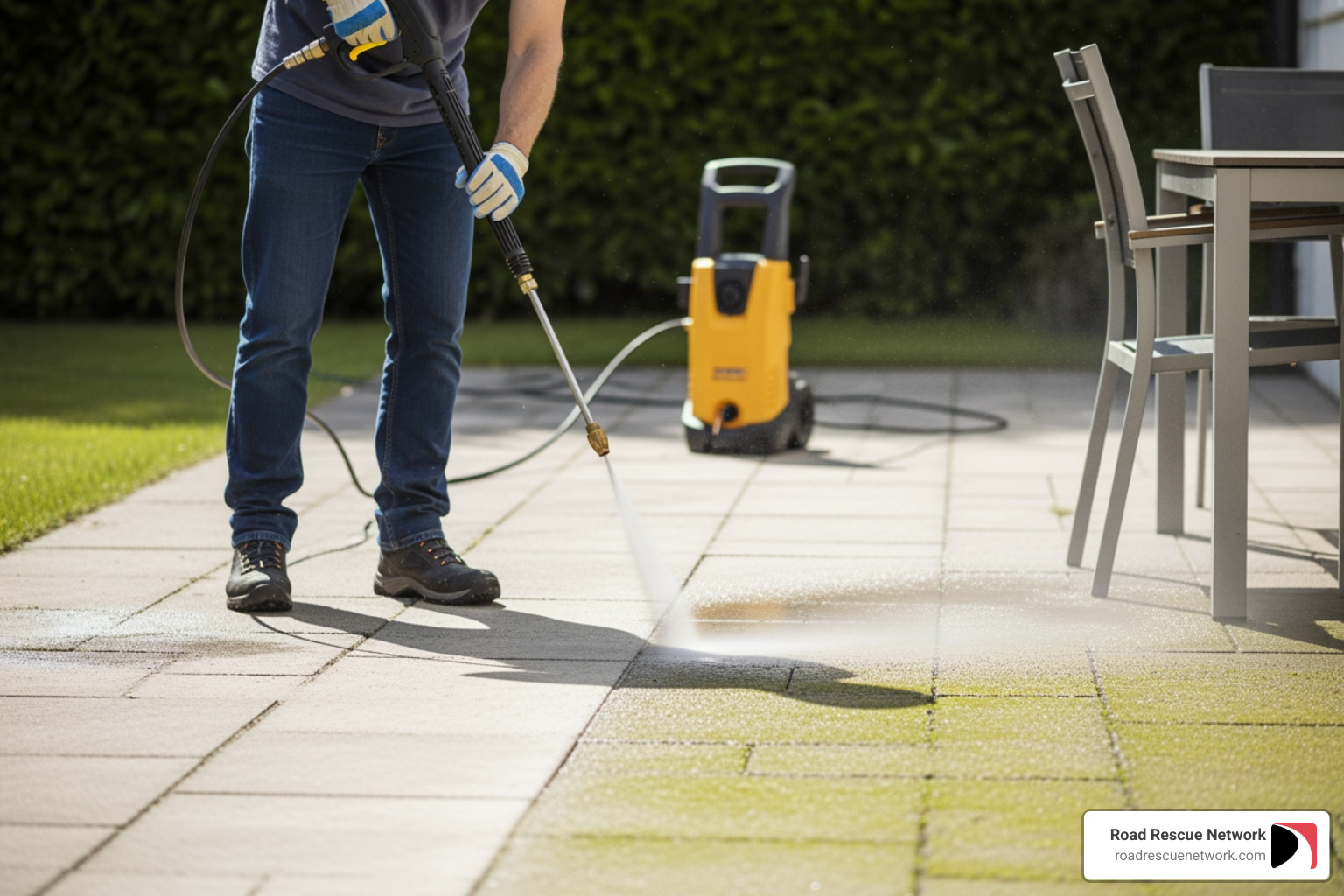
High pressure hose replacement is a critical maintenance task that every pressure washer owner will eventually face. Whether you’re dealing with a leaking hose, visible damage, or reduced performance, knowing when and how to replace your hose keeps your equipment running safely and efficiently.
Quick Answer for High Pressure Hose Replacement:
- Identify the problem – Look for leaks, cracks, bulges, or reduced pressure
- Match specifications – Check your washer’s PSI rating (typically 3200-4500 PSI for home use)
- Choose the right diameter – 1/4″ for consumer models, 3/8″ for professional units
- Verify fittings – M22 threaded or Quick Connect are most common
- Install safely – Always depressurize first, hand-tighten connections, test for leaks
Why replacement matters: High-pressure hoses can handle anywhere from 3,200 PSI to over 10,000 PSI depending on the model. A damaged hose isn’t just ineffective—it’s a serious safety hazard that can cause high-pressure water injection injuries or sudden bursts.
The most common signs you need a replacement include visible cracks, persistent leaks at fittings, bulging sections, or a noticeable drop in cleaning power. Research shows that steel-braided hoses significantly outlast basic PVC models, with proper care extending lifespan considerably.
I’m Byron Tarlton, and through my work with Road Rescue Network and managing equipment across multiple service companies, I’ve seen how critical proper high pressure hose replacement is for keeping equipment operational and workers safe. This guide combines industry best practices with real-world experience to help you make the right choice and complete the job correctly.
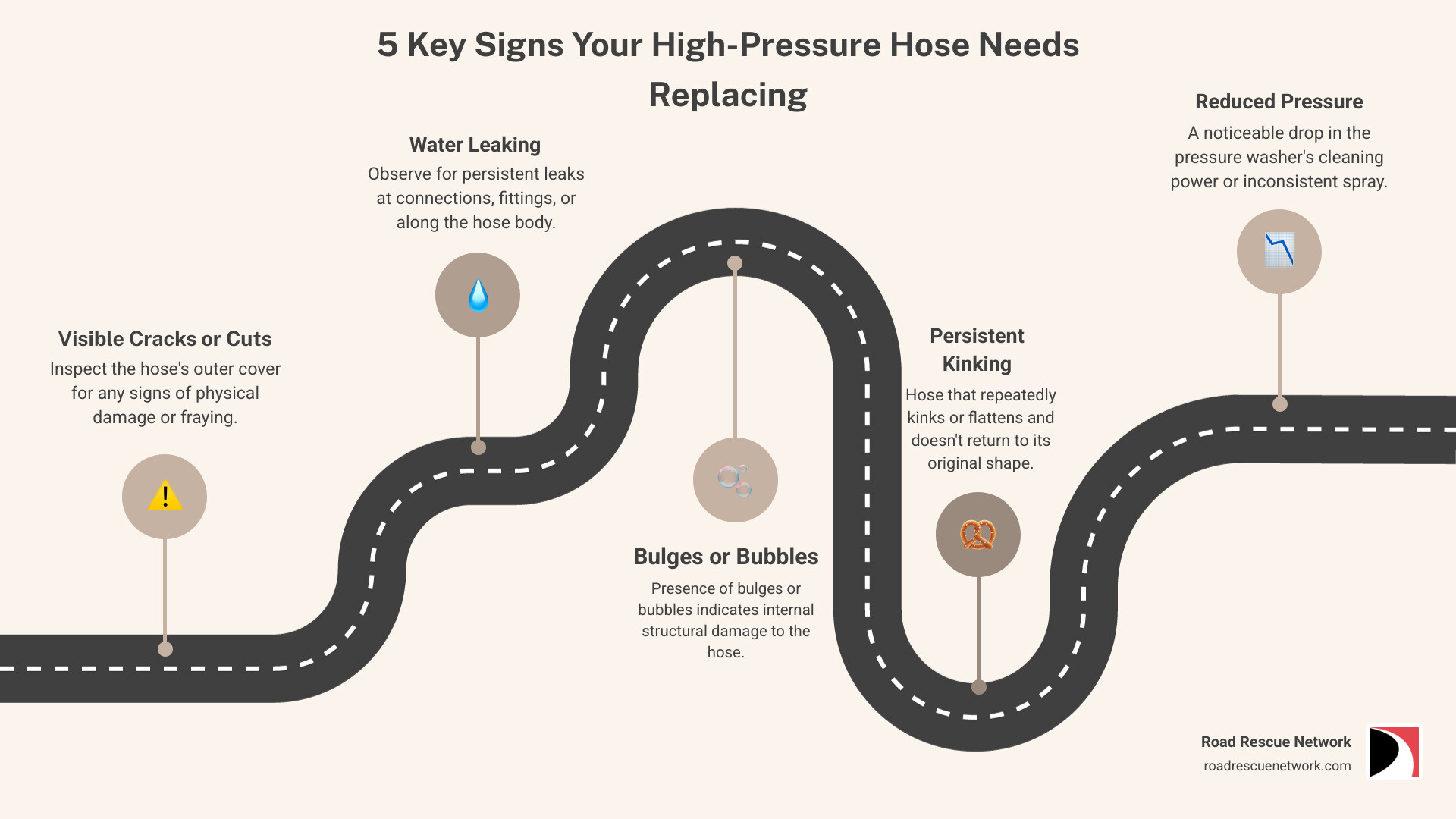
Quick look at high pressure hose replacement:
Recognizing the Red Flags: When Your Hose Needs Replacing
A damaged hose isn’t just an inconvenience—it’s a significant safety hazard that can lead to high-pressure water injection injuries. We often push our equipment to its limits, but ignoring the signs of a failing high pressure hose can turn a routine cleaning task into a dangerous situation. High-pressure hoses take a heck of a beating from the pressurized water they contain, and regular inspection is key to preventing accidents.
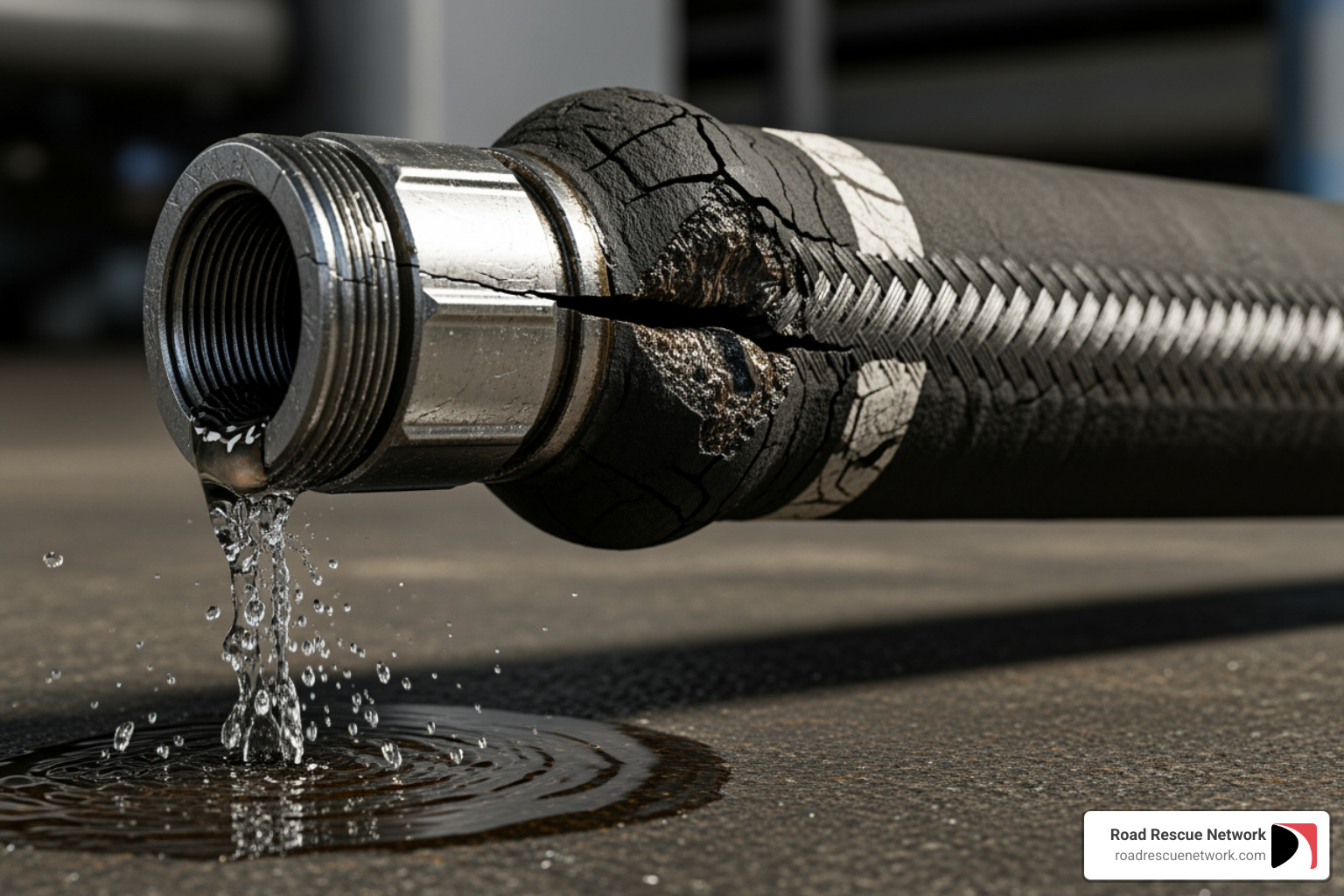
Telltale Signs of a Failing Hose
It’s crucial to know what to look for. If you notice any of these signs, it’s time to consider a high pressure hose replacement:
- Visible Damage: This is the most obvious sign. Look for cuts, abrasions, deep scratches, or gouges in the outer cover of the hose. A hose can be cut if it is pulled around a sharp edge or corner, or if it gets run over.
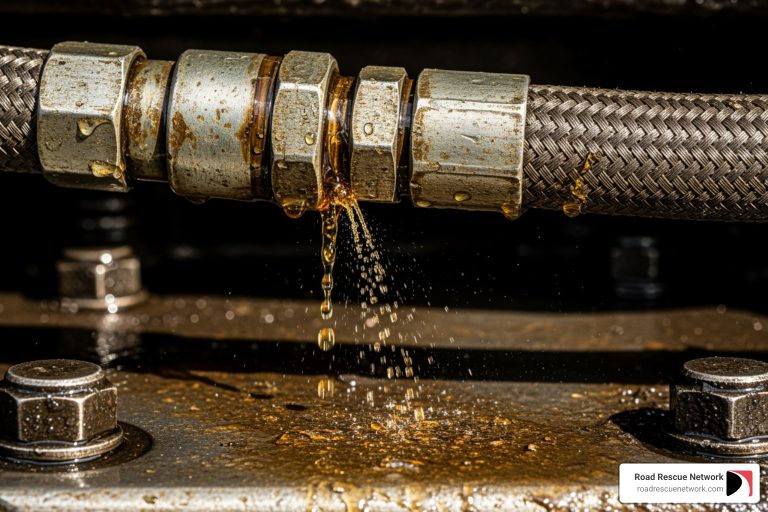
- Leaks at Connections: If you see water dripping or spraying from where the hose connects to your pressure washer pump or spray gun, the fittings might be worn, or the internal O-rings could be compromised. Even a small leak can indicate a weak point.
- Pinhole Leaks: These are tiny, almost invisible leaks along the length of the hose that create fine sprays of water. They often indicate internal damage or material fatigue.
- Bubbles or Bulges in the Hose Cover: This is a critical warning sign that the internal layers of the hose have failed, and the hose is about to burst. The outer layer might still be intact, but the structural integrity is gone.
- Kinking or Flattening: While some hoses are more prone to kinking than others, if your hose consistently kinks or flattens and retains that shape even when straightened, its internal structure might be damaged, restricting water flow and creating weak points.
- Fraying or Abrasion: The outer layer of the hose can fray, especially if it’s been dragged over rough surfaces. While this might not immediately cause a leak, it weakens the hose and exposes the reinforcing layers to damage.
- Reduced Water Pressure or Inconsistent Spray: If your pressure washer isn’t performing as powerfully as it used to, and you’ve ruled out issues with the pump or nozzle, a failing hose could be the culprit. Internal damage can restrict flow, leading to a drop in effective pressure.
The Dangers of a Damaged High-Pressure Hose
Ignoring the signs of a damaged high pressure hose is not an option. The potential consequences are severe:
- High-Pressure Injection Injuries: This is perhaps the most serious risk. Water exiting a pinhole leak or burst in a high-pressure hose can penetrate skin, eyes, or other soft tissues. These injuries can look minor but are extremely dangerous, potentially leading to severe infection, tissue damage, and even amputation if not treated immediately by medical professionals. The pressure can be high enough to inject cleaning solutions or other contaminants directly into the bloodstream.
- Hose Bursting: A catastrophic hose failure can release a sudden, powerful jet of water that can cause serious injury to anyone nearby, or damage property. The hose itself can whip around violently, posing a direct physical threat.
- Electric Shock Risk (for Electric Washers): If you’re using an electric pressure washer, a burst hose can spray water onto electrical components, creating a severe electrocution hazard.
- Loss of Control: A sudden burst or leak can cause you to lose control of the spray gun, potentially directing the high-pressure stream unintentionally towards yourself, others, or fragile objects.
- Inefficient Cleaning: While not a direct safety hazard, a damaged hose will significantly reduce your pressure washer’s effectiveness, making cleaning tasks longer and more frustrating.
Our stance is clear: if water is leaking from your high-pressure hose, it’s time for a new one.
The Ultimate Buyer’s Guide to High-Pressure Hoses
Choosing a replacement hose involves more than just grabbing one off the shelf. Matching the specifications to your machine is crucial for both performance and safety. We’ll walk you through the essential factors to consider when selecting your new high pressure hose replacement.
Decoding Hose Specifications for a Perfect Match
When we’re looking for a new hose, we always keep these key specifications in mind to ensure a perfect fit and optimal performance:
- PSI Rating (Pounds per Square Inch): This is paramount. The replacement hose’s PSI rating must be equal to or, ideally, higher than your pressure washer’s maximum PSI output. Using an underrated hose can cause it to burst, leading to dangerous situations. For example, the Karcher 9m high-pressure replacement hose is rated for a maximum of 160 bar (approximately 2320 PSI). However, many consumer-grade hoses, like some YAMATIC models, are rated up to 3200 PSI, while heavy-duty options like the Simpson Cleaning 41030 Monster Series can handle 4500 PSI, and industrial hoses can go even higher, up to 10,000 PSI. Always check your pressure washer’s manual for its maximum PSI output.
- GPM (Gallons Per Minute): While PSI indicates pressure, GPM indicates flow. Larger diameter hoses generally allow for greater water volume, which can improve cleaning efficiency, especially for larger surfaces.
- Hose Length: Common lengths range from 25ft to 100ft. A 9-meter (approximately 30-foot) Karcher hose is common for domestic use. Consider your typical cleaning area. A longer hose offers more reach, allowing you to clean larger areas without moving the pressure washer, but it can be more cumbersome to store and manage. Too short, and you’ll constantly be relocating your machine.
- Hose Diameter: The internal diameter of the hose affects both pressure and flow.
- 1/4-inch hoses: Most common for consumer-grade electric and small gas power washers, typically rated up to 3,200 PSI.
- 5/16-inch hoses: Less common, often found on prosumer-grade gas pressure washers, typically rated between 2,700-3,600 PSI.
- 3/8-inch hoses: Designed for professional and some prosumer-grade gas pressure washers, capable of handling up to 10,000 PSI and allowing for greater water volume.
- Temperature Rating: If your pressure washer uses hot water, ensure your replacement hose can handle the heat. Many standard hoses are rated for up to 60 °C (140 °F), like the Karcher hose. Some specialized hoses, such as certain YAMATIC models, can handle temperatures up to 212°F, making them suitable for hot water applications.
Material Matters: Steel-Braided vs. PVC and Polyurethane
The material of your high-pressure hose significantly impacts its flexibility, durability, and performance. Let’s compare the common types:
| Material | Flexibility | Durability | Kink-Resistance | Non-Marking Properties | Cost |
|---|---|---|---|---|---|
| PVC Hoses | Stiff, prone to kinking | Decent for light use, susceptible to abrasion | Poor | Often leaves black marks on surfaces | Low |
| Rubber Hoses | Good, more flexible than PVC | Good, resistant to abrasion and weather | Better than PVC, less prone to kinking | Can leave black streaks on surfaces | Moderate |
| Polyurethane Hoses | Excellent, very flexible, lightweight | Very good, resistant to abrasion and chemicals | Excellent, highly kink-resistant | Generally non-marking | Moderate-High |
| Steel-Braided Hoses | Varies by outer jacket, often good | Excellent, highly resistant to bursts and punctures | Excellent due to internal braiding | Depends on outer jacket (can be non-marking) | High |
Steel-braided reinforcement is a key feature in many durable high-pressure hoses. These hoses are constructed from high-quality rubber with an internal steel-braided layer, making them far superior to basic PVC hoses. They offer exceptional burst resistance and longevity, making them ideal for demanding tasks. Our experience shows that steel-braided hoses are generally more reliable and can withstand the rigors of frequent use much better than their purely plastic counterparts. Plus, a good steel-braided hose with a quality outer jacket can be non-marking, which is a huge benefit when cleaning delicate surfaces like concrete patios or painted surfaces.
Finding the Perfect Fit: A Guide to Connectors
Perhaps the most frustrating part of a high pressure hose replacement is ensuring you have the correct fittings. There’s nothing worse than getting a new hose only to find it doesn’t connect to your machine or spray gun!
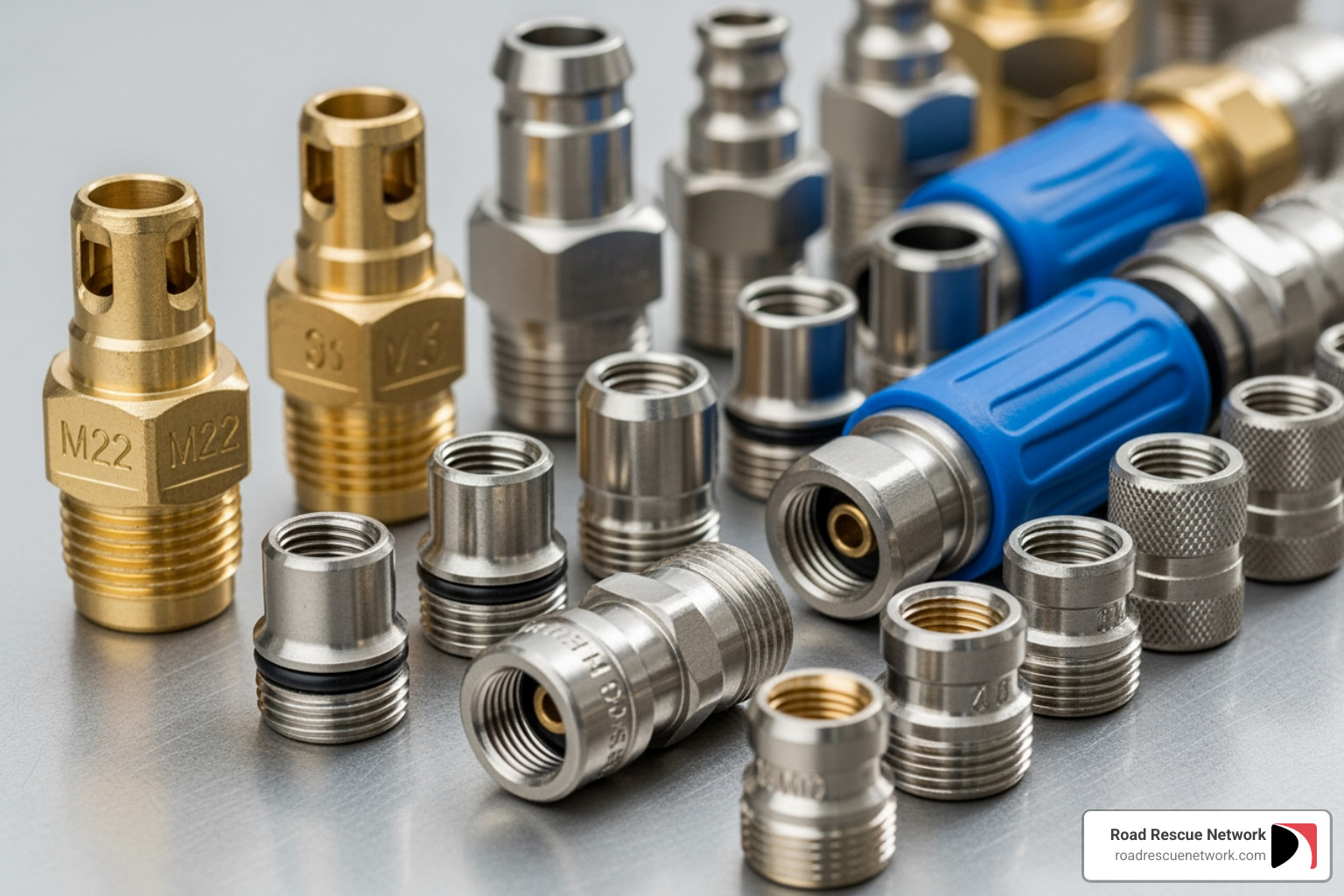
Here’s how we approach finding the perfect fit:
- M22 Fittings: These are incredibly common, especially for residential and light commercial pressure washers. M22 refers to the 22mm diameter of the thread. However, there’s a crucial distinction: M22 14mm and M22 15mm. The “14mm” or “15mm” refers to the internal diameter of the male pin. A 15mm pin will not fit into a 14mm coupler, and vice versa. It’s vital to measure your existing fittings carefully. Many YAMATIC and LULUW hoses, for example, come with M22 brass fittings.
- Quick Connect (QC) Fittings: As the name suggests, these allow for quick attachment and detachment of the hose from the pressure washer and spray gun. They often involve a male plug and a female coupler. Many Kärcher K3-K7 series pressure washers from 2009 onwards feature a Quick Connect system. You might also find 3/8″ Quick Connect adapters on universal hoses.
- NPT (National Pipe Taper) Threads: Predominantly found on pressure washers and accessories manufactured in the USA. These are tapered threads that create a seal when tightened.
- BSP (British Standard Pipe) Threads: While BSP is common for machines built in Australia, NPT is generally from the USA. For our customers in the US, NPT is the more relevant standard to be aware of.
- Measuring Fittings: To avoid guesswork, we recommend measuring your existing hose fittings. Use Vernier calipers, a ruler, or a tape measure. Measure across the diameter of the threaded male part of the fitting, including the thread. Common measurements you’ll encounter are:
- 13mm = 1/4″
- 14mm = 14mm (this is a common M22 pin size)
- 16.5mm = 3/8″
- 22mm = 22mm (this is the M22 thread size)
- 20mm = 1/2″
3/8″ and 22mm are the most common sizes, followed by 1/4″ then 14mm.
For a more comprehensive understanding of selection, check out this Pressure Washer Hose Buyers Guide.
Your Step-by-Step High Pressure Hose Replacement Guide
Now that you’ve got the perfect new hose, let’s get it installed. This section provides a clear, actionable process for a successful high pressure hose replacement.
Step 1: Safety and Preparation
Safety first, always! High-pressure water can be extremely dangerous.
- Turn off and Unplug (or Shut Down) the Pressure Washer: If you have an electric pressure washer, unplug it from the power source. For gas-powered units, turn off the engine and remove the spark plug wire to prevent accidental starting.
- Disconnect the Water Supply: Turn off the water spigot or faucet that supplies water to your pressure washer.
- Squeeze the Trigger Gun to Release All Pressure: This is a crucial step. Point the spray gun in a safe direction and squeeze the trigger to release any residual pressure in the system. You’ll hear the water stop flowing and feel the pressure drop.
- Gather Tools: You’ll typically only need a few basic tools, such as adjustable pliers or a wrench, to help loosen stubborn connections.
Step 2: Removing the Old Hose
Once the system is depressurized and safe, we can proceed with removing the old hose:
- Unthread the Hose from the Pump Outlet: Locate where the high-pressure hose connects to the pressure washer pump. Carefully unthread the fitting. If it’s a Quick Connect, simply pull back the collar and detach.
- Unthread the Hose from the Trigger Handle: Do the same for the connection at your spray gun or trigger handle.
- Dealing with Corroded Fittings: Sometimes, corrosion can make fittings incredibly difficult to separate. If you encounter this, don’t force it too hard, as you could damage the pump or gun. A good trick, as noted in guides like “How to Replace the High Pressure Hose on a Ryobi Pressure Washer,” is to carefully slide any plastic sheaths away from the couplers to expose the metal fittings. Then, use adjustable pliers to gently rotate and rock the components back and forth. Apply steady, increasing pressure until the corrosion breaks free. A little penetrating oil can also help. For detailed steps on this, refer to How to Replace the High Pressure Hose on a Ryobi Pressure Washer.
Step 3: Installing the New Hose
With the old hose removed, installing the new one is usually straightforward:
- Inspect New Hose O-Rings: Before connecting, always check the O-rings inside the new hose fittings. Ensure they are present, seated correctly, and free from any nicks or damage. These O-rings are essential for a leak-free seal.
- Hand-Tighten the New Hose to the Pump Outlet: Thread the new high-pressure hose coupling onto the pump outlet. Start by hand-tightening it. This helps prevent cross-threading. Once you can no longer hand-tighten, use a wrench or pliers for a snug fit. Avoid overtightening, as this can damage the threads or O-rings.
- Connect the Other End to the Trigger Handle: Repeat the process for the connection to your spray gun or trigger handle. Hand-tighten first, then use a wrench for a secure fit. If using Quick Connect fittings, simply push them together until they click and lock.
- Reconnect Water Supply and Power: Turn on your water supply to the pressure washer. Check for any immediate leaks. Then, if electric, plug in your pressure washer. If gas, reconnect the spark plug wire.
- Test for Leaks Before Use: Before you start cleaning, turn on the pressure washer for a few seconds and squeeze the trigger to let water flow. Carefully inspect both connections (pump and gun) for any leaks. If you see drips or sprays, turn off the machine, depressurize, and re-tighten the connections. Sometimes, a faulty O-ring needs replacement.
Maximizing Hose Lifespan & Brand-Specific Tips
Proper care and understanding brand-specific features can significantly extend the life of your new hose and make future replacements easier. We want our equipment to last, and a little preventative maintenance goes a long way.
Kärcher-Specific vs. Universal High Pressure Hose Replacement
When it comes to high pressure hose replacement, you’ll often encounter specific brand hoses and universal options. Let’s look at the differences, particularly with popular brands like Kärcher:
- Kärcher K3-K7 Series: Kärcher is a prominent brand, and their domestic pressure washers, especially models from the K3-K7 series manufactured from 2009 onwards, often use a specific Quick Connect system. For these machines, a Kärcher-specific hose like their 9m replacement hose (part number 2.641-721.0) is designed for guaranteed compatibility and seamless integration with their Quick Connect system for both the gun and the pressure washer. This ensures hassle-free attachment and detachment. You can find more details on High Pressure Hoses for Kärcher Retail Pressure Washers.
- Universal Hoses: Brands like YAMATIC, Flexzilla, LULUW, Simpson Cleaning, and Westinghouse offer universal replacement hoses. These are designed to be compatible with a wider range of pressure washers, including popular brands like Ryobi, Troy Bilt, Greenworks, and CRAFTSMAN. Universal hoses typically feature standard M22 brass fittings (often M22 14mm or M22 15mm) and/or 3/8″ Quick Connect adapters.
- Advantages of Kärcher-Specific: Guaranteed fit, often optimized for Kärcher’s unique Quick Connect system, ensuring peak performance and ease of use.
- Advantages of Universal: Greater versatility, often more readily available, and can be a more cost-effective solution if you own multiple brands or are looking for specific features not offered by the OEM. However, always double-check fitting sizes (especially M22 14mm vs. M22 15mm) to ensure compatibility. For instance, LULUW hoses are rated for 3600PSI and feature M22 14mm fittings, which might require an adapter for machines with 15mm M22 connections.
Pro Tips for Extending Your High Pressure Hose Replacement Cycle
We know that replacing a hose isn’t anyone’s favorite task, so here are our pro tips to make your new high pressure hose last longer:
- Proper Storage: After each use, ensure your hose is properly coiled. Avoid tight kinks or sharp bends when storing. Ideally, hang it on a hose reel or a hook in a cool, dry place, away from direct sunlight and extreme temperatures.
- Avoid Kinks and Sharp Corners: During operation, try to keep the hose in a natural, unkinked line. Never pull the hose sharply around corners, over obstacles, or across abrasive surfaces. This can cause internal damage and premature wear, as well as fraying of the outer jacket.
- Do Not Pull or Drag the Hose: Instead of dragging the hose by the spray gun, walk back to the pressure washer and move the machine itself. Pulling the hose roughly can strain fittings and damage the hose material.
- Flush After Use: Before storing, disconnect the hose from the pressure washer and run fresh water through it (without pressure) to clear out any detergent residue or debris. This prevents chemical buildup and helps maintain the hose’s integrity.
- Store Out of Direct Sunlight: UV rays can degrade hose materials over time, making them brittle and prone to cracking. Keep your hose in a shaded area or covered when not in use.
- Regular Inspection: Make it a habit to quickly inspect your hose before and after each use. Look for any of the “red flag” signs we discussed earlier. Catching small issues early can prevent them from becoming dangerous failures.
While this guide focuses on pressure washer hoses, the principles of proper care apply to all high-pressure systems. For more complex hydraulic hose needs, especially for heavy machinery or industrial applications, professional expertise is invaluable. For example, our network provides specialized services for hydraulic hose services in Texas and hydraulic hose services in Florida, connecting you with experts who can handle custom fabrication and on-site repairs.
Frequently Asked Questions about High Pressure Hose Replacement
We hear a lot of questions about high pressure hose replacement, and we want to make sure you have all the answers you need.
Can I repair a high-pressure hose instead of replacing it?
No. This is a critical safety point we cannot stress enough. Attempting to repair a high-pressure hose with tape, sealants, or any makeshift solution is extremely dangerous and ill-advised. The immense pressure (often thousands of PSI) will easily cause the repair to fail, leading to a sudden burst, a violent whipping hose, and the risk of severe high-pressure injection injuries. Always replace a damaged hose; never attempt to repair it. The integrity of the hose material is paramount for safe operation.
What’s the most common hose size for a home pressure washer?
For most consumer-grade electric and small gas pressure washers, which typically operate up to around 3200 PSI, a 1/4-inch diameter hose is the most common standard. These hoses frequently come with M22 threaded connections, though the specific M22 pin size (14mm or 15mm) can vary, so it’s always best to measure.
How do I know what PSI rating my replacement hose needs?
The replacement hose’s PSI rating must be equal to or, ideally, higher than your pressure washer’s maximum PSI output. This information is usually found on a sticker or plate on your pressure washer unit, or in its owner’s manual. For example, if your pressure washer puts out 2800 PSI, you should choose a hose rated for at least 2800 PSI, but opting for one rated for 3000 PSI, 3200 PSI, or even 3600 PSI provides an extra margin of safety and durability. Using a hose rated below your machine’s output is a recipe for disaster and can lead to immediate hose failure.
Conclusion
Successfully completing a high pressure hose replacement is a straightforward task that not only boosts your pressure washer’s performance but, more importantly, ensures safe operation. By carefully choosing a hose with the correct specifications—considering PSI, length, material, and connector types—and following our simple step-by-step installation guide, you can tackle any cleaning job with confidence. A damaged hose is a dangerous hose, and replacement is always the safest option.
For those more complex hydraulic hose issues that go beyond your typical pressure washer, such as on heavy machinery or commercial equipment, professional service is key. Road Rescue Network connects you with experts for specialized needs, ensuring you get back to work quickly and safely.
Find expert hydraulic hose repair services in your area.