The Real Cost of Repairing Your Car Tyre Puncture
What Does a Car Tyre Puncture Repair Actually Cost?
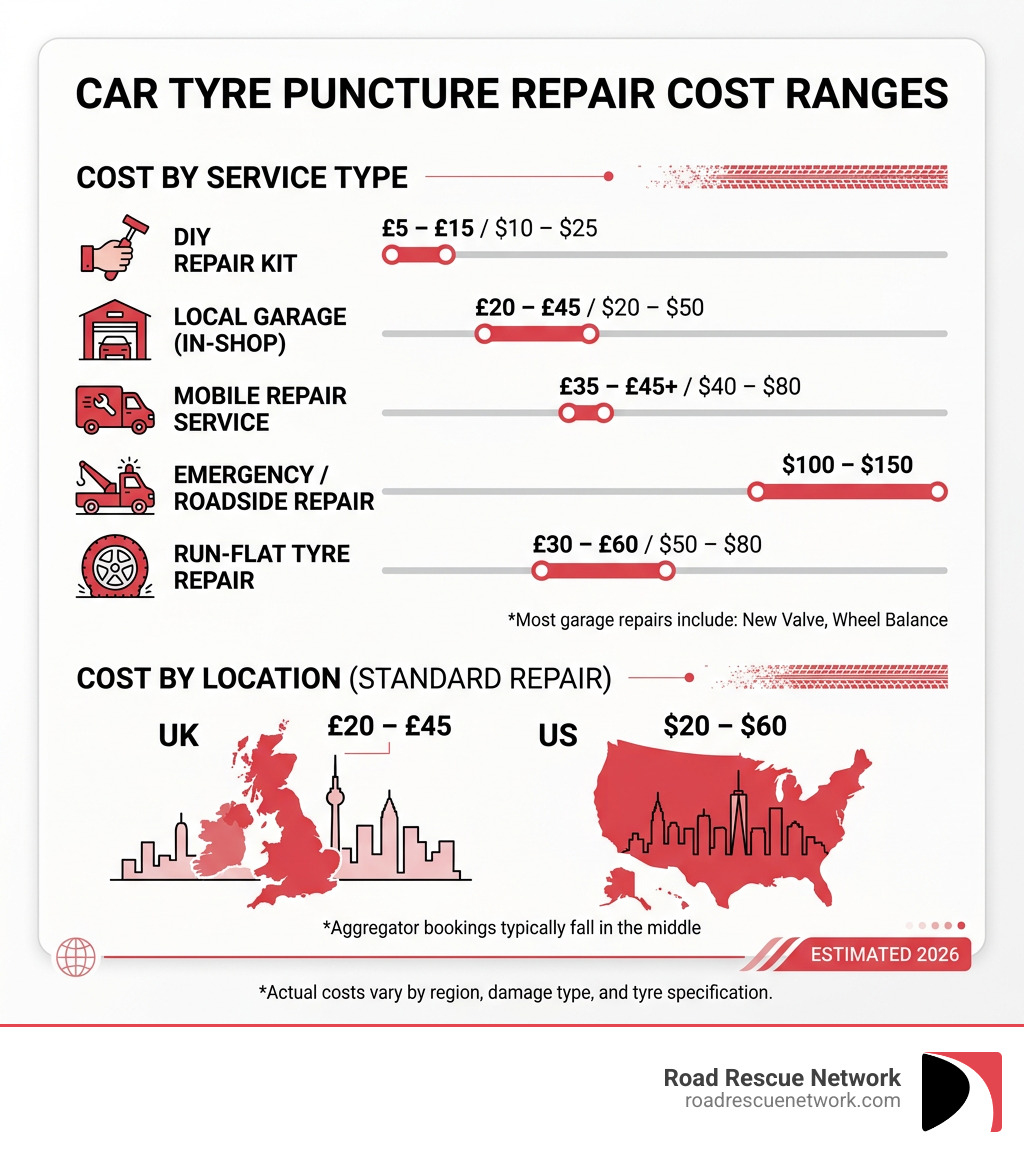
Car tyre puncture repair cost typically ranges from £20 to £45 in the UK and $20 to $60 in the US, depending on where you go and what the damage looks like.
Here’s a quick breakdown so you know what to expect:
| Service Type | Typical Cost |
|---|---|
| DIY repair kit | £5–£15 / $10–$25 |
| Local garage (in-shop) | £20–£45 / $20–$50 |
| Mobile repair service | £35–£45+ / $40–$80 |
| Emergency / roadside repair | $100–$150 |
| Run-flat tyre repair | £30–£60 / $50–$80 |
Most standard repairs at a garage include a new valve and a wheel balance. If you book through a service aggregator or mobile provider, expect to pay toward the middle of that range.
Punctures are stressful — especially when you’re not sure whether your tyre can even be repaired, or whether you’re about to be hit with a bill for a full replacement. The damage location, puncture size, and tyre type all play a role. A small nail in the centre of the tread is a very different situation from a gash near the sidewall.
The good news? Most punctures are fixable — and the repair cost is almost always far less than a new tyre.
I’m Byron Tarlton, founder of Road Rescue Network, and I’ve spent decades in the towing and roadside assistance industry helping drivers navigate exactly these situations. My hands-on experience across transportation and emergency vehicle services gives me a grounded perspective on what a fair car tyre puncture repair cost looks like — and when you’re being overcharged.
Essential car tyre puncture repair cost terms:
Average Car Tyre Puncture Repair Cost in 2025
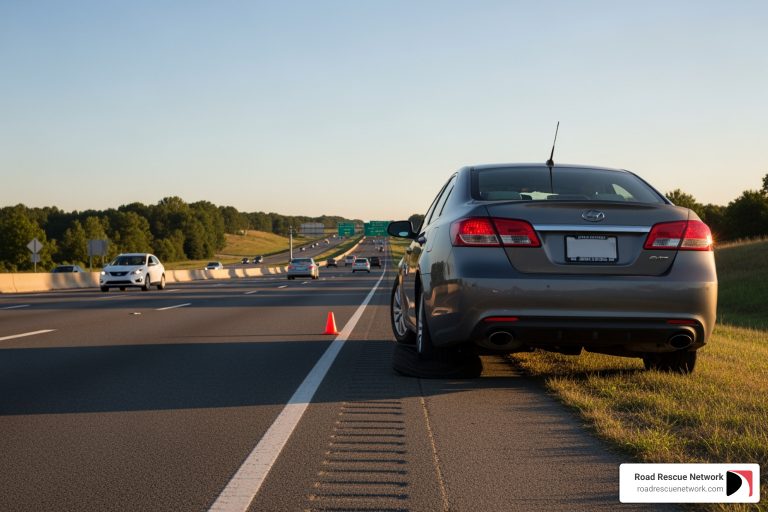
When you’re stuck on the side of the road in a city like Chicago, IL or Houston, TX, the first thing on your mind is “How much is this going to set me back?” In 2025, the market for tyre repairs has stabilized, but inflation has nudged prices up slightly from previous years. On average, you can expect to pay between $20 and $60 for a professional in-shop repair.
However, the “real” cost often depends on the type of service you choose. A brick-and-mortar shop might offer a lower base price, but you have to factor in the time spent driving there (if your tyre holds air) or the cost of a tow. This is where mobile services provide immense value.
In-Shop vs. Mobile Repair Costs
| Feature | Fixed-Location Shop | Mobile Service (Road Rescue Network) |
|---|---|---|
| Base Repair Cost | $20 – $50 | $40 – $80 |
| Convenience Fee | $0 | Included in base / Service call fee |
| Wait Time | 1–3 hours | 30–60 minutes (travel time) |
| Towing Required? | Often yes ($75+) | No |
Professional mobile services are becoming the preferred choice for busy drivers in major hubs like Los Angeles, CA or Phoenix, AZ. While the upfront cost might be $10–$20 higher than a discount tyre shop, you save significantly by avoiding towing fees and lost wages from sitting in a waiting room.
Regional Price Variations
Geography plays a surprisingly large role. In high-cost-of-living areas like New York, NY or San Francisco, CA, labour rates are naturally higher, which can push a standard patch-and-plug repair toward the $60 mark. Conversely, in cities like San Antonio, TX or Jacksonville, FL, you might find independent shops charging as little as $20–$30.
If you find yourself near the coast, services like Mobile Tire Repair in First Encounter Beach, MA show how specialized local providers cater to specific regional needs.
Labour and Time Estimates
A proper professional repair isn’t just “sticking a plug in it.” It involves:
- Dismounting the tyre from the wheel (to inspect internal damage).
- Cleaning and buffing the inner liner.
- Applying a vulcanizing patch and plug.
- Remounting and balancing the wheel.
This process typically takes 30 to 60 minutes of labour. If a shop claims they can do it in 5 minutes without taking the tyre off the rim, they aren’t performing a permanent, safe repair.
Factors That Influence Your Car Tyre Puncture Repair Cost
Not all punctures are created equal. Several technical factors can turn a $20 quick-fix into a more complex service.
Tyre Type and Performance Ratings
High-performance tyres found on luxury vehicles in areas like Scottsdale, AZ or Miami, FL often have stiffer sidewalls and specialized rubber compounds. Repairing a tyre rated for high speeds (V, W, or Y ratings) requires more precision. Some manufacturers even limit the number of repairs allowed on high-performance rubber—often just one—to maintain the tyre’s structural integrity at speed.
Puncture Location and Severity
This is the “Golden Rule” of tyre repair. For a repair to be safe and compliant with industry standards (like the US Tire Manufacturers Association or the British Standard BS AU 159), the puncture must be located in the central three-quarters of the tread. If the nail is in the “shoulder” or the sidewall, it is unrepairable.
TPMS Sensor Recalibration
Most modern cars manufactured after 2012 are equipped with a Tyre Pressure Monitoring System (TPMS). If the puncture occurred near the sensor or if the tyre was driven flat, the sensor might be damaged. Replacing a TPMS sensor can add $40 to $150 to your total bill. Even if it’s not damaged, a professional service will often include a reset or recalibration to ensure your dashboard lights stay off.
Emergency Call-Out Fees
If you’re stranded at 2:00 AM on a Tuesday, expect to pay a premium. Emergency roadside assistance typically involves a dispatch fee. At Road Rescue Network, we pride ourselves on transparent pricing, but generally, “after-hours” or “emergency” calls across the industry can range from $100 to $150. For example, a Tire Change in Lower Santan Village, AZ might vary based on the time of day and distance.
Wheel Balancing and Valves
A standard professional repair should always include wheel balancing. When a patch is added to the inside of a tyre, it changes the weight distribution. Without re-balancing, you’ll feel a vibration in your steering wheel at highway speeds. Most reputable shops include this in the $30–$50 price, along with a new rubber valve stem.
Professional Repair vs. DIY Puncture Kits
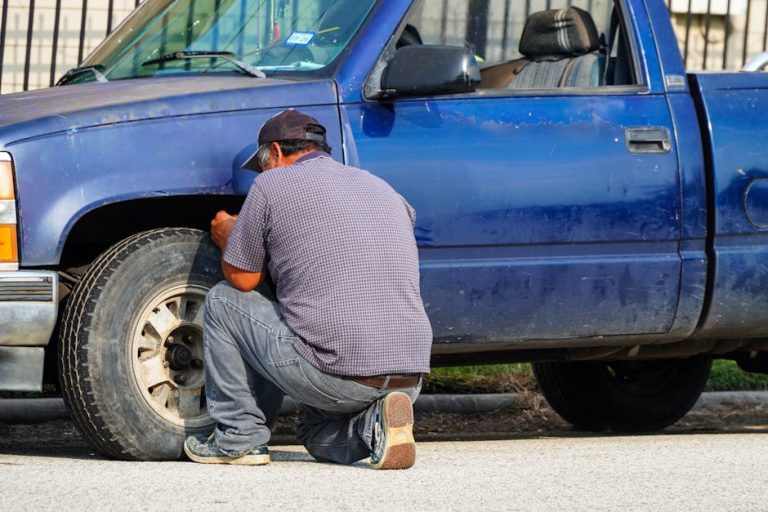
We’ve all seen those $10 “bacon strip” plug kits at the local auto parts store. While they can be a lifesaver in a pinch, understand the difference between a temporary “get-you-home” fix and a permanent professional repair.
The Dangers of DIY External Plugs
External string plugs (the ones you poke in from the outside without removing the tyre) are considered temporary. Why? Because they don’t allow the technician to see the inside of the tyre.
- Hidden Damage: Driving even a short distance on a low-pressure tyre can cause the internal structure (the “carcass”) to shred. You won’t see this from the outside.
- Air Leaks: String plugs can eventually dry out or shrink, leading to slow leaks that leave you flat again in a week.
The Professional “Mushroom” Plug
A professional repair uses a combination patch-and-plug (often called a mushroom plug). This requires taking the tyre off the rim. The “stem” seals the hole through the tread, while the “patch” seals the inner liner. This is the only method that meets the structural safety standards required to keep the tyre’s speed rating intact.
Safety Standards and Compliance
In the UK, the BS AU 159 standard is the law of the land for repairs. In the US, we follow similar strict guidelines from the USTMA. These standards dictate that:
- No repairs are allowed on the sidewall.
- Punctures larger than 6mm (1/4 inch) are unrepairable.
- You cannot repair a tyre that has already been repaired in the same area.
For those in North Carolina, a Mobile Tire Repair in Granite Falls, NC will always prioritize these safety checks before beginning work.
When a Repair Isn’t Possible: Knowing When to Replace
Sometimes, the news isn’t what you want to hear. About 50% of flat tyres caused by punctures actually require a full replacement rather than a repair. Knowing the signs can save you a wasted trip to the shop.
The “No-Go” Zones
If the puncture is in the outer 1/4 of the tyre (the shoulder) or the sidewall, it’s game over. The sidewall undergoes the most flex while driving; a patch here will almost certainly fail, potentially causing a dangerous blowout.
6mm Puncture Diameter
If you ran over a large bolt or a piece of jagged metal, and the hole is wider than 6mm (about the size of a pencil eraser), the structural cables inside the tyre have likely been severed. A patch cannot restore the strength of those steel belts.
Tread Depth Limits
If your tyre’s tread is already worn down to 2/32 of an inch (1.6mm), it is legally “bald.” Most shops will refuse to repair a bald tyre because it’s already unsafe for the road. In this case, your car tyre puncture repair cost effectively becomes the cost of a new tyre.
Secondary Damage from “Driving Flat”
This is the most common reason a repairable nail turns into an unrepairable tyre. If you drive on a flat tyre, the rim pinches the sidewall against the road, creating a “heat ring” or “scuffing” on the inside. Once the internal rubber starts to crumble into “rubber dust,” the tyre is structurally compromised.
If you are near Tire Change in West Point, NY, our technicians will check for this internal “marbling” before attempting any fix.
Run-Flat Limitations
Run-flat tyres are designed to keep you moving for about 50 miles after a puncture. However, the very act of driving on them while “flat” usually destroys the reinforced sidewall’s integrity. Most manufacturers and reputable shops, including those we partner with, will not repair a run-flat tyre that has been driven on while depressurized.
Frequently Asked Questions about Car Tyre Puncture Repair Cost
Is a car tyre puncture repair cost covered by insurance?
In most cases, no. Standard car insurance views a puncture as “wear and tear” or a maintenance issue. However, there are exceptions:
- Road Hazard Warranty: If you bought your tyres recently, they might have come with a road hazard warranty that covers repairs or pro-rated replacements.
- Comprehensive Add-ons: Some premium policies include tyre and wheel protection.
- Pothole Claims: If a massive pothole in a city like Philadelphia, PA or Detroit, MI caused the damage, you may be able to claim the repair cost back from the local city council or Department of Transportation, though this is often a long and bureaucratic process.
- Roadside Assistance: While the insurance might not pay for the patch, your policy might cover the cost of a Tire Change in Strayhorn, MS to get your spare on so you can drive to a shop.
How much does a run-flat car tyre puncture repair cost?
If a shop does agree to repair a run-flat (usually only if the pressure never dropped below a certain level), expect to pay $30 to $60. The labour is more intensive because run-flat tyres are significantly harder to mount and dismount from the rim due to their stiff sidewalls. However, be prepared for the technician to recommend a replacement, which can cost anywhere from $200 to $500 depending on the vehicle.
How long does a professional car tyre puncture repair take?
A professional in-shop repair usually takes 30 to 60 minutes. This allows time for:
- Inspection and pressure testing.
- Dismounting.
- Cleaning and buffing the puncture site.
- Vulcanizing (curing) the patch.
- Re-mounting and balancing.
Mobile services like ours offer the same turnaround time, with the added benefit that you can stay in your home or office while we work.
Conclusion
A puncture doesn’t have to ruin your day or your budget. While the car tyre puncture repair cost can vary based on your location—from the busy streets of Dallas, TX to the suburbs of Columbus, OH—it remains one of the most affordable automotive fixes available.
At Road Rescue Network, we believe in making roadside assistance simple. We provide on-demand support for flat tyres, jumpstarts, and lockouts with no membership fees and no hidden costs. Our transparent pricing ensures you know exactly what you’re paying for before our local rescuer even arrives.
Whether you’re dealing with a slow leak in Seattle, WA or a total flat in Atlanta, GA, we are here to help 24/7. Don’t let a nail in your tread slow you down.
Get help now with a tire change in North Carolina and experience the fastest, most reliable way to get back on the road.