The Ultimate Guide to Blown Tire Repair: What You Need to Know
Understanding Your Options When Disaster Strikes
Blown tire repair starts with understanding whether your tire can actually be fixed–or if you need a replacement. Here’s what you need to know right now:
Can Your Blown Tire Be Repaired?
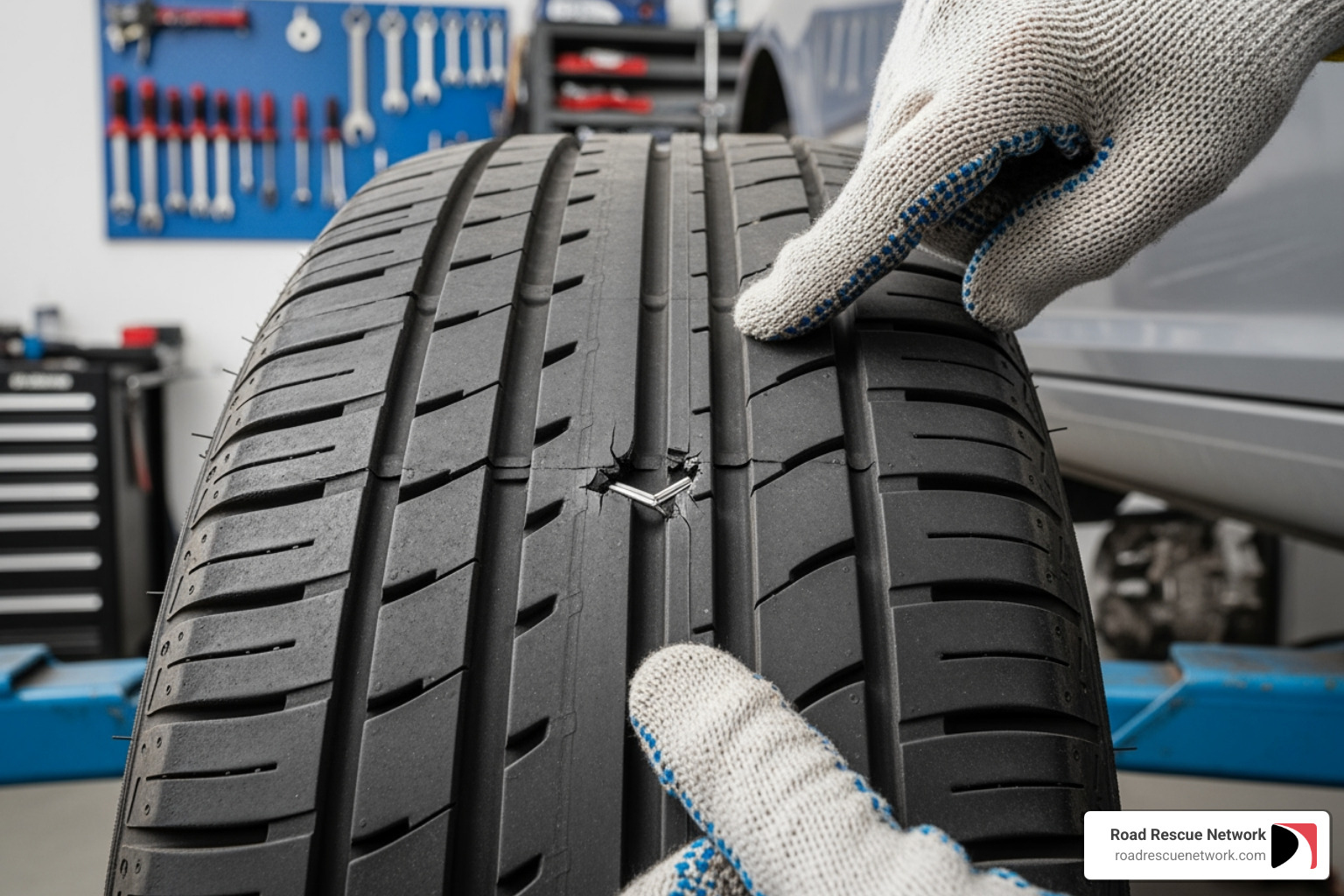
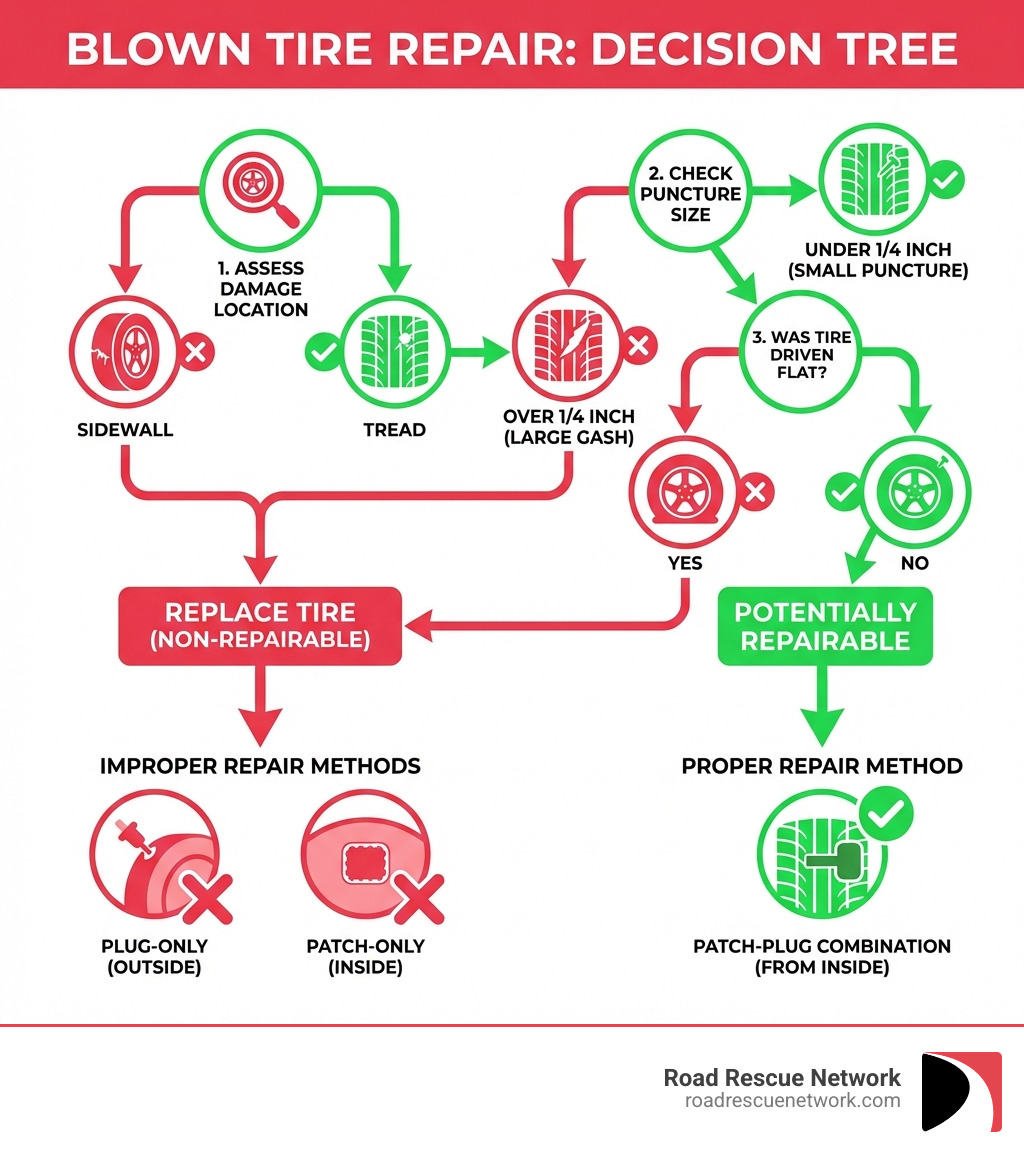
- YES – Small punctures in the tread (under 1/4 inch) can often be repaired with a professional patch-plug combination
- NO – Sidewall damage, large gashes, or tires driven on while flat cannot be safely repaired
- MAYBE – Requires professional inspection if the tire was driven only briefly while flat or has minor tread damage
- REPLACEMENT NEEDED – If you see bulges, blisters, or the tire has multiple previous repairs
Whether you’re driving along, jamming to your favorite song, when suddenly your car starts acting weird–or you walk out to find a completely flat tire in your driveway–the sinking feeling is the same. With over 220 million flat tires occurring each year among 230 million US drivers, you’re not alone in facing this frustrating situation.
The difference between a simple flat and a blown tire matters. A flat tire slowly loses air over time, while a blowout happens suddenly–often with a loud bang–causing rapid air loss that can make your vehicle pull sharply to one side. Understanding this distinction helps you determine your next steps.
The most important thing to know: Not every blown tire can be repaired. The location and extent of damage determine whether you’re looking at a $5-$40 repair or a $50-$150 replacement.
Here’s the reality: If the damage is on the sidewall, if you drove on the flat tire, or if the puncture is larger than 1/4 inch, you’re replacing that tire–period. The sidewall has no reinforcing cords like the tread does, so any patch won’t hold, and the tire becomes a safety hazard waiting to fail at highway speeds.
But if you caught it early, the damage is in the tread’s “crown” area, and the puncture is small, a proper repair using a patch-plug combination can restore your tire safely and save you significant money.
I’m Byron Tarlton, founder of Road Rescue Network, and I’ve spent over two decades in the roadside assistance and towing industry, coordinating thousands of emergency tire repairs and replacements across the country. Throughout my career building Interstate Fleet Services and Road Rescue Network, blown tire repair has been one of the most common–and most misunderstood–roadside emergencies I’ve encountered.
Blown tire repair definitions:
What to Do Immediately When a Tire Blows Out
Imagine this: You’re cruising down I-95 near Miami, listening to your favorite tunes, when suddenly, your car lurches, and you hear a loud “POP!” followed by a frantic flapping sound. That’s a tire blowout, and it can be incredibly startling. Our first piece of advice? Don’t panic! Staying calm is the most important step, as it helps you maintain control of your vehicle and make sound decisions.
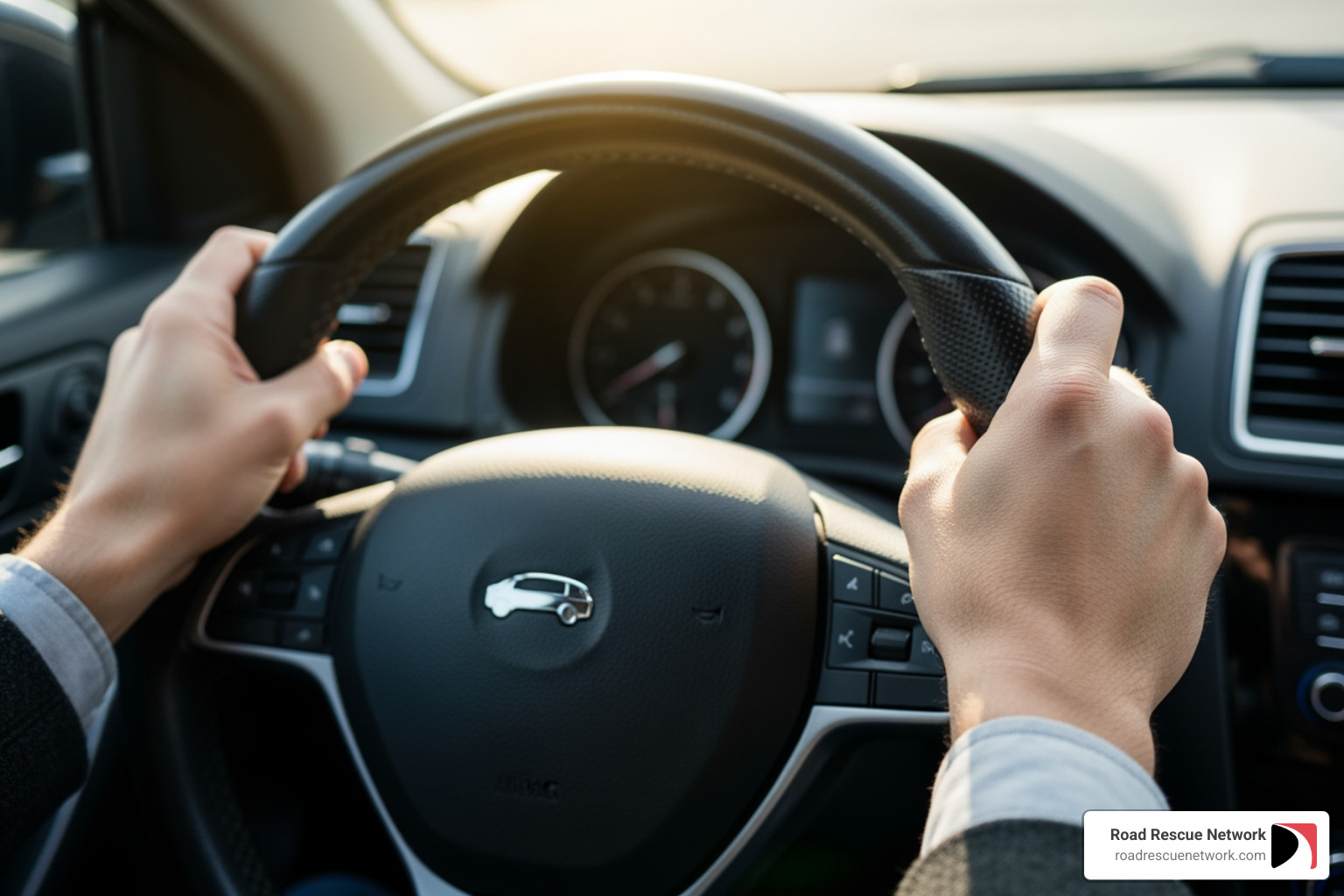
When a tire blows out, your vehicle will likely pull sharply in the direction of the blown tire. Our instinct might be to slam on the brakes, but resist that urge. Instead, keep both hands firmly on the steering wheel, easing off the accelerator gently. Make all your driving inputs gentle and deliberate. You need to drive through the blowout, slowly decreasing your speed and trying to maintain a straight path.
Once you’ve regained a measure of control, signal and pull over safely. Your goal is to keep calm and pull the vehicle over as far as you can, away from the flow of traffic. This might mean moving to the shoulder of a highway or finding a quiet side street in a city like Los Angeles or Chicago. Turn on your hazard lights immediately to warn other motorists of your situation.
After you’ve safely stopped, take a moment to assess the situation. Is there any visible damage beyond the tire itself? Sometimes a blowout can cause secondary damage to your wheel, fender, or even brake lines. This initial assessment helps us determine the best course of action for your blown tire repair. If you’re in a tricky spot, like a busy freeway in Houston, or feel unsafe, our Mobile Tire Repair in Florida | Road Rescue Network and other locations are just a call away, ready to assist.
Securing Your Vehicle and Ensuring Your Safety
Once you’ve safely pulled over, your next priority is securing your vehicle and ensuring everyone’s safety. This is crucial whether you’re attempting a DIY tire change or waiting for professional help.
First, engage your parking brake and turn off the engine. If you drive a manual transmission, put the car in gear. This prevents any unexpected movement. If you have wheel wedges, place them under the tires diagonally opposite the flat to add extra stability, especially if you’re on a slight incline.
Next, ensure all occupants are safe. If possible, have them exit the vehicle and move to a safe location away from traffic, such as behind a guardrail or a safe distance from the road. When waiting for help, it’s always best to stay farther off the road, behind your vehicle, rather than inside it or in front of it.
Finally, improve your visibility to other drivers. Turn on your hazard lights, and if you have reflective traffic triangles or flares, set them up. On high-speed roads, place them about 100 feet behind your vehicle to give approaching drivers ample warning. This simple step can prevent further accidents and keep you and your passengers safe while you deal with the blown tire repair.
The Realities of Blown Tire Repair: Can It Be Fixed?
When we talk about blown tire repair, the first question on everyone’s mind is always, “Can it be fixed?” The honest answer is: it depends entirely on the nature and location of the damage. Not all tire damage is created equal, and understanding the distinctions is key to making the right decision for your safety and your wallet.
Our technicians perform a thorough tire inspection to determine repairability. We look at two main factors: whether it’s a simple puncture or a full-blown blowout, and where the damage is located on the tire.
Punctures, often caused by nails or screws, usually result in a slow leak. A blowout, on the other hand, is a catastrophic failure, often leaving a large, ragged hole. The key difference in terms of repair is the extent of the damage. A small nail in the tread (the part of the tire that touches the road) is far different from a large gash or tear.
The most critical factor is the location of the damage. Sidewall damage–any injury on the side of the tire–is almost always unrepairable. The sidewall is designed to flex and absorb impact, but it lacks the reinforcing cords found in the tread. A patch won’t hold securely, and attempting a repair creates a significant safety hazard. As industry experts like Michelin and Kal Tire emphasize, sidewall damage immediately renders a tire irreparable.
Tread damage, however, offers more hope. Small punctures, typically 1/4 inch or smaller in diameter, located within the central “crown” area of the tread (not too close to the shoulder or sidewall), can often be safely repaired. But if the tire was driven on while flat, even a small puncture in the tread might become irreparable. Driving on a flat tire, even for a short distance, can shred the tire’s internal structure and sidewall, compromising its integrity beyond repair.
You might also wonder about run-flat tires. These specialized tires are designed to allow you to continue driving for a limited distance (typically up to 50 miles at speeds up to 50 mph) after a puncture, giving you time to reach a repair shop. However, even run-flats have limitations. If they’ve been driven on while completely flat, or if the damage is severe, they may also require replacement.
Here’s a quick overview to help you understand the repairability of different types of tire damage:
| Type of Damage | Repairable? | Notes |
|---|---|---|
| Small Puncture (Tread) | Yes | Punctures 1/4 inch (6mm) or smaller in the central tread area. Requires professional patch-plug. |
| Sidewall Puncture/Damage | No | Any damage to the sidewall (bulges, cuts, punctures) compromises structural integrity and cannot be safely repaired. |
| Large Gash/Cut (Tread) | No | Punctures larger than 1/4 inch (6mm) or irregular cuts compromise the tire’s structure. |
| Driven on While Flat | No | Even small initial punctures can cause internal damage (shredded sidewall, bead damage) if the tire was driven on with insufficient pressure. |
| Shoulder Puncture | No | The shoulder area, where the tread meets the sidewall, is too flexible for a safe, lasting repair. |
| Multiple Previous Repairs | No | If a tire has overlapping repairs or too many repairs in close proximity, its structural integrity is compromised. |
| Insufficient Tread Depth | No | Tires with less than 1.6 mm (2/32 inch) tread depth are considered worn out and should be replaced, regardless of puncture. Shops may refuse repair due to liability. |
| Blisters/Bulges | No | Indicate internal structural damage (e.g., separated plies) and are extremely dangerous. Immediate replacement is necessary. |
Understanding Your Blown Tire Repair Options
When a tire is repairable, it’s crucial to understand what constitutes a proper and safe repair. According to the National Highway Traffic Safety Administration (NHSTA) and the Tire Industry Association (TIA), the only method to properly repair a tire puncture is a combination repair, often called a patch-plug. This involves filling the injury channel with a repair stem (the plug) and backing it with a repair patch from the inside of the tire.
Why is this combination so important? A simple plug, inserted from the outside, might stop the air leak, but it doesn’t seal the inner liner of the tire. This can allow moisture and air to seep into the tire’s internal structure, leading to rust on steel belts or degradation of other materials, which can eventually cause tire failure. A patch-only repair, while sealing the inside, doesn’t fill the injury channel, leaving a path for moisture to enter. The patch-plug, however, addresses both issues, sealing the injury completely and maintaining the tire’s integrity.
Our technicians follow these stringent industry guidelines. The process involves:
- Removing the tire from the wheel: This is non-negotiable. An external plug without internal inspection is a temporary fix at best, and potentially dangerous.
- Thorough internal and external inspection: We check for hidden damage, like internal cord separation, which can occur if the tire was driven on while flat.
- Preparing the injury: The puncture is cleaned and drilled to ensure a smooth channel for the plug.
- Applying the patch-plug: A one-piece repair unit (combining the plug and patch) is typically used. For punctures with an angle exceeding 35 degrees, a two-piece combination repair might be necessary. This is applied with a chemical vulcanizing agent for a permanent bond.
- Rebalancing the tire: After repair, the tire is remounted, inflated to manufacturer specifications, and rebalanced to ensure smooth operation.
A proper repair is only possible if the puncture is within the tread area and generally no larger than 1/4 inch (for passenger tires). Some shops, like our partners for Tire Change in Texas | Road Rescue Network, may also consider the tire’s overall condition and tread depth. If your tire has less than 1.6 mm of tread depth, it’s considered worn out, and most reputable shops will advise replacement over repair due to safety and liability concerns.
When Replacement is the Only Answer
Sometimes, no matter how much we wish we could save a tire, replacement is the only safe option. This is especially true for a severe blown tire repair.
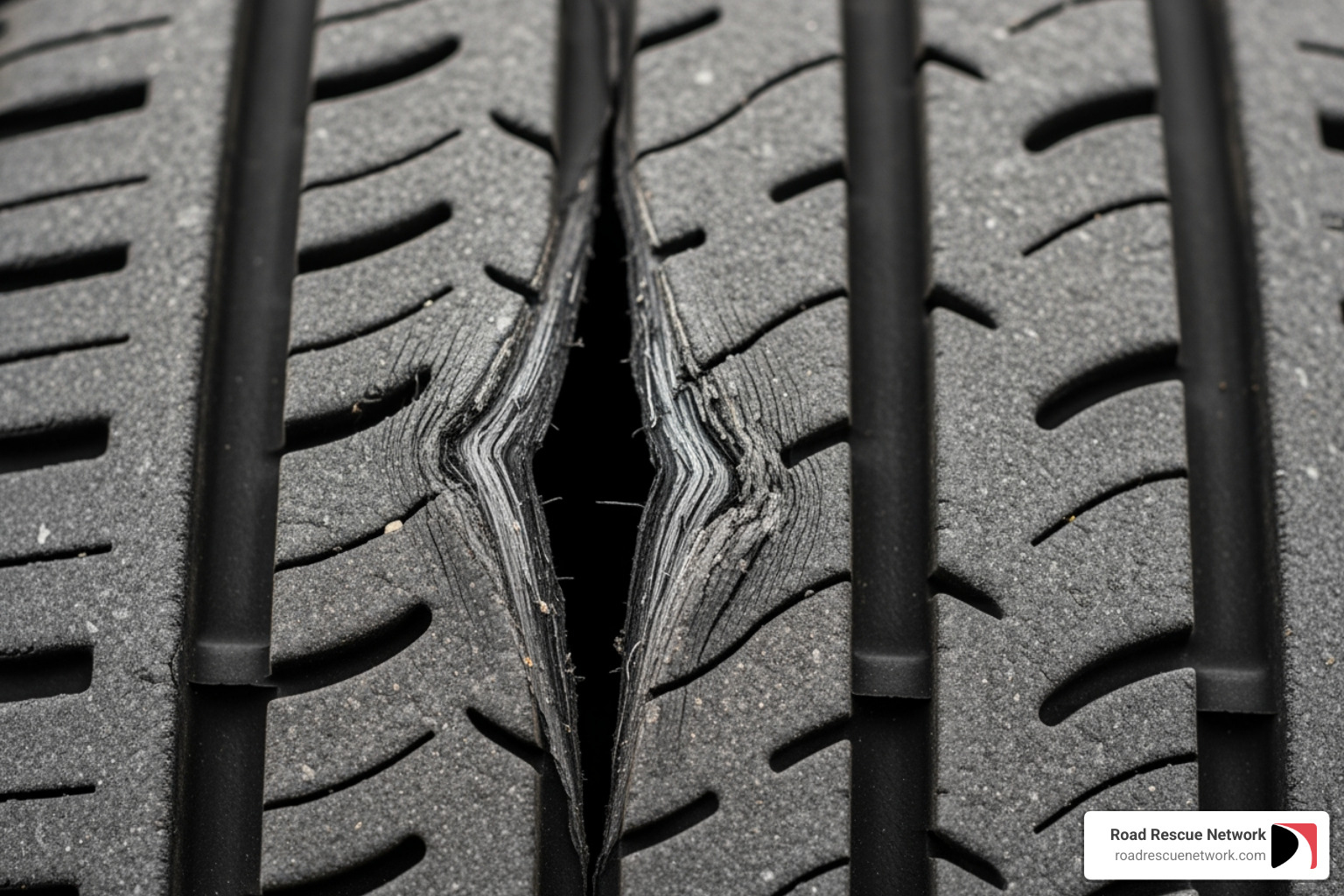
Here are the definitive signs that your tire is beyond repair and needs to be replaced:
- Sidewall Punctures or Damage: As we discussed, any damage to the sidewall–be it a puncture, cut, bulge, or blister–renders the tire unsafe and unrepairable. The sidewall is not designed to withstand repairs and its structural integrity is paramount for safe driving.
- Large Gashes or Cuts: If the damage is a large gash, cut, or a puncture bigger than 1/4 inch (6mm), the tire’s internal structure has been too compromised for a safe repair. Think of it like a large rip in fabric–a small stitch might work, but a big tear needs a new piece of cloth.
- Tires Driven on While Flat: This is a common scenario after a blowout. If you drove on the tire for any significant distance while it was flat, the internal components, especially the sidewall, likely suffered irreparable damage from flexing without air pressure. This kind of damage isn’t always visible from the outside but makes the tire extremely dangerous.
- Internal Structural Damage: Sometimes, damage isn’t from a puncture but from hitting a pothole or curb, causing internal separation of the tire’s plies. This can manifest as a bulge or bubble on the sidewall or tread. These are ticking time bombs and require immediate replacement.
- Multiple Previous Repairs: While a tire can sometimes have one proper repair, too many repairs, or repairs that are too close together, compromise the tire’s overall strength. Our technicians will assess previous repairs to determine if a new one would be safe.
- Insufficient Tread Depth: Even if a puncture is repairable, if the tire’s tread is worn down below 1.6 mm (2/32 inch), it’s at the end of its life. Driving on bald tires is dangerous, reducing traction and increasing the risk of hydroplaning. Many shops will refuse to repair such a tire, and we strongly advise against it for your safety.
In these situations, attempting a repair would be a gamble with your safety and the safety of others on the road. We always prioritize your well-being, and sometimes that means recommending a new tire.
How to Safely Change a Tire After a Blowout
If your tire is beyond blown tire repair and you have a spare, knowing how to change it safely is a valuable skill. Even if you’re a AAA member or plan to call for roadside assistance, understanding the process can empower you and help you know what to expect.
First things first: locate your tools. You’ll need a jack, a lug nut wrench, and your spare tire. These are usually stored in the trunk, under the cargo area, or sometimes underneath the vehicle itself. Check your owner’s manual if you can’t find them–it’s your car’s instruction book and often provides specific guidance on where to find these items and how to use them for your particular model.
A critical point to remember is the type of spare tire you have. Many modern cars no longer come with a full-size spare. Instead, they might have a compact temporary spare, affectionately known as a “donut.” These donuts are lighter and smaller, contributing to better fuel efficiency for the car, as noted by Consumer Reports. However, they come with significant limitations:
- Speed Limit: Do not drive over 50 mph on a donut spare.
- Distance Limit: They are only intended for short distances, typically not more than 50 miles, just enough to get you to a repair shop.
- Handling Differences: Due to their smaller size, donuts can affect your car’s handling, braking, and stability. Drive cautiously.
Always check the pressure in your spare tire regularly, as they can lose air over time just like your primary tires. There’s nothing worse than getting a flat only to find your spare is also flat!
If you’re in a situation where you don’t have a spare, or if you’re uncomfortable changing the tire yourself, help is just a phone call away. Companies like Road Rescue Network offer Mobile Tire Repair in New York | Road Rescue Network and other major cities, bringing the service directly to you. We understand that sometimes, the safest and most efficient option is to call for professional assistance. After all, AAA responds to over 3.5 million calls about flat tires a year, so you’re in good company!
Step-by-Step Tire Changing Instructions
Once you’ve safely pulled over and gathered your tools, it’s time to get to work. Follow these steps carefully to change your tire:
- Loosen Lug Nuts: While the vehicle is still on the ground, use your lug wrench to loosen the lug nuts on the flat tire. Turn them counter-clockwise, about a quarter to a half turn, until they break free. We do this before lifting the car because the weight of the vehicle helps keep the wheel stable, preventing it from spinning while you apply force. If your car has a hubcap, you may need to remove it first to access the lug nuts.
- Position the Jack and Raise the Vehicle: Consult your owner’s manual to find the correct jack points on your vehicle’s frame. These are typically reinforced areas designed to safely support the car’s weight. Place the jack securely under the designated point. Begin to raise the vehicle slowly and steadily until the flat tire is a few inches off the ground. Never place any part of your body under the vehicle while it is supported only by a jack.
- Remove the Flat Tire: Once the tire is lifted, finish unscrewing the lug nuts by hand and place them in a safe spot where they won’t roll away (like your hubcap, if you removed it). Carefully pull the flat tire straight off the wheel studs and set it aside, preferably under the vehicle frame as an extra safety measure in case the jack fails.
- Mount the Spare Tire: Line up the holes on your spare tire with the wheel studs on your vehicle. Carefully push the spare onto the studs. Once it’s seated, hand-tighten the lug nuts back onto the studs. It’s helpful to tighten them in a star or crisscross pattern to ensure the wheel is seated evenly.
- Lower the Vehicle and Tighten Lug Nuts: Slowly lower the jack until the spare tire is resting on the ground, but not yet bearing the full weight of the vehicle. Now, use your lug wrench to tighten the lug nuts firmly. Again, use a star pattern, tightening each nut a little at a time, moving across the wheel, rather than fully tightening one nut at once. This ensures even pressure and prevents warping. Once the lug nuts are snug, fully lower the vehicle and remove the jack. Give the lug nuts one final, firm tightening with the wrench.
- Check Spare Tire Pressure: Before driving off, it’s a good practice to check the air pressure in your newly installed spare tire using a tire gauge. Inflate it to the manufacturer’s recommended PSI, which is often higher for temporary spares (e.g., 60 PSI for many donuts). If you don’t have a gauge or pump, drive slowly to the nearest service station to have it checked.
Remember to gather all your tools and the flat tire and secure them in your trunk. Your flat tire will need professional attention, whether it’s for blown tire repair or replacement.
Frequently Asked Questions about Blown Tires
We encounter many questions about blown tire repair and flat tires in general. Here are some of the most common ones we hear, answered with our expert insights.
Can a tire that has been driven on while flat be repaired?
In most cases, no. This is one of the most critical distinctions. While a small puncture might have initially caused the flat, driving on a tire with insufficient or no air pressure causes severe, irreversible internal damage. The sidewalls, designed to flex under normal inflation, will collapse and rub against themselves, shredding the internal structure and potentially damaging the bead (the part that seals against the wheel). This damage is often not visible from the outside but completely compromises the tire’s integrity, making any repair unsafe. Even if the initial puncture was tiny, if you drove on it flat, you’re almost certainly looking at a replacement.
How fast and far can I drive on a temporary “donut” spare?
Temporary “donut” spare tires are designed for emergency use only, not for long-term driving. The general rule of thumb is to drive no faster than 50 mph and no farther than 50 miles. These tires have a smaller diameter, thinner tread, and different construction than your regular tires, which affects your vehicle’s handling, braking, and stability. Exceeding these limits can be dangerous and can also damage the spare tire, your vehicle’s drivetrain, or other components. Our best advice is to get to the nearest tire shop for a proper tire repair or replacement as soon as possible.
Is it safe to plug a blown tire myself?
While DIY tire plug kits are widely available and can provide a temporary fix, they are generally not recommended for a permanent or safe blown tire repair, especially after a blowout. These kits typically involve inserting a rubberized string into the puncture from the outside. The problem is, this method doesn’t allow for a thorough internal inspection of the tire, which is crucial to ensure there’s no hidden damage. Also, these plugs don’t properly seal the inner liner, potentially allowing moisture to enter and degrade the tire’s internal structure over time, leading to a dangerous failure. A proper, permanent repair, as recommended by industry standards, requires dismounting the tire, inspecting it internally, and using a patch-plug combination from the inside. For your safety, we always recommend professional assessment and repair.
Conclusion
Dealing with a blown tire is never fun, but with the right knowledge and preparation, it doesn’t have to be a nightmare. We’ve walked through the immediate steps to take, the crucial differences between repairable and unrepairable damage, and how to safely change a tire. The key takeaways for blown tire repair are always prioritizing safety, understanding the limitations of repairs, and knowing when to call in the professionals.
Proactive maintenance plays a huge role in preventing blowouts and flats. Regularly checking your tire pressure, inspecting your tires for wear and tear, and addressing small punctures promptly can save you a lot of hassle and expense down the road. Remember to check your spare tire’s pressure too—it’s easy to overlook!
Your safety is our top concern. If you’re ever in doubt about the repairability of your tire, the safety of changing it yourself, or simply need fast, reliable help, don’t hesitate to reach out. Road Rescue Network is here to provide on-demand roadside assistance, connecting you instantly with local rescuers. For fast and reliable assistance with a blown tire, get help from our mobile tire repair services. We’re available 24/7 with no memberships or hidden fees, ready to get you back on the road safely, whether you’re in New York, Los Angeles, Chicago, Houston, Phoenix, or any of the hundreds of cities we serve across the country.