
Membership-based roadside clubs are no longer the fastest or most transparent way to get a tow in 2026. You're likely here because you're stuck on a shoulder, staring at a dead engine, and wondering exactly how much does towing cost before you commit to a service. It's frustrating to feel like you're at the mercy of a dispatcher who won't give you a straight price. We understand that stress. You want to get home safely without being exploited by predatory emergency surcharges.
According to 2024 industry data, nearly 40% of drivers report feeling overcharged during roadside emergencies due to hidden fees. You deserve to move with confidence and know exactly what you're paying for. This guide breaks down the standard "hookup plus mileage" formula so you can secure help without the sticker shock. We'll compare the price difference between light and heavy-duty hauls and show you how to find a Rescuer who arrives in minutes, not hours. By the end of this article, you'll have the tools to get back on the road for a fair, pay-per-use price.
Key Takeaways
- Master the standard towing formula of hookup fees and mileage to accurately estimate your expenses before a truck even arrives.
- Learn exactly how much does towing cost based on your vehicle size and why light-duty cars have different pricing than heavy equipment.
- Spot hidden variables like after-hours surcharges and location difficulty that can unexpectedly inflate your roadside bill.
- Decide if expensive annual memberships are worth it compared to on-demand platforms that offer transparent, pay-per-use pricing.
- Connect with vetted Rescuers who provide fast, nationwide assistance in minutes, not hours, ensuring you never overpay for help.
Table of Contents
- Understanding the Towing Cost Formula: Hookup Fees and Mileage
- Light, Medium, and Heavy-Duty Towing: Why Vehicle Size Matters
- Hidden Variables and Surcharges: Beyond the Standard Quote
- Towing Insurance vs. Pay-Per-Use: Which is Actually Cheaper?
- Fast, Transparent Towing with Road Rescue Network
Understanding the Towing Cost Formula: Hookup Fees and Mileage
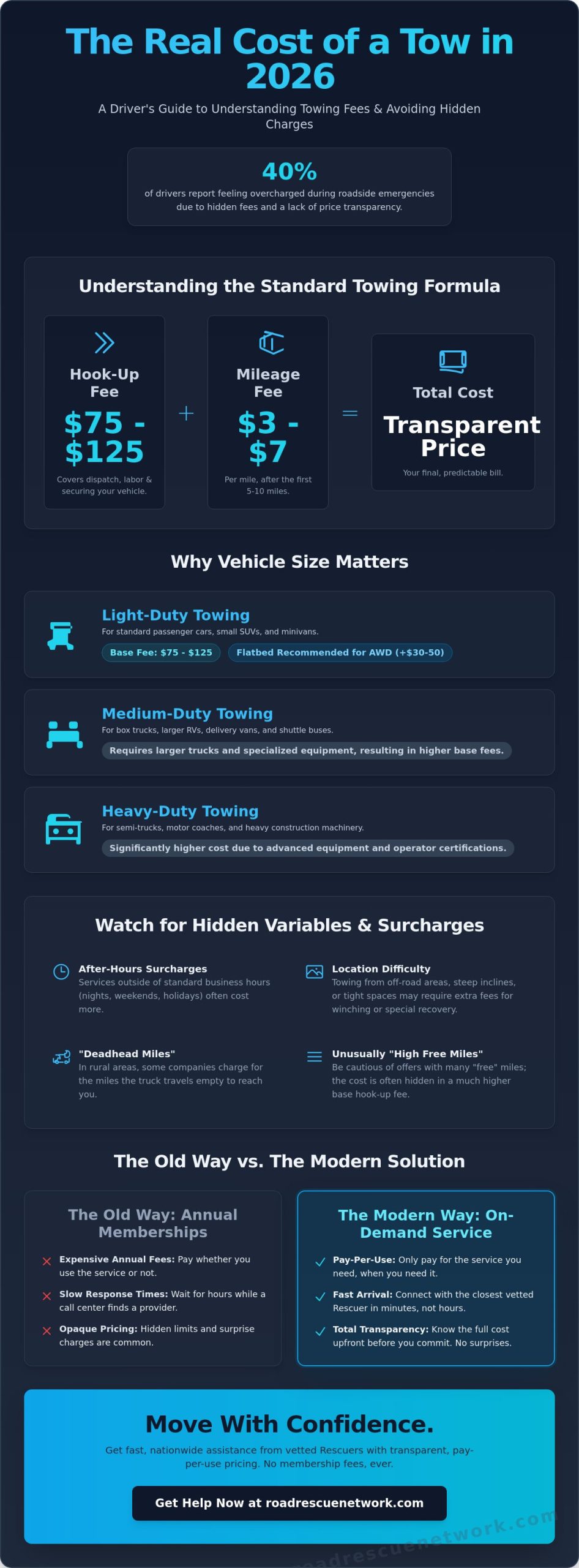
When you're stuck on the shoulder, the first question on your mind is how much does towing cost. You want a fair price and a fast solution. Most professional towing services use a standard formula to calculate your final bill. This includes a base hookup fee and a per-mile charge. Understanding these components helps you move with confidence and avoid surprises when the Rescuer arrives. National data for 2026 shows that average hookup fees for light-duty vehicles currently range from $75 to $125. This price covers the immediate costs of getting a truck to your location and securing your vehicle for transport.
The Base Hookup Fee: What You Pay for Dispatch
The hookup fee is a non-negotiable part of professional roadside service. It ensures that a qualified Rescuer is available to help you in minutes, not hours. This fee covers the dispatch technology, insurance, and the physical labor of connecting your car to the truck. For a standard light-duty hookup, the equipment typically includes high-strength chains, wheel straps, and specialized lighting for safety.
Rescuers use different types of tow trucks depending on your specific needs. Whether it's a flatbed or a wheel-lift truck, the base fee remains the foundation of the quote. Modern GPS dispatch technology plays a massive role in keeping these costs competitive. By tracking the fleet in real time, the platform identifies the closest Rescuer to your GPS coordinates. This efficiency reduces the time you spend waiting and helps stabilize the base rate by minimizing unnecessary fuel consumption.
Mileage Charges: How Distance Impacts the Bottom Line
Once the vehicle is secured, the distance of the tow determines the remainder of the cost. Most service providers include the first 5 to 10 miles of transport within the base hookup fee. After you exceed that initial distance, you can expect to pay a per-mile rate. These rates typically fall between $3.00 and $7.00 per mile for local tows. If you require long-distance transport over 50 miles, some companies may offer a slightly lower per-mile rate, though the total cost will naturally be higher. For those who need to move a car across the country rather than just to a local shop, it is often more cost-effective to check out GAATCO for professional vehicle shipping.
You should also be aware of how geography affects your quote. "Deadhead miles" is a term defining the distance a tow truck must travel empty to reach your vehicle from its starting point. In remote or rural areas, some companies add a surcharge for these miles. To estimate your total before the truck arrives, follow these steps:
- Identify the base hookup fee (usually $75 to $125).
- Determine the total distance to your destination.
- Subtract the "free miles" included in the base fee (typically 5 to 10 miles).
- Multiply the remaining miles by the per-mile rate.
Be cautious of quotes that promise an unusually high number of "free miles." In the towing industry, these costs are often baked into a significantly higher base fee. A transparent provider will break down these costs clearly so you know exactly what you're paying for before the hookup begins.
Light, Medium, and Heavy-Duty Towing: Why Vehicle Size Matters
When you call for help, the first question a dispatcher asks is what you are driving. This isn't just small talk. The size and weight of your vehicle determine the equipment needed and, ultimately, how much does towing cost for your specific situation. Towing companies categorize vehicles into three main classes to ensure they send a Rescuer with the right tools for a safe recovery.
- Light-duty: Standard passenger cars, small SUVs, and half-ton pickups.
- Medium-duty: Box trucks, delivery vans, shuttle buses, and larger RVs.
- Heavy-duty: Semi-trucks, trailers, motor coaches, and heavy construction machinery.
The heavier the vehicle, the more specialized the "Rescuers" must be. Heavy-duty jobs require advanced certifications and equipment that costs significantly more to maintain and operate than a standard flatbed.
Passenger Vehicle and Light-Duty Costs
Most roadside breakdowns involve light-duty vehicles. For a standard tow in 2026, hook-up fees typically range from $75 to $125. However, modern vehicle designs often require specific handling. If you drive an All-Wheel Drive (AWD) vehicle or a car with very low ground clearance, a flatbed truck is the safest option. Flatbed towing is the preferred method because it keeps all four wheels off the ground, preventing transmission damage. While it might add $30 to $50 to the base price, it protects your investment. You should also be aware of state towing laws that limit how much companies can charge for storage and after-hours releases.
Heavy-Duty and Semi-Truck Towing Expenses
Moving a semi-truck or a loaded tractor-trailer is a massive undertaking. The equipment involved, such as "rotators" or heavy wreckers, can cost upwards of $1 million. This high overhead means that heavy-duty towing is rarely charged at a flat rate. Instead, you'll likely see hourly rates starting at $250 or more. The process is labor-intensive. Rescuers often have to perform air line hookups or driveshaft removals just to get the truck ready to move. Because these expenses add up fast, it is often smarter to look for alternatives. A Mobile Truck Repair service can often fix mechanical issues right on the shoulder, saving you the high cost of a heavy-duty tow and getting you back on schedule faster.
Understanding these categories helps you provide better information when you call for assistance. It ensures the right truck arrives the first time so you aren't left waiting. If you find yourself stranded, don't stress yourself out. You can connect with a Rescuer in seconds to get an accurate estimate of how much does towing cost for your specific vehicle type and location.
Hidden Variables and Surcharges: Beyond the Standard Quote
Understanding how much does towing cost requires looking past the base hook-up fee. A standard quote often covers a simple pickup on a paved surface during business hours. If your car won't roll because of a locked transmission or broken axle, a Rescuer must use dollies. These specialized wheel sets lift the tires completely off the ground to prevent drivetrain damage. This equipment requires extra setup time and physical labor. You might also encounter "standby time" charges if the Rescuer waits at the scene for more than 15 minutes. This often happens while waiting for police to clear a scene or for you to find your insurance documents.
Location plays a massive role in the final invoice. A pickup on a wide highway shoulder is straightforward. However, a vehicle stuck in a cramped parking garage or on a narrow mountain pass requires more precision. These "difficult access" scenarios often trigger additional fees because they increase the risk to the Rescuer and the equipment. Don't stress yourself out; being clear about your location helps the dispatcher send the right tools the first time.
After-Hours, Weekend, and Holiday Rates
Emergency help doesn't follow a 9-to-5 schedule. Providing 24/7 coverage means companies pay staff higher shift differentials to stay ready at 3:00 AM or on Thanksgiving. Labor costs for roadside technicians rose by 4.2% annually leading into 2026, which directly impacts these premiums. Always ask if a "night rate" or "holiday surcharge" applies before the dispatch is confirmed. During peak demand periods like winter storms, the value of "minutes, not hours" response times is the priority. You're paying for the security of a fast arrival when every second counts and most shops are closed.
Winch-Outs and Recovery: The Cost of Getting Unstuck
A standard tow involves moving a vehicle that's already on a flat, accessible surface. If your car is in a ditch, mud, or deep snow, you need a winch-out. This is a recovery service, not a simple tow. The fee typically depends on how far the vehicle has traveled from the pavement. Most standard trucks carry 50 to 100 feet of cable. If the Rescuer needs to use extensions or multiple snatch blocks to create a safe pull angle, the price goes up. Winching is often billed by the hour or by the half-hour increment to cover the technical expertise required. These variables are why the question of how much does towing cost can't always be answered with a single number until the Rescuer assesses the scene.
Towing Insurance vs. Pay-Per-Use: Which is Actually Cheaper?
When you're stuck on the shoulder of a busy highway, the first thing you wonder is how much does towing cost. For many drivers, the answer depends on whether they've been paying for a membership they rarely use. The choice between an annual subscription and a pay-per-use model isn't just about convenience; it's a financial strategy. Traditional memberships bank on the fact that most members won't call for help in a given year. On-demand platforms flip this script, ensuring you only spend money when a Rescuer is actually on the way to help you.
The Real Cost of Annual Roadside Memberships
Annual roadside memberships often feel like a safety net, but they come with a recurring price tag that adds up quickly. Top-tier memberships in 2026 typically range from $60 to $165 per year. If you go five years without a breakdown, you've spent up to $825 without receiving a single service. Many of these plans also include strict limitations. Basic tiers often cap "free" towing at just 5 miles. If you need a 15-mile tow, you'll still pay out-of-pocket for the extra distance. During high-volume weather events, membership holders frequently face wait times exceeding three hours because the dispatch systems prioritize volume over localized efficiency.
Why On-Demand Roadside Assistance Saves Money
The pay-per-use philosophy is built for the modern driver. You don't pay for "what ifs," you only pay for results. This model eliminates monthly dues and hidden annual fees entirely. By using advanced GPS technology, on-demand platforms connect you to the closest available Rescuer in real time. This proximity is vital because it directly impacts how much does towing cost by reducing the "hook fee" and travel distance charges. You get a transparent price quote in seconds, allowing you to move forward with confidence instead of waiting on hold for an operator. This nationwide network approach ensures help is available in minutes, not hours, regardless of your location.
Don't let a breakdown ruin your day or your budget. If you need a Rescuer right now, get professional Roadside Assistance without the membership hassle.
Choosing on-demand service means you keep your money in your pocket until the moment you need a professional. It's a faster, more transparent way to handle emergencies. You get the same high-quality service from a nationwide network of professionals without the burden of a contract. This modern approach to roadside help ensures you stay in control of your expenses and your time.
Ready to get back on the road? Request a Rescuer now and only pay for the service you need.
Fast, Transparent Towing with Road Rescue Network
When you're stranded on the shoulder of a busy highway, you don't have time to wonder how much does towing cost or wait for an insurance representative to authorize a dispatch. Road Rescue Network provides nationwide coverage for any vehicle, anywhere, at any time. We've built a platform that removes the friction from roadside emergencies by connecting you with a powerful network of professionals. There are no expensive memberships, no hidden fees, and no waiting for "approval" from a corporate office. You get the help you need exactly when you need it.
Our Rescuers are ready to move at a moment’s notice. We call them Rescuers because they do more than just drive a truck; they're vetted professionals dedicated to getting you out of a tough spot safely. Whether you're in a rural area or a major city, our technology identifies the closest available help to ensure we arrive in minutes, not hours. This speed is a core part of our mission to provide the nation's most advanced roadside platform.
Our 3-Step Process for Instant Help
We designed our system for speed and simplicity. You can secure help from your mobile device without the stress of a long phone call or a confusing automated menu. Our digital-first approach ensures accuracy and efficiency from the first click.
- Step 1: Click "Get Help" on our platform and enter your vehicle details and location. This allows us to match you with the right equipment for your specific car or truck in seconds.
- Step 2: Receive transparent pricing and confirm your dispatch. You'll know the total before you commit, so there are no surprises or hidden surcharges when the Rescuer arrives.
- Step 3: Track your Rescuer in real-time. You'll see exactly where they are and their estimated arrival time as they head toward your location, giving you peace of mind while you wait.
Reliability You Can Count On
Our network is equipped to handle every type of roadside challenge. We manage everything from light-duty lockouts and flat tires to heavy-duty mobile truck repair for commercial drivers. Every Rescuer is a verified professional who has passed our security and quality checks. This gives you the security of knowing your Rescuer is a trusted partner you can rely on in an emergency.
We understand that a breakdown is more than just a mechanical failure; it's a disruption to your life or business. That's why we focus on calm authority and efficiency. Instead of wondering how much does towing cost in a moment of panic, you can get a clear answer and a fast solution. We're the modern solution for drivers who value their time and safety. Move with confidence knowing that we're always on the way.
Get a transparent towing quote now and get back on the road!
Take Control of Your Roadside Experience
Navigating the logistics of a breakdown shouldn't feel like a guessing game. Understanding how much does towing cost in 2026 starts with the basic formula of hookup fees combined with per-mile charges. Industry benchmarks indicate that standard hookup rates often fall between $75 and $125, while heavy-duty recoveries require specialized equipment and higher labor costs. You can save money by choosing transparent providers instead of paying for a monthly membership you might never use. It's about being prepared without being overcharged.
Road Rescue Network offers a nationwide network of vetted Rescuers ready for 24/7 dispatch. We handle everything from light-duty cars to heavy-duty commercial vehicles with a focus on speed and reliability. Our pay-per-use model means you only pay for the help you actually receive. We aim for minutes, not hours, so you can get back to your day without the stress of hidden surcharges. Trust a platform designed to be your most dependable partner on the road.
GET HELP NOW: Fast Towing and Roadside Assistance Without a Membership
You've got this, and we're here to make sure you're never stranded for long.
Frequently Asked Questions
How much does it cost to tow a car 5 miles versus 50 miles?
Knowing how much does towing cost for different distances is vital, as a 5-mile tow averages $75 to $125 while a 50-mile trip can reach $600. Most companies charge a base hookup fee plus a per-mile rate that averages $4 to $7 in 2026. This means a 50-mile journey involves higher fuel and labor costs. You'll save money by choosing a Rescuer who is already nearby to minimize extra mileage fees.
Is towing more expensive at night or on weekends?
Towing is often 20% to 50% more expensive during after-hours periods, which include nights, weekends, and holidays. These surcharges cover the higher labor costs for on-call Rescuers working outside standard 9-to-5 business hours. You should expect an additional after-hours fee ranging from $50 to $150 depending on your specific location. Emergency response at 3:00 AM requires specialized staffing that drives these costs upward.
Does my car insurance cover the cost of a tow?
Most standard car insurance policies cover towing only if you've specifically added Roadside Assistance or Towing and Labor coverage. According to 2024 industry data from the Insurance Information Institute, this add-on typically costs less than $20 per year. If you don't have this rider, you'll likely pay the full cost out of pocket. Check your policy's declarations page to see if you're covered before requesting a Rescuer.
What is the average hookup fee for a semi-truck?
The average hookup fee for a semi-truck or heavy-duty vehicle ranges from $200 to $500 in 2026. Heavy-duty towing requires specialized equipment like integrated tow trucks or rotators that often cost over $500,000 to purchase. Because of the technical skill and massive machinery involved, these base rates are significantly higher than standard passenger vehicle fees. Total costs will rise based on the complexity of the recovery.
Can I get a tow if I don’t have a roadside assistance membership?
You can absolutely get a tow without a membership by using an on-demand platform like Road Rescue Network. Traditional clubs often require a 24-hour waiting period after you join before you can request help. On-demand services allow you to connect with a Rescuer instantly and pay only for the help you need. This eliminates annual fees and provides a faster solution when you're stranded on the shoulder.
What factors can cause my towing price to increase after the initial quote?
Several factors can increase how much does towing cost after your initial quote, including wait time at the scene or the use of specialized tools. If a Rescuer spends more than 15 minutes preparing your vehicle, you might face labor fees billed in 30-minute increments. Other variables include using dollies for 4WD vehicles or extra mileage if your destination changes mid-trip. Clear communication helps avoid these surprises.
How much does a winch-out service cost if I am stuck in mud?
A standard winch-out service for a vehicle stuck in mud typically costs between $75 and $250 per hour. This fee covers the use of a motorized cable and the expertise of a Rescuer to safely pull your car without damaging the frame. If your vehicle is more than 50 feet from a paved surface, costs increase because additional cable extensions or a second truck are required for the recovery.
Is a flatbed tow truck more expensive than a traditional hook and chain?
Flatbed towing is generally $20 to $50 more expensive than traditional hook and chain methods, but it's the safest option for most modern cars. Flatbeds prevent wear on your transmission and protect the bumpers from road debris. Many Rescuers now use flatbeds exclusively for AWD or electric vehicles to prevent drivetrain damage. While it costs slightly more, it saves you from expensive repair bills later.


