01
OEM diagnostic software
Carrier and Thermo King interfaces
Every controller fault. The two makes do not share codes, tooling, or configuration software — a tech carries both or serves half the fleet.
Need reefer repair in Anderson? We send a reefer mechanic for Thermo King and Carrier units, and do APU repair on the same call. Being this far from the next town changes the call — we bring what the symptom points to, because a second trip costs a day. US-36, US-35, and SR-67 all run through Anderson, so most of our calls come off one of those. Freight around here moves for outfits like Nestlé Distribution Center and Red Gold Tomato Products, which is work that runs on a schedule.
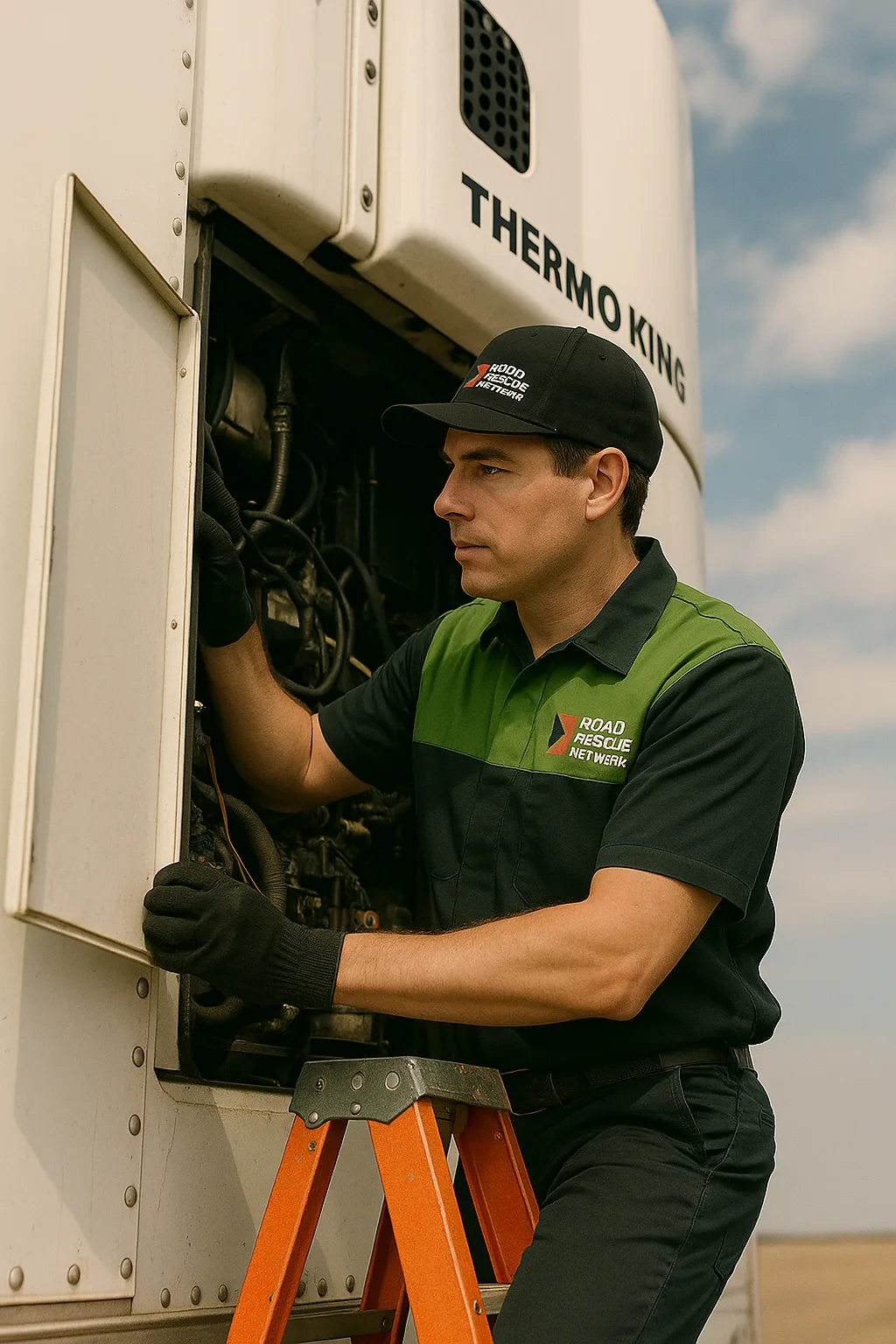
Refrigeration work is a licensed trade with its own tooling. A diesel mechanic with a socket set cannot legally or practically service a Anderson reefer circuit.
Carrier and Thermo King interfaces
Every controller fault. The two makes do not share codes, tooling, or configuration software — a tech carries both or serves half the fleet.
Certified recovery, vacuum, weighed charge
Any circuit opened. Refrigerant must be recovered rather than vented, and the charge weighed rather than guessed.
Heated-diode or infrared, plus UV dye
Low-charge and repeat top-off calls. Finding the leak is the repair; adding gas is a delay.
High/low side, micron gauge
Standard on all circuit work. Pulling a proper vacuum is what removes moisture before the new charge goes in.
Traceable calibration, downloadable
Verification and dispute work. An independent reading is what settles a rejected-load argument at the dock.
Common Carrier and Thermo King wear parts
Carried so routine failures finish on the first visit rather than becoming a second dispatch.
Coil cleaner, fin comb, wash gear
Capacity complaints in warm weather. Frequently restores full performance with no parts at all.
Standby testing, phase verification
Electric standby faults at docks and cold-storage yards.
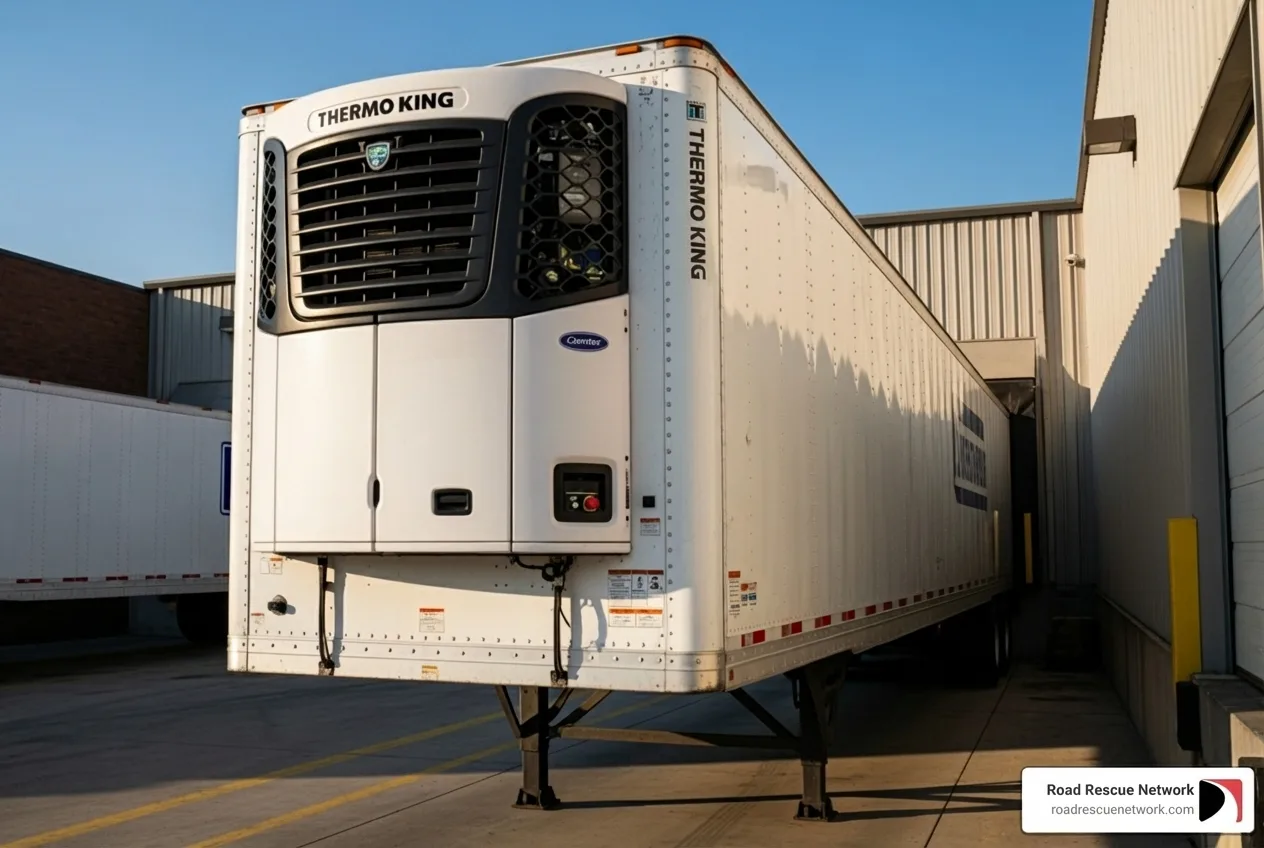
One call puts a reefer repair unit on the road to you anywhere in Anderson or out along US-36 and US-35. Tell us the road and which way you are pointed and we do the rest.
Carrier Transicold and Thermo King units diagnosed and repaired where the trailer sits across the Anderson metro. A reefer call is a cargo call — the clock started when the box temperature did.
Carrier and Thermo King both throw coded alarms, and the code numbering is not shared between them. A Anderson tech reads the actual controller rather than guessing from the symptom.
Carrier Advance and Micro-Link controllers, Thermo King SR and Premier microprocessors. Configuration corruption and firmware faults strand Anderson units that are mechanically perfect.
Return air, supply air, ambient, coil, and cargo probes. A failed sensor makes a healthy Anderson unit chase a temperature that was never real, then alarm out.
Continuous versus start-stop, cycle-sentry, fresh versus frozen range. A large share of Anderson "not holding temperature" calls are a unit configured for the wrong commodity.
Two-way monitoring so a Anderson fleet sees a drift before the driver does. The difference between a service call and a rejected load at the dock.
A failed pretrip is the unit telling you it will not survive the run. Worth clearing in a Anderson yard rather than discovering it 200 miles out with product aboard.
Carrier 05G and 06D, Thermo King X-series compressors. The most expensive component on the unit, and often the symptom rather than the cause of a Anderson failure.
Electronic leak detection, evacuation, and weighed-in charge. Topping off a Anderson unit without finding the leak means the same call again next week, and venting refrigerant is a federal violation.
Coil cleaning, fin repair, fan motor and grille service. Road debris and cardboard dust blind a coil, and a blinded coil in Anderson summer heat cannot reject the load.
TXV and electronic valve diagnosis. A metering fault gives you a unit that runs continuously, pulls fuel, and never reaches setpoint anywhere in Anderson.
Defrost initiation, termination, and drain heaters. An iced evaporator stops airflow entirely, so a Anderson frozen load warms up while the unit reports that it is running.
Filter-drier replacement and moisture removal after the system has been opened. Skipping it on a Anderson repair is how an acid problem starts eating the new compressor.
The small diesel driving the unit — Carrier's Kubota-based engines and Thermo King's Yanmar-based units. Serviced on its own hours, entirely separate from the tractor's schedule in Anderson.
A thrown belt stops the compressor while the engine keeps running, so a Anderson driver sees a unit that sounds fine and a box that is warming.
Filters, lines, and priming. The reefer has its own tank, it runs dry long before the tractor does, and a Anderson restart after a run-dry needs bleeding.
Glow plugs, preheat, and starter service. A Anderson unit that cranks and will not catch on a cold morning is usually preheat, not fuel.
The reefer carries its own battery and charging circuit. A dead reefer battery in a Anderson yard leaves the box unrefrigerated with a perfectly good tractor attached.
Shore-power operation, contactors, and phase issues. Lets a Anderson dock or cold-storage yard hold a loaded trailer without burning diesel or generating exhaust.
Worn seals let Anderson ambient air in continuously. The unit compensates, burns fuel, ices the coil, and eventually loses the fight — an inexpensive part with an expensive failure mode.
Punctured panels and delaminated insulation from forklift strikes. Wet insulation stops insulating, and a Anderson trailer with a soaked wall never holds frozen again.
Torn chutes and blocked returns. Product loaded tight against the bulkhead short-circuits the airflow, so the front reads perfect while the Anderson tail of the load spoils.
Blocked defrost drains put water on the floor, which refreezes and blocks airflow. Common on Anderson produce lanes running high humidity.
Recorder service and download. The temperature record is what a Anderson receiver uses to accept or reject the load, and a missing record can lose a claim you would otherwise win.
When the unit cannot be saved in time, the load moves. We line up Anderson cold storage and a replacement trailer before the product crosses its temperature threshold.
Rolling 30-day average dispatch-to-arrival, by service type, across the local rescuer network.
A reefer invoice looks like an HVAC invoice with a diesel engine attached, because that is what it is. Here is what a Anderson call is made of — and why the cargo, not the repair, usually sets the urgency.
Getting a refrigeration tech and a stocked van to the trailer. Billed once, separate from labor.
Pulling codes, verifying sensors, and confirming the actual fault. Charged as labor and worth every minute — a misdiagnosed compressor is the most expensive mistake on this list.
Refrigeration labor prices above general mechanical labor because it is a certified trade with its own tooling.
Charged by weight at current market. Prices swing hard with regulatory phase-downs, so this line moves year over year.
Sensors and belts are inexpensive. Compressors, controllers, and coils are not, and availability by make can drive the timeline more than the price.
Reefer failures do not respect business hours, and a loaded trailer will not wait until Monday. Expect the premium tier on most emergency calls.
Not a line item, but it drives everything. A frozen load with hours of thermal headroom is a different dispatch than fresh produce already drifting.
When the unit cannot be saved in time, moving the product is its own cost — and almost always less than the claim for losing it.
Units under OEM warranty may need dealer work to preserve coverage. Confirm before authorizing, because the wrong repair path voids it.
A top-off is cheap and temporary. Finding and fixing the leak costs more once and stops the repeat call — and venting refrigerant is a federal violation, not a shortcut.
A unit that must be unloaded or repositioned to reach adds time. Yard space and a driver on hand keep this at zero.
Temperature downloads and written cause notes for a cargo claim. Frequently pays for the whole visit.
Road Rescue Network does not set a member operator's rates. What the network does is get a reefer-certified tech — not a general diesel mechanic — to the trailer with the right make's software, and the diagnosis separated from the repair on the quote.
The same crews that run Anderson also cover Indianapolis (45 mi), Muncie (33 mi) and Noblesville (35 mi), so a call from either side of reaches the same desk.
Each service links to local response times, rescuer coverage, and recent dispatched jobs in this metro.
A live map of every reefer repair technician in Anderson metro, with real-time positions, ETAs, and dispatch status, available inside your dashboard.
Sign in to track network rescuers across Anderson in real time, dispatch jobs, and confirm ETA before the truck rolls.
Each corridor has a dedicated breakdown landing page with service zones, exits, and recent dispatched jobs.

6 exits in Anderson
East-west backbone through Anderson connecting Indianapolis to eastern Indiana and Ohio. Carries significant automotive parts and finished goods freight destined for assembly plants and eastern distribution hubs. Winter ice formation occurs earliest on this route due to north-facing bridge approaches and standing water areas. Freight volume peaks 10 PM–6 AM as overnight consolidation shipments move from Nestlé and secondary warehouses. Breakdown response on US 36 corridor is critical; RRN maintains dedicated asset pre-positioning during high-risk hours.

4 exits in Anderson
North-south artery connecting Indianapolis and South Bend, passing directly through Anderson. Carries 800+ heavy vehicles daily, particularly concentrated in 10 PM–8 AM window when overnight freight consolidation occurs at Nestlé DC. Bridge approaches north and south of Anderson are known breakdown hotspots during ice formation. I-69 merger south of Anderson creates congestion during day hours; night-time breakdown response is faster.

8 exits in Anderson
North-south connector through Madison County, linking Anderson to smaller manufacturing centers and agricultural areas. Moderate truck traffic; breakdown response times extend 10–15 minutes beyond main corridor due to distance from major service centers. Subject to early-season spring flooding in creek crossing areas.

5 exits in Anderson
East-west state route through Anderson's downtown and industrial areas, connecting to secondary warehousing and truck service facilities. Lower speed, sharper geometry increases accident and jackknife risk during adverse weather. Winter traction issues are endemic; breakdown frequency on SR 38 is 15% higher than US 36 due to grade changes and inadequate shoulder width in sections.

4 exits in Anderson
SR 9 runs through the Anderson metro and is a common service-call corridor for the Anderson dispatch area.

4 exits in Anderson
Fisherburg Avenue runs through the Anderson metro and is a common service-call corridor for the Anderson dispatch area.

4 exits in Anderson
SR 37 runs through the Anderson metro and is a common service-call corridor for the Anderson dispatch area.

4 exits in Anderson
SR 109 runs through the Anderson metro and is a common service-call corridor for the Anderson dispatch area.
Patterns observed across recent dispatch data in this metro, by service type and corridor.
A long-haul operator pulls into Love's Truck Stop in Pendleton (8 miles west of Anderson) for overnight fuel and rest. The transmission feels sluggish going into gear; the driver pulls forward 20 feet and the rig stalls. RRN dispatch reaches the driver within 8 minutes, routes a mobile transmission specialist from Anderson, and coordinates towing to an on-site service bay within the Love's lot. Technician diagnoses transmission fluid cavitation and low pressure; repair (fluid flush, filter replacement, pressure sensor check) takes 2 hours. Driver rests and continues his route without major delay.
A refrigerated reefer hauling Nestlé dairy products southbound on US 35 toward Indianapolis notices temperature gauges rising rapidly as he approaches the icy bridge just south of Anderson. The coolant level is dropping; the driver safely coasts to shoulder. RRN dispatch immediately alerts him to stop, prevent engine overheat, and wait for mobile help. A diesel mechanic with coolant hose replacement kit and antifreeze inventory arrives within 40 minutes. Technician diagnoses a hose crimp failure, replaces hose section, refills coolant, and inspects for leak. Reefer back on route with product still in temperature window.
One parked rig's dual-wheel tire ruptures and explodes; the debris punctures three tires on adjacent rig in the crowded Pilot lot. RRN dispatch receives urgent call from Pilot lot management, mobilizes two mobile tire crews simultaneously. Crews arrive within 35 minutes, swap six drive wheels across two tractors, and manage lot flow to prevent gridlock. Both rigs cleared and ready for road within 95 minutes. Pilot lot operations continue without significant disruption.
A dump truck carrying sand for road treatment loses air brake pressure on US 36 eastbound just past Anderson. The driver feels spongy brake response and downshifts hard. RRN dispatch advises pullover and safety positioning, routes a mobile air brake specialist with compressor rebuild kit and compressed air dryer cartridge. Technician diagnoses compressor valve failure, performs emergency rebuild and air system purge, restores brake pressure. Vehicle cleared in 65 minutes; load delivery window maintained.
A reefer trailer awaiting load at Nestlé DC in Anderson develops electrical arcing in the refrigeration control panel. RRN dispatch receives notification from facility safety personnel, coordinates immediate response with local fire and dispatch. Mobile electrical specialist arrives with fire suppression equipment and replacement control module. Technician safely isolates power, confirms fire is out, replaces damaged panel, and restores backup refrigeration. Load transfer to backup reefer takes 90 minutes; no product loss.
A heavy-haul rig attempting to cross SR 67 in April encounters unexpected water depth in creek-crossing section during rapid spring thaw. The driver stops, backs up, and reports being trapped with rising water levels. RRN dispatch alerts emergency services, coordinates extraction via heavy-duty recovery unit with specialized high-water vehicle capability. Recovery vehicle tows the rig out of water to higher ground within 75 minutes. Rig and cargo preserved; emergency services prevented from high-risk water rescue.
Reefer work sits under environmental law and food-safety law at the same time. What governs a repair and a load in Anderson, Indiana.
Federal law requires technicians who service refrigerant circuits to be certified, and prohibits knowingly venting refrigerant to the atmosphere. Recovery equipment is mandatory, not optional — an uncertified tech opening a circuit is committing a violation.
High-global-warming-potential refrigerants are being phased down under federal rule, which is why prices move and why newer units run different blends. Charging the wrong refrigerant into a unit damages it and voids coverage.
Federal food-safety rules place obligations on carriers moving food under temperature control, including pre-cooling, monitoring, and record retention. Your temperature record is a compliance document, not just a receipt.
In a rejected-load dispute the recorder download is the evidence. A unit that failed with documented pre-cool and monitoring is a very different claim than one with no record at all.
Several states regulate emissions from transport refrigeration units, with registration and reporting obligations that attach to the equipment owner. Requirements travel with the trailer, not the tractor.
Local anti-idling ordinances frequently exempt refrigeration units precisely because the cargo requires them, but the exemption is not universal. Electric standby is the clean answer where a dock supports it.
Most Anderson calls are answered in about 46 minutes. You get a real time before anyone rolls, and the price before the work starts.
US 36 and US 35 form the primary north-south freight backbone through Anderson; combined daily heavy-vehicle traffic exceeds 1,200 rigs moving automotive parts, packaged consumer goods, and specialty food products. Nestlé Distribution Center (Anderson proper) and Red Gold Distribution Center (Alexandria, 15 miles south) push product across the upper Midwest nightly. The truck stop cluster (six facilities within 15 miles) creates a "critical service node": breakdowns here impact not just the individual driver but the entire stop operations and the 40–50 other rigs parked overnight. Any significant downtime in Anderson extends outward to supply chains serving Indianapolis, Michigan automotive plants, and Chicago distribution hubs.
Anderson is a city in and the county seat of Madison County, Indiana, United States. The population was 54,788 at the 2020 census. It is named after Chief William Anderson. The city is the headquarters of the Church of God and its Anderson University. Highlights of the city include the historic Paramount Theatre and the Gruenewald House.
Anderson is the county seat of Madison County and a critical logistics node in North Central Indiana, situated on the US 36 and US 35 north-south corridor connecting Indianapolis to Chicago and Michigan. The city's Nestlé Distribution Center and proximity to the Red Gold regional hub in Alexandria make Anderson a major consolidation point for food and beverage freight. With six major truck stops within a 15-mile radius: Flying J in Spiceland, Pilots in Daleville and Greenfield, Love's in Pendleton, and Petro in Gaston: Anderson anchors a critical rest-and-refuel network where carriers moving overnight loads pause, fuel up, and service their equipment.
Madison County winters are brutal: ice accumulation on US 36 and US 35 is routine January through March, visibility on state routes drops to near-zero during freezing rain events, and breakdown frequency spikes on icy bridge approaches and elevated sections of highway. The terrain around Anderson is gently rolling farmland interrupted by creek valleys; water management becomes critical during spring thaw when culvert blockage and shoulder washout create unexpected hazards. Truck stop parking lots in the area fill quickly during major winter storms, leaving stranded drivers with limited shelter and charging points. Breakdown response during white-out conditions demands dispatch discipline and rescuer crews trained in low-visibility recovery.
RRN's verified network in Anderson spans the truck stop corridor and extends directly into the Nestlé distribution facility. Our dispatch team maintains relationships with mobile tire shops, diesel mechanics, and heavy-duty recovery units stationed at and between each truck stop cluster. A breakdown at Love's in Pendleton, Pilot in Daleville, or on US 35 between Anderson and Muncie triggers a joint response within 35–45 minutes; facility-adjacent issues resolve faster. We understand that Anderson area drivers often fuel at one stop, service at another, and may break down at a third. RRN dispatch ties the entire corridor together with 24/7 coverage and asset pre-positioning.
January–March ice formation on US 35 and US 36 bridge approaches is the #1 breakdown driver. Transmission fluid gelation, battery failure, and fuel freeze-up spike during sub-zero nights. RRN's verified rescuers pre-stage winter repair kits (fuel system heaters, battery testing equipment, transmission fluid additives) and maintain extended shift coverage during predicted cold snaps.
Anderson area has six truck stops within 15 miles. RRN dispatch pre-positions mobile rescuers at or near the busiest stops (Pilot Daleville, Love's Pendleton) and maintains rapid-response coordination protocols. A breakdown at one truck stop can draw resources from adjacent stops within 10–15 minutes if needed, ensuring no driver is stranded more than 35–45 minutes.
Yes. RRN has standing agreements with Nestlé DC safety and operations. Breakdowns occurring at loading docks or in facility access areas trigger immediate dispatch response within 15–20 minutes. For on-dock failures (refrigeration, electrical), we coordinate directly with facility maintenance and prioritize load preservation and dock flow continuity.
SR 67 creek-crossing sections can flood rapidly April–May during heavy rainfall or snowmelt. RRN dispatch monitors USGS creek stage data and INDOT closure alerts. If you encounter rising water, we advise against crossing and coordinate mobile recovery from high ground. Never attempt to drive through flood water; we'll extract you safely.
RRN maintains relationships with DOT-certified brake specialists who operate mobile inspection services at Pilot Daleville, Love's Pendleton, and Pilot Greenfield. Routine inspections can often be completed at the truck stop within 50–60 minutes without towing. Emergency brake repairs (adjustment, replacement) take 75–120 minutes depending on scope.
During major winter events, RRN elevates dispatch protocol to Tier-1 alert: all verified rescuers in the Anderson corridor are mobilized, standby crews are positioned at truck stops, and preemptive asset staging occurs before ice is reported. Our dispatch team also coordinates with Indiana State Police and INDOT to track road conditions, lane closures, and optimal routing. Real-time telematics from every RRN-connected rig informs dynamic asset repositioning.
Mobile transmission flush service (fluid change, filter swap, pressure diagnostic) typically runs $450–650 and takes 90–120 minutes. Most truck stops in the area have lift bays where we can work. RRN dispatch arranges on-site service at your truck stop or arranges towing to the nearest facility with lift availability if needed.
Absolutely. Hazmat transport breakdowns trigger enhanced protocols: RRN dispatch immediately alerts local fire, police, and INDOT. Our verified rescuers on the Anderson corridor include hazmat-certified technicians. We isolate the hazmat safely, prevent secondary incidents, and coordinate proper disposal or secondary transport if needed. All hazmat incidents are logged and reported per DOT requirements.
Anderson runs about 54,788 people and sits in , inside the North Central Indiana Regional Hub / Greater Indianapolis Extended Area. We take the call, find the closest crew that actually does this work, and tell you what it costs before anyone turns a wheel.
Coverage in surrounding cities and metros across the same network of verified rescuers.
The same verified network of providers, dispatched 24/7 across every major Indiana metro and freight corridor.
Whether the truck is sitting in Anderson or out toward Noblesville, it is the same phone number and the same crews. One call, day or night.
Road Rescue Network is actively recruiting verified reefer repair providers in the Anderson metro. Heavy traffic, real fleet leads, no auction race-to-the-bottom, straight rescuer-to-customer dispatch with confirmed pricing.
We send Anderson reefer repair calls directly to verified rescuers in your service radius. Apply once. Insurance & DOT verified. Live dispatch, fleet accounts, transparent pricing, no motor-club shave-down.
Deep-dive guide on choosing the right provider, common pitfalls, and what to expect on a service call.
OpenOpen positions at our network rescuers, full-time, part-time, and 1099 contract.
OpenOn-site photos from recent calls, see the work, not just the marketing.
OpenNetwork technicians carry diagnostic equipment, OEM-spec tooling, and common-failure parts for every major reefer repair brand on the road. Out-of-stock specifics order in within 24 hours.
Service trucks dispatch routinely to these locations across the metro freight corridors.



Local parts houses and diesel suppliers used by network mechanics for time-critical roadside repairs.
Major shippers, distribution centers, and industrial freight nodes generating outbound and inbound truck volume.
Three steps from the call to a cleared scene. Same flow whether you call from a fleet desk or the shoulder of an interstate.
Carrier or Thermo King, the alarm code on the display, the setpoint, and what is in the box. The commodity sets the clock — a frozen Anderson load has hours of headroom, fresh produce may have minutes.
We dispatch someone certified for refrigerant work carrying your make's software and recovery equipment. A Anderson general mechanic cannot legally open the circuit, and half of reefer faults are inside it.
Repair, then a run to setpoint to prove it holds, then the temperature record downloaded for your file. If the unit cannot be saved in time, we move the load to Anderson cold storage instead of watching it spoil.
Network rescuers accept all major credit cards, fleet cards, and consumer payment apps. Confirmed at dispatch.