01
Jump packs & battery testers
Heavy-duty boost, load and charging-system test
Every no-start. The test is what separates a jump from a battery replacement instead of guessing and returning.
Need roadside assistance in Johns Creek? We come to you — jump start, fuel, a flat, a lockout, a winch out of a ditch. Most calls we finish without a tow. Most calls here come off a highway at a bad hour, so where you are standing matters as much as how fast we get there. GA-141, GA-400, and US-23 all run through Johns Creek, so most of our calls come off one of those. Freight around here moves for outfits like Emory Johns Creek Hospital and Macy's Systems and Technology, which is work that runs on a schedule.
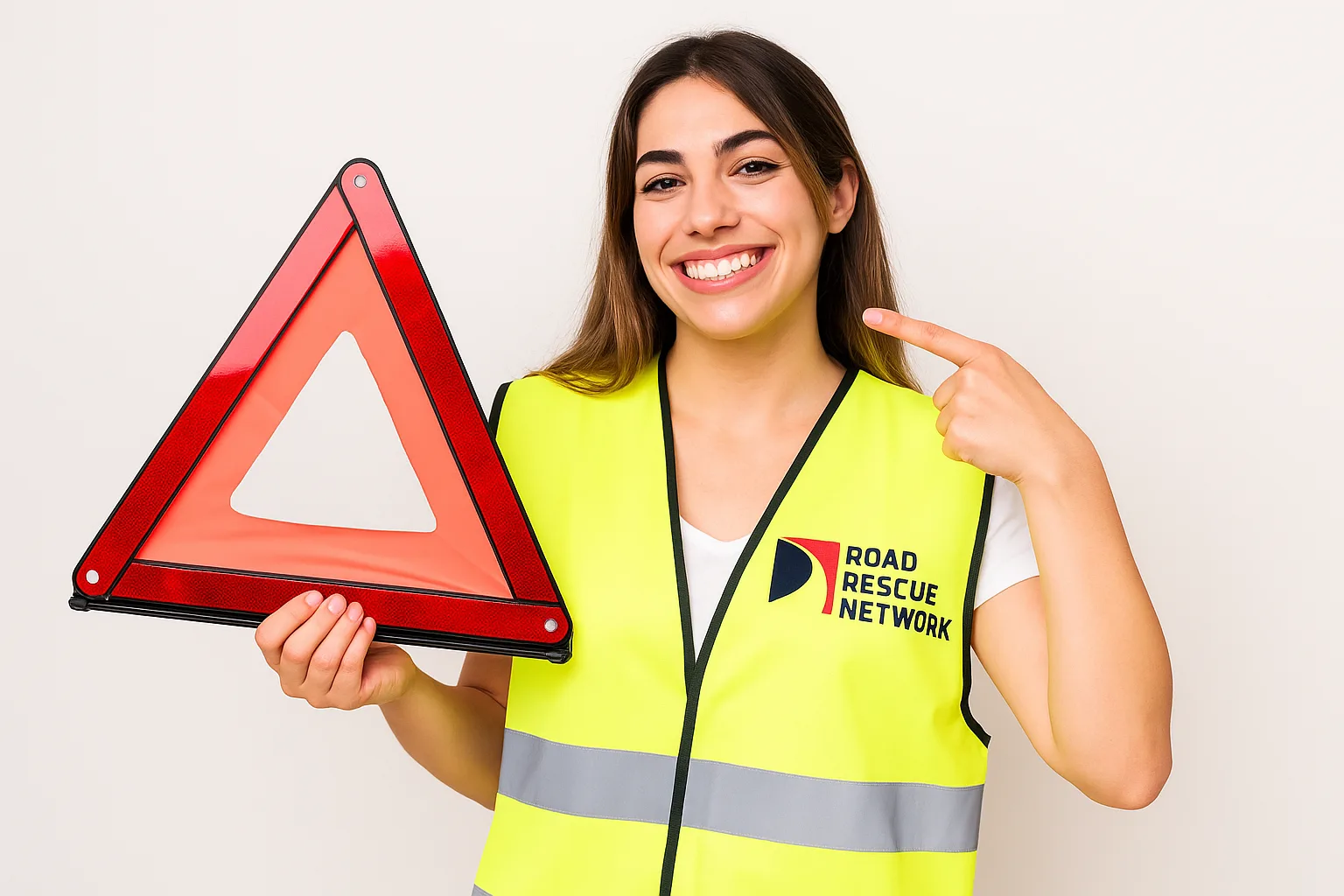
A roadside truck is stocked to end most calls without a tow. What it carries decides whether a Johns Creek driver leaves under their own power or waits for a second vehicle.
Heavy-duty boost, load and charging-system test
Every no-start. The test is what separates a jump from a battery replacement instead of guessing and returning.
Onboard compressor, gauges, plug and patch kits
Tires and commercial air system calls. Frequently ends the call outright.
Non-destructive entry, wedges, long-reach tools
Lockouts. Non-destructive matters — a damaged weatherstrip or bent frame costs more than the service call did.
Approved gas and diesel containers, priming gear
Out-of-fuel calls. Diesel run dry needs priming, which a can of fuel alone does not accomplish.
Rated winch, straps, snatch blocks, recovery points
Anything off the pavement. Rated gear and correct attachment points — improvised recovery is how people get hurt.
Cones, flares, reflective triangles, warning lights
Every live-roadway call, without exception. Secondary crashes are the real hazard at a breakdown.
Scene lighting and light tower
Night and low-visibility work. Being seen is a safety measure, not a convenience.
Batteries, belts, hoses, fuses, glad hands, lamps
Carried so the frequent failures end on the first visit rather than converting into a tow.

One call puts a roadside assistance unit on the road to you anywhere in Johns Creek or out along GA-141 and GA-400. Tell us the road and which way you are pointed and we do the rest.
One dispatch covering everything that strands a vehicle across Johns Creek — cars, pickups, RVs, and commercial trucks. Most roadside calls are resolved on scene without a tow, and knowing which is which before a truck rolls is the difference between a short bill and a long one.
Boost and battery testing on scene. The most common Johns Creek roadside call there is, and the one where a five-minute test tells you whether you need a jump or a battery.
When the battery will not hold, replacing it where the vehicle sits beats jumping it twice. A Johns Creek jump that dies again in an hour was never the repair.
Enough fuel delivered to reach a station, gas or diesel. A Johns Creek diesel run completely dry usually also needs priming, which a fuel can alone will not solve.
Non-destructive entry for cars, trucks, and RVs. The Johns Creek calls that matter most are a running vehicle with keys inside, or a child or pet locked in — those move to the front of the queue.
Assessment, coolant, and the honest call on whether the vehicle can be driven at all. Continuing to drive a Johns Creek overheated engine converts a roadside call into an engine replacement.
Separating a starter, an alternator, a fuel problem, and a security lockout on scene. Determines whether a Johns Creek vehicle leaves under its own power or on a truck.
Spare mounted and torqued where the vehicle sits. Straightforward in a Johns Creek parking lot and genuinely hazardous on a live shoulder, which is why position matters more than the tire does.
Increasingly common — many vehicles ship without one, and the ones that have one often have it flat. A Johns Creek plug or patch on scene, or a tow when the tire is beyond repair.
Puncture repair where the damage allows it. Sidewall damage and run-flat destruction do not allow it, and being told so honestly saves a Johns Creek second call.
Truck and trailer tires on the road, which is a different truck and different equipment than a passenger tire change anywhere in Johns Creek.
Seized lugs, locking lug keys, and stripped studs. The reason a Johns Creek tire change that should take fifteen minutes sometimes cannot be done at all.
Inflation and sensor faults. A Johns Creek slow leak found in a parking lot is maintenance; the same leak found at highway speed is a blowout.
Vehicles off the pavement — soft shoulder, ditch, mud, snow, or sand. A Johns Creek recovery pulled from the wrong angle damages more than it recovers.
Response after a collision, worked alongside Johns Creek law enforcement, including debris and fluid on the roadway and moving the vehicle to a safe location.
Cones, flares, and advance warning on a live roadway. Secondary crashes at Johns Creek breakdown scenes are the real danger, far more than the original failure.
Whether to stay with the vehicle or get behind a barrier. On a Johns Creek interstate shoulder the correct answer is frequently to get out on the passenger side and move away, and dispatch will say so.
Yards, construction sites, and unpaved access roads around Johns Creek where a standard flatbed cannot reach and a wrecker with winch capacity can.
Re-securing a shifted load before a Johns Creek commercial vehicle moves. A shifted load is an out-of-service condition, not a cosmetic problem.
Deciding on scene whether a Johns Creek truck is a roadside repair, a limp-in, or a tow. Getting that call right is worth more than the repair itself, because the wrong one means two dispatches.
A commercial vehicle that cannot build air is not moving. Frequently a cheap Johns Creek fix — a line, a glad hand seal, a valve — that otherwise becomes a tow.
Response when an inspection strands a vehicle where it stands. Nothing moves in Johns Creek until the defect is corrected, which makes these urgent by definition.
Light, medium, or heavy duty as the vehicle requires, to a Johns Creek destination you choose rather than the nearest lot the tow operator prefers.
Getting the person somewhere safe, which is the part most roadside coverage forgets. A Johns Creek shoulder at 2 a.m. is not a place to wait for a shop to open.
Continuous dispatch, because breakdowns are not scheduled. Most Johns Creek roadside volume lands outside the hours a shop is open, which is the entire premise.
Rolling 30-day average dispatch-to-arrival, by service type, across the local rescuer network.
Google shows "how much does emergency roadside assistance cost" on this search because page one deflects it. Here is what a Johns Creek roadside bill is actually made of — and where you might not need to pay at all.
Getting a truck and a technician to the vehicle. Charged once. This is the base of almost every pay-per-use roadside invoice.
The widest swing on this list. A jump start or a lockout is the low end; a winch-out from a ditch or a commercial air repair is a different service entirely.
A car, a loaded RV, and a Class 8 truck need different equipment and different operator qualifications. This is the single biggest multiplier on the bill.
Overnight, weekend, and holiday calls carry a premium tier. Most roadside volume happens outside business hours, which is when the premium applies.
Mileage from the responding operator, which is why a remote stretch of highway costs more than a metro parking lot for the identical service.
A live interstate shoulder requires advance warning and sometimes a second unit. Real cost, and not the place to economize.
Billed on time and equipment. Depth, angle, and whether the vehicle is loaded matter far more than the distance it has to move.
A battery, a belt, a hose, or a glad hand seal fitted roadside. Almost always cheaper than the tow that not having the part would have required.
Hook-up plus per-mile, and the class of truck required. Confirm the destination before it is hooked — a chosen shop beats the nearest lot.
Motor clubs, insurers, credit cards, and new-vehicle warranties frequently include roadside. Check before authorizing anything; you may already be covered.
Daily storage accrues fast once a vehicle sits in a lot. This is the line that surprises people, and it is avoidable by deciding the destination up front.
Not a cost at all. Many state DOTs run free service patrols on urban interstates during peak hours — see the regulations section below. If you are on a covered stretch, that call is free.
Road Rescue Network does not set a member operator's rates. What the network does is send the right class of truck the first time and tell you honestly on scene whether the vehicle can be fixed where it sits or needs to be towed — and point you at free state assistance where it covers you.

The same crews that run Johns Creek also cover Alpharetta (6 mi), Duluth (6 mi) and Suwanee (7 mi), so a call from either side of Fulton County reaches the same desk.
Each service links to local response times, rescuer coverage, and recent dispatched jobs in this metro.
A live map of every roadside assistance provider in Johns Creek metro, with real-time positions, ETAs, and dispatch status, available inside your dashboard.
Sign in to track network rescuers across Johns Creek in real time, dispatch jobs, and confirm ETA before the truck rolls.
Each corridor has a dedicated breakdown landing page with service zones, exits, and recent dispatched jobs.

0 exits in Johns Creek
The primary north-south arterial through Johns Creek, linking the office belt to Peachtree Corners and Duluth. Heavy commute and commercial-delivery volume; the State Bridge Road junction is a recurring breakdown zone.
0 exits in Johns Creek
The expressway west of Johns Creek, reached via Old Alabama and McGinnis Ferry. Long-haul freight bound for Johns Creek stages off the GA-400 north-Fulton exits before the run east.
0 exits in Johns Creek
The older north-south route east of Johns Creek toward Buford and the I-985 corridor. Mixed commercial and warehouse-feeding traffic across the Gwinnett line.
0 exits in Johns Creek
The Atlanta Perimeter beltway, reached south of Johns Creek via GA-400 or GA-141. Long-haul freight destined for the area stages off the Perimeter interchanges.
0 exits in Johns Creek
The northeastern interstate spur toward Gainesville, reached via US-23 and the Gwinnett corridor. Long-haul approach for northeast-metro freight overflowing into the Johns Creek market.
0 exits in Johns Creek
The east-west arterial linking Johns Creek to Duluth and the GA-400 corridor across the Chattahoochee. Heavy commercial and retail-delivery traffic at the river crossing.
Patterns observed across recent dispatch data in this metro, by service type and corridor.
A truck stalling on GA-141 (Medlock Bridge) during the north-Fulton commute peak backs up the whole office belt and the Chattahoochee crossing behind it. We stage Johns Creek rescuers near the State Bridge and Abbotts Bridge junctions so a tech can reach a stalled rig before the gridlock fully sets. Our dispatchers coordinate safe-pullout on the arterial where shoulders are tight.
Georgia summers stack 95-plus degree heat on heavy humidity, and the stop-and-go on GA-141 punishes cooling systems that would survive open-road running fine. We see radiator-hose blowouts and water-pump complaints across July and August. Johns Creek service trucks stock coolant and hose kits so most overheats are roadside fixes, not tows.
Spring and summer bring violent Georgia thunderstorms with hail and straight-line winds, and the remnants of Gulf hurricanes can dump days of rain that flood the Chattahoochee-adjacent low spots and down trees across the wooded corridors. After a system passes we prioritize recovery on the cleared routes and coordinate with local crews on blocked roads. Our rescuers carry the gear to extract rigs from storm-debris and high-water situations.
Two things worth knowing before you are on a shoulder in Johns Creek, Georgia: what the law requires of you and of passing traffic, and where help is already free.
Most state transportation departments operate free highway service patrols on urban interstates, typically during peak commuting hours, providing fuel, jump starts, tire changes, and relocation to a safe spot at no charge. Coverage is limited to specific corridors and hours, so it is worth knowing whether your route qualifies before you need it — check your state DOT, and note that 511 systems in many states can dispatch them.
Every state now has some form of Move Over law requiring drivers to change lanes or slow substantially for stopped emergency, tow, and service vehicles displaying warning lights. Many states have extended this to any disabled vehicle with hazard lights. These laws exist because roadside workers and stranded motorists are struck with grim regularity.
Federal rules require commercial drivers to activate hazard lights immediately on stopping and to place warning devices — reflective triangles — within ten minutes, positioned by road type. Failure to do so is both a citation and the specific circumstance in which stopped trucks get struck.
On a highway shoulder the safest position is usually out of the vehicle, exiting on the side away from traffic, and behind a barrier or well up an embankment. The exception is heavy traffic with no safe egress, where staying belted inside is safer. Dispatch will tell you which situation you are in if you ask.
Roadside assistance is commonly bundled into auto insurance policies, credit cards, motor club memberships, and new-vehicle warranties, and most people who have it do not know they do. Checking before you authorize a pay-per-use call takes two minutes and frequently makes the call free.
In most circumstances outside a police-ordered tow after a collision, you have the right to name where your vehicle goes. Deciding before it is hooked avoids a storage lot you did not choose and the daily fees that follow — this is the single most common avoidable roadside cost.

Most Johns Creek calls are answered in about 40 minutes. You get a real time before anyone rolls, and the price before the work starts.
Johns Creek occupies northeastern Fulton County along the GA-141 and Medlock Bridge corridors, a tech-and-medical office belt feeding the broader Atlanta distribution machine. Last-mile delivery, medical-supply, and retail-resupply trucks dominate the local mix, threading between GA-141, GA-400, and the Chattahoochee River crossings. Its proximity to the Peachtree Corners and Alpharetta technology campuses keeps commercial vehicles moving steadily through the area.
Johns Creek is a city in Fulton County, Georgia, United States. According to the 2020 census, the population was 82,453. The city is a northeastern suburb of Atlanta.
Johns Creek's freight economy runs on the GA-141 (Medlock Bridge) corridor and the nearby GA-400 expressway, the routes that tie this north Fulton office belt into Atlanta's vast distribution network. Road Rescue Network's Johns Creek rescuers are on-call 24/7, with response time times tuned to the affluent-suburb traffic pattern of medical-supply and last-mile runs. When a delivery van or a medical-courier truck goes down, the closest verified mechanic is one call away.
Anyone who's dispatched a truck through Johns Creek knows the GA-141 corridor and the Chattahoochee crossings bottleneck during commute peaks, and a breakdown there snarls the whole office belt. Our network is built around rescuers who work this congestion daily and stage near the chokepoints rather than fighting across the north metro after a call. That positioning keeps response times honest in one of the country's worst traffic markets.
Whether you're a fleet manager routing medical supplies to Emory Johns Creek or an owner-operator stranded on GA-141 near State Bridge Road, Road Rescue Network coordinates the response. One phone call reaches our 24/7 operations desk, which handles rescuer dispatch, ETA confirmation, and follow-through until your wheels are turning again.
Reviews collected from fleet customers and drivers after completed service calls in this metro.
“Medical-supply truck stalled on GA-141 at evening rush. RRN had a tech weaving to us in 40 minutes and fixed a fuel-relay issue on the shoulder. In this corridor at that hour, that's genuinely fast.”
“Trailer tire shredded near State Bridge Road in 94-degree heat. Service truck arrived in about 37 minutes with the right size and had me legal fast. Professional and courteous.”
“Tractor went down after a thunderstorm flooded a low spot near Abbotts Bridge. Recovery took about 50 minutes with the water, but the crew routed around it well. Good service.”
A winch-out is recovery rather than towing: the vehicle is not broken, it is stuck, and the job is getting it back onto solid ground under its own power. Typical Johns Creek cases are sliding off into a ditch or median, dropping a wheel off a soft shoulder, getting buried in mud or snow, and backing off the edge of a lot or a construction entrance. The operator arrives with a winch-equipped truck, assesses the angle and what the vehicle is resting on, sets up an anchor point and a pull line, and extracts it — sometimes with recovery straps, snatch blocks, or a second attachment point to change the direction of pull. Damage-free recovery is the whole skill: a bad pull can bend a frame, tear a bumper off, or destroy a driveline, which is why the setup takes longer than the pull. Once the vehicle is out, most drivers continue on their way. If the incident that put it there also broke something, that becomes a separate repair or tow decision.
It depends on your membership tier and on the club that serves your area, so the honest answer is check your own coverage rather than trust a general rule. Motor clubs commonly include a limited amount of winching or extraction in roadside coverage — often defined by how far the vehicle is from a paved surface, how long the recovery takes, or how many service calls you have used that year — with anything beyond those limits billed to you. Recoveries needing more than one truck, specialized equipment, or extended time routinely exceed what a membership covers. Two things worth knowing before you call anyone. First, coverage you may already have is not only a motor club: auto insurance policies, credit cards, and new-vehicle warranties frequently include roadside with winching provisions. Second, if you are on a covered urban interstate during peak hours, a free state highway service patrol may reach you first and can often relocate a vehicle off the travel lanes at no charge.
Winch-outs are priced on the recovery rather than on distance, because nothing is being transported anywhere. What moves the number in Johns Creek: how far off the roadway the vehicle is and what it is sitting in, since deep mud, snow, or a steep embankment is a different job from a wheel off a shoulder; the vehicle's weight and class, because a passenger car and a loaded tractor-trailer need entirely different equipment; the angle and whether a straight pull is possible or the operator needs a snatch block, a second anchor, or a second truck; how long the recovery takes, as extended work is usually billed on time; and when it happens, since overnight, weekend, and holiday calls carry a premium. Weather is the hidden factor — the ice storm that put you in the ditch put fifty other people there too, and that stretches both price and response. Ask for the estimate before authorizing, and check whether your insurance, credit card, motor club, or vehicle warranty already covers winching, because a large share of people who have that coverage do not know it.
Pay-per-use roadside is built from a service call fee plus whatever the job actually requires. A jump start, lockout, fuel delivery, or tire change sits at the low end and normally ends the call. A winch-out from a ditch, a commercial air-system repair, or anything needing a heavy truck is a different service and a different number. Three things move the total more than people expect: vehicle class, time of day — overnight, weekend, and holiday calls carry a premium — and distance from the responding operator. Before authorizing anything in Johns Creek, check whether you already have coverage through your auto insurance, a credit card, a motor club, or a new-vehicle warranty, because a large share of people who have it do not know it. And if you are on a covered urban interstate during peak hours, a free state service patrol may reach you first.
Get safe first, then worry about the bill. On a highway shoulder that usually means hazard lights on, exiting away from traffic, and moving behind a barrier or up the embankment — not standing beside the vehicle and not sitting in it if there is a safe way out. Then check for coverage you might not know you have: auto insurance policies, credit cards, motor club memberships, and new-vehicle warranties commonly include roadside. If you are on an urban interstate in peak hours, check whether a free state highway service patrol covers that stretch. After that, any pay-per-use provider including Road Rescue Network can dispatch to Johns Creek without a membership — ask for the service call fee and the likely total before the truck rolls, and if a tow is needed, name the destination before it is hooked so you do not inherit storage fees at a lot you did not choose.
In many cases yes, on specific roads at specific times. Most state transportation departments — Georgia included — operate free highway service patrols that circulate on congested urban interstates during peak hours, providing fuel, jump starts, tire changes, and relocation off the travel lanes at no charge. The limits are real: coverage is corridor-specific and hour-specific, so a breakdown on a covered stretch at rush hour may get free help within minutes, while the same breakdown on a rural highway at midnight will not. Many states also dispatch these patrols through their 511 traveler information line. Separately, and independent of the state, you may already have roadside coverage through auto insurance, a credit card, a motor club, or a vehicle warranty. Check both before paying for a call in Johns Creek.
In a metro area like Johns Creek a typical response runs in the tens of minutes rather than hours, but the honest answer is that it depends on four things: how far the nearest suitable operator is, what class of vehicle you need — a heavy wrecker has far fewer units on the road than a light service truck — traffic and weather at the time, and how precisely you described your location. That last one is the one you control. Road, direction of travel, nearest mile marker or exit, and which side you are on cuts more time off a response than anything else, and a dropped pin is better than all of it. Storms and the first hard freeze of the season produce call volume that stretches everyone's response, including ours.
It depends entirely on whether you already have it, which most people have not checked. Auto insurers commonly offer it as an inexpensive policy add-on, many credit cards include it, and most new vehicles come with it for the warranty period — paying a motor club on top of any of those is buying the same thing twice. If you genuinely have none of them, a membership tends to pay off for older vehicles, long commutes, and anyone who drives at night or in remote areas, and pay-per-use tends to win for a newer vehicle driven mostly around town. Read what the plan actually covers before assuming: towing mileage caps, winch-out coverage, and whether the plan follows the person or the vehicle are the three details that decide whether it helps on the night you need it.
It depends on where you stopped, and getting it wrong is the most dangerous part of a breakdown. On a highway with a wide shoulder or a barrier, the safer choice is usually to exit on the side away from traffic and move well clear — behind a guardrail or up an embankment — because a stopped vehicle on a shoulder is struck far more often than people imagine. In heavy fast traffic with no shoulder and nowhere safe to stand, staying belted inside with hazards on is safer than standing exposed. Either way, hazard lights go on immediately, and commercial drivers are federally required to place warning triangles within ten minutes. If you are unsure which situation you are in, say where you are when you call and dispatch will tell you.
Average response time in Johns Creek is 40 minutes for mobile truck repair, faster off-peak and longer during the GA-141 commute crunch. We stage rescuers near the major junctions to hold response times down despite Atlanta traffic, and we publish real averages.
Yes. GA-141 and the Abbotts Bridge / State Bridge Chattahoochee crossings are our most-frequented Johns Creek service zones. Our dispatchers coordinate safe-pullout on the arterials and we position rescuers near these chokepoints.
Every Road Rescue Network rescuer here carries current general liability, automobile liability, workers comp, and where applicable garage-keepers coverage. We re-verify each renewal cycle. Expired insurance means automatic suspension from dispatch.
Yes. We service national accounts with consolidated invoicing, fleet-card billing, and a single point of contact. Most fleets onboard in under 48 hours. Use the form on this page or call dispatch.
24/7/365. There's no after-hours surcharge in our network; rescuers quote the same rate at 3am as at 3pm.
We dispatch routinely to the QuikTrip on Medlock Bridge Road and the RaceTrac on Old Alabama Road in Johns Creek, plus Love's off I-985 in Buford and the Pilot off I-85 in Suwanee for the northeast runs. Our service trucks know these stops by sight.
Most DPF regen issues we resolve roadside with a forced regen and a cleaning of the differential-pressure sensor. Full DPF removal and cleaning happens at our partner shops. We tell you upfront which path we're taking.
Standard service-call dispatch runs $155-230 in north Fulton depending on time of day and service type. Heavy-duty towing starts around $475 for in-area moves. You get a confirmed quote before the truck rolls.
Yes. Several Johns Creek rescuers run fleet-PM programs with scheduled yard visits, well-suited to the local medical-supply and last-mile fleets. Tell us your fleet size and DOT inspection cadence and we'll match you with the right shop.
If we determine on-scene that the truck can't be fixed roadside in a reasonable window, we coordinate the tow with a heavy-duty network rescuer. Many of our service trucks roll alongside a wrecker so there's no second response time.
Johns Creek runs about 83,335 people and sits in Fulton County, inside the Atlanta Metropolitan Area. We take the call, find the closest crew that actually does this work, and tell you what it costs before anyone turns a wheel.
Sample of recent dispatched service calls in this metro. Customer details removed; locations and response times preserved.
| When | Service | Location | Response |
|---|---|---|---|
| Tuesday 17:52 ET | Mobile Truck Repair | GA-141 at State Bridge Rd | 41 min |
| Monday 22:26 ET | Heavy-Duty Towing | GA-141 near Abbotts Bridge | 49 min |
| Sunday 11:09 ET | Commercial Tire Repair | QuikTrip Medlock Bridge | 37 min |
| Saturday 14:38 ET | Mobile RV Repair | RV lot near the Chattahoochee | 58 min |
| Friday 08:51 ET | Mobile Welding | Johns Creek Technology Park | 51 min |
| Thursday 07:04 ET | Mobile Bus Repair | Fulton school depot, Johns Creek | 63 min |
| Wednesday 15:17 ET | Fuel Delivery | Old Alabama Rd at GA-141 | 30 min |
| Monday 03:22 ET | Trailer Repair | State Bridge Commerce Center | 45 min |
Coverage in surrounding cities and metros across the same network of verified rescuers.
The same verified network of providers, dispatched 24/7 across every major Georgia metro and freight corridor.
Whether the truck is sitting in Johns Creek or out toward Suwanee, it is the same phone number and the same crews. One call, day or night.
Road Rescue Network is actively recruiting verified roadside assistance providers in the Johns Creek metro. Heavy traffic, real fleet leads, no auction race-to-the-bottom, straight rescuer-to-customer dispatch with confirmed pricing.
We send Johns Creek roadside assistance calls directly to verified rescuers in your service radius. Apply once. Insurance & DOT verified. Live dispatch, fleet accounts, transparent pricing, no motor-club shave-down.
Deep-dive guide on choosing the right provider, common pitfalls, and what to expect on a service call.
OpenOpen positions at our network rescuers, full-time, part-time, and 1099 contract.
OpenOn-site photos from recent calls, see the work, not just the marketing.
OpenService trucks dispatch routinely to these locations across the metro freight corridors.
High-flow diesel lanes
View Directory Profile →Diesel and parking
View Directory Profile →
Nearest full truck stop NE, tire care
View Directory Profile →
Fuel, parking, 24/7 east of Johns Creek
View Directory Profile →Truck-accessible park-and-ride lot
Local parts houses and diesel suppliers used by network mechanics for time-critical roadside repairs.

Truck and trailer parts
View Directory Profile →Heavy-duty parts depot
View Directory Profile →
Engine service and parts dealer
View Directory Profile →Major shippers, distribution centers, and industrial freight nodes generating outbound and inbound truck volume.
Medical-supply receiving, courier freight
Tech-campus freight and distribution
Corporate-campus delivery receiving
Last-mile and retail-resupply staging
Office-flex, medical-device, and distribution tenants
Trade-fleet and service-vehicle cluster
Three steps from the call to a cleared scene. Same flow whether you call from a fleet desk or the shoulder of an interstate.
Road, direction of travel, nearest exit or mile marker, and which side you are on. Half of Johns Creek roadside delay is a truck on the correct highway going the wrong way, and a dropped pin removes that entirely.
Before anything else, dispatch will tell you whether to stay belted inside or get out on the passenger side and move behind a barrier. On a Johns Creek shoulder that call matters more than how fast the truck arrives.
Most Johns Creek roadside calls end without a tow — a jump, a tire, fuel, a lockout, an air line. If it genuinely cannot be fixed where it sits, you choose the destination before anything is hooked.
Network rescuers accept all major credit cards, fleet cards, and consumer payment apps. Confirmed at dispatch.