01
Jump packs & battery testers
Heavy-duty boost, load and charging-system test
Every no-start. The test is what separates a jump from a battery replacement instead of guessing and returning.
Need roadside assistance in Elwood? We come to you — jump start, fuel, a flat, a lockout, a winch out of a ditch. Most calls we finish without a tow, and we'll tell you where it's safe to wait while we're on the way. The same trucks cover Channahon, Joliet, and Minooka, so a call from outside town reaches the same people.
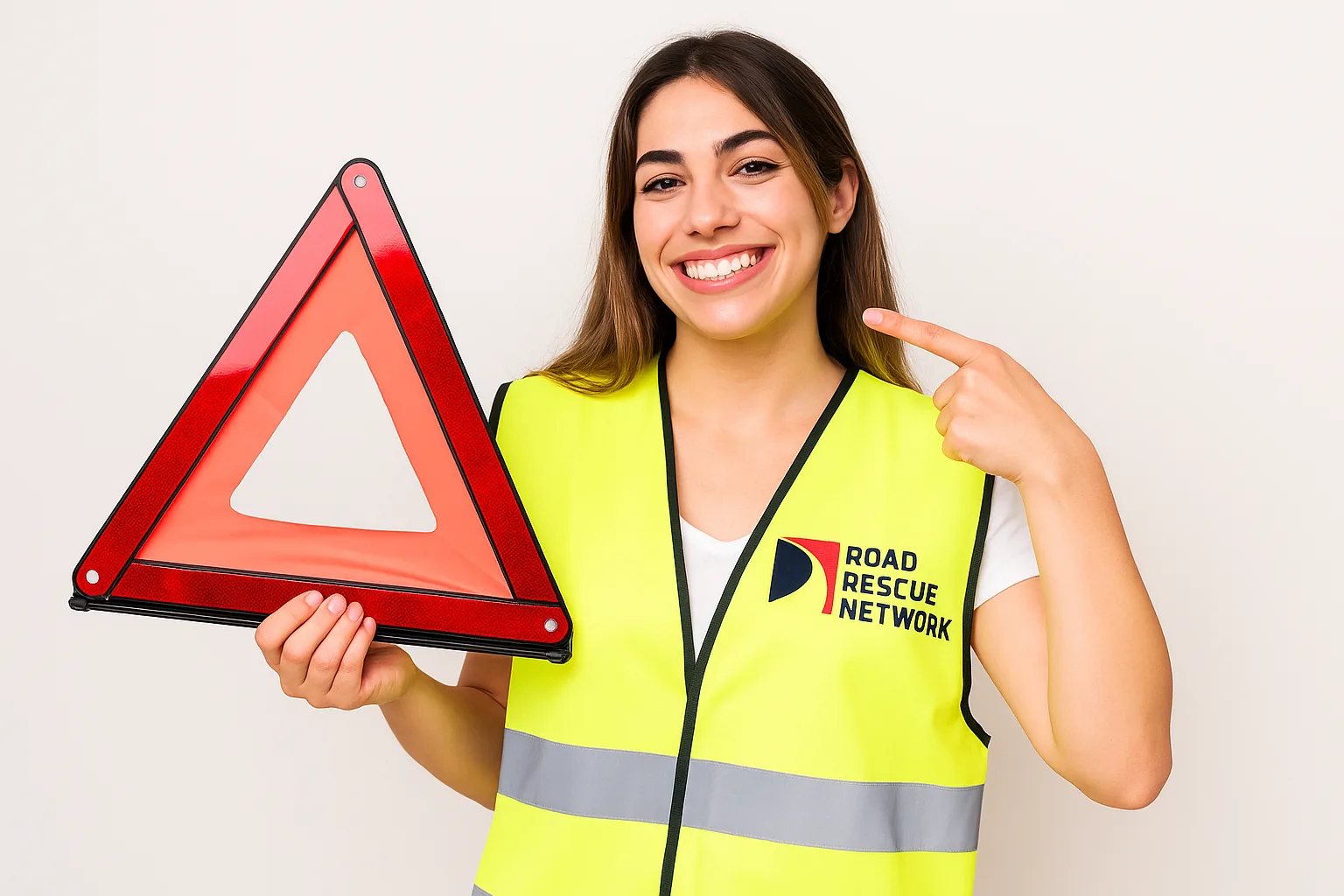
A roadside truck is stocked to end most calls without a tow. What it carries decides whether a Elwood driver leaves under their own power or waits for a second vehicle.
Heavy-duty boost, load and charging-system test
Every no-start. The test is what separates a jump from a battery replacement instead of guessing and returning.
Onboard compressor, gauges, plug and patch kits
Tires and commercial air system calls. Frequently ends the call outright.
Non-destructive entry, wedges, long-reach tools
Lockouts. Non-destructive matters — a damaged weatherstrip or bent frame costs more than the service call did.
Approved gas and diesel containers, priming gear
Out-of-fuel calls. Diesel run dry needs priming, which a can of fuel alone does not accomplish.
Rated winch, straps, snatch blocks, recovery points
Anything off the pavement. Rated gear and correct attachment points — improvised recovery is how people get hurt.
Cones, flares, reflective triangles, warning lights
Every live-roadway call, without exception. Secondary crashes are the real hazard at a breakdown.
Scene lighting and light tower
Night and low-visibility work. Being seen is a safety measure, not a convenience.
Batteries, belts, hoses, fuses, glad hands, lamps
Carried so the frequent failures end on the first visit rather than converting into a tow.
One call puts a roadside assistance unit on the road to you anywhere in Elwood and the surrounding Will County. Tell us where you are stopped and we do the rest.
One dispatch covering everything that strands a vehicle across Elwood — cars, pickups, RVs, and commercial trucks. Most roadside calls are resolved on scene without a tow, and knowing which is which before a truck rolls is the difference between a short bill and a long one.
Boost and battery testing on scene. The most common Elwood roadside call there is, and the one where a five-minute test tells you whether you need a jump or a battery.
When the battery will not hold, replacing it where the vehicle sits beats jumping it twice. A Elwood jump that dies again in an hour was never the repair.
Enough fuel delivered to reach a station, gas or diesel. A Elwood diesel run completely dry usually also needs priming, which a fuel can alone will not solve.
Non-destructive entry for cars, trucks, and RVs. The Elwood calls that matter most are a running vehicle with keys inside, or a child or pet locked in — those move to the front of the queue.
Assessment, coolant, and the honest call on whether the vehicle can be driven at all. Continuing to drive a Elwood overheated engine converts a roadside call into an engine replacement.
Separating a starter, an alternator, a fuel problem, and a security lockout on scene. Determines whether a Elwood vehicle leaves under its own power or on a truck.
Spare mounted and torqued where the vehicle sits. Straightforward in a Elwood parking lot and genuinely hazardous on a live shoulder, which is why position matters more than the tire does.
Increasingly common — many vehicles ship without one, and the ones that have one often have it flat. A Elwood plug or patch on scene, or a tow when the tire is beyond repair.
Puncture repair where the damage allows it. Sidewall damage and run-flat destruction do not allow it, and being told so honestly saves a Elwood second call.
Truck and trailer tires on the road, which is a different truck and different equipment than a passenger tire change anywhere in Elwood.
Seized lugs, locking lug keys, and stripped studs. The reason a Elwood tire change that should take fifteen minutes sometimes cannot be done at all.
Inflation and sensor faults. A Elwood slow leak found in a parking lot is maintenance; the same leak found at highway speed is a blowout.
Vehicles off the pavement — soft shoulder, ditch, mud, snow, or sand. A Elwood recovery pulled from the wrong angle damages more than it recovers.
Response after a collision, worked alongside Elwood law enforcement, including debris and fluid on the roadway and moving the vehicle to a safe location.
Cones, flares, and advance warning on a live roadway. Secondary crashes at Elwood breakdown scenes are the real danger, far more than the original failure.
Whether to stay with the vehicle or get behind a barrier. On a Elwood interstate shoulder the correct answer is frequently to get out on the passenger side and move away, and dispatch will say so.
Yards, construction sites, and unpaved access roads around Elwood where a standard flatbed cannot reach and a wrecker with winch capacity can.
Re-securing a shifted load before a Elwood commercial vehicle moves. A shifted load is an out-of-service condition, not a cosmetic problem.
Deciding on scene whether a Elwood truck is a roadside repair, a limp-in, or a tow. Getting that call right is worth more than the repair itself, because the wrong one means two dispatches.
A commercial vehicle that cannot build air is not moving. Frequently a cheap Elwood fix — a line, a glad hand seal, a valve — that otherwise becomes a tow.
Response when an inspection strands a vehicle where it stands. Nothing moves in Elwood until the defect is corrected, which makes these urgent by definition.
Light, medium, or heavy duty as the vehicle requires, to a Elwood destination you choose rather than the nearest lot the tow operator prefers.
Getting the person somewhere safe, which is the part most roadside coverage forgets. A Elwood shoulder at 2 a.m. is not a place to wait for a shop to open.
Continuous dispatch, because breakdowns are not scheduled. Most Elwood roadside volume lands outside the hours a shop is open, which is the entire premise.
Google shows "how much does emergency roadside assistance cost" on this search because page one deflects it. Here is what a Elwood roadside bill is actually made of — and where you might not need to pay at all.
Getting a truck and a technician to the vehicle. Charged once. This is the base of almost every pay-per-use roadside invoice.
The widest swing on this list. A jump start or a lockout is the low end; a winch-out from a ditch or a commercial air repair is a different service entirely.
A car, a loaded RV, and a Class 8 truck need different equipment and different operator qualifications. This is the single biggest multiplier on the bill.
Overnight, weekend, and holiday calls carry a premium tier. Most roadside volume happens outside business hours, which is when the premium applies.
Mileage from the responding operator, which is why a remote stretch of highway costs more than a metro parking lot for the identical service.
A live interstate shoulder requires advance warning and sometimes a second unit. Real cost, and not the place to economize.
Billed on time and equipment. Depth, angle, and whether the vehicle is loaded matter far more than the distance it has to move.
A battery, a belt, a hose, or a glad hand seal fitted roadside. Almost always cheaper than the tow that not having the part would have required.
Hook-up plus per-mile, and the class of truck required. Confirm the destination before it is hooked — a chosen shop beats the nearest lot.
Motor clubs, insurers, credit cards, and new-vehicle warranties frequently include roadside. Check before authorizing anything; you may already be covered.
Daily storage accrues fast once a vehicle sits in a lot. This is the line that surprises people, and it is avoidable by deciding the destination up front.
Not a cost at all. Many state DOTs run free service patrols on urban interstates during peak hours — see the regulations section below. If you are on a covered stretch, that call is free.
Road Rescue Network does not set a member operator's rates. What the network does is send the right class of truck the first time and tell you honestly on scene whether the vehicle can be fixed where it sits or needs to be towed — and point you at free state assistance where it covers you.
The same crews that run Elwood also cover Channahon (8 mi), Joliet (12 mi) and Minooka (6 mi), so a call from either side of Will County reaches the same desk.
Each service links to local response times, rescuer coverage, and recent dispatched jobs in this metro.
Patterns observed across recent dispatch data in this metro, by service type and corridor.
5:30 AM winter morning, minus-eight-degree ambient at Harbor Freight DC (Elwood). Loaded trailer from overnight freeze-check ready for 6 AM departure. Driver starts tractor; fuel lines gelled from sub-zero overnight cold. No engine cranking. RRN mobile fuel-system tech dispatches immediately (contacted by DC dispatch). Drains gelled fuel, flushes filter housing with heated solvent, installs new filter, delivers premium winter-grade diesel with anti-gel additive. Truck rolls by 6:15 AM, preserves national distribution schedule. DC postpones one backup tractor; no cascading delays.
Morning dock arrival, loaded tractor with time-sensitive shipment. Backup attempted; battery voltage collapses. RRN dispatches immediately with reserve battery. Mobile tech performs load-test, confirms battery failure (cold-rated battery too old for extreme cold). Swaps battery, cleans corrosion, applies terminal upgrade. Truck rolls within 18 minutes. Driver receives new battery recommendation; DC shifts load to backup unit if needed, minimal impact.
Heavy snow overnight, icy morning. Loaded tractor exiting Harbor Freight DC on County Road 48 hits unexpected ice, jackknifes. Trailer blocks warehouse gate access. RRN dual-unit recovery immediately mobilized. First unit chains tractor, second chains trailer. Coordinated extraction rights vehicles over 45 minutes. DC temporarily diverts outbound traffic to alternate staging area. No cargo damage; tractor towed to FleetPride (Chicago) for frame/suspension inspection. DC resumes normal outbound flow.
Truck departing Elwood on I-55 northbound toward Chicago distribution. Alternator bearing fails; no charging. Battery slowly discharges over 8 miles. Low-voltage warning lights; driver pulls to shoulder before losing all power. RRN mobile diagnostics arrives, confirms alternator failure. Loads battery to prevent stranding, coordinates controlled tow to FleetPride Chicago with priority bay. Load transferred to backup tractor at staging; on-time delivery preserved. RRN coordination prevents dock window loss.
County Road 48 to Harbor Freight DC congestion: multiple trucks queued for loading dock, stop-and-go over 2 miles. Transmission temperature climbs on one tractor. Driver notices delayed shifts; pulls aside before DC gate. RRN mobile tech checks transmission fluid (low) and cooler (salt-fouled). Top-off and cooler-line pressure test restore function. Truck advances into dock sequence; no rescheduling impact. Driver advised to schedule cooler flush and transmission service during maintenance window.
Trailer approaching Harbor Freight DC loading dock; air-brake pressure drops from 120 PSI to 75 PSI. Driver feels loss of brake response. Pulls aside on County Road 48 near warehouse. RRN air-brake tech dispatched; pressure-tests system, identifies slow leak in trailer supply line. Replaces damaged hose coupling with new assembly, recharges to spec. Pressure holds at 120 PSI. Truck resumes dock entry within 22 minutes; no load rescheduling.
Two things worth knowing before you are on a shoulder in Elwood, Illinois: what the law requires of you and of passing traffic, and where help is already free.
Most state transportation departments operate free highway service patrols on urban interstates, typically during peak commuting hours, providing fuel, jump starts, tire changes, and relocation to a safe spot at no charge. Coverage is limited to specific corridors and hours, so it is worth knowing whether your route qualifies before you need it — check your state DOT, and note that 511 systems in many states can dispatch them.
Every state now has some form of Move Over law requiring drivers to change lanes or slow substantially for stopped emergency, tow, and service vehicles displaying warning lights. Many states have extended this to any disabled vehicle with hazard lights. These laws exist because roadside workers and stranded motorists are struck with grim regularity.
Federal rules require commercial drivers to activate hazard lights immediately on stopping and to place warning devices — reflective triangles — within ten minutes, positioned by road type. Failure to do so is both a citation and the specific circumstance in which stopped trucks get struck.
On a highway shoulder the safest position is usually out of the vehicle, exiting on the side away from traffic, and behind a barrier or well up an embankment. The exception is heavy traffic with no safe egress, where staying belted inside is safer. Dispatch will tell you which situation you are in if you ask.
Roadside assistance is commonly bundled into auto insurance policies, credit cards, motor club memberships, and new-vehicle warranties, and most people who have it do not know they do. Checking before you authorize a pay-per-use call takes two minutes and frequently makes the call free.
In most circumstances outside a police-ordered tow after a collision, you have the right to name where your vehicle goes. Deciding before it is hooked avoids a storage lot you did not choose and the daily fees that follow — this is the single most common avoidable roadside cost.
You get a real time before anyone rolls, and the price before the work starts. No motor club runaround and no waiting on a callback.
Harbor Freight DC in Elwood drives regional and national distribution logistics. The distribution center operates 24/7, routing tools, equipment, and merchandise to retail stores across the Midwest and beyond. A single tractor breakdown at the loading dock or on access roads can back up 5–10 trailers scheduled for departure, multiplying delays nationally. Peak outbound windows (early morning, 6–8 AM, and afternoon, 2–4 PM) see 40–50 trucks staging for dispatch. Winter weather during peak windows can snarl the entire operation; RRN priority dispatch during sub-zero conditions is critical to maintaining distribution schedules.
Elwood is a village in rural Will County, Illinois, United States, approximately 45 miles southwest of Chicago. The population was 2,229 at the 2020 United States census, down from 2,279 in 2010.
Elwood is a small village of 2,229 residents 45 miles southwest of Chicago, but punches far above its weight as a regional distribution hub. Harbor Freight Tools Distribution Center (3401 S Brandon Rd) anchors the area as the primary employer, staging trucks for nationwide retail distribution. While Elwood itself has limited highway presence on state mapping, the village is adjacent to I-55 access and benefits from proximity to Joliet’s I-55/I-80 interchange zone. Local roads (Township Roads, County Routes) route trucks between the distribution center and I-55 ramps, creating a consistent stream of relay traffic toward Chicago’s warehouse district and regional markets. Breakdowns at or near Harbor Freight DC create urgent scheduling impacts; a disabled trailer can delay dozens of outbound shipments across the nation.
Winter weather in Elwood follows the Chicago metropolitan pattern: December through March brings ice storms, heavy snow, and sub-zero cold. The village’s rural setting provides less urban heat-island insulation; temperatures can drop 3–5 degrees lower than downtown Chicago on clear nights. Moisture from farm ponds and small waterways accelerates frost and black-ice formation on local road surfaces near distribution facilities. Salt application on access roads is lighter than urban zones; rural roads may become icy and treacherous. Battery failures and fuel gelling are more common here due to colder ambient; trucks staging overnight in frozen conditions face mechanical challenges.
Road Rescue Network serves Elwood with priority focus on Harbor Freight DC logistics and regional warehouse operations. We maintain 24/7 mobile dispatch for local roads connecting Elwood to I-55 and Joliet corridors. Vendor partnerships include River Valley Truck Parts (Kankakee), FleetPride Chicago, and independent shops trained in rapid-response warehouse emergencies. Winter-specialty services include fuel additives, battery exchange, and roadside diagnostics calibrated for sub-zero conditions. We coordinate directly with Harbor Freight logistics to preserve dock scheduling and minimize cargo staging delays during breakdowns. Our network extends into Channahon, Minooka, and the greater Will County warehouse cluster.
A winch-out is recovery rather than towing: the vehicle is not broken, it is stuck, and the job is getting it back onto solid ground under its own power. Typical Elwood cases are sliding off into a ditch or median, dropping a wheel off a soft shoulder, getting buried in mud or snow, and backing off the edge of a lot or a construction entrance. The operator arrives with a winch-equipped truck, assesses the angle and what the vehicle is resting on, sets up an anchor point and a pull line, and extracts it — sometimes with recovery straps, snatch blocks, or a second attachment point to change the direction of pull. Damage-free recovery is the whole skill: a bad pull can bend a frame, tear a bumper off, or destroy a driveline, which is why the setup takes longer than the pull. Once the vehicle is out, most drivers continue on their way. If the incident that put it there also broke something, that becomes a separate repair or tow decision.
It depends on your membership tier and on the club that serves your area, so the honest answer is check your own coverage rather than trust a general rule. Motor clubs commonly include a limited amount of winching or extraction in roadside coverage — often defined by how far the vehicle is from a paved surface, how long the recovery takes, or how many service calls you have used that year — with anything beyond those limits billed to you. Recoveries needing more than one truck, specialized equipment, or extended time routinely exceed what a membership covers. Two things worth knowing before you call anyone. First, coverage you may already have is not only a motor club: auto insurance policies, credit cards, and new-vehicle warranties frequently include roadside with winching provisions. Second, if you are on a covered urban interstate during peak hours, a free state highway service patrol may reach you first and can often relocate a vehicle off the travel lanes at no charge.
Winch-outs are priced on the recovery rather than on distance, because nothing is being transported anywhere. What moves the number in Elwood: how far off the roadway the vehicle is and what it is sitting in, since deep mud, snow, or a steep embankment is a different job from a wheel off a shoulder; the vehicle's weight and class, because a passenger car and a loaded tractor-trailer need entirely different equipment; the angle and whether a straight pull is possible or the operator needs a snatch block, a second anchor, or a second truck; how long the recovery takes, as extended work is usually billed on time; and when it happens, since overnight, weekend, and holiday calls carry a premium. Weather is the hidden factor — the ice storm that put you in the ditch put fifty other people there too, and that stretches both price and response. Ask for the estimate before authorizing, and check whether your insurance, credit card, motor club, or vehicle warranty already covers winching, because a large share of people who have that coverage do not know it.
Pay-per-use roadside is built from a service call fee plus whatever the job actually requires. A jump start, lockout, fuel delivery, or tire change sits at the low end and normally ends the call. A winch-out from a ditch, a commercial air-system repair, or anything needing a heavy truck is a different service and a different number. Three things move the total more than people expect: vehicle class, time of day — overnight, weekend, and holiday calls carry a premium — and distance from the responding operator. Before authorizing anything in Elwood, check whether you already have coverage through your auto insurance, a credit card, a motor club, or a new-vehicle warranty, because a large share of people who have it do not know it. And if you are on a covered urban interstate during peak hours, a free state service patrol may reach you first.
Get safe first, then worry about the bill. On a highway shoulder that usually means hazard lights on, exiting away from traffic, and moving behind a barrier or up the embankment — not standing beside the vehicle and not sitting in it if there is a safe way out. Then check for coverage you might not know you have: auto insurance policies, credit cards, motor club memberships, and new-vehicle warranties commonly include roadside. If you are on an urban interstate in peak hours, check whether a free state highway service patrol covers that stretch. After that, any pay-per-use provider including Road Rescue Network can dispatch to Elwood without a membership — ask for the service call fee and the likely total before the truck rolls, and if a tow is needed, name the destination before it is hooked so you do not inherit storage fees at a lot you did not choose.
In many cases yes, on specific roads at specific times. Most state transportation departments — Illinois included — operate free highway service patrols that circulate on congested urban interstates during peak hours, providing fuel, jump starts, tire changes, and relocation off the travel lanes at no charge. The limits are real: coverage is corridor-specific and hour-specific, so a breakdown on a covered stretch at rush hour may get free help within minutes, while the same breakdown on a rural highway at midnight will not. Many states also dispatch these patrols through their 511 traveler information line. Separately, and independent of the state, you may already have roadside coverage through auto insurance, a credit card, a motor club, or a vehicle warranty. Check both before paying for a call in Elwood.
In a metro area like Elwood a typical response runs in the tens of minutes rather than hours, but the honest answer is that it depends on four things: how far the nearest suitable operator is, what class of vehicle you need — a heavy wrecker has far fewer units on the road than a light service truck — traffic and weather at the time, and how precisely you described your location. That last one is the one you control. Road, direction of travel, nearest mile marker or exit, and which side you are on cuts more time off a response than anything else, and a dropped pin is better than all of it. Storms and the first hard freeze of the season produce call volume that stretches everyone's response, including ours.
It depends entirely on whether you already have it, which most people have not checked. Auto insurers commonly offer it as an inexpensive policy add-on, many credit cards include it, and most new vehicles come with it for the warranty period — paying a motor club on top of any of those is buying the same thing twice. If you genuinely have none of them, a membership tends to pay off for older vehicles, long commutes, and anyone who drives at night or in remote areas, and pay-per-use tends to win for a newer vehicle driven mostly around town. Read what the plan actually covers before assuming: towing mileage caps, winch-out coverage, and whether the plan follows the person or the vehicle are the three details that decide whether it helps on the night you need it.
It depends on where you stopped, and getting it wrong is the most dangerous part of a breakdown. On a highway with a wide shoulder or a barrier, the safer choice is usually to exit on the side away from traffic and move well clear — behind a guardrail or up an embankment — because a stopped vehicle on a shoulder is struck far more often than people imagine. In heavy fast traffic with no shoulder and nowhere safe to stand, staying belted inside with hazards on is safer than standing exposed. Either way, hazard lights go on immediately, and commercial drivers are federally required to place warning triangles within ten minutes. If you are unsure which situation you are in, say where you are when you call and dispatch will tell you.
Call RRN immediately and mention Harbor Freight DC Elwood. We coordinate directly with DC logistics and warehouse operations. For mobile-repairable issues (fuel, battery, air-brake diagnostics), we typically fix on-site within 20–30 minutes. For major work (transmission, engine), we arrange fast-track towing with backup tractor coordination so your load continues to national distribution. DC appreciates early notification; we can often preserve scheduling by offloading cargo to standby unit.
Yes. RRN maintains winter-grade diesel (treated with cold-flow enhancer) in mobile delivery tankers November through March. If you’re at Harbor Freight DC or anywhere in Elwood and fuel lines are gelling, call immediately. Average delivery response is 22 minutes. We can also deliver to local truck stops (Pilot Channahon, Minooka) for pre-fueling before winter hauls.
County Road 48 is rural with lighter salt maintenance than urban roads. Ice forms quickly during freeze events. Early morning (5–8 AM) is most treacherous due to overnight frost and reduced traffic to break ice. If you’re approaching the DC during freeze warnings, add 15–20 minutes to your ETA. RRN monitors County Road 48 conditions and provides emergency recovery if you jackknife or slide. Report hazards via app so we can alert other DC-bound trucks.
Absolutely. Harbor Freight DC typically has sub-zero startup challenges during January–February extremes. RRN pre-positions heated-battery reserves at staging areas near Elwood. Call with battery failure symptoms; we’ll deploy mobile tech with replacement within 18–20 minutes. Installed battery is tested under load before departure. Driver receives recommendation for battery upgrade if rated for less than 1000 CCA for your engine.
For mobile-repairable issues: 20–30 minutes (minimal impact). For major work: 2–4 hours (DC coordinates backup tractor, your load continues). RRN coordinates with DC dispatch to minimize rescheduling by offloading to standby unit or towing to priority-bay shop. Worst-case (multi-hour major repair): 6–8 hour delay, but RRN works to preserve your place in national distribution queues.
Elwood itself has no dedicated truck stop, but nearby: Pilot Travel Center (Channahon, 11 miles), Love’s (Channahon, 15 miles). Pilot Minooka (301 Ridge Rd) is 8 miles away. RRN can arrange overnight warehouse staging at Harbor Freight or nearby facilities if your load is compatible. For extended repairs, we coordinate with FleetPride Chicago or River Valley Truck Parts (Kankakee) with bay overnight staging.
Elwood doesn’t have a dedicated DOT station, but RRN coordinates inspections at Will County authorized facilities (Joliet area, 12 miles). Mobile pre-trip inspections for brake, lighting, tire, hazmat compliance average 24 minutes at Harbor Freight DC or roadside. Schedule in advance through app. For pre-departure checks at DC, we can often coordinate inspection at loading dock area.
Peak outbound (6–8 AM, 2–4 PM) creates stop-and-go queuing on County Road 48. Preventive: (1) Check transmission fluid monthly. (2) Monitor temperature gauge during dock staging. (3) Shift to neutral during extended stops. (4) Schedule cooler flush annually to remove salt/debris. If temperature climbs during staging, exit queue, cool 10 minutes, re-enter. RRN mobile diagnostics can check cooler condition roadside (28 min).
Call RRN immediately (5–30-min response). Mobile fuel-system tech will drain gelled fuel, flush filter, deliver winter-grade diesel with anti-gel. Truck typically rolls within 20–30 minutes. For future cold seasons, pre-treat all fuel loads with approved cold-flow additive and consider block heater installation. RRN can refer you to equipment vendors for engine-block heater setup.
Yes. Mobile air-brake service available on all local roads (County Road 48, I-55 access) and I-55 corridor from Elwood. Average response 30 minutes. Common issues: pressure loss from cold-weather moisture icing in compressor discharge, trailer supply-line leaks (salt corrosion), valve stiction. We carry replacement valves, hose couplings, and desiccant cartridges. Pressure-test confirms integrity before you roll.
Elwood runs about 2,229 people and sits in Will County, inside the Elwood Warehouse District (Chicago Metropolitan Extended). We take the call, find the closest crew that actually does this work, and tell you what it costs before anyone turns a wheel.
Coverage in surrounding cities and metros across the same network of verified rescuers.
The same verified network of providers, dispatched 24/7 across every major Illinois metro and freight corridor.
Whether the truck is sitting in Elwood or out toward Minooka, it is the same phone number and the same crews. One call, day or night.
Road Rescue Network is actively recruiting verified roadside assistance providers in the Elwood metro. Heavy traffic, real fleet leads, no auction race-to-the-bottom, straight rescuer-to-customer dispatch with confirmed pricing.
We send Elwood roadside assistance calls directly to verified rescuers in your service radius. Apply once. Insurance & DOT verified. Live dispatch, fleet accounts, transparent pricing, no motor-club shave-down.
Deep-dive guide on choosing the right provider, common pitfalls, and what to expect on a service call.
OpenOpen positions at our network rescuers, full-time, part-time, and 1099 contract.
OpenOn-site photos from recent calls, see the work, not just the marketing.
OpenService trucks dispatch routinely to these locations across the metro freight corridors.


Local parts houses and diesel suppliers used by network mechanics for time-critical roadside repairs.
Major shippers, distribution centers, and industrial freight nodes generating outbound and inbound truck volume.
Three steps from the call to a cleared scene. Same flow whether you call from a fleet desk or the shoulder of an interstate.
Road, direction of travel, nearest exit or mile marker, and which side you are on. Half of Elwood roadside delay is a truck on the correct highway going the wrong way, and a dropped pin removes that entirely.
Before anything else, dispatch will tell you whether to stay belted inside or get out on the passenger side and move behind a barrier. On a Elwood shoulder that call matters more than how fast the truck arrives.
Most Elwood roadside calls end without a tow — a jump, a tire, fuel, a lockout, an air line. If it genuinely cannot be fixed where it sits, you choose the destination before anything is hooked.
Network rescuers accept all major credit cards, fleet cards, and consumer payment apps. Confirmed at dispatch.