01
Mobile PM service truck
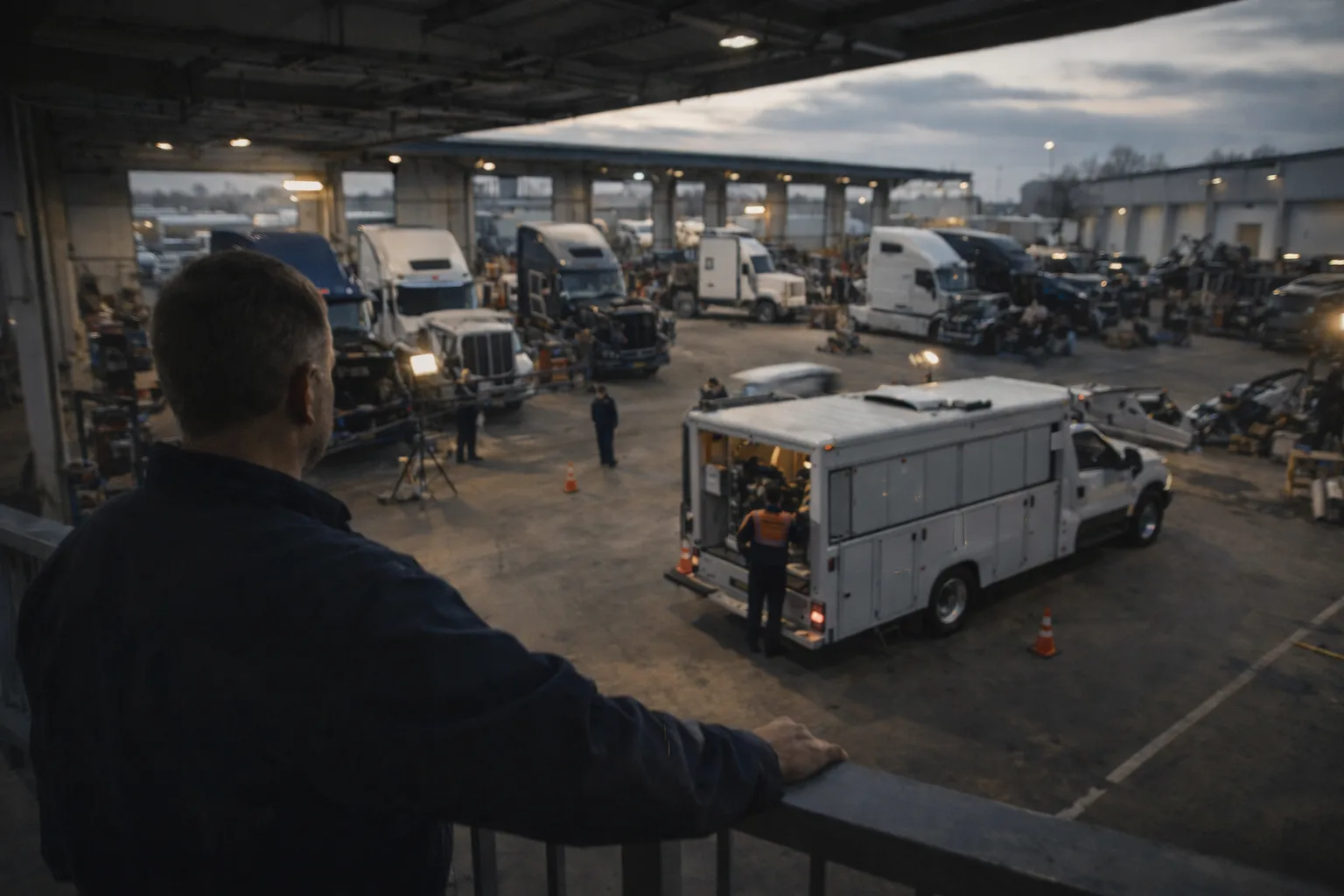
Bulk oil, filters, lubricants, air and electrical tooling, and lighting for overnight work
Scheduled A and B services performed at your yard on your parking cycle.
Need fleet maintenance in Palatine? We service your trucks at your yard on your parking cycle and keep the records properly, so breakdowns and audits both stop being surprises. Highway running means mileage comes fast and PM intervals arrive sooner than the calendar suggests. I-90, IL-53, and US-12 all run through Palatine, so most of our calls come off one of those. Freight around here moves for outfits like Weber-Stephen Products and Catalent, which is work that runs on a schedule.
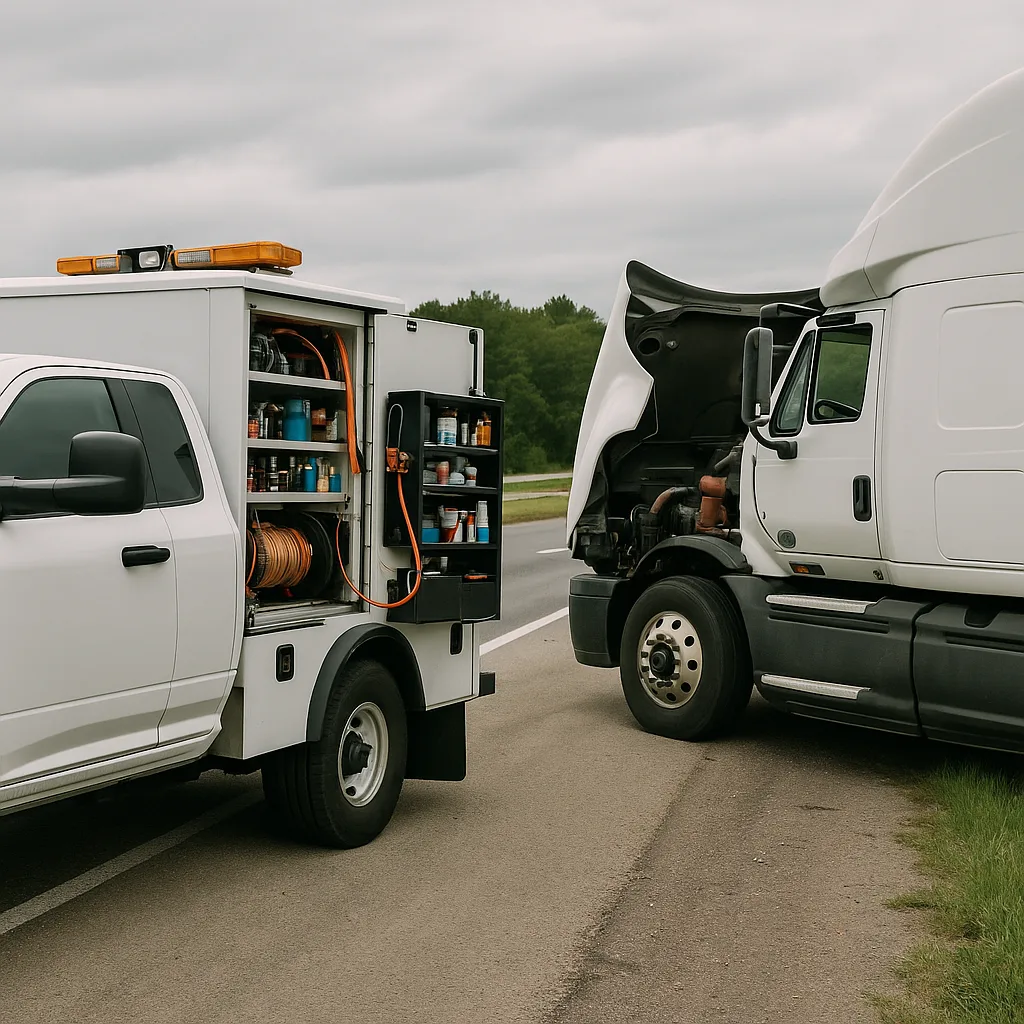
Fleet maintenance is delivered by service trucks and technicians rather than by a single class of equipment. What matters for a Palatine program is whether the unit that arrives can complete the service on your lot instead of scheduling a second visit.
Bulk oil, filters, lubricants, air and electrical tooling, and lighting for overnight work
Scheduled A and B services performed at your yard on your parking cycle.
Bulk fluid delivery with metering and used-oil recovery
Multi-unit service days where handling drums per truck would be the bottleneck.
Manufacturer-level ECM software for engine, chassis, aftertreatment, and ABS
PM services on late-model equipment where a fault code needs reading, not guessing.
Air system tooling, drum and rotor service capability, qualified brake inspector on board
B and C services, annual inspections, and any brake defect certification.
Commercial tire changing, balancing, torque, and casing evaluation
Tire program work batched into a PM day rather than run as separate visits.
Qualified inspector, inspection documentation, and decal issuance
The 396.17 annual, scheduled ahead of expiry instead of after a roadside stop finds it.
One call puts a fleet maintenance unit on the road to you anywhere in Palatine or out along I-90 and IL-53. Tell us the road and which way you are pointed and we do the rest.
A scheduled program run against intervals and records, not a phone number you call after something breaks. The point of a Palatine PM contract is that the roadside call never happens — and that when a DOT officer asks for the file, it exists.
The short-interval service — lube, oil and filters, fluid levels, tire pressures and tread, lights, and a walkaround. Most Palatine fleets run this every 10,000 to 25,000 miles depending on duty cycle, and it is where developing faults get caught cheaply.
Everything in the A service plus brake measurement, slack adjuster travel, air system checks, driveline inspection, and steering and suspension. The service that keeps a Palatine truck out of the out-of-service category, since brakes drive more OOS violations than any other system.
Coolant and DEF quality testing, differential and transmission service, air dryer cartridge, fuel filters, and the deeper inspection items. Timed to the manufacturer's schedule rather than convenience, because a skipped Palatine C service shows up as a failure two intervals later.
The 49 CFR 396.17 annual inspection, performed by a qualified inspector and documented on the vehicle. Every commercial vehicle in your Palatine fleet needs one every twelve months, and the decal or the paperwork must be available on demand.
Rotation, matching, pressure discipline, tread depth tracking, and pull-point decisions made before a casing is scrapped. Tires are usually the second-largest maintenance line in a Palatine fleet after fuel-related work, and most of that spend is controllable.
Pre-winter and pre-summer passes — batteries and charging under load, coolant protection, air dryer and moisture, block heaters, and DEF handling. In Palatine the first hard freeze produces a cluster of failures that a September battery test would have prevented.
Driver vehicle inspection reports collected, defects repaired or certified as not needing repair, and the certification signed before the vehicle goes back out. A Palatine DVIR with an open defect and no repair record is a violation whether or not the truck was safe.
A record per vehicle identifying the unit, listing every inspection, repair, and service performed with dates and mileage. Federal rules require these be kept while the vehicle is under your control and for six months after — the file, not the memory, is what gets audited in Palatine.
Brake work performed and documented by someone meeting the federal brake inspector qualification standard. This is one of the most commonly missed requirements in a Palatine audit, because the work was done correctly by someone whose qualification was never recorded.
Watching the roadside inspection violations that feed your maintenance score, and fixing the pattern rather than the ticket. A Palatine carrier with a rising Vehicle Maintenance BASIC gets inspected more often, which produces more violations — the loop closes on itself.
A truck placed out of service at a Palatine scale or roadside needs repair before it moves, documentation of that repair, and the violation certified and returned. Handling this badly turns a one-truck problem into an audit finding.
Pulling the maintenance side of a compliance review into one package — annual inspections, DVIRs, repair orders, inspector qualifications. The Palatine fleets that fail this part rarely failed the maintenance; they failed the paperwork that proves it.
Maintenance cost per mile by unit, so the truck that is quietly consuming the budget becomes visible. Most Palatine fleets can name their fuel cost per mile instantly and cannot name their maintenance cost per mile at all.
The point where accumulated repair spend on a Palatine unit passes what a replacement would cost to run. Making this call on data rather than on the last invoice is where a fleet program pays for itself.
Tracking hours out of service and cause, separating scheduled downtime from breakdown downtime. A Palatine fleet with rising unscheduled downtime has a PM interval problem, not a luck problem.
Catching work that belongs to a manufacturer warranty or an open recall before you pay for it. Missed warranty claims are one of the few pure-refund line items in a Palatine maintenance budget.
Common filters, pads, lamps, and fluids across the Palatine fleet so that stocking is possible and a roadside repair does not wait on a part nobody carries.
Every unscheduled Palatine road call reviewed against the PM record — was the interval wrong, was the item on the checklist, or did somebody sign for an inspection that did not happen. This is the loop that makes a program improve instead of merely repeat.
Technicians and a service truck to your Palatine lot, working units while they sit. For fleets that park overnight, this converts maintenance downtime into hours the trucks were not earning anyway.
PM scheduled against your dispatch calendar rather than shop hours. A Palatine truck serviced Saturday is a truck that never missed a load.
Units serviced where they actually sit — a terminal, a customer yard, a truck stop on the lane — for fleets whose trucks rarely come home to Palatine.
Alignments, major driveline, frame and body work, and anything needing a lift go to a shop. A Palatine program that pretends everything is mobile produces bad work at the roadside.
When something does break, the Palatine response is by the operator who holds your maintenance file and knows the unit, not a stranger reading a VIN over the phone.
Tractors, trailers, straight trucks, and light service vehicles under one Palatine schedule. Most fleets are mixed, and splitting them across vendors is how intervals get missed.
Rolling 30-day average dispatch-to-arrival, by service type, across the local rescuer network.
Fleet maintenance is not priced like a road call. A Palatine program is quoted per unit against a written scope — which services, at which intervals, on which equipment — so the honest answer to "what does it cost" is a description of the structure and the variables, not a single number. Below is what actually moves a quote.
Per-unit cost falls as unit count rises, because a service day amortizes travel across every truck on the lot. A mixed fleet of tractors, trailers, and light vehicles prices per class rather than as one blended rate.
An A-service-only program and a full A/B/C program with annual inspections are different products. Shortening intervals raises the program cost and usually lowers total maintenance cost — that trade is the whole decision.
Service at your yard on your parking cycle prices differently than service scattered across locations or performed on-route. Concentration is the single biggest lever a fleet controls.
Overnight and weekend windows carry a premium and frequently pay for themselves, because a truck serviced outside dispatch hours never left the revenue schedule.
A five-year-old vocational truck in stop-and-go service consumes more PM than a two-year-old highway tractor at the same mileage. Duty cycle predicts cost better than odometer reading.
OEM versus quality aftermarket, and extended-drain versus conventional oil, change both the invoice and the interval. The cheaper filter on a longer interval is sometimes the more expensive choice.
Annual federal inspections, DVIR handling, brake inspector documentation, and maintenance file assembly can be inside the program or billed as performed. Inside is usually cheaper and always more complete.
Programs that include emergency response price higher per unit and lower per incident. Fleets with thin spare capacity generally find the attached coverage cheaper than paying road calls at retail.
Programs are quoted per unit against a written scope. We do not publish a per-truck rate because a rate quoted without the scope beside it is not comparable to anything — including our competitors' numbers.

The same crews that run Palatine also cover Arlington Heights (4 mi), Schaumburg (6 mi) and Hoffman Estates (7 mi), so a call from either side of Cook County reaches the same desk.
Each service links to local response times, rescuer coverage, and recent dispatched jobs in this metro.
A live map of every fleet maintenance provider in Palatine metro, with real-time positions, ETAs, and dispatch status, available inside your dashboard.
Sign in to track network rescuers across Palatine in real time, dispatch jobs, and confirm ETA before the truck rolls.
Each corridor has a dedicated breakdown landing page with service zones, exits, and recent dispatched jobs.
4 exits in Palatine
The Jane Addams Memorial Tollway, Chicago's main northwest freight corridor toward Rockford. Heavy intermodal and O'Hare cargo traffic; breakdowns cluster near the Roselle Road and Barrington Road interchanges.

3 exits in Palatine
The freeway spur connecting I-90 to the northwest suburbs and Lake County. Funnels suburban distribution freight; common service points at the Lake-Cook Road and Dundee Road exits.

11 exits in Palatine
Runs diagonally through Palatine as Rand Road, the suburb's busiest box-truck and delivery corridor linking Des Plaines to the Lake County line.

8 exits in Palatine
Parallels the Union Pacific Northwest rail line through downtown Palatine. Heavy local-delivery and contractor traffic; tight at the Metra grade crossings.

6 exits in Palatine
East-west arterial across the north suburbs connecting Palatine to the Tri-State Tollway. Commercial vehicle congestion at the IL-53 interchange.

5 exits in Palatine
Southern arterial linking Palatine to the Schaumburg warehouse cluster and the I-90 ramps. Steady distribution-center truck flow.
Patterns observed across recent dispatch data in this metro, by service type and corridor.
A truck down on I-90 during the morning rush doesn't just sit, it blows the O'Hare cargo dock window for an entire shipment. Palatine breakdowns near the Roselle Road interchange demand fast triage because the freight clock is unforgiving. Our nearest unit averages under 30 minutes from notification to arrival on the I-90 shoulders.
Chicago's Alberta clippers can drop the temperature 30 degrees in an afternoon, and Palatine's overnight lows hit double digits below zero for stretches in January. Air dryers freeze, brake lines lock, and trailers won't release. Our local mechanics carry methanol injection and air-dryer rebuild kits and clear most of these roadside.
Cook County brines its arterials heavily, and the salt eats air-line fittings, ABS sensors, and trailer wiring through a long Chicago winter. We see corrosion-driven faults pile up from December through March across Rand Road and the suburban industrial parks. Service trucks stock dielectric grease, replacement fittings, and sensor harnesses for exactly this.
The federal maintenance rules are the ones that decide a Illinois audit, and they are about records as much as wrenches. A Palatine fleet can be maintained impeccably and still fail a compliance review because the file does not prove it.
Every motor carrier must systematically inspect, repair, and maintain all vehicles under its control. The word doing the work is systematic: an unwritten schedule and a good mechanic do not satisfy it. Carriers must also keep a record for each vehicle identifying it, listing the inspections and maintenance performed with dates, and retain that record for the period the vehicle is controlled plus six months afterward.
Drivers must report defects at the end of each driving day on any vehicle where a defect exists. The carrier must repair any defect affecting safe operation before the vehicle is dispatched again, and must certify on the report that the repair was made or that no repair was needed. An open defect with no certified response is a violation independent of whether the vehicle was actually unsafe.
Each commercial vehicle must pass a comprehensive inspection at least every twelve months, performed by a qualified inspector against the minimum standards in Appendix A. Proof travels with the vehicle — a decal or the inspection report — and must be produced on demand. Roadside inspections performed to the same standard can satisfy the requirement, which is worth knowing before paying for a duplicate.
Annual inspections must be performed by an inspector meeting defined training and experience requirements, and brake work by someone meeting the brake inspector standard. The carrier must retain evidence of those qualifications. This is one of the most commonly missed items in a maintenance audit, because the work itself was competent and the qualification record was never created.
Roadside inspection violations feed the Vehicle Maintenance BASIC in the federal Safety Measurement System, weighted by severity and how recent they are. A score above the intervention threshold raises inspection frequency, which produces more violations, which raises the score. Lights, brakes, and tires generate the bulk of these — and all three are PM checklist items.
Roadside inspectors apply the North American Standard out-of-service criteria, which define the defect thresholds that stop a vehicle where it sits rather than generating a citation. Brake defects dominate. The practical consequence for a fleet is that the threshold is published — a PM program can inspect to it deliberately instead of hoping.
In a compliance review the maintenance file is the evidence. Annual inspection reports, DVIRs with certified repairs, repair orders tied to units, and inspector qualification records are what an investigator reads. Well-maintained trucks with no file look identical, on paper, to neglected ones.

Most Palatine calls are answered in about 41 minutes. You get a real time before anyone rolls, and the price before the work starts.
Palatine sits in Chicago's dense northwest suburban freight belt, minutes from the I-90 Jane Addams Tollway and the O'Hare cargo complex. The village feeds last-mile distribution across the Schaumburg and Arlington Heights corridors and channels manufacturing freight to the intermodal yards that make Chicago the busiest rail-truck transfer point in North America. Rand Road and Northwest Highway carry a constant box-truck stream serving the suburban warehouse cluster.
Palatine is a village in Cook and Lake counties, Illinois, United States. It is a predominantly residential suburb within the northwestern Chicago metropolitan area. The population was 67,908 at the 2020 census.
Palatine sits at the convergence of the I-90 tollway, the O'Hare cargo gateway, and the suburban intermodal sprawl that makes Chicago the freight capital of the continent. A truck down on the Jane Addams during the morning surge ripples straight into the O'Hare dock schedule. Road Rescue Network's Palatine rescuers run 24/7 and beat the metro-Chicago benchmark on response time, even when the expressway is wall-to-wall.
The mechanics in Palatine who handle heavy-duty calls have learned to read the Chicago winter the way pilots read weather. When an Alberta clipper drops the temperature 30 degrees in an afternoon, air systems freeze, fuel gels, and the salt brine that coats every northwest-suburb road eats wiring and air fittings alive. Our service trucks carry methanol kits, anti-gel, dielectric grease, and the patience for a December that punishes equipment from Thanksgiving to St. Patrick's Day.
Whether you're a fleet manager staging containers off the I-90 intermodal ramps or an owner-operator stuck on Rand Road with a blown air bag, the nearest verified, insurance-current rescuer in our Palatine network is a single call away. Road Rescue Network's 24/7 operations team handles coordination, dispatch, and ETA confirmation, no answering service, no runaround.
Reviews collected from fleet customers and drivers after completed service calls in this metro.
“Tractor died on the Jane Addams at rush hour with an O'Hare delivery on the clock. RRN had a tech rolling in under 20 minutes, swapped a failed sensor, and we still made the dock window. Lifesaver.”
“Slid off IL-53 in a clipper squall near Dundee. The recovery operator knew the safe staging spot and had me out without a scratch. Clean, fast, professional.”
“Trailer tire let go at the UPS hub during the night sort. Tech arrived in about 35 minutes with the right size. Knocked one star because billing took a couple calls to sort, but the road work was excellent.”
Fleet maintenance services are a scheduled program that keeps a company's vehicles serviced, inspected, documented, and legal — as opposed to a repair shop you call after something fails. A real program in Palatine has four parts. First, preventive service at defined intervals: oil and filters, brakes, tires, fluids, and inspection items, usually tiered as A, B, and C services with the deeper work at longer intervals. Second, federal compliance work: the annual 396.17 inspection on every commercial unit, driver vehicle inspection reports collected and defects certified as repaired, and brake work documented by a qualified inspector. Third, records — a maintenance file per vehicle, because in an audit the file is the evidence and a well-maintained truck with no paperwork looks the same as a neglected one. Fourth, the repair work the program generates, done at your yard where possible. What separates a program from a vendor relationship is that it is scheduled and measured: cost per mile, unscheduled downtime, and roadside call frequency should all be moving in the right direction, and if they are not, the intervals are wrong.
Day to day it is three streams of work running at once. The scheduled stream is PM services coming due by mileage, hours, or calendar — lube and filters, brake measurement and adjustment, tire rotation and pressure, air system checks, coolant and DEF testing, and the annual federal inspection. The reactive stream is defects: whatever drivers report on their DVIRs, whatever a technician finds during a PM, and whatever fails between services. The administrative stream is the one fleets underestimate — certifying DVIR repairs, filing repair orders against the right unit, tracking annual inspection expiries, keeping inspector qualification records, and watching the Vehicle Maintenance BASIC for the violation pattern that is quietly raising your inspection frequency. In a Palatine operation the scheduled stream should be the largest of the three. When the reactive stream grows past it, the program is not preventing anything — it is just paying for breakdowns on a slower schedule.
They overlap and they are not the same thing, which matters when you compare quotes. Fleet maintenance is the physical and regulatory upkeep of the vehicles: services, repairs, inspections, and the maintenance records behind them. Fleet management is the broader commercial function — acquisition and disposal, financing and leasing, fuel programs, telematics and driver behavior, licensing and registration, insurance, and total cost of ownership analysis across the fleet. A large fleet management company will typically include maintenance inside its offering and price the whole bundle per unit per month. A maintenance provider does the upkeep and hands you the data. Which you want depends on where your gap is: if your trucks are serviced but you cannot say what a unit costs per mile, you have a management problem, and if you can produce a spreadsheet but not an annual inspection report, you have a maintenance problem. Buying the wrong one is common and expensive.
Almost always per unit per month, and the number is meaningless without the scope beside it. The structures you will encounter are a flat per-vehicle monthly fee covering a defined service list, a per-vehicle management fee with maintenance billed as performed, a cost-per-mile arrangement on defined equipment, or a full-service lease where maintenance is bundled into the lease payment. What moves the figure is fleet size, vehicle class and age, duty cycle, the service intervals you choose, whether annual inspections and compliance recordkeeping are included, and whether roadside response is attached. When comparing vendors, force the comparison onto the same footing: ask each one for the written scope — which services, at which intervals, on which equipment, with what included — because a lower per-unit price with A services only and compliance billed separately is not cheaper than a higher price with the whole program inside it. It just looks cheaper on the first page.
Follow the manufacturer's schedule as the floor, then shorten it for duty cycle. A highway tractor running long steady miles may go 25,000 miles or more between A services on extended-drain oil, while the same engine in Palatine stop-and-go work — port drayage, city delivery, vocational service — accumulates engine hours and brake cycles far faster than the odometer suggests and needs a shorter interval. That is why hours or fuel burn is often a better trigger than mileage for an urban fleet. Two dates are fixed regardless of how you set intervals: the federal annual inspection every twelve months on every commercial vehicle, and any state periodic inspection your registration requires, which runs alongside the federal one rather than replacing it. The practical test of whether your intervals are right is your own data — if unscheduled road calls and downtime are rising while PM spend is flat, the interval is too long, and the road calls are already paying the difference.
Often more worth it than for a large one, because a small fleet has no spare capacity. When a ten-truck operation puts one unit out of service, it has lost ten percent of its revenue capability for the day; a two-hundred-truck fleet reassigns the load and moves on. The federal obligations are also identical regardless of size — a three-truck carrier owes the same systematic maintenance, annual inspections, DVIR handling, and records that a national fleet does, and small carriers fail compliance reviews on paperwork far more often than on mechanical condition. Where the math genuinely changes is per-unit cost: a small fleet cannot amortize a service visit across many trucks, so per-unit pricing is higher. The honest comparison is not program cost against zero, it is program cost against what you currently spend on unscheduled repairs, road calls, and downtime — numbers most small fleets have never added up. When they do, the program is frequently already being paid for, just at retail and at the worst possible moment.
Average response time in Palatine is 41 minutes for mobile truck repair, faster along the I-90 corridor and the central village, longer out toward the Lake County line. We track every call and post real averages.
Yes, the Jane Addams between Roselle Road and Barrington Road is one of our busiest service zones. It's a high-volume cargo corridor feeding O'Hare, and breakdowns there are time-critical. We stage rescuers on both sides for fast coverage.
Every Road Rescue Network rescuer in Palatine maintains current general liability, automobile liability, workers comp, and where applicable garage-keepers insurance. We re-verify each renewal cycle. Expired coverage means automatic suspension from dispatch.
Yes. We service national accounts with consolidated invoicing, fleet-card billing, and a single point of contact. Most fleets onboard in under 48 hours. Reach out via the form on this page or call dispatch.
24/7/365. There is no after-hours surcharge in our network, rescuers quote the same rate at 3am as at 3pm.
We dispatch routinely to the Pilot at Elgin, the Mobil O'Hare Truck Plaza in Des Plaines, Love's at Hampshire (I-90 Exit 36), and the Belvidere Oasis on the tollway. Our service trucks know each of these.
Constantly, it's the dominant cold-weather call here. Most frozen air dryers, gelled fuel, and dead batteries we resolve on-site with methanol injection, anti-gel additive, and high-CCA jump packs. Tow-aways are the exception.
Standard service-call dispatch runs $160-235 in the northwest suburbs depending on time of day and service type. Heavy-duty towing starts around $500 for in-area moves. We confirm a quote before the truck rolls.
Yes. Several Palatine-area rescuers run fleet-PM programs with scheduled yard or terminal visits. Tell us your fleet size and DOT inspection cadence and we'll match you with the right shop.
If we determine on-scene the truck can't be fixed roadside in a reasonable window, we coordinate the tow with one of our heavy-duty network rescuers. Many service trucks dispatch alongside a wrecker so there's no second response time.
Palatine runs about 69,308 people and sits in Cook County, inside the Chicago Metropolitan Area. We take the call, find the closest crew that actually does this work, and tell you what it costs before anyone turns a wheel.
Sample of recent dispatched service calls in this metro. Customer details removed; locations and response times preserved.
| When | Service | Location | Response |
|---|---|---|---|
| Tuesday 06:48 CT | Mobile Truck Repair | I-90 W near Roselle Rd | 39 min |
| Monday 19:33 CT | Heavy-Duty Towing | IL-53 N at Dundee Rd | 47 min |
| Sunday 11:21 CT | Commercial Tire Repair | UPS Palatine Hub | 35 min |
| Saturday 08:12 CT | Mobile RV Repair | Rand Road RV dealer lot | 60 min |
| Friday 22:50 CT | Mobile Welding | Centex Industrial Park | 51 min |
| Wednesday 05:18 CT | Mobile Bus Repair | Township School District yard | 67 min |
| Thursday 14:44 CT | Fuel Delivery | I-90 E Barrington Rd | 29 min |
| Saturday 01:39 CT | Lockout Service | Northwest Hwy near downtown | 22 min |
Coverage in surrounding cities and metros across the same network of verified rescuers.
The same verified network of providers, dispatched 24/7 across every major Illinois metro and freight corridor.
Whether the truck is sitting in Palatine or out toward Hoffman Estates, it is the same phone number and the same crews. One call, day or night.
Road Rescue Network is actively recruiting verified fleet maintenance providers in the Palatine metro. Heavy traffic, real fleet leads, no auction race-to-the-bottom, straight rescuer-to-customer dispatch with confirmed pricing.
We send Palatine fleet maintenance calls directly to verified rescuers in your service radius. Apply once. Insurance & DOT verified. Live dispatch, fleet accounts, transparent pricing, no motor-club shave-down.
Deep-dive guide on choosing the right provider, common pitfalls, and what to expect on a service call.
OpenOpen positions at our network rescuers, full-time, part-time, and 1099 contract.
OpenOn-site photos from recent calls, see the work, not just the marketing.
OpenNetwork technicians carry diagnostic equipment, OEM-spec tooling, and common-failure parts for every major fleet maintenance brand on the road. Out-of-stock specifics order in within 24 hours.
Service trucks dispatch routinely to these locations across the metro freight corridors.

Open 24/7, full service, west of city
View Directory Profile →Diesel, parking, restaurant
View Directory Profile →Cargo-area fueling, tight lot
View Directory Profile →
Tire Care center, west of city
View Directory Profile →Tollway oasis, truck parking, food court
Local parts houses and diesel suppliers used by network mechanics for time-critical roadside repairs.
Heavy-duty parts, will-call
View Directory Profile →
HD truck parts
View Directory Profile →Detroit Diesel / Allison dealer
View Directory Profile →Major shippers, distribution centers, and industrial freight nodes generating outbound and inbound truck volume.
Grill manufacturer outbound freight
Pharma distribution, temperature-controlled
Last-mile delivery station
Package sortation, night-sort surge
Light-industrial freight cluster
One of the largest consolidated industrial parks in the US
Three steps from the call to a cleared scene. Same flow whether you call from a fleet desk or the shoulder of an interstate.
Unit list, ages, duty cycles, current intervals, and whatever maintenance records exist. A Palatine quote written without this is a guess, and the survey routinely finds units that are past an annual inspection nobody was tracking.
Which services, at which intervals, on which units, with what included. This is the document that makes a Palatine program comparable to another vendor's — and the one most quotes leave out.
Work planned against your parking and load calendar, at your Palatine yard where possible, overnight or on weekends where that keeps trucks earning.
Network rescuers accept all major credit cards, fleet cards, and consumer payment apps. Confirmed at dispatch.