01
Qualified inspector
Meets 49 CFR 396.19 training and experience requirements, with the qualification file to prove it
Every annual inspection. This is the requirement most commonly missed on paper rather than in practice.
Need a DOT inspection in Coon Rapids? We bring a qualified inspector to your yard so you are not burning driver hours on an appointment. First thing we check is whether you even need one. City duty cycle wrecks intervals built on mileage — hours or fuel burn is the better trigger here. US-10, MN-610, and MN-252 all run through Coon Rapids, so most of our calls come off one of those. Freight around here moves for outfits like Mercy Hospital and Cargill, which is work that runs on a schedule.
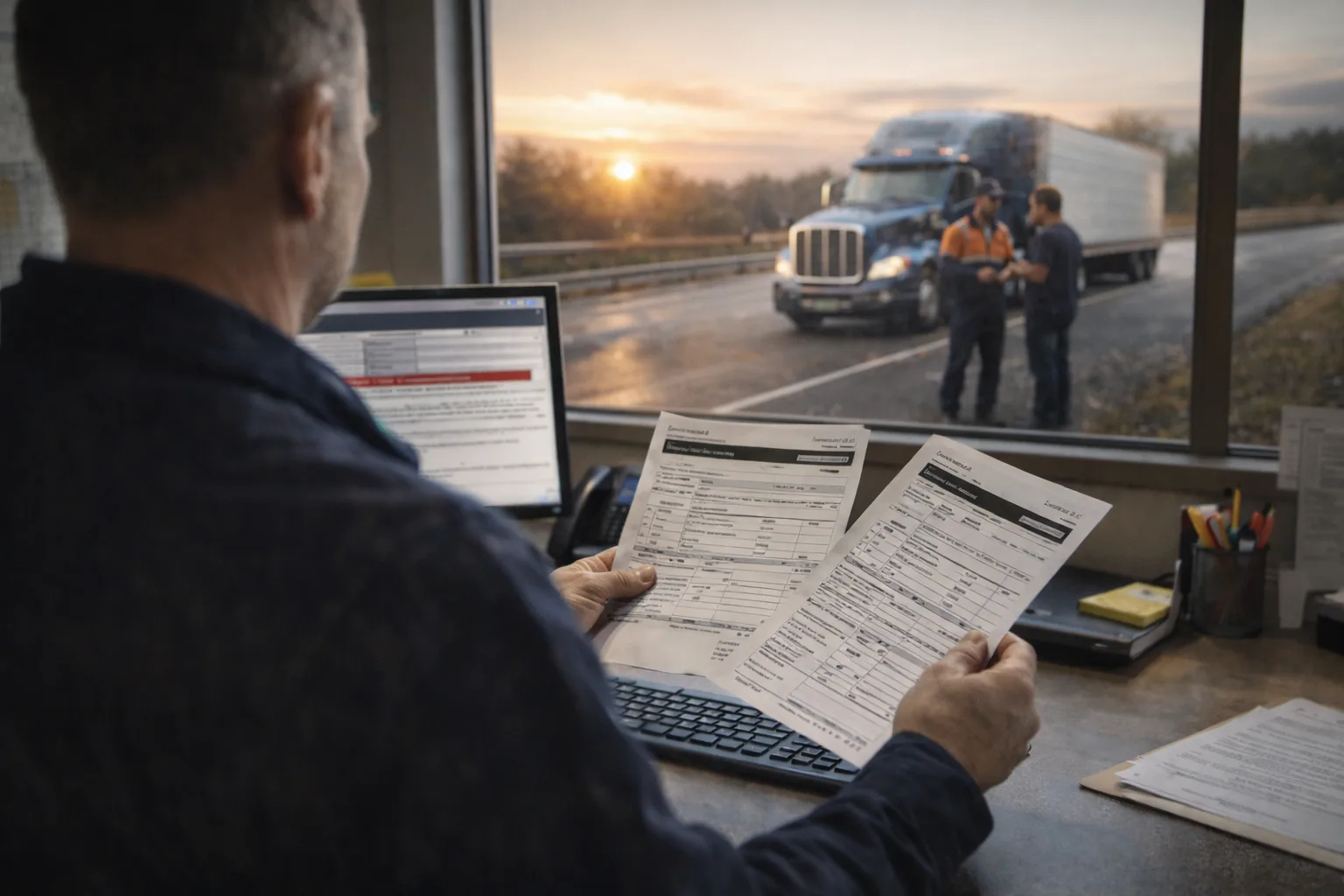
An annual inspection needs a qualified inspector, the tooling to measure rather than eyeball, and somewhere the truck can be worked safely. All three come to your Coon Rapids yard.
Meets 49 CFR 396.19 training and experience requirements, with the qualification file to prove it
Every annual inspection. This is the requirement most commonly missed on paper rather than in practice.
Meets the separate 396.25 brake inspector standard
Any inspection or repair touching the brake system — which is nearly all of them.
Measurement tooling, air system gauges, lighting, and common repair parts on board
Inspections at your yard, so a minor finding is corrected the same visit instead of scheduling a second one.
Pushrod stroke measurement, lining thickness gauges, air loss timing
The brake section of every annual — the part that decides pass or fail more often than anything else.
ABS, chassis, and aftertreatment fault reading
Late-model equipment where an ABS lamp or an active fault affects the inspection result.
Parts and tooling for findings that would otherwise fail the inspection
Fleet inspection days, where finding six problems and fixing none of them helps nobody.

One call puts a DOT inspection unit on the road to you anywhere in Coon Rapids or out along US-10 and MN-610. Tell us the road and which way you are pointed and we do the rest.
The federal annual inspection and the roadside levels it interacts with, performed by a qualified inspector at your Coon Rapids yard or terminal. Below is what is actually examined, what stops a truck, and the paperwork that has to exist afterward.
Linings and pads, drums and rotors, hoses and tubing, low-pressure warning, tractor protection, air loss rate, and pushrod travel on every wheel. This is where most Coon Rapids trucks fail, and it is the section requiring a qualified brake inspector.
Steering wheel free play, column, gear box, pitman arm, drag link, tie rods, and ball-and-socket joints. Wear here is gradual enough that a Coon Rapids driver adapts to it without noticing anything changed.
Springs, hangers, U-bolts, torque rods, air bags, axle positioning, plus frame members, cross members, and mounting for cracks or unauthorized welds. Frame findings are the ones most likely to surprise a Coon Rapids owner.
Tread depth at 4/32 steer and 2/32 drive and trailer, sidewall condition, inflation, matching, and wheels and rims for cracks, elongated bolt holes, and missing fasteners. Cheap to fix beforehand, expensive at a Coon Rapids scale.
Every required lamp and reflector, wiring condition, and connections. Lighting produces enormous violation volume nationally, and it is the single easiest Coon Rapids pre-inspection item to clear yourself.
Fifth wheel, pintle hooks, safety devices, exhaust leaks and mounting, fuel tank security and leaks, plus windshield, wipers, mirrors, horn, and emergency equipment. The remainder of Appendix A, and where a Coon Rapids inspection frequently finds something nobody was looking for.
The full inspection: driver credentials, hours, and a complete vehicle examination including under the truck. A Coon Rapids Level I performed to the annual standard and documented properly can satisfy your 396.17 requirement.
Driver and vehicle, but without going underneath. The most common Coon Rapids roadside inspection and still fully capable of producing an out-of-service order.
Credentials, medical certificate, hours of service, and required documents. No vehicle component, but violations still feed your Coon Rapids carrier's CSA record.
A one-time examination of a specific item, and a full vehicle inspection performed without the driver present — the level typically used at a Coon Rapids terminal or during a compliance review.
Radioactive materials transport, and electronic inspection performed wirelessly while the vehicle is in motion. The second one is expanding, and it inspects Coon Rapids trucks that never stop.
Defects meeting the North American Standard out-of-service criteria stop the vehicle where it sits until repaired. Brakes dominate. A Coon Rapids OOS also requires the violation be certified and returned, not merely fixed.
The report identifies the inspector, the vehicle, each component inspected, and the result. It is retained for fourteen months, with a copy where the Coon Rapids vehicle is housed or maintained.
Where a decal is used, it goes on the vehicle showing the month and year of the inspection. Convenient at a Coon Rapids roadside stop, but the report is the record — a decal alone does not satisfy the rule.
Evidence that whoever performed the inspection met the 396.19 requirements, and the brake inspector standard for brake work. Missing this is a violation even where the Coon Rapids inspection itself was flawless.
Anything found and corrected has to be documented against the unit and filed. The Coon Rapids repair order is what proves the finding was closed.
Defects a driver reported feed into the inspection picture. A Coon Rapids annual that passes while an uncorrected DVIR defect sits open is an audit problem in itself.
The annual is due every twelve months per unit, and state periodic inspections run on their own clock. Most Coon Rapids fleets that get caught were tracking one of the two.
Rolling 30-day average dispatch-to-arrival, by service type, across the local rescuer network.
An annual inspection is a small, predictable line item — the money is in what it finds. A Coon Rapids inspection quote covers the inspection itself; repairs required to pass are separate, and knowing which is which before you book is the entire point.
The inspection fee buys the examination and the documentation. Anything that has to be corrected to pass is quoted separately. A quote that blurs the two is impossible to compare against another vendor's.
Mobile inspection at your yard costs more per unit than driving to a station, and costs less in total once you count the driver hours and the truck being out of service to get there.
Travel amortizes. Inspecting eight trailers on one visit prices very differently per unit than inspecting one, which is why fleets batch annuals rather than spreading them across the year.
A trailer inspects faster than a tractor, and a straight truck faster than a combination unit. Specialized equipment — tankers, lowboys, vocational bodies — carries additional inspection items.
A well-maintained unit inspects quickly and passes. A neglected one consumes inspector time, fails, needs repair, and needs re-inspection. Condition affects the total far more than the inspection rate does.
A lamp, a hose, or a brake adjustment corrected during the inspection visit avoids a second dispatch and a second failed attempt. This is where a mobile inspection recovers its premium.
Inspections booked ahead of expiry price normally. An inspection needed today because a unit was stopped is emergency work, and it is priced as such.
Annual inspections are quoted per unit and per visit. Repairs required to pass are quoted separately and authorized before they are performed — you will never receive an inspection invoice with repair work folded into it.
The same crews that run Coon Rapids also cover Blaine (5 mi), Anoka (4 mi) and Andover (5 mi), so a call from either side of Anoka County reaches the same desk.
Each service links to local response times, rescuer coverage, and recent dispatched jobs in this metro.
A live map of every DOT inspection provider in Coon Rapids metro, with real-time positions, ETAs, and dispatch status, available inside your dashboard.
Sign in to track network rescuers across Coon Rapids in real time, dispatch jobs, and confirm ETA before the truck rolls.
Each corridor has a dedicated breakdown landing page with service zones, exits, and recent dispatched jobs.

5 exits in Coon Rapids
The northwest corridor from the Twin Cities toward St. Cloud running through Coon Rapids as a freeway. Heavy manufacturing and distribution freight; breakdowns cluster at the Hanson Boulevard and Round Lake Boulevard interchanges.

4 exits in Coon Rapids
East-west freeway connecting Coon Rapids across the Mississippi to the I-94/694 beltway in Brooklyn Park. A key distribution-center connector along the northern tier.

3 exits in Coon Rapids
North-south route along the Mississippi linking Coon Rapids to the Brooklyn Center industrial zone and I-694. Steady commercial-vehicle flow.
6 exits in Coon Rapids
North-south arterial through Coon Rapids toward Anoka and the northern Anoka County towns. High local-delivery and contractor freight.

4 exits in Coon Rapids
North-south route east of Coon Rapids linking the north suburbs to the central metro. Distribution and retail-delivery traffic.

7 exits in Coon Rapids
Primary arterial along the Mississippi serving the riverfront industrial and distribution cluster with constant box-truck delivery traffic.
Patterns observed across recent dispatch data in this metro, by service type and corridor.
The US-10/610 junction is the north metro's busiest freight point, where the St. Cloud corridor meets the beltway connector. A breakdown there during the evening surge backs traffic into the north suburbs and the central-Minnesota run. Our nearest unit averages under 30 minutes to the junction shoulders so the backup doesn't cascade.
When the polar vortex settles over the Twin Cities and Coon Rapids bottoms out at 20 below, air dryers freeze and brake chambers lock so hard trailers won't budge. We field a surge of these every cold snap along US-10 and the Riverdale district. Our mechanics run methanol injection and air-dryer rebuilds roadside and clear most without a tow.
Fog off the Mississippi freezes to glaze on the Highway 610 river crossing on the coldest mornings, and trucks lose traction on the deck while air lines freeze. We coordinate safe-staging recovery with the State Patrol and clear the frozen systems on-site. Local rescuers know the river-crossing staging points and carry the cold-weather kit.
The annual inspection is federal, so the standard is the same in Minnesota as everywhere else. What changes by state is whether a separate periodic inspection applies on top of it — and that is where Coon Rapids fleets most often get caught.
Every commercial motor vehicle must pass a comprehensive inspection at least once every twelve months. The vehicle must be inspected against the minimum periodic inspection standards in Appendix A to Part 396, and proof of the inspection must be retained. A vehicle operated without a current annual inspection is in violation regardless of its actual mechanical condition.
A roadside inspection performed to the periodic inspection standard — in practice a North American Standard Level I — can meet the annual requirement, provided the documentation is retained. Fleets routinely buy an annual inspection for a unit that already received a qualifying Level I months earlier. Check the file before booking.
Inspectors must be qualified through a combination of training and experience: understanding the inspection standards, being able to identify defective components, and having completed a recognized training program or accumulated a year of relevant experience. The carrier must retain evidence of qualification for each inspector while they perform inspections and for a year afterward.
Anyone who inspects, repairs, or maintains brakes must separately meet the brake inspector standard. Because brakes are the largest section of the annual and the leading cause of out-of-service orders, this qualification is effectively required for annual inspections — and it is the record most commonly absent from a maintenance file.
The inspection report must be retained for fourteen months from the inspection date, with a copy kept where the vehicle is housed or maintained. Where a decal is used, it must show the month and year and be displayed on the vehicle. The report is the record; the decal is a convenience.
The North American Standard out-of-service criteria define the defect thresholds that stop a vehicle at the roadside rather than producing a citation. They are published and updated annually, which means a fleet can inspect deliberately against the same thresholds an enforcement officer will apply.
Roadside inspection results feed the Vehicle Maintenance BASIC in the Safety Measurement System, weighted by severity and recency. A clean inspection improves the score; a violation-heavy one raises inspection frequency, which generates further inspections. The annual is the cheapest opportunity to find those violations before an officer does.
Most Coon Rapids calls are answered in about 40 minutes. You get a real time before anyone rolls, and the price before the work starts.
Coon Rapids anchors the northern Twin Cities suburbs along US-10 and Highway 610 where the Mississippi River swings through Anoka County. Its position on the US-10 corridor links the metro to St. Cloud and the central-Minnesota manufacturing belt, while Highway 610 ties it into the I-94/694 beltway. A band of distribution centers and manufacturers along Coon Rapids Boulevard and the Riverdale retail district keep regional and last-mile freight moving through the north suburbs.
Coon Rapids is a northern suburb of Minneapolis, and the second-largest city by population in Anoka County, Minnesota, United States. The population was 63,599 at the 2020 census, making it Minnesota's 15th-largest city and the seventh-largest Twin Cities suburb.
Coon Rapids's freight economy runs on the US-10 corridor, the link between the north metro and the St. Cloud manufacturing belt, anchored where Highway 610 ties into the I-694 beltway. A truck down on the US-10/610 junction during the evening surge backs traffic into the north suburbs and the central-Minnesota run behind it. Road Rescue Network's Coon Rapids rescuers run 24/7 and beat the Twin Cities benchmark on response time.
Anyone who's dispatched through the north metro in deep winter knows Anoka County cold has a way of finding every weak air system in the fleet. When the polar vortex parks over the Twin Cities and lows hit 20 below, brake chambers lock, diesel gels, and batteries that tested fine in fall die at the curb. Our local mechanics carry methanol injection, heated anti-gel, and high-output jump packs because in Coon Rapids the cold-weather no-start is the most common call on the morning board.
Whether you're a fleet manager routing freight up US-10 toward St. Cloud or an owner-operator stuck on Highway 610 with a frozen brake chamber, the nearest verified, insurance-current rescuer in our Coon Rapids network is one call away. Road Rescue Network's 24/7 operations team handles coordination, dispatch, and ETA confirmation throughout.
Reviews collected from fleet customers and drivers after completed service calls in this metro.
“Truck wouldn't build air on US-10 at 19 below heading toward St. Cloud. RRN had a tech out in 40 minutes who thawed the dryer and swapped the purge valve. Driver made the run on schedule. They get Anoka County cold.”
“Slid on glaze on the 610 river crossing in the morning fog. The recovery operator coordinated with the troopers and pulled me out clean. Knew the crossing and the conditions cold.”
“Drive tire blew at the Round Lake Kwik Trip. Tech showed in about 35 minutes with the right casing. One star off for an ETA that ran slightly long, but the work and price were right.”
The inspection itself is a modest, predictable per-unit fee — it is a defined examination against a published standard, not open-ended work. What varies enormously is what the inspection finds, since repairs needed to pass are quoted separately from the inspection. Four things move the inspection price in Coon Rapids: whether it is performed at your yard or you drive the unit to a station, how many units you inspect on the same visit since travel amortizes across them, the type of vehicle — a trailer inspects faster than a combination tractor, and specialized equipment carries extra items — and how much lead time you give, because an inspection needed today on a stopped truck is emergency work. The number that actually decides your annual cost is equipment condition. A well-maintained unit inspects quickly and passes; a neglected one consumes inspector time, fails, needs repairs, and needs re-inspecting. Before you book anything, check whether the unit already had a qualifying Level I roadside inspection this year — if it did and you kept the paperwork, you may not need to buy one at all.
You have three options and they are not equivalent. You can take the vehicle to a truck service facility or dealership that performs annual inspections, which works well if the unit is already going there for other work. You can use a state inspection station where your state runs a periodic program — but be careful, because a state safety inspection and the federal 396.17 annual are separate requirements with separate proof, and passing one does not satisfy the other. Or you can have a qualified inspector come to your Coon Rapids yard or terminal, which is what most fleets running more than a handful of units end up doing, because it eliminates driver hours, deadhead miles, and the unit sitting out of service waiting for an appointment slot. The requirement is about who performs the inspection, not where it happens: any location works provided the inspector meets the federal qualification standard and the vehicle can be examined properly, including underneath.
For the annual inspection itself, the vehicle needs its registration and identification available, and it helps enormously to have the maintenance file — prior inspection reports, recent repair orders, and any open DVIR defects — so the inspector is not discovering history mid-inspection. After the inspection, the documentation that matters is the report identifying the inspector, the vehicle, each component inspected and its result, retained for fourteen months with a copy where the vehicle is housed or maintained, plus the decal where one is used. Separately, the carrier must retain evidence that the inspector met the federal qualification requirements. For a roadside inspection the driver's document set is different: commercial driver's license, medical examiner's certificate, hours of service records or ELD access, and the vehicle's registration and permits, along with the current annual inspection proof. The most common documentation failure is not a missing report — it is a missing inspector qualification record for an inspection that was performed perfectly well.
No, and this is the rule fleets most often get wrong. Federal regulations require that annual inspections be performed by a qualified inspector, defined by a combination of understanding the inspection standards, being able to identify defective components, and having either completed a recognized training program or accumulated at least a year of relevant experience inspecting or repairing commercial vehicles. Separately, anyone who inspects, repairs, or maintains brakes must meet the brake inspector qualification standard — and since brakes are the largest section of the annual, that qualification is effectively required to perform one. The carrier, not the shop, is responsible for retaining evidence of those qualifications. This produces the single most common audit finding in this area: the inspection was performed competently by someone genuinely capable, and no record exists proving they were qualified to do it. A capable mechanic without a documented qualification is a violation waiting for a compliance review.
The federal annual inspection is required at least every twelve months on every commercial motor vehicle, and it runs per unit rather than per fleet — each tractor, each trailer, each straight truck has its own clock. On top of that, if your state operates a periodic commercial vehicle inspection program and your vehicles are registered there, that inspection runs on its own separate schedule and does not replace the federal one. A Coon Rapids fleet may therefore be carrying two obligations with two different expiry dates, and tracking only one is how units end up operating out of compliance while everyone believes they are current. Roadside inspections happen whenever enforcement selects the vehicle and are not scheduled at all — though a Level I performed to the periodic standard can satisfy the annual requirement if the documentation is retained, which is worth checking before you pay for one.
Brakes, lights, and tires, in roughly that order, and all three are on any competent preventive maintenance checklist. Brake violations dominate both failures and out-of-service orders: linings worn past limits, pushrod stroke beyond adjustment limits, air leaks, and inoperative components. Lighting produces enormous violation volume nationally and is the easiest category to clear yourself the day before — every required lamp and reflector, working, with sound wiring. Tires fail on tread depth below the four-thirty-seconds steer and two-thirty-seconds other-position minimums, sidewall damage, and inflation. After those, the recurring findings are steering component wear, suspension and frame issues, exhaust leaks, and coupling device defects. The pattern worth noticing is that almost nothing on that list appears suddenly. They are wear items that crossed a threshold, which is why a fleet with genuine preventive maintenance intervals rarely fails an annual — the inspection confirms the program instead of substituting for one.
Average response time in Coon Rapids is 40 minutes for mobile truck repair, faster along US-10 and the Riverdale district, longer out toward the northern Anoka County edge. We track every call and post real averages.
Yes, the US-10/610 junction is our busiest zone, where the St. Cloud corridor meets the beltway connector. A stalled truck there backs up the north suburbs, so we treat it as time-critical and stage rescuers nearby.
Every Road Rescue Network rescuer in Coon Rapids maintains current general liability, automobile liability, workers comp, and where applicable garage-keepers insurance. We re-verify each renewal cycle. Expired coverage means automatic suspension from dispatch.
Yes. We service national accounts with consolidated invoicing, fleet-card billing, and a single point of contact. Most fleets onboard in under 48 hours. Reach out via the form on this page or call dispatch.
24/7/365. There is no after-hours surcharge in our network, rescuers quote the same rate at 3am as at 3pm.
We dispatch routinely to the Holiday on Coon Rapids Boulevard, the Kwik Trip on Round Lake Boulevard, the Speedway in Blaine, and the Pilot at Rogers out west. Our service trucks know each location.
Constantly, it's the most common call on the morning board here. Most frozen air dryers, gelled fuel, and dead batteries we resolve on-site with methanol injection, heated anti-gel, and high-CCA jump packs. Tow-aways are the exception.
Standard service-call dispatch runs $155-225 in the north metro depending on time of day and service type. Heavy-duty towing starts around $485 for in-area moves. We confirm a quote before the truck rolls.
Yes. Several Coon Rapids rescuers run fleet-PM programs with scheduled yard or terminal visits. Tell us your fleet size and DOT inspection cadence and we'll match you with the right shop.
If we determine on-scene the truck can't be fixed roadside in a reasonable window, we coordinate the tow with one of our heavy-duty network rescuers. Many service trucks dispatch alongside a wrecker so there's no second response time.
Coon Rapids runs about 63,599 people and sits in Anoka County, inside the Minneapolis-Saint Paul Metropolitan Area. We take the call, find the closest crew that actually does this work, and tell you what it costs before anyone turns a wheel.
Sample of recent dispatched service calls in this metro. Customer details removed; locations and response times preserved.
| When | Service | Location | Response |
|---|---|---|---|
| Tuesday 17:14 CT | Mobile Truck Repair | US-10 W at Hanson Blvd | 39 min |
| Monday 20:48 CT | Heavy-Duty Towing | MN-610 W at the river crossing | 45 min |
| Sunday 12:27 CT | Commercial Tire Repair | Kwik Trip Round Lake Blvd | 35 min |
| Saturday 09:33 CT | Mobile RV Repair | Coon Rapids RV dealer lot | 57 min |
| Friday 23:16 CT | Mobile Welding | Springbrook Business Park | 50 min |
| Wednesday 05:51 CT | Mobile Bus Repair | Anoka-Hennepin schools bus yard | 64 min |
| Thursday 14:39 CT | Fuel Delivery | MN-47 N near Anoka | 28 min |
| Saturday 02:44 CT | Battery Jumpstart | Riverdale Commercial District | 24 min |
Coverage in surrounding cities and metros across the same network of verified rescuers.
The same verified network of providers, dispatched 24/7 across every major Minnesota metro and freight corridor.
Whether the truck is sitting in Coon Rapids or out toward Andover, it is the same phone number and the same crews. One call, day or night.
Road Rescue Network is actively recruiting verified dot inspection providers in the Coon Rapids metro. Heavy traffic, real fleet leads, no auction race-to-the-bottom, straight rescuer-to-customer dispatch with confirmed pricing.
We send Coon Rapids dot inspection calls directly to verified rescuers in your service radius. Apply once. Insurance & DOT verified. Live dispatch, fleet accounts, transparent pricing, no motor-club shave-down.
Deep-dive guide on choosing the right provider, common pitfalls, and what to expect on a service call.
OpenOpen positions at our network rescuers, full-time, part-time, and 1099 contract.
OpenOn-site photos from recent calls, see the work, not just the marketing.
OpenNetwork technicians carry diagnostic equipment, OEM-spec tooling, and common-failure parts for every major dot inspection brand on the road. Out-of-stock specifics order in within 24 hours.
Service trucks dispatch routinely to these locations across the metro freight corridors.
Diesel lanes, 24-hr
View Directory Profile →
Open 24/7, full service, west of city
Diesel, 24-hr
View Directory Profile →Diesel, near city
View Directory Profile →Transit and truck staging lot
Local parts houses and diesel suppliers used by network mechanics for time-critical roadside repairs.
Heavy-duty parts, will-call
View Directory Profile →
HD truck parts
View Directory Profile →Mack / Volvo / Hino dealer parts and service
View Directory Profile →Major shippers, distribution centers, and industrial freight nodes generating outbound and inbound truck volume.
Ag and food-ingredient freight
Retail distribution, high outbound volume
Last-mile delivery station
Ammunition and outdoor-goods freight
Light-industrial and distribution tenants
Retail-distribution and warehouse cluster
Three steps from the call to a cleared scene. Same flow whether you call from a fleet desk or the shoulder of an interstate.
Before booking anything, we ask whether the unit has had a Level I roadside inspection in the last twelve months. If it has and the paperwork was retained, that Coon Rapids unit may already satisfy the annual and you should not be buying a second one.
A qualified inspector to where the truck sits in Coon Rapids, on a schedule that fits your dispatch rather than a station's opening hours. No driver hours spent, no unit deadheaded to an appointment.
Anything that would fail the inspection is reported with what it needs, and repairs are quoted and authorized separately. A Coon Rapids inspection invoice never arrives with repair work folded into it.
Network rescuers accept all major credit cards, fleet cards, and consumer payment apps. Confirmed at dispatch.