01
Mobile tire service truck
Onboard compressor, crane or hoist, tire rack
Every commercial call. A Class 8 drive tire is heavy enough that the hoist is a safety device, not a convenience.
Need mobile tire repair in St. Paul? We are the 24 hour tire shop that comes to you — flat repair or full tire replacement at the shoulder, in your size, torqued properly so you don't lose a wheel twenty miles down the road. The same trucks cover Minneapolis, Bloomington, and Roseville, so a call from outside town reaches the same people.

Commercial tire work at the roadside needs equipment a passenger-car tire shop does not own. This is what a St. Paul service truck carries.
Onboard compressor, crane or hoist, tire rack
Every commercial call. A Class 8 drive tire is heavy enough that the hoist is a safety device, not a convenience.
Truck and trailer tire capable
Any mount or dismount at the roadside. Commercial beads do not break with hand tools.
Torque wrench or calibrated multiplier
Every wheel installation. The impact gun spins the nut on; the torque tool is what makes it correct.
OSHA-compliant restraining device
Any tire inflated off the vehicle. A commercial tire failing during inflation carries lethal energy — this is a mandatory control, not best practice.
Calibrated depth gauge, dual-foot chuck
Every call. Documented readings are what make a DOT compliance claim defensible later.
Inside patch, vulcanizing capability
Repairable injuries. An inside repair is a real repair; an outside plug is a temporary measure.
Cones, triangles, scene lighting, high-vis
Rolls on every interstate call. Working the traffic side of a truck in the dark is the highest-risk part of this job.
Common steer, drive, and trailer sizes
Carried so a call finishes on the first visit. Dispatch confirming your size is checking stock, not stalling.

One call puts a mobile tire repair unit on the road to you anywhere in St. Paul and the surrounding Ramsey County. Tell us where you are stopped and we do the rest.
Roadside and on-site tire work across the St. Paul metro — steer, drive, trailer, and light-truck positions. Repaired where it is repairable, replaced where it is not, and torqued to spec either way.
New or casing-matched tire mounted and balanced at the shoulder or the dock. The standard St. Paul road-call, and the reason a blowout does not have to become a tow.
Repaired properly from the inside when the injury is in the repairable crown area. A St. Paul plug alone from the outside is a temporary fix that industry standards do not recognize as a repair.
Correcting under-inflation across the unit, which is what causes most of the St. Paul blowouts we get called to in the first place. Underinflated duals run hot and fail at highway speed.
Mounting a tire you already own onto the wheel on the truck, or onto your spare, so a St. Paul fleet using its own casing program does not pay for inventory twice.
Stems, cores, extensions, and sensor service. A slow leak on a St. Paul inner dual is very often the stem rather than the tire, and it is a fraction of the cost to find out.
Dispatch to a live shoulder with cones, lighting, and a shadow position. St. Paul interstate tire work is done from the traffic side more often than anyone would like, so how a truck sets up matters.
The most safety-critical position on the vehicle and the one with the strictest tread requirement. A St. Paul steer failure at speed is a control event, not an inconvenience.
Drive axle duals, including matched-pair replacement. Mismatched diameters on a St. Paul dual set scrub continuously and destroy both tires plus the differential over time.
Trailer tires run the highest neglect rate in any fleet because nobody walks the back of the unit. Most St. Paul trailer calls are a tire that was flat before the trip started.
Wide-base single service and conversion questions. A St. Paul super single carries the whole position with no companion tire, so a failure strands the unit immediately.
Diameter and tread-depth matching across a dual set within tolerance. Getting this wrong is the quiet cause of repeat St. Paul failures on the same position.
Retread fitment on legal positions and casing management for St. Paul fleets. Retreads are prohibited on the steering axle of buses and are a routine, legal, economical choice elsewhere.
Cracked, bent, and corroded wheels swapped out. A St. Paul rim that failed once will fail again — replacing the tire on a damaged wheel is buying the same road call twice.
Sheared studs and stretched fasteners replaced. A wheel-off event on a St. Paul highway is catastrophic, and it nearly always starts as one loose or damaged fastener.
Calibrated torque at installation, plus the re-torque interval afterward. An impact gun alone is a guess, and the re-torque is the step that gets skipped and causes wheel-offs.
Seals, bearings, and oil-bath hubs when the tire failure exposed a wheel-end problem. A St. Paul hub running hot will take out the new tire too.
Different torque values, different corrosion behavior, different failure modes. A St. Paul tech torquing aluminum to a steel spec is over-clamping the wheel.
Full fastener and hub inspection after a separation event, before the unit moves again anywhere in St. Paul.
Federal minimums are 4/32 on the steering axle and 2/32 on all others. A St. Paul unit below that is out of service at roadside, and the fine is the cheap part.
Tire and wheel items caught before an inspector catches them. Tires are among the most frequently cited defects in St. Paul roadside inspections.
Pressure, tread, and wear-pattern surveys on a St. Paul yard schedule. Every dollar here removes several from the emergency road-call line.
Tracking, inspecting, and routing casings to retread. A St. Paul fleet that manages casings well runs meaningfully lower cost per mile.
Feathering, cupping, and one-sided wear read as symptoms of alignment, inflation, or suspension faults. Replacing a St. Paul tire without reading the old one guarantees the same failure again.
Old casings removed and disposed of under state waste-tire rules. Leaving them in a St. Paul yard creates a regulatory problem of its own.
Roadside tire work is a service call plus the tire, and the two should never arrive as one number. Here is what a St. Paul invoice is actually made of.
Getting the truck and the tech to you, billed once regardless of how many tires get touched. The number to compare between providers.
Distance beyond the core service area. Ask whether it counts from their shop or your location — on a rural interstate call that is the whole difference.
The tire itself, which varies enormously by position, brand, and load range. Bringing your own casing removes this line entirely.
Charged per tire and separate from the service call. Doing two tires on one visit is far cheaper than two visits.
A proper inside repair costs a fraction of a new tire. Whether the injury sits in the repairable crown area decides it, and an honest tech will show you.
Overnight and holiday road calls price above daytime. Most blowouts do not happen at 10 a.m. on a Tuesday.
Damaged rims, sheared studs, and stems billed as parts. A tire failure frequently takes the wheel with it.
The re-torque follow-up may be a separate visit or a separate line. Skipping it is how wheel-off events happen — do not decline this one.
A usable casing carries trade value against a retread program. Fleets that track this see real money; fleets that do not leave it on the shoulder.
Waste tire disposal is regulated and charged per tire in most states.
Extended waits for a police traffic break or lane closure on a live shoulder are billable time.
The same tire fitted in your yard on a Tuesday costs materially less than fitted on I-95 at midnight. Tire PM is the cheapest line item on this page.
Road Rescue Network does not set a member operator's rates. What the network does is get the road call, the tire, and the labor quoted as separate lines before the truck rolls — and confirm the operator actually stocks your size first.
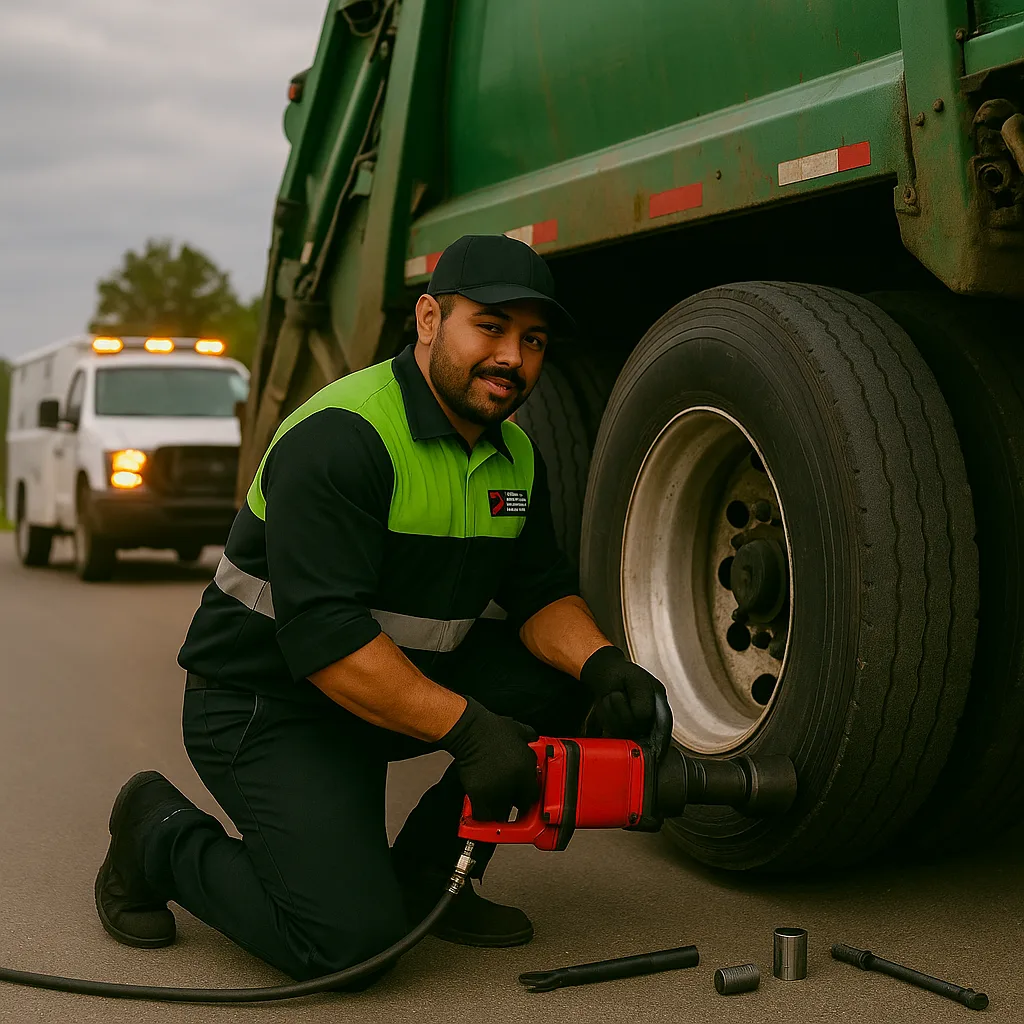
The same crews that run St. Paul also cover Minneapolis (8 mi), Bloomington (12 mi) and Roseville (10 mi), so a call from either side of Ramsey County reaches the same desk.
Each service links to local response times, rescuer coverage, and recent dispatched jobs in this metro.
Patterns observed across recent dispatch data in this metro, by service type and corridor.
February 0600, I-494 eastbound approaching the airport split: light snow overnight turned to glazed ice. A loaded flatbed with 3M equipment hits the ice, trailer breaks loose, blocks all lanes. RRN dispatches heavy-duty tow to the nearest exit (Nicollette Avenue) while traffic backs up 4 miles. Road Rescue coordinates with Minnesota State Patrol for lane closure and works the recovery while secondary breakdowns spike across the network.
June midday, US 52 southbound near downtown: refrigerated trailer (frozen foods, dairy) loses compressor drive belt. Temperature climb inside unit threatens $40K cargo. RRN mobile tech reaches the breakdown in 22 minutes with spare belt inventory from Blaine Brothers. Repair takes 18 minutes. Driver continues to distribution center in Lakeville without spoilage loss.
October 1700, I-35E northbound in downtown St. Paul: tandem tractor runs loss of air brakes while merging from 35E to I-94 eastbound interchange. Driver safely pulls onto shoulder. RRN arrives 12 minutes later, diagnoses failed compressor, sources replacement from Universal Truck Parts (Roseville), and completes air brake service roadside in 45 minutes.
April morning, I-494 near Murphy Logistics Fridley facility: heavy goods carrier develops sidewall damage on drive axle tire. Driver limps to nearby exit. RRN mobile tire service arrives with load-rated tire inventory, changes all drive axle tires on-site in 35 minutes. Load continues to warehouse without downtime.
May afternoon, Stone Arch Bridge crossing on US 52: cement truck develops hydraulic line rupture crossing the Mississippi. Driver pulls to designated shoulder. RRN hydraulic specialist arrives in 28 minutes, sections failed hose, installs backup line rated for next segment. Truck clears bridge within 55 minutes to prevent rush-hour cascade failure.
November 0400, I-494 westbound near airport: Amazon freight unit reports engine knock, suspects mechanical timing issue. RRN engine diagnostics unit arrives in 19 minutes, runs full scan, identifies valve wear. Quick valve adjustment restores operation for remaining segment to regional hub. Peak-season delivery timeline maintained.
Tires are among the most-cited defects in roadside inspections, and the rules are specific and enforceable. What governs a commercial tire in St. Paul, Minnesota.
Federal safety regulations set 4/32 of an inch of tread on the steering axle and 2/32 on all other axles. Below that the vehicle is out of service at roadside — measured at the shallowest point, not the average.
Beyond tread depth, an inspector will place a vehicle out of service for exposed belt or cord, a visible bulge, a flat or audibly leaking tire, or an unsafe repair in the sidewall. Any one of those ends the trip where it stands.
Regrooved, recapped, or retreaded tires are prohibited on the front steering axle of buses. Retreads remain legal, economical, and routine on other positions across the industry.
A tire's load capacity is a function of its inflation pressure. Running underinflated is not merely inefficient, it silently overloads the tire, builds heat, and is the leading cause of highway blowouts.
Loose or damaged fasteners are an out-of-service item. Torque at installation and the follow-up re-torque are the entire defense against a wheel separation.
Scrap tires are regulated waste in most states, with handling and disposal requirements that fall on whoever generates them. That is the disposal line on your invoice.
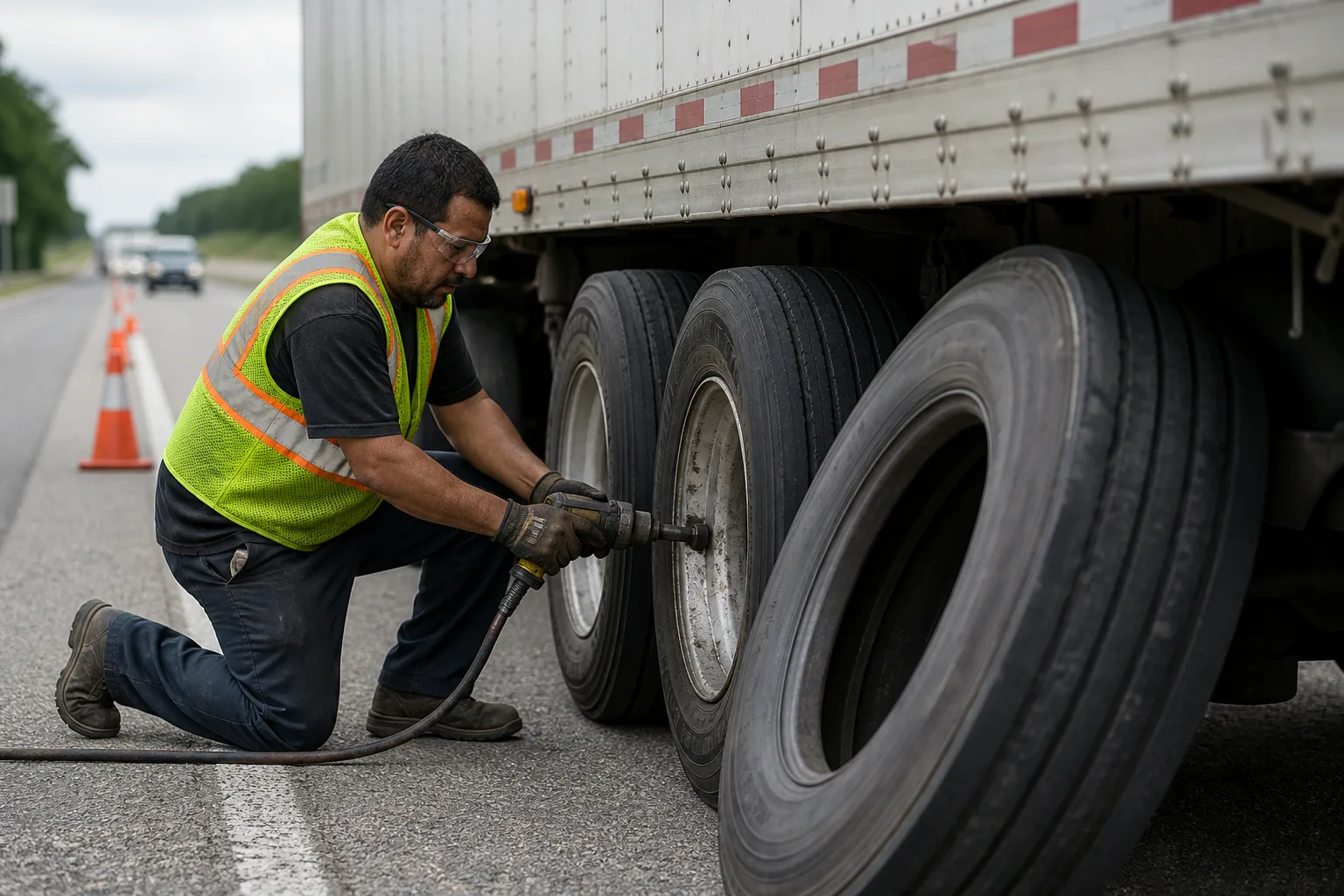
You get a real time before anyone rolls, and the price before the work starts. No motor club runaround and no waiting on a callback.
St. Paul's freight movement follows I-94, I-35E, and I-494, with additional capacity on US 52 and US 61. Major employers like 3M (medical devices, electronics), General Mills (consumer packaged goods), U.S. Bancorp, Target logistics, and Best Buy distribution generate constant heavy-truck traffic. Weather patterns—deep freeze in winter, black ice on bridge approaches, occasional summer thunderstorms—create predictable breakdown windows. A single mechanical failure or weather incident on I-494 eastbound backing up to the airport affects retail distribution, medical supply chain, and regional trucking for hours.
Saint Paul is the capital city of the U.S. state of Minnesota and the county seat of Ramsey County. As of the 2020 census, the city had a population of 311,527, making it Minnesota's second-most populous city and the 69th-most populous in the United States. Saint Paul and neighboring Minneapolis form the core of the Twin Cities metropolitan area, the third most populous in the Midwest with around 3.7 million residents.
St. Paul sits at the heart of Minnesota's freight corridor where I-94, I-35E, and I-494 converge—the backbone of Midwest distribution. As the state capital and second-most populous city in Minnesota, St. Paul handles everything from 3M healthcare logistics to General Mills consumer goods, with daily heavy traffic crossing the Mississippi River bridges and funneling south through the Blaine Brothers Distribution hub. A breakdown on I-94 eastbound through downtown doesn't just strand one driver; it cascades across the Twin Cities network within minutes.
Winter here is relentless. November through March brings black ice on I-494's eastbound climb toward the airport, and St. Paul's crosstown routes (I-35E, US 52) become slick corridors where lightweight trailers jackknife. The 2020 census recorded 311,527 residents within city limits, but the metro area swells to 3.7 million—making congestion, weather shutdowns, and accident response times critical. Murphy Logistics runs major distribution out of both St. Paul and Fridley; when a Reefer unit breaks down on a temperature swing, you're racing against spoilage across a three-state supply chain.
RRN covers St. Paul's freight ecosystem 24/7: Blaine Brothers Parts in downtown St. Paul connects directly to repair vendors; truck stops at Pilot (Inver Grove Heights), Flying J (Northfield), and TA centers (Hudson, Rogers) feed demand into our vendor network. We staff for the predictable—mechanical breakdowns on cross-town gridlock—and the unexpected: winter pile-ups on the I-94/I-35E interchange, chemical haul incidents on US 52, and high-speed recovery near the airport corridor where Federal Express and Amazon Air operations run continuous freight.
Black ice on the eastbound climb toward the airport (MP 48-52) is the primary concern November through March. Lightweight trailers and loaded tandems both struggle on the glazed sections. RRN stations heavy-duty tow capacity strategically to respond within 28 minutes to I-494 corridor calls. Air brake and engine warm-up time are also critical; we carry spare glow plugs and heating line fittings for cold-start failures.
US 52 runs congested through downtown St. Paul, especially during rush (0700-0900 and 1600-1800). RRN mobile units stage near downtown exits and can reach most breakdowns in 22-28 minutes. Traffic congestion is factored into our dispatch algorithm; we route heavy recovery via backroads (Stone Arch Bridge, Fort Road) to minimize additional delays.
Yes. Murphy Logistics (Fridley and St. Paul facilities) moves significant refrigerated loads. RRN partners with specialized refrigeration shops and carries common compressor, condenser, and insulation repair materials. Reefer breakdowns near the I-494/Murphy hub typically resolve in 38-42 minutes, protecting temperature-sensitive goods.
Fuel delivery to stranded trucks on I-494 eastbound is coordinated with Minnesota State Patrol and airport authorities due to hazmat regulations. RRN dispatches fuel units with proper credentials to designated safe zones off the main lanes. Standard fuel calls respond in 24-28 minutes; hazmat coordination may add 8-12 minutes but ensures legal and safe delivery.
St. Paul's winter weather (heavy snow, black ice, wind) creates multi-vehicle incidents on I-94 and I-494 intersections. RRN coordinates with Minnesota State Patrol, pre-stages additional heavy-duty tow and winch recovery units on forecast high-risk days, and provides real-time dispatch updates to freight carriers. Response to pile-up scenes typically takes 18-32 minutes depending on severity and access.
Yes. Universal Truck Parts (Roseville), Blaine Brothers Parts Distribution (downtown St. Paul), and FleetPride (Roseville) are RRN-integrated suppliers. Manders Diesel (Lakeville) serves southern corridor calls. Most common replacement parts (belts, hoses, brake pads, filters) are in stock for 20-30 minute mobile repair windows; rare parts are sourced same-day via overnight courier.
RRN-certified DOT inspectors operate from staging points across the Twin Cities metro. For St. Paul area calls, inspection arrival is typically 38-45 minutes. Pre-scheduled inspections at warehouse or truck stop facilities can often be completed in under 30 minutes. We coordinate with General Mills, Target, and 3M distribution for regular fleet maintenance windows.
Yes. Amazon Air operations near the Minneapolis-St. Paul airport run 24/7 freight schedules. RRN provides priority engine diagnostics, brake system checks, and rapid reefer repairs to keep Amazon units mobile. We maintain a dedicated dispatch tier for airport-adjacent breakdowns with target response under 22 minutes to protect peak-season and time-sensitive loads.
Call RRN dispatch immediately and provide your mile marker, direction, visible symptoms, and truck configuration (tractor-trailer, tandem, etc.). I-35E downtown runs congested; dispatch will route you to safe staging area (shoulder or designated exit) and dispatch the nearest available unit. Average response is 26-34 minutes. Have your carrier account number and insurance details ready.
RRN serves the entire Twin Cities metro (Minneapolis, Ramsey, Hennepin, Carver, Scott, Washington counties) plus extended corridors: I-35E south to Lakeville, I-494 east to the Wisconsin border, US 52 south to Northfield, and US 61 north to Wyoming. Truck stops at Pilot, TA, and Flying J are fully integrated into our network. Response times increase 8-15 minutes as you move into fringe areas but remain predictable and logged.

St. Paul runs about 311,527 people and sits in Ramsey County, inside the Twin Cities Metropolitan Area. We take the call, find the closest crew that actually does this work, and tell you what it costs before anyone turns a wheel.
Coverage in surrounding cities and metros across the same network of verified rescuers.
The same verified network of providers, dispatched 24/7 across every major Minnesota metro and freight corridor.
Whether the truck is sitting in St. Paul or out toward Roseville, it is the same phone number and the same crews. One call, day or night.
Road Rescue Network is actively recruiting verified mobile tire repair providers in the St. Paul metro. Heavy traffic, real fleet leads, no auction race-to-the-bottom, straight rescuer-to-customer dispatch with confirmed pricing.
We send St. Paul mobile tire repair calls directly to verified rescuers in your service radius. Apply once. Insurance & DOT verified. Live dispatch, fleet accounts, transparent pricing, no motor-club shave-down.
Deep-dive guide on choosing the right provider, common pitfalls, and what to expect on a service call.
OpenOpen positions at our network rescuers, full-time, part-time, and 1099 contract.
OpenOn-site photos from recent calls, see the work, not just the marketing.
OpenNetwork technicians carry diagnostic equipment, OEM-spec tooling, and common-failure parts for every major mobile tire repair brand on the road. Out-of-stock specifics order in within 24 hours.
Service trucks dispatch routinely to these locations across the metro freight corridors.


Local parts houses and diesel suppliers used by network mechanics for time-critical roadside repairs.
Major shippers, distribution centers, and industrial freight nodes generating outbound and inbound truck volume.
Three steps from the call to a cleared scene. Same flow whether you call from a fleet desk or the shoulder of an interstate.
Steer, drive, or trailer; the size off the sidewall; and whether it is flat, damaged, or gone. That tells St. Paul dispatch whether this is a repair, a swap onto your casing, or a tire we need to be carrying.
We confirm the operator has your size on the truck and send the road call, the tire, and the labor as separate numbers. Nothing wastes a St. Paul hour like a service truck arriving without the tire.
Repairable injuries get a proper inside repair. Replacements get mounted, inflated in a restraint, torqued with a calibrated tool, and you get the re-torque interval before we leave you in St. Paul.
Network rescuers accept all major credit cards, fleet cards, and consumer payment apps. Confirmed at dispatch.