01
Agricultural tire service truck
Boom or crane for handling, bead breaking capacity for large-diameter tires, ballast pump
Tractor, combine, sprayer, and implement tires in the field or the yard.
Need tractor tire repair in Wilmington? We come to the machine — tractor, loader, forklift, or industrial. These are heavy, usually full of fluid, and on wheels that hurt people when handled wrong, so we do them right. US-68, US-22, and SR-73 all run through Wilmington, so most calls come off one of those.
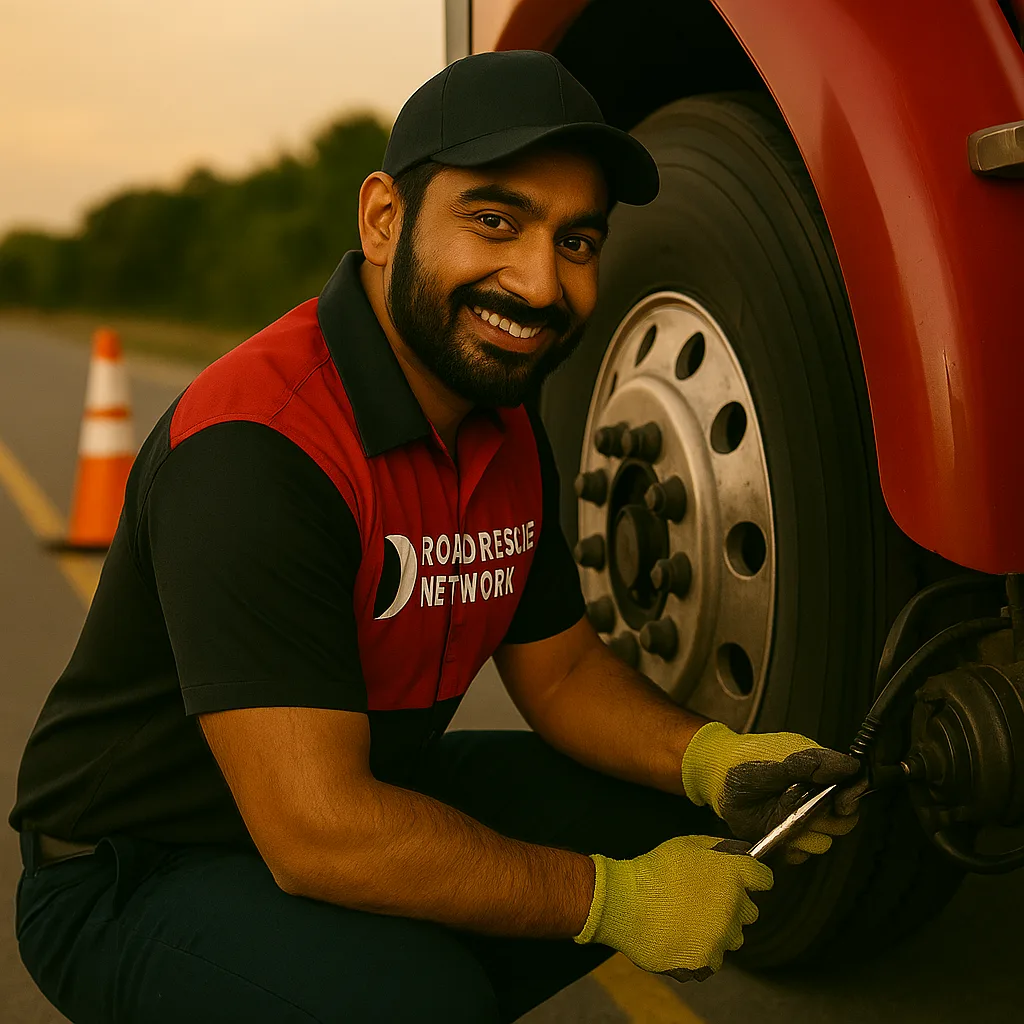
An agricultural or earthmover tire can weigh several hundred pounds and hold hundreds of pounds of liquid on top of that. A Wilmington highway tire truck cannot do this work — not because the technician lacks skill, but because the handling equipment is not on it.
Boom or crane for handling, bead breaking capacity for large-diameter tires, ballast pump
Tractor, combine, sprayer, and implement tires in the field or the yard.
Heavy hydraulic handling, high-torque tooling, and section repair capability
Loader, grader, dozer, and articulated dump tires on the jobsite.
Fill and evacuation pumping with containment for chloride solution and beet juice
Any loaded tire — the fluid comes out before the repair and goes back after it.
Hydraulic press for press-on cushion tires plus solid pneumatic capability
Lift-truck fleets in warehouses, yards, and manufacturing floors.
Polyurethane fill equipment and cure handling
Scrap, demolition, and landfill machines where punctures are constant and downtime is worse.
Inflation cage, matched rim components, and the federally required servicing charts
Every multi-piece and lock-ring wheel. This is a safety requirement, not an option.
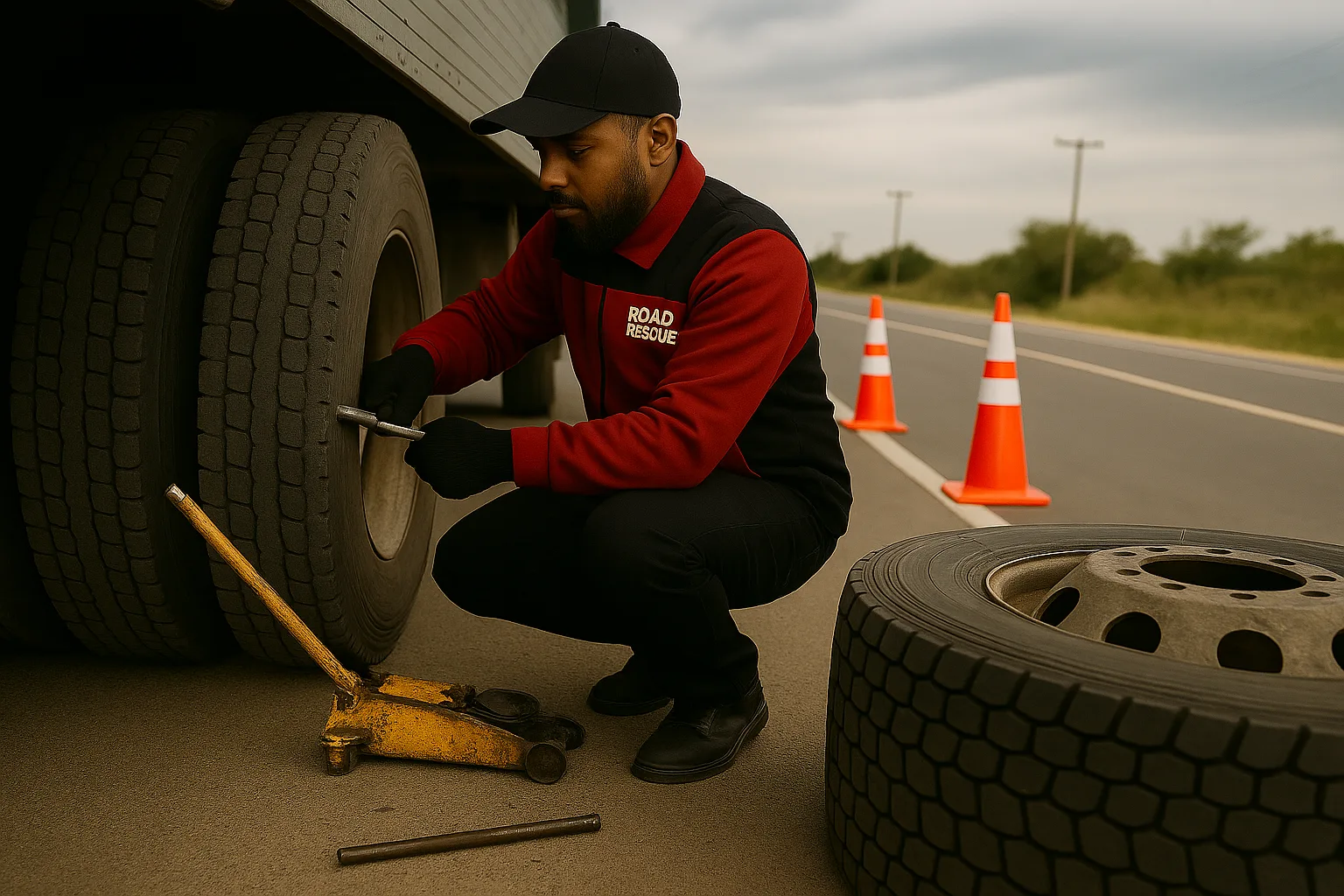
One call puts a tractor tire repair unit on the road to you anywhere in Wilmington or out along US-68 and US-22. Tell us the road and which way you are pointed and we do the rest.
Tires on machines that mostly do not drive on roads — tractors, loaders, graders, forklifts, and yard equipment — serviced where the machine sits across Wilmington. Highway truck tires are a different job on different equipment; that work lives on our mobile tire repair page.
Punctures, stubble damage, and sidewall injuries assessed for repairability rather than replaced by default. A Wilmington tractor tire is a four-figure item, so the repair-versus-replace call is worth making carefully.
Most loaded ag tires carry hundreds of pounds of liquid ballast, and it comes out before any repair and goes back after. This is the step that makes a Wilmington field tire job a different trade from a truck tire job.
Matching construction and load rating to the machine and the work. Increased-flexion and very-high-flexion tires carry the same load at lower pressure, which is the whole point of them on a Wilmington field.
Tread designation matched to ground conditions — general agricultural, deep, wet and flooded, turf, or industrial. Fitting the wrong one to a Wilmington machine costs traction, fuel, or the turf it drives on.
Dual assemblies, spacing, and row-crop width changes. Heavy, awkward work that needs handling equipment rather than muscle on any Wilmington farm.
Tube replacement, tubeless conversion where the rim supports it, and sealing corroded beads. Corrosion from old calcium chloride ballast is the most common Wilmington cause of a tire that will not hold air.
L-2 through L-5 traction and rock service tires on wheel loaders and related machines. Rock cuts and sidewall damage decide whether a Wilmington tire is repairable, and the assessment matters more than the repair.
G-series grader tires and earthmover fitments on heavy equipment, serviced on the Wilmington site rather than trucked to a shop the machine cannot easily reach.
Section repair on large off-road tires where the injury permits it — a genuine and long-established practice on casings worth far more than the repair. Frequently the right answer on a Wilmington machine and frequently not offered.
Mixed-fitment machines with different front and rear requirements, plus the solid and severe-duty options that suit Wilmington demolition and scrap work.
Rim inspection, component matching, and replacement of cracked or distorted wheels. On a Wilmington multi-piece rim this is a safety inspection first and a tire job second.
A stopped machine on a live Wilmington jobsite holds up everything around it. Response is dispatched to the site, on the ground where the machine failed.
Solid press-on tires pressed off and on with the correct equipment. This is machine work, not hand work, and it is why a Wilmington forklift tire call needs a press unit rather than a tire iron.
Solid replacements for pneumatic fitments on machines working where punctures are constant — Wilmington scrap yards, recycling floors, and demolition sites.
Conventional pneumatic fitments on rough-terrain and outdoor lift trucks across Wilmington yards and lumber operations.
Non-marking and polyurethane tires for Wilmington food, pharmaceutical, and clean-floor environments where a black tire mark is a real problem.
Press-on tires carry a wear indicator, and running past it damages the wheel and the truck rather than merely the tire. A Wilmington fleet that replaces on the line spends less than one that replaces on failure.
Scheduled tire service across a Wilmington lift-truck fleet, batched into one visit rather than handled one breakdown at a time.
Ballast filled, topped, or removed — beet juice, chloride solution, or plain water depending on what is in there and what the Wilmington climate does to it in January.
Calcium chloride is hard on steel, and decades of it eats rims from the inside. Frequently the real reason a Wilmington tire will not seal, and the tire gets blamed.
Polyurethane fill for machines where punctures are constant. It ends flats permanently and it also ends repairability, adds substantial weight, and costs real money to dispose of — a Wilmington decision worth making deliberately.
Cracked, bent, or corroded wheels replaced rather than nursed. A Wilmington rim failure under load is far more dangerous than a tire failure.
Multi-piece and lock-ring assemblies serviced under the federal safety procedure — deflated fully before demounting, matched components, and inflation inside a restraining device. Never on a Wilmington shortcut.
Large-bore valves, water valves, extensions, and hardware suited to ballast and off-road service, which are not the parts on a Wilmington highway tire truck.
Rolling 30-day average dispatch-to-arrival, by service type, across the local rescuer network.
Off-road tire work prices differently from highway tire work, and the tire itself is often the smaller half of it. Below is what actually moves a Wilmington invoice on a machine that does not drive to you.
A large agricultural or earthmover tire needs handling equipment to move at all. Size drives labor time, the class of truck dispatched, and whether one technician can complete the job.
A loaded tire holds hundreds of pounds of liquid that must be pumped out before the repair and back in afterward, with containment. It is routinely the longest step in the job.
Off-road casings are expensive enough that repair — including section repair on large OTR tires — is frequently the right answer. Assessing repairability honestly is where the money is actually saved.
A machine in a yard on hard standing and a machine sitting in soft ground on a slope are different jobs. Terrain decides whether the work is even safe to attempt where the machine stopped.
Corroded, cracked, or mismatched rim components turn a tire job into a wheel job. Old chloride ballast is the usual cause, and it is discovered rather than predicted.
Liquid ballast, foam fill, or air are three different costs with three different consequences. Foam ends punctures permanently and also ends repairability, adds weight, and carries a real disposal cost later.
Servicing a yard of lift trucks or a run of implement tires on one visit prices very differently per unit than a single emergency call. Concentration is the lever the customer controls.
A machine stopped mid-shift on a jobsite is emergency work priced accordingly. The same tire replaced during planned downtime is the cheapest version of the job.
Off-road tire work is quoted per job after we know the tire, the fill, and where the machine is sitting. A quote given without those three is a guess, and the ballast is the part people forget.
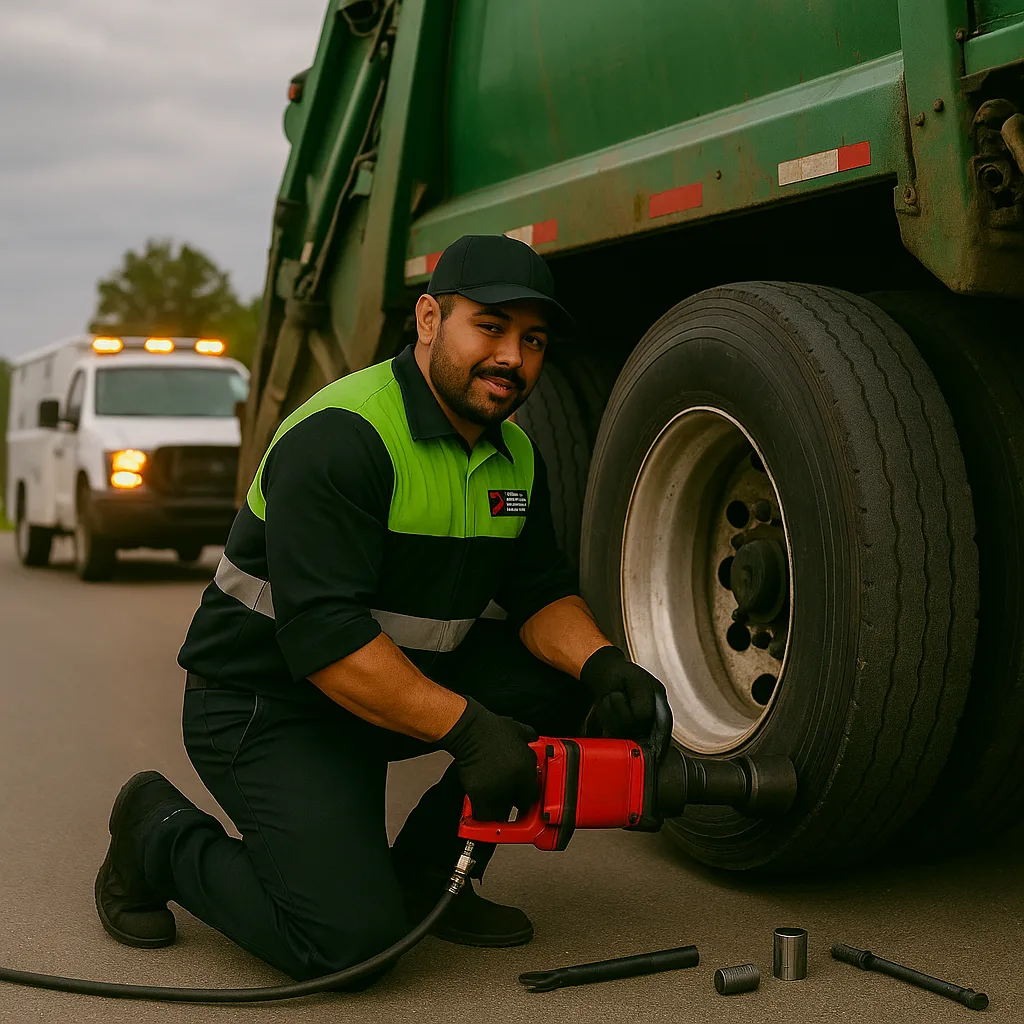
The same crews that run Wilmington also cover Xenia (24 mi), Lebanon (26 mi) and Mason (18 mi), so a call from either side of Clinton County reaches the same desk.
Each service links to local response times, rescuer coverage, and recent dispatched jobs in this metro.
A live map of every farm and industrial tire service truck in Wilmington metro, with real-time positions, ETAs, and dispatch status, available inside your dashboard.
Sign in to track network rescuers across Wilmington in real time, dispatch jobs, and confirm ETA before the truck rolls.
Each corridor has a dedicated breakdown landing page with service zones, exits, and recent dispatched jobs.

3 exits in Wilmington
The main north-south artery through Wilmington and the primary drayage route serving the Air Park. Carries the heaviest concentrated truck traffic in Clinton County, especially between 2 and 6 a.m. when the overnight sort clears. Two-lane with narrow berms through most of the corridor, so a disabled tractor blocks a live lane rather than pulling clear. Tire failures and starting faults dominate here. Winter drifting across open farmland north of town cuts visibility with little warning.
2 exits in Wilmington
East-west route linking Wilmington toward Washington Court House and the Columbus approaches. Regional LTL and agricultural hauling share this road, and the mix creates uneven pavement wear. Shoulder width is inconsistent; several stretches have drop-offs that make jacking a loaded trailer hazardous without cribbing. Common call types are suspension, air-brake, and wheel-end failures from the rough surface.

2 exits in Wilmington
The westbound connector from Wilmington to I-71 at exit 50, the single most important twelve miles of road in the county for freight, because it is how Air Park volume reaches the interstate system. Rolling grades and open farmland exposure. Spring runoff sheets across low points and winter ice forms early on the shaded curves. Brake and traction incidents cluster on the descent approaching I-71.

2 exits in Wilmington
North-south secondary route serving Clinton County agricultural shippers and providing an alternate when US 68 backs up. Lower volume but heavier axle loads during grain season. Narrow, few turnouts, and limited lighting. Recovery work here takes longer simply because there is nowhere safe to stage equipment.
Patterns observed across recent dispatch data in this metro, by service type and corridor.
An outbound drayage tractor pulling a loaded air-freight van blows a steer tire two hundred yards north of the Air Park entrance. No usable shoulder, the rig is holding a live lane on US 68 in the middle of the overnight outbound push. RRN dispatch rolls mobile tire service with traffic control from our US 68 stage point. Cones out, replacement steer mounted and torqued, wheel-end temperature checked: 27 minutes on scene, lane clear. The load made its air window.
A refrigerated trailer stages at the sortation dock and the unit faults out on high head pressure with temperature-sensitive freight aboard. Every minute at the dock is a minute the door is not producing. RRN dispatch sends a reefer technician who finds a condenser fan motor failure. Motor swapped, unit pulled down and verified holding setpoint: 41 minutes total. No product loss, no dock hold.
A line-haul tractor westbound on SR 73 toward exit 50 loses air pressure on the rolling descent and the driver gets it stopped on a gravel berm short of the interchange. RRN dispatch sends a mobile air-brake specialist. Failed governor is diagnosed and replaced, system charged and leak-tested, brakes re-adjusted before release: 36 minutes. Driver continues to I-71 under his own power.
Overnight drifting across open Clinton County farmland closes visibility on US 68 north. A loaded van drifts off the crown and jackknifes into the ditch, no injuries. RRN dispatch deploys a heavy-duty recovery unit with winching capability. The trailer is walked back onto the pavement, running gear and landing legs inspected, kingpin checked before release: 58 minutes. Truck rolls under its own power.
Three tractors staged overnight at the Air Park lot all fail to crank at 4 a.m. after a hard freeze. RRN dispatch sends a single unit to work them in sequence rather than three separate calls. Two get jumped and load-tested clear; the third has a failed battery bank and gets a full replacement on the spot. All three released in 52 minutes total.
A dump trailer working the SR 134 grain route bursts a hydraulic hose on the hoist circuit with the bed partially raised, a load nobody can safely move. RRN dispatch sends a mobile hydraulic unit with hose and fittings aboard. Hose is fabricated and crimped on scene, circuit bled and pressure-tested, bed cycled twice under load: 39 minutes.
Off-road tire servicing is governed by workplace safety law rather than by the highway rules that cover truck tires. The distinction matters in Ohio: there is no federal tread-depth minimum on a machine that never enters the roadway, and there is a very specific federal procedure for the wheel it is mounted on.
Federal law sets a specific procedure for servicing multi-piece and single-piece rim wheels on trucks, tractors, trailers, buses, and off-road machines. It requires a trained employee, the manufacturer's charts available in the service area, correct and matched rim components, and a restraining device for inflation. It expressly does not cover automobile or light-truck tires — this rule exists because these assemblies store enough energy to kill.
The tire must be fully deflated, with the valve core removed, before any demounting begins — including on a dual assembly where both tires are deflated. Attempting to break a bead on a pressurized large rim wheel is one of the most dangerous shortcuts in the trade, and it is the one the regulation exists to prevent.
Inflation is performed inside a restraining device or cage, with the technician standing clear of the trajectory — the path a component takes if the assembly separates. No one stands over the wheel, and no one strikes an inflated assembly with a hammer. These are not shop preferences, they are written requirements.
Rim bases, rings, and lock rings must be matched by manufacturer, size, and type. Mixed components can appear to assemble correctly and then separate under pressure. Any cracked, bent, badly corroded, or unidentifiable component is scrapped rather than reused.
Forklift tire condition falls under the powered industrial truck standard, which requires that a truck found to be in unsafe condition be removed from service. Press-on tires carry a wear indicator, and running past it transfers load into the wheel and the truck rather than the tire.
The federal tread-depth minimums and out-of-service criteria that govern truck tires apply to commercial vehicles on the highway, not to a loader working a pit. But the moment equipment travels a public road under its own power or on a trailer, road-legal requirements attach to that movement, and tire condition becomes part of it.
Calcium chloride solution is corrosive and beet juice is not, but neither is simply poured out on the ground. Evacuated ballast is contained and disposed of appropriately, and foam-filled tires carry a genuine end-of-life disposal cost that should be part of the decision to foam fill in the first place.
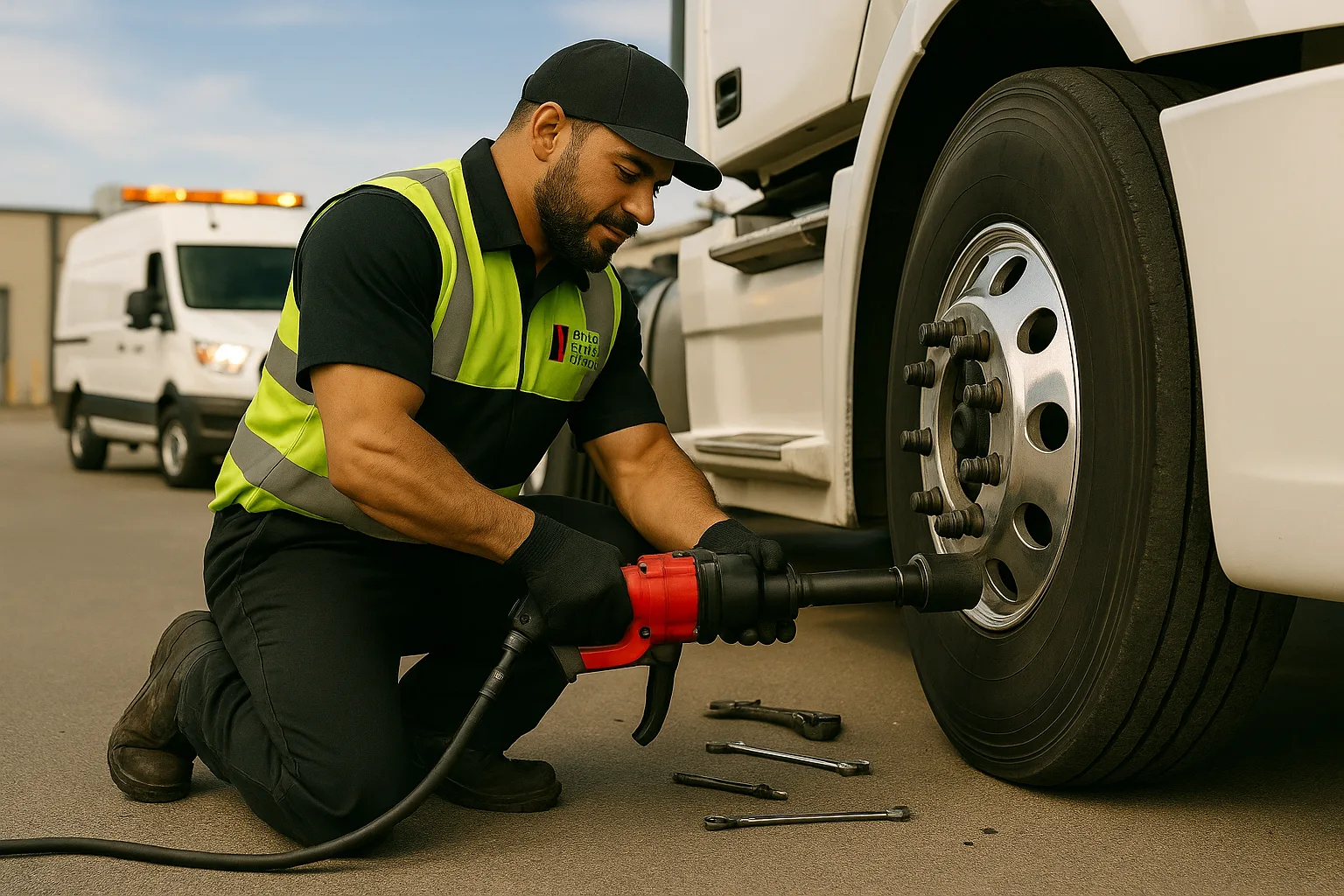
Most Wilmington calls are answered in about 31 minutes. You get a real time before anyone rolls, and the price before the work starts.
Wilmington is an air-cargo town before it is anything else. The Wilmington Air Park spreads across 1,900 acres with nearly 3 million square feet of hangar, warehouse, and sort space, and it moves more cargo tonnage than any other airport in Ohio: 25th in the entire country. Amazon Air runs a 1.1 million square foot sortation operation here with roughly 1,100 people on the clock, and Air Transport Services Group, ABX Air, Air Transport International, and Cargo Aircraft Management all base freighter operations on the field. Every one of those pallets leaves by truck. US 68 and US 22 carry the drayage north and east, SR 73 runs the westbound link to I-71 at exit 50, and the surge is nocturnal, the sort finishes overnight and the yard empties between 2 and 6 a.m. That is a breakdown window most repair shops are closed for. Peak parcel season from October through December roughly doubles the tractor count on US 68 north of town.
Wilmington is a city in Clinton County, Ohio, United States, and its county seat. Its population was 12,664 at the 2020 census. It is the principal city of the Wilmington micropolitan area, which includes all of Clinton County and is part of the greater Cincinnati–Wilmington–Maysville combined statistical area.
Wilmington sits at the crossing of US 68 and US 22 in Clinton County, twelve miles east of I-71 exit 50, and it punches far above its 12,600 population because of what happens on the north side of town. The Wilmington Air Park (the old Airborne Express and DHL hub, now Amazon Air's Ohio linchpin) generates a truck flow that behaves nothing like a town this size should. Drayage tractors, LTL line-haul, and 53-foot dry vans cycle through the gates around the clock. RRN dispatch treats the US 68 corridor between the Air Park and SR 73 as a dedicated response zone, and mobile truck repair here averages 31 minutes from call to wheels-on-scene.
The road geometry is what makes Wilmington breakdowns different. US 68 and US 22 are two-lane for long stretches with soft berms and shallow ditches, there is often no real shoulder to limp to. A blown steer tire outside the Air Park gate means the rig is sitting in a live lane, not parked safely. SR 73 westbound toward I-71 rolls through Clinton County farmland where winter drifting closes visibility fast and spring field runoff sheets across the pavement. Our technicians stage toward US 68 north because that is where the volume and the risk both concentrate, and they carry traffic control because half of these calls are lane-blocking from the first minute.
Because the Air Park sort runs overnight, Wilmington's call pattern is inverted from a normal freight town. The heavy hours are 11 p.m. to 6 a.m., when a truck that will not start or a reefer that quits means a missed air window, and a missed air window is not recoverable the next morning. RRN keeps 24-hour coverage tuned to that cycle: jumpstarts and air-system failures in the small hours, tire and hydraulic work in the pre-dawn outbound push, DOT and PM work in daylight. The ONE9 Travel Center on North US 68 is our most common staging point and the single most frequent origin for calls in Clinton County.
Not a general tire shop, in most cases, and that is the honest starting point. A tractor tire is large, heavy, usually loaded with several hundred pounds of liquid ballast, and frequently mounted on a wheel that requires a specific federal servicing procedure. Doing the work needs a service truck with handling equipment — a boom or crane — bead-breaking capacity for the diameter, a ballast pump with containment, and a restraining device for inflation. Your options in Wilmington are an agricultural tire dealer, an equipment dealer's service department, or a mobile off-road tire service that comes to the machine. The last one is usually what people actually want, because a tractor with a flat is not driving anywhere and hauling it is its own expense. What you should avoid is a highway truck tire service treating it as a big truck tire. The skill transfers; the equipment does not, and the ballast alone will stop the job.
Frequently yes, and given what a large agricultural tire costs, it is worth asking before accepting a replacement. Tread-area punctures are commonly repairable, and larger injuries can often be handled with a section repair — a long-established practice on big casings where the damage is assessed, the injury prepared, and a reinforced repair applied. What is generally not repairable is significant sidewall damage, since the sidewall flexes constantly and carries the load; a separation or a break in the casing cords; damage from long running flat, which destroys the inner liner even when the outside looks fine; and severe weather checking or rot in an old tire. Two practical points. First, a loaded tire has to have its ballast pumped out before any repair and refilled afterward, which is a real part of the job. Second, if the tire will not hold air after a competent repair, suspect the rim — decades of chloride ballast corrode wheels from the inside, and the tire often takes the blame for a rim problem.
The tire itself varies enormously — a small implement tire and a large rear radial on a high-horsepower tractor are different orders of magnitude — so the useful answer is what drives the total beyond the tire. Size and weight decide the handling equipment and the labor time. Ballast is the big one people forget: several hundred pounds of fluid pumped out, contained, and refilled adds real time to every loaded tire. Construction matters, because radial, increased-flexion, and very-high-flexion tires cost more than bias and generally return it in traction, fuel, and soil compaction. Where the machine is sitting affects access and safety. And the rim decides whether this stays a tire job — corroded or cracked wheels found during the work turn it into a wheel job. Before replacing, get a genuine repairability assessment in Wilmington, including whether a section repair would hold. On a casing worth what these are worth, that conversation is worth having every time.
Yes, and it is genuinely different work again from either farm or highway tires. Lift trucks run press-on cushion tires, solid pneumatics, conventional pneumatics, or non-marking polyurethane depending on the machine and the floor, and press-on tires are pressed off and on with hydraulic equipment rather than mounted by hand — which is why this needs a press unit on site rather than a tire iron. The most useful thing to know is that press-on tires carry a wear indicator, sometimes called a safety line, and running past it stops being a tire problem: load transfers into the wheel and the truck, and the damage costs more than the tire did. Federal workplace rules also require that a powered industrial truck found in unsafe condition be taken out of service. For a Wilmington warehouse or yard running several lift trucks, the cheapest approach is scheduled service across the fleet on one visit rather than a call per breakdown.
They solve different problems and people frequently buy the wrong one. Liquid ballast — beet juice, chloride solution, or water — adds weight low in the tire for traction and stability, mostly on agricultural machines. It is reversible, it does not stop punctures, and the choice of fluid matters: chloride solution is corrosive and will eat rims over decades, beet juice is not, and plain water freezes. Foam fill is polyurethane pumped in to replace air entirely. It permanently ends flats, which is why it belongs on scrap, demolition, landfill, and recycling machines where punctures are continuous and downtime is expensive. What it costs you is real: the tire becomes unrepairable, gains substantial weight that the machine has to carry, rides harder, and carries a genuine disposal cost at end of life. The rule of thumb is that foam fill is worth it where you are pulling punctures constantly and the machine works slowly on a fixed site, and it is a poor trade on anything that travels or where flats are occasional.
Yes, under the federal procedure that exists specifically for these assemblies — and the reason the procedure exists is worth stating plainly. A multi-piece rim wheel stores enough energy that a component separating during inflation can be fatal. Federal workplace rules require a trained technician, the manufacturer's servicing charts available, rim components correctly matched by manufacturer, size, and type, complete deflation with the valve core removed before any demounting, inflation inside a restraining device, and nobody standing in the trajectory. Cracked, bent, badly corroded, or unidentifiable components are scrapped rather than reused, and nothing gets struck with a hammer while it holds pressure. That is how we do it, and it is the honest reason a job like this takes longer than you might expect. If anyone offers to service a lock-ring wheel faster by skipping the cage or breaking a bead on a pressurized assembly, that is not a better price — it is a different risk, and it is being taken on your site.
We run overnight because Wilmington's freight runs overnight. The Air Park sort clears between 2 and 6 a.m. and that is our heaviest call block in Clinton County, jumpstarts, air-system faults, and tire failures on outbound drayage. Technicians are staged toward US 68 north during those hours, not dispatched from another county after you call. Average response in that window is 31 minutes.
US 68 has no usable shoulder through most of that stretch, so we treat every call there as lane-blocking from the start and roll traffic control with the repair unit rather than sending it after. Tire work averages 27 minutes on scene. If the unit cannot be repaired in the lane we bring recovery in the same dispatch so the road opens once, not twice.
Yes, and dock reefer calls get priority dispatch because a held door costs more than the repair. Most Wilmington reefer faults we see are condenser fan, belt, or high-head-pressure related and get resolved on the spot. Average arrival is 36 minutes and most units are back to setpoint inside 45 minutes total. We carry Thermo King and Carrier common-failure parts.
All twelve miles to exit 50 and onto the interstate itself. That connector is how Air Park freight reaches I-71, so we cover it as a single corridor rather than stopping at a city limit. Response on SR 73 averages 33 minutes. The descent approaching I-71 is our known brake and traction hotspot and technicians assigned there carry air-system parts by default.
Yes. US 22 is fully in our Clinton County service area. Pavement out there is rougher than US 68 and the calls skew toward suspension, wheel-end, and air-brake failures rather than engine faults. Shoulder drop-offs are a real hazard, so our technicians bring cribbing for any job that needs the trailer jacked. Response averages 36 minutes.
The ONE9 Travel Center on North US 68 is the single most frequent call origin, followed by the Air Park gates themselves. ONE9 is where drivers discover problems during their pre-trip after parking overnight, which is why our first call of the day often comes from that lot. We stage there routinely and can be on a unit in the lot in under 20 minutes.
Yes. Drifting across open farmland on US 68 and SR 134 is the county's defining winter hazard, visibility drops fast with almost no warning and rigs go off the crown into shallow ditches. We run heavy-duty recovery with winching for those, and we inspect running gear, landing legs, and kingpin before releasing anything that has been in a ditch. Recovery averages 47 minutes.
Yes. Clinton County runs a lot of agricultural and dump equipment on SR 134 and the county roads, and hoist-circuit hose failures with a bed partially raised are a regular call. Our hydraulic units fabricate and crimp hose on scene rather than hauling the machine somewhere. Average response is 39 minutes and most jobs finish inside 40 minutes on site.
Tractor counts on US 68 north roughly double and our call volume follows. We add staged capacity for that window rather than letting response times slide. Expect our normal 31-minute average to hold on repair calls; recovery may run slightly longer during the heaviest nights simply because more units are committed. Booking PM and DOT work before October is the smart move for local fleets.
Yes. R+L Carriers is headquartered here and regional LTL line-haul runs constantly on US 68 and US 22. We handle roadside repair on those units the same as anyone else, tire, air, wheel-end, and electrical are the common failures on high-cycle LTL equipment. Predictable routing means our technicians usually know the road before they know the truck.
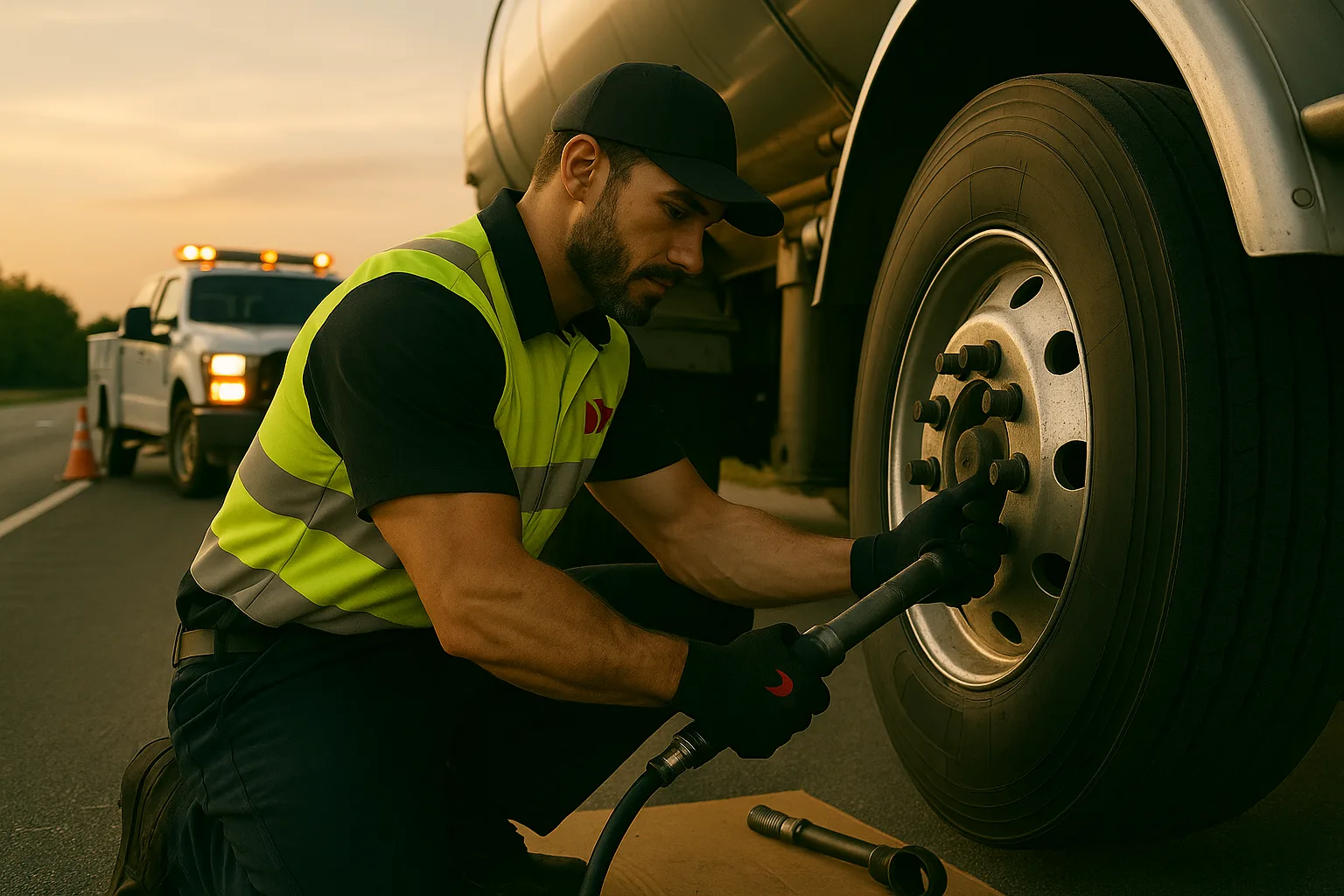
Wilmington runs about 12,664 people and sits in Clinton County, inside the Wilmington, OH Micropolitan Area. We take the call, find the closest crew that actually does this work, and tell you what it costs before anyone turns a wheel.
Coverage in surrounding cities and metros across the same network of verified rescuers.
The same verified network of providers, dispatched 24/7 across every major Ohio metro and freight corridor.
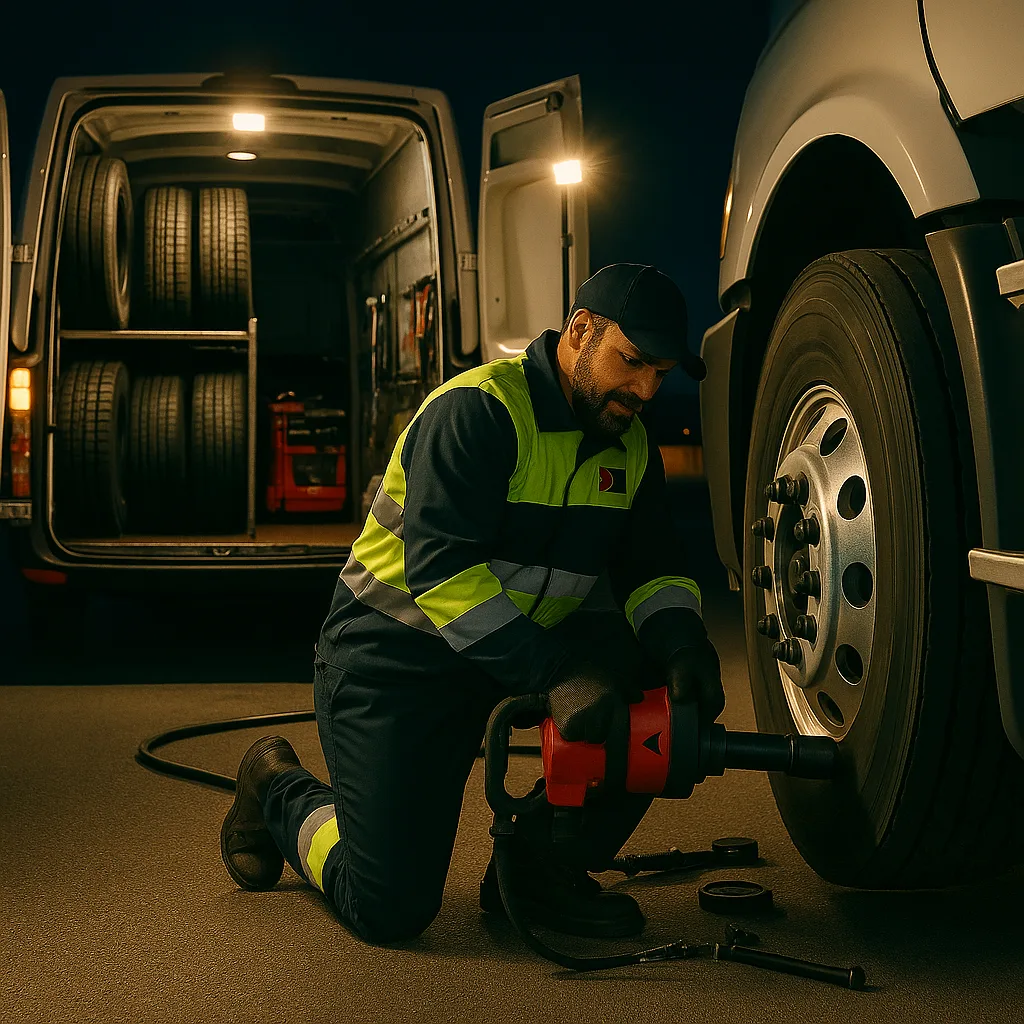
Whether the truck is sitting in Wilmington or out toward Mason, it is the same phone number and the same crews. One call, day or night.
Road Rescue Network is actively recruiting verified tractor tire repair providers in the Wilmington metro. Heavy traffic, real fleet leads, no auction race-to-the-bottom, straight rescuer-to-customer dispatch with confirmed pricing.
We send Wilmington tractor tire repair calls directly to verified rescuers in your service radius. Apply once. Insurance & DOT verified. Live dispatch, fleet accounts, transparent pricing, no motor-club shave-down.
Deep-dive guide on choosing the right provider, common pitfalls, and what to expect on a service call.
OpenOpen positions at our network rescuers, full-time, part-time, and 1099 contract.
OpenOn-site photos from recent calls, see the work, not just the marketing.
OpenNetwork technicians carry diagnostic equipment, OEM-spec tooling, and common-failure parts for every major tractor tire repair brand on the road. Out-of-stock specifics order in within 24 hours.
Service trucks dispatch routinely to these locations across the metro freight corridors.

24-hour truck parking, showers, scales. Highest-frequency call origin in Clinton County.
Local parts houses and diesel suppliers used by network mechanics for time-critical roadside repairs.
Major shippers, distribution centers, and industrial freight nodes generating outbound and inbound truck volume.
1.1M sq ft. Overnight sort drives the 2–6 a.m. call surge.
Three steps from the call to a cleared scene. Same flow whether you call from a fleet desk or the shoulder of an interstate.
Make and model, the size off the sidewall, and whether the tire is loaded with fluid. Those three decide which Wilmington truck is dispatched, and the fill is the one people forget to mention.
Yard, field, jobsite, or warehouse floor — and what the ground is like. A Wilmington machine on a slope or in soft ground changes whether the work can be done safely where it stopped.
Off-road casings are expensive enough that repair, including section repair on large tires, is often the right call. You get an honest Wilmington assessment of repairability rather than a default sale.
Network rescuers accept all major credit cards, fleet cards, and consumer payment apps. Confirmed at dispatch.