01
LP gas manometer & leak detection
Manometer, electronic detector, regulator gauges
Any work touching the gas system. A leak test after service is a safety requirement, not an upsell.
Need mobile RV repair in Centreville? We send an RV tech to your campground, your driveway or the shoulder — motorhome, travel trailer or camper — instead of a three-week dealership queue. Highway miles break different parts than city miles — cooling, aftertreatment and tires, more than brakes and mounts. I-66, US-29, and VA-28 all run through Centreville, so most of our calls come off one of those. Freight around here moves for outfits like Inova Health and Fairfax County Public Schools, which is work that runs on a schedule.
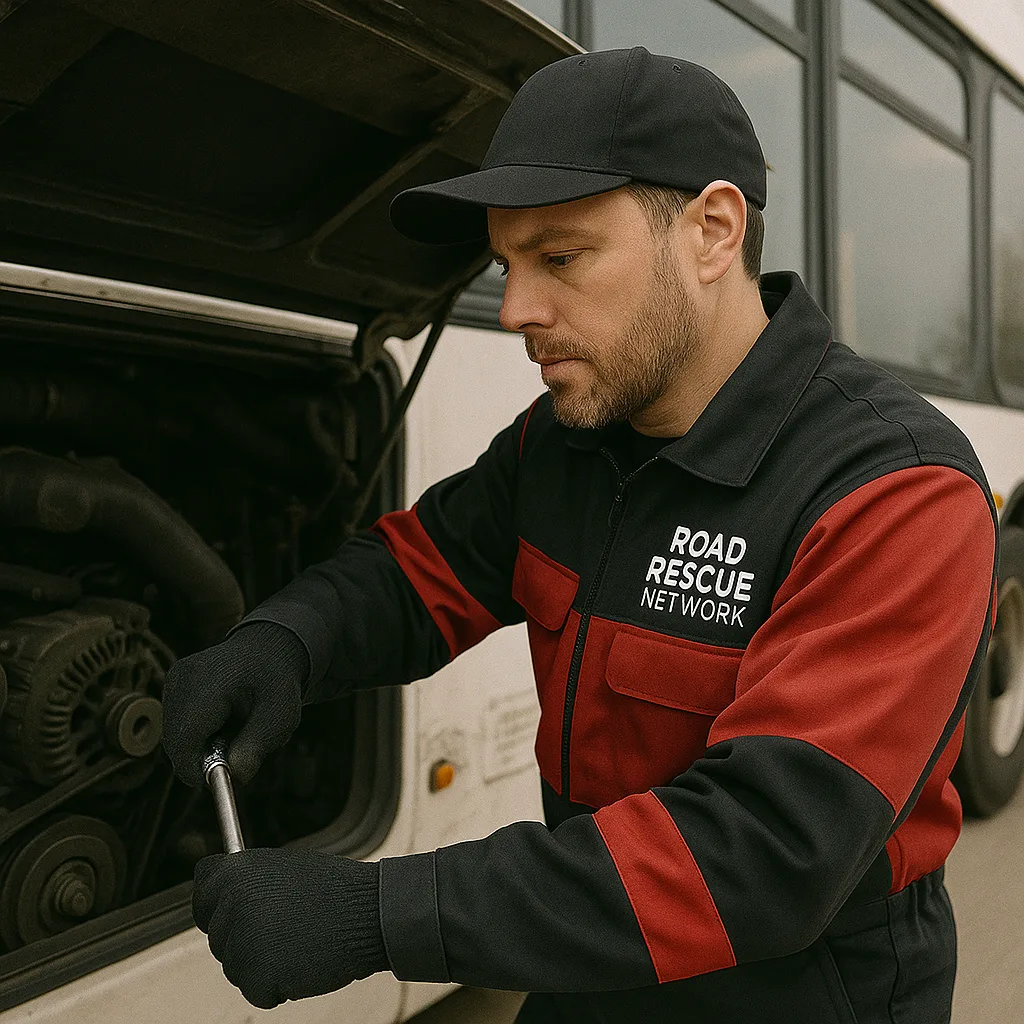
An RV is a house and a vehicle sharing one frame, so a Centreville tech carries appliance, electrical, plumbing, and gas tooling on the same van. That breadth is exactly why RV work is billed differently from truck work.
Manometer, electronic detector, regulator gauges
Any work touching the gas system. A leak test after service is a safety requirement, not an upsell.
Dometic/Norcold/Suburban/Atwood service data, board testers
Refrigerator, furnace, and water heater calls. The brands do not share fault behavior, and guessing replaces a board that was fine.
Multimeter, clamp meter, polarity and pedestal testers
Every power complaint. Confirms whether the fault is the RV, the cord, or the campground pedestal before anything is replaced.
Self-leveling lap sealant, EPDM/TPO materials, seam tape
Leak and roof calls. Carried so a found leak gets sealed on the same visit rather than left open to the next rain.
Lippert and Schwintek service tools, manual override gear
Stuck slides and jacks. A manual retract makes an immobile RV movable even when the repair has to wait.
Pin and pinless moisture reading, borescope
Water intrusion. Finds the actual entry point behind a wall instead of sealing where the stain shows.
Pumps, fittings, antifreeze, blow-out adapters
Leak repairs and seasonal service, which is the cheapest RV work on the calendar and the most expensive to skip.
Capacitors, thermostats, igniters, fuses, water pumps
Carried so the high-frequency failures finish on the first visit — the entire advantage of mobile over a dealership queue.
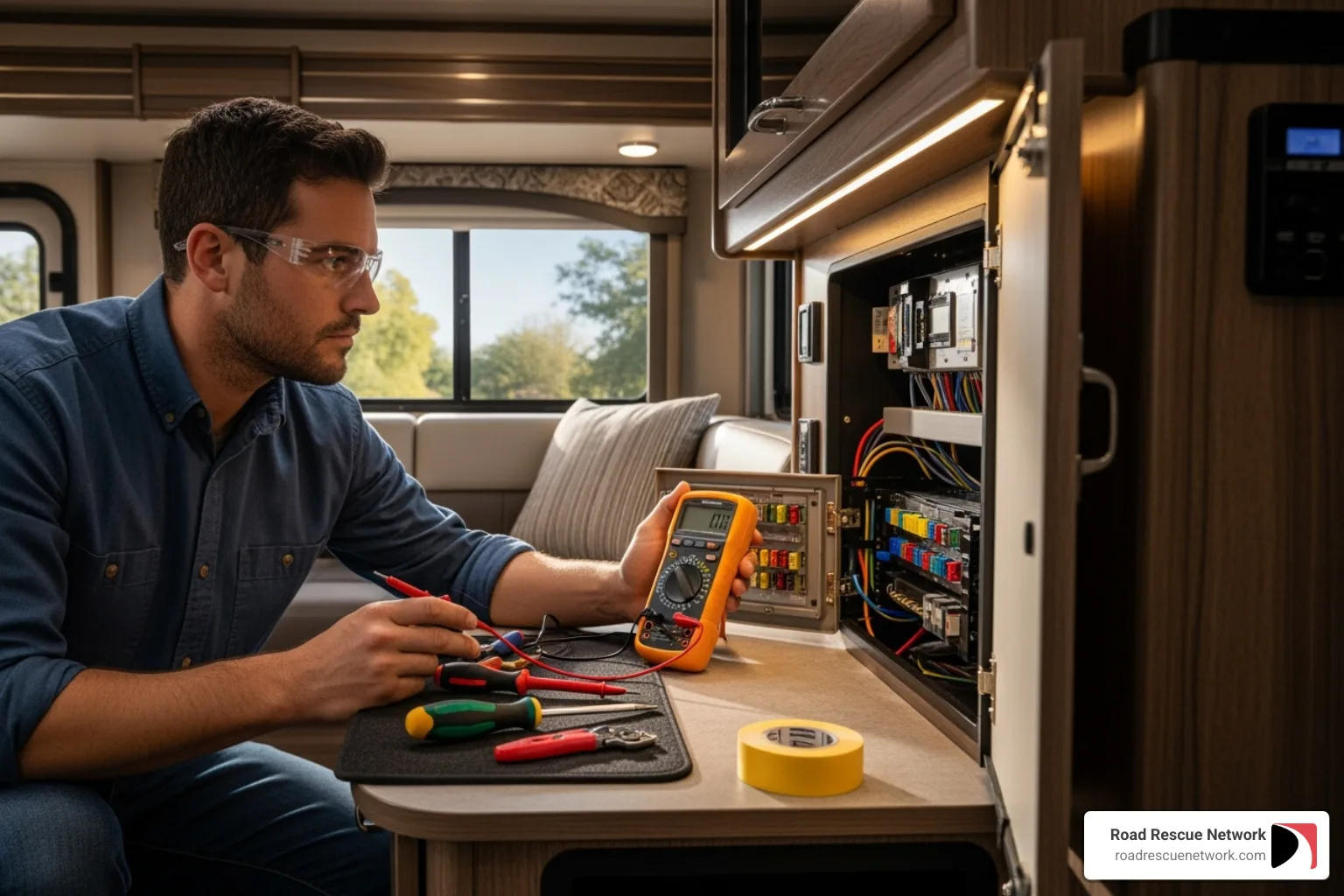
One call puts a mobile RV repair unit on the road to you anywhere in Centreville or out along I-66 and US-29. Tell us the road and which way you are pointed and we do the rest.
Motorhomes, fifth wheels, travel trailers, and camper vans serviced where they are parked across the Centreville area — campground, storage lot, driveway, or roadside. Most RV work does not need a dealership bay, and a mobile visit skips the weeks an RV typically waits in one.
Dometic and Norcold absorption units plus 12-volt compressor models. Cooling-unit failure, boiler blockage, and control-board faults — the most common appliance call in Centreville, and one that spoils food before it strands anyone.
Coleman-Mach, Dometic, and Furrion units. Capacitor failure, frozen coils, blower motors, and thermostat faults. A dead A/C in Centreville summer heat ends a trip as effectively as a dead engine.
Suburban and Atwood furnaces — sail switches, limit switches, ignition boards, and blocked exhaust. A Centreville furnace that clicks and never lights is usually a switch, not a furnace.
Gas and electric elements, thermostats, ECO resets, anode rods, and bypass valves. A Centreville unit that heats on shore power but not on propane narrows the fault immediately.
Onan and Cummins gensets — carburetion, fuel pickup, brushes, and control boards. Long storage between Centreville trips is what kills most RV generators, and the fuel system is where it shows.
Igniters, thermocouples, LP regulation, and inverter-fed microwaves. Small parts, and a Centreville galley that does not work turns a camper back into a trailer.
Lead-acid, AGM, and lithium house banks. Sulfated batteries, failed charge profiles, and parasitic drains that leave a Centreville RV dead after a week in storage.
Progressive Dynamics and WFCO converters, plus inverter and transfer-switch failures. The classic Centreville symptom is everything working on shore power and nothing working off it.
30-amp and 50-amp cords, plugs, surge protection, and reverse-polarity or open-ground faults at the pedestal. Frequently the Centreville campground's wiring rather than the RV's.
Fuse panels, grounds, and corroded connections behind panels. Intermittent Centreville lighting and pump faults almost always live here rather than in the device that stopped working.
Panel, controller, and battery-monitor installation and troubleshooting. Increasingly the reason a Centreville RV can boondock at all, and increasingly the reason its charging profile is wrong.
Tank level senders, battery monitors, and control panels. A Centreville panel reading a full black tank that is actually empty is a sensor problem, not a plumbing one.
Lippert and Schwintek electric mechanisms, cable systems, and hydraulic slides. A Centreville slide stuck out cannot travel and a slide stuck in cannot be lived in — either way the trip stops.
Hydraulic and electric leveling systems, pumps, solenoids, and controllers. A jack that will not retract strands a Centreville RV exactly as thoroughly as a mechanical breakdown.
Carefree and Girard awnings — fabric, arms, motors, and wind damage. One of the most common Centreville campground calls, and often repairable rather than replaceable.
EPDM, TPO, and fiberglass roofs, lap sealant, and seam repair. The single highest-value preventive service on any RV — a Centreville roof leak destroys walls and floors long before anyone sees water.
Locating the actual entry point behind soft walls, delaminated fiberglass, and stained ceilings. Chasing a Centreville leak to its source is the whole job; sealing where the stain is rarely works.
Roof vents, fans, window seals, and door latches and frames. Cheap parts guarding an expensive interior in Centreville weather.
Water pumps, city-water inlets, leaks, and pressure regulation. A Centreville pump that runs continuously is telling you there is a leak somewhere behind a wall.
Black and grey tanks, gate valves, seals, and sensor cleaning. A stuck valve at a Centreville campground is an urgent problem in a way few other repairs are.
Blow-out, antifreeze, bypass, and spring recommissioning. Skipping this before a Centreville freeze splits lines and fittings throughout the coach, and the damage is not visible until spring.
Regulators, lines, and detectors, with a manometer leak test after any gas work. This is a safety system — a Centreville LP leak is not a comfort issue.
Tire replacement, bearing repack, and electric brake service. RV tires age out before they wear out, and a Centreville blowout on a fifth wheel usually takes bodywork with it.
Breakdown response and, when the coach cannot be made roadworthy, towing by an operator equipped for RV height, length, and weight. A Centreville motorhome is not a car with a bigger tow bill.
Insurance-current network rescuers with verified compliance, equipment, and live availability status.
Rolling 30-day average dispatch-to-arrival, by service type, across the local rescuer network.
Google shows "what is the average labor rate for RV repair" and "are RVs expensive to repair" on this search because page one does not answer either one. Here is what a Centreville RV invoice is actually made of.
Getting a technician and a stocked van to where the RV is parked. Billed once, separate from labor, and usually mileage-based outside the metro.
Independent mobile RV labor generally prices below dealership shop rates, and certified technicians price above uncertified ones. Always confirm the rate and the minimum before authorizing.
Charged as labor. Worth it on refrigerators, slide-outs, and water leaks specifically, where the wrong guess replaces an expensive assembly that was never the fault.
Capacitors, thermostats, igniters, and fuses are inexpensive. Cooling units, slide mechanisms, control boards, and A/C units are not, and availability drives the timeline more than the price.
The widest split on this list. An appliance repair is hours. Water intrusion with delamination is a multi-day structural job, and it is the one that decides whether a coach is worth keeping.
Priced by linear footage and materials. Routine resealing is among the cheapest work on an RV, and deferring it is among the most expensive decisions an owner can make.
Many mobile technicians work with RV warranty and extended-service administrators, but authorization has to happen before the work. Starting first and claiming later is how coverage gets denied.
A campground site with shore power is straightforward. A storage lot with no power, a tight driveway, or a roadside shoulder each add time and constrain what can be done at all.
Spring de-winterizing and the first heat wave both create a queue. This is why dealership waits stretch to weeks in season and why mobile availability is worth more then.
RV failures happen on weekends and holidays by definition, because that is when people are using them. Emergency dispatch carries a premium tier.
A breakdown on a live shoulder is stabilize-and-tow, not repair. The same fault at a campsite is a normal service call, and the location changes the bill more than the part does.
Required after work on the gas system. A small line item and a non-negotiable one — this is the safety check, not an add-on.
Road Rescue Network does not set a member operator's rates. What the network does is get an RV technician to where the coach is parked rather than putting it in a dealership queue, and separate the diagnosis from the repair on the quote so an owner can see which is which.
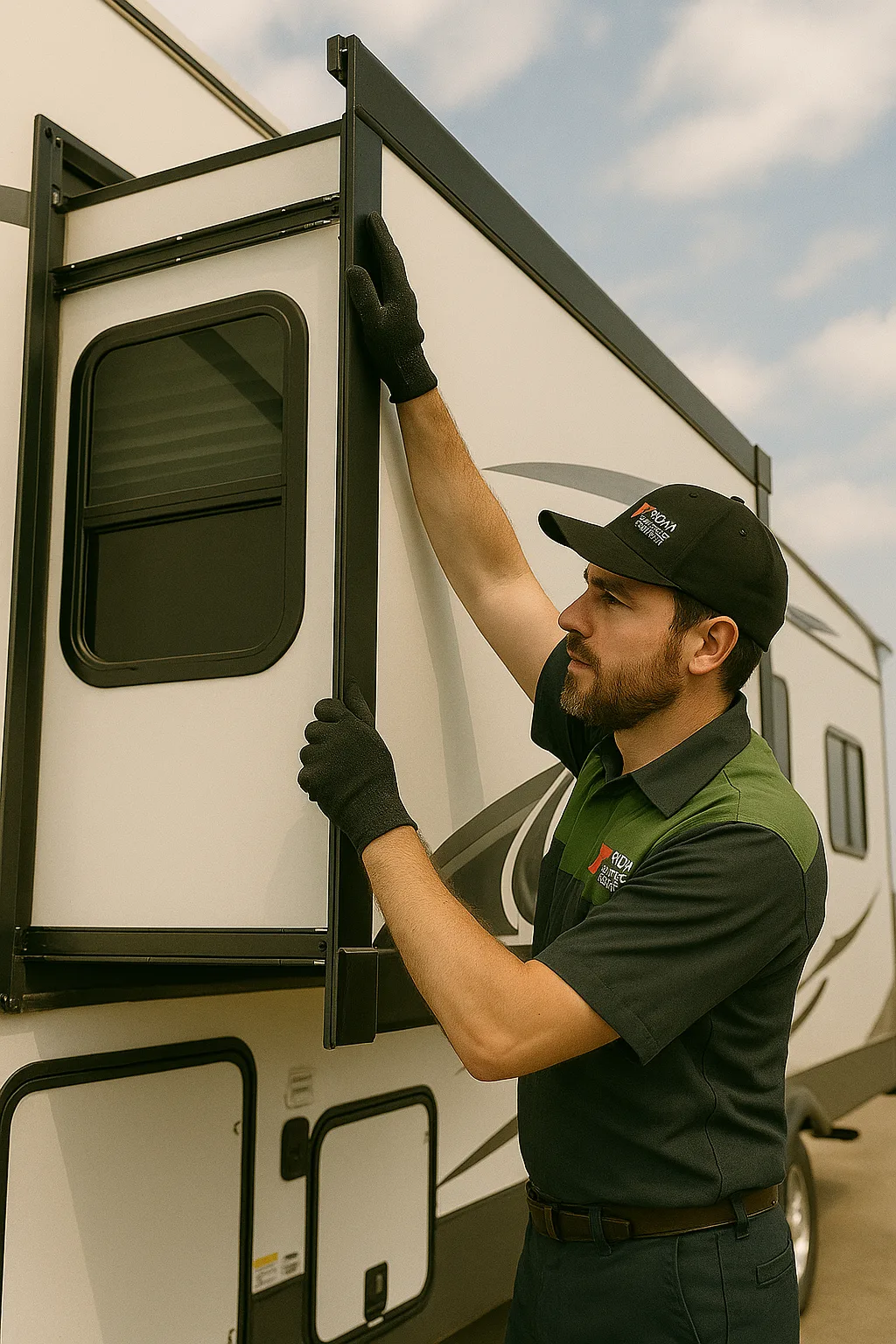
The same crews that run Centreville also cover Chantilly (5 mi), Fairfax (8 mi) and Manassas (9 mi), so a call from either side of Fairfax County reaches the same desk.
Each service links to local response times, rescuer coverage, and recent dispatched jobs in this metro.
A live map of every mobile RV technician in Centreville metro, with real-time positions, ETAs, and dispatch status, available inside your dashboard.
Sign in to track network rescuers across Centreville in real time, dispatch jobs, and confirm ETA before the truck rolls.
Each corridor has a dedicated breakdown landing page with service zones, exits, and recent dispatched jobs.
3 exits in Centreville
The main east-west freight and commuter spine through Centreville toward Washington. Breakdown hotspots cluster at the US-29 (Exit 53) and VA-28 (Exit 53B) interchanges; HOV and time-of-day rules complicate access during the commuter crush.
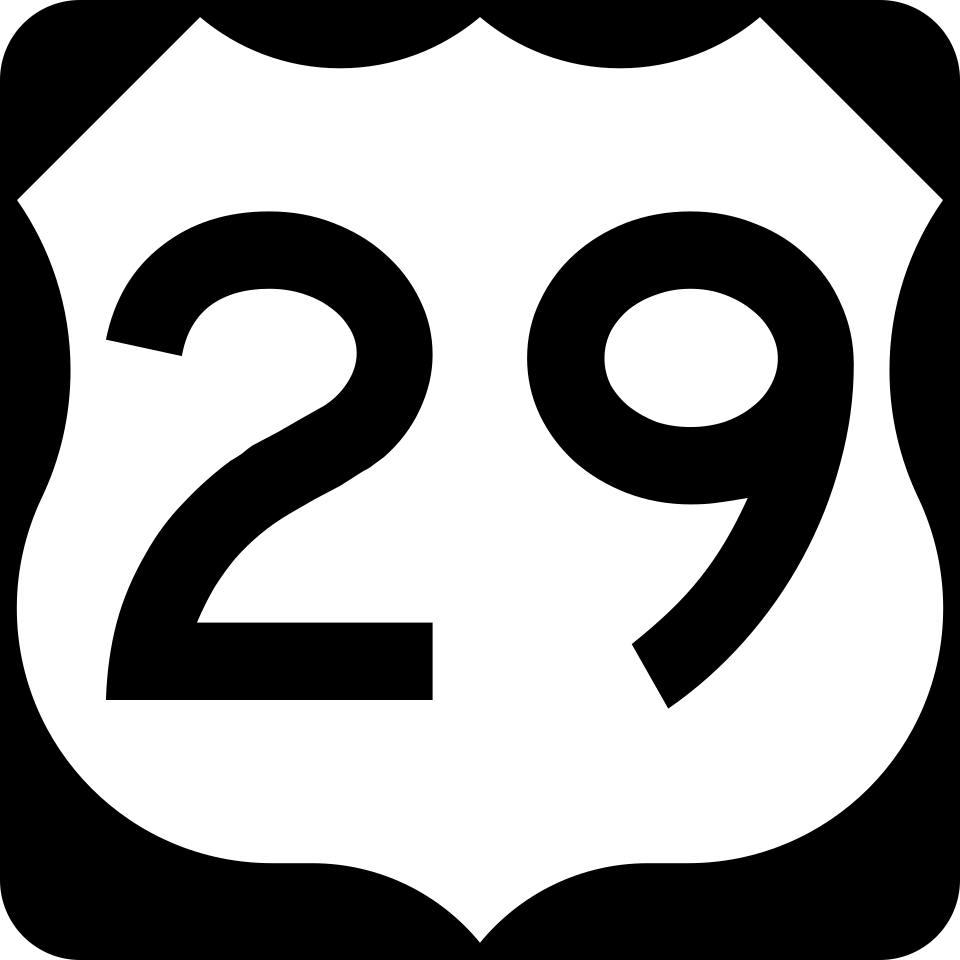
0 exits in Centreville
Lee Highway runs through the heart of Centreville, the primary surface artery for retail-resupply and local-delivery freight paralleling I-66. The densest commercial corridor in the city; constant box-truck activity.

0 exits in Centreville
The Sully Road corridor links Centreville north to the Dulles tech-and-data-center belt and the airport's air-cargo flow. Heavy data-center construction and tech freight; a key feeder to the airport.

0 exits in Centreville
Runs north of Centreville toward Chantilly and Fairfax, a major east-west commercial route carrying heavy retail and contractor freight. A common reliever when I-66 backs up.

0 exits in Centreville
East-west connector through southern Centreville toward Burke and Fairfax, serving residential growth and local-delivery freight. Tree-lined stretches catch storm debris and downed limbs.
0 exits in Centreville
The southern Centreville Road segment of VA-28 links the city to Manassas and the Prince William County industrial areas. Steady commuter and distribution freight.
Patterns observed across recent dispatch data in this metro, by service type and corridor.
Northern Virginia gets real winters, and a snow or ice event can shut I-66 and glaze US-29's overpasses, stranding trucks and freezing air systems solid. Our Centreville mechanics carry chains, traction gear, and methanol-injection and air-dryer kits because DC-metro winters mean both snow and ice. We stage ahead of forecast storms and know which arterials Fairfax plows clear first.
The I-66 and US-29 corridors run some of the worst commuter congestion in the country, with HOV and time-of-day rules that complicate getting a service truck to a stranded rig at peak. A breakdown in the rush can sit for an hour without a plan. Our dispatchers know the access routes, the HOV windows, and the shoulder-pullout points to reach a disabled truck fast and clear the lane.
The Dulles corridor up VA-28 is the densest data-center construction zone in the world, generating heavy equipment, generator, and material freight that strains haulers and hydraulics. Overloaded-suspension, hydraulic, and heavy-tire calls on construction rigs are routine here. Our rescuers carry hydraulic-hose and heavy-tire capability to keep the build freight moving.
An RV is regulated as a vehicle and as a dwelling at the same time. What actually governs one in Centreville, Virginia.
Industry standards call for a pressure leak test on the propane system after any work that opens it, and RV service standards treat this as mandatory rather than optional. A technician who works on your gas system and does not test it afterward has left the job unfinished.
RVs carry CO and propane detectors with defined service lives — typically five to seven years — after which they are replaced rather than tested. An expired detector reads as working right up until it does not, which is the entire hazard.
RV technician certification is administered through the industry's own bodies rather than by a federal license. Certification is genuinely meaningful here because the trade spans gas, 120-volt, 12-volt, plumbing, and appliances — and because there is no licensing floor keeping anyone out.
Every RV carries a GVWR, GAWR, and a cargo carrying capacity on its federal label, and overloading is both the most common and the most ignored RV safety problem. Water is roughly 8.3 pounds per gallon, which is how owners exceed a rating without loading anything.
RV tires typically age out before they wear out, and manufacturers commonly advise replacement in the five-to-seven-year range regardless of remaining tread. The DOT date code on the sidewall is the number that matters, not how the tread looks.
Larger combinations can require a non-commercial special license depending on the state and the combined weight, and trailer brake requirements vary by weight and jurisdiction. Both are commonly discovered at a traffic stop rather than before a trip.
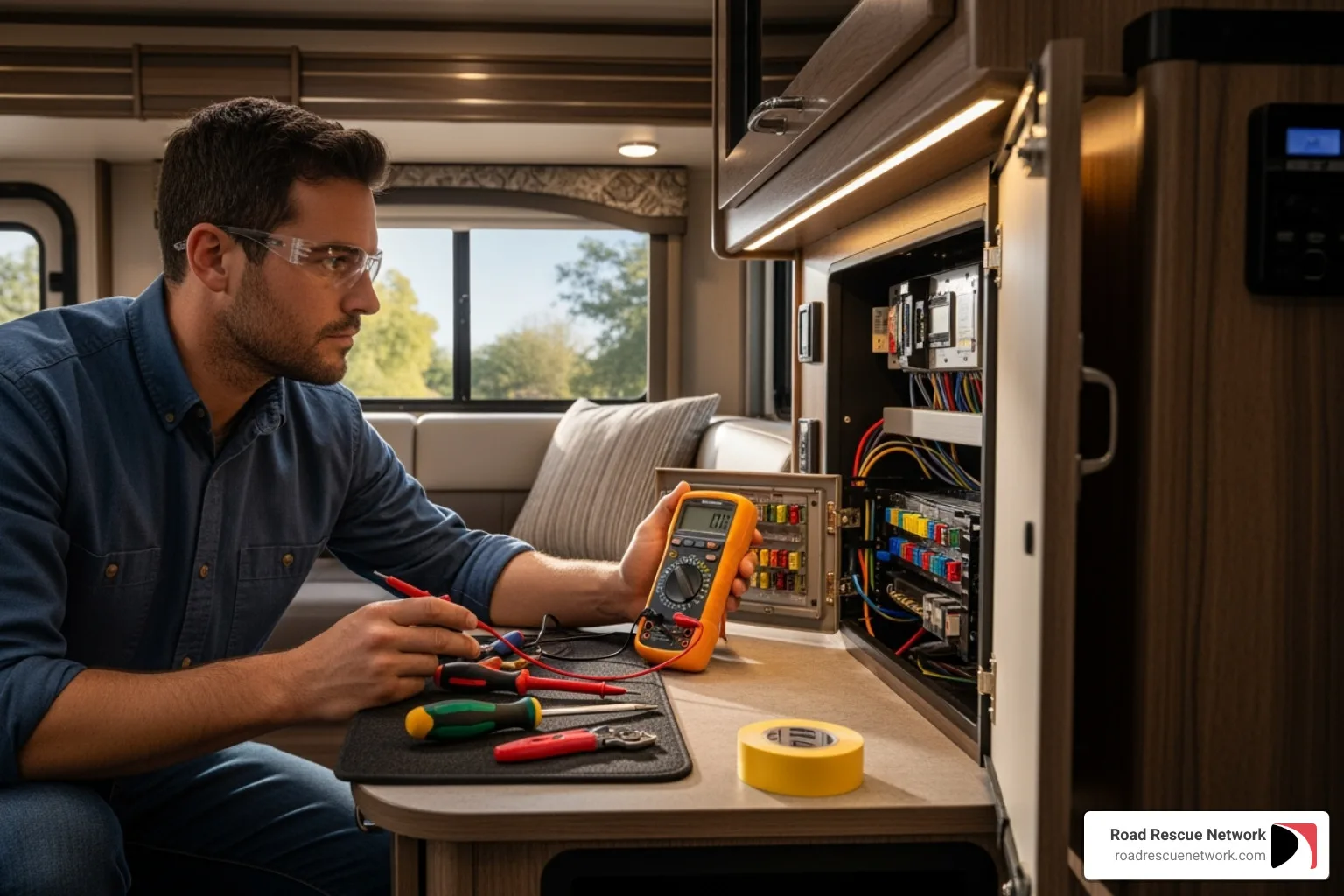
Most Centreville calls are answered in about 37 minutes. You get a real time before anyone rolls, and the price before the work starts.
Centreville sits in western Fairfax County at the I-66 and US-29 junction, a Northern Virginia commuter-belt city whose freight runs on suburban retail resupply, data-center construction, and the relentless last-mile delivery that serves one of the wealthiest, densest metro fringes in the country. VA-28 ties it to the Dulles tech corridor and the airport's air-cargo flow, while I-66 carries the east-west freight and commuter crush toward Washington. Time-of-day congestion and HOV restrictions shape every dispatch.
Centreville is a census-designated place (CDP) in Fairfax County, Virginia, United States. It is a suburb of Washington, D.C., the nation's capital. As of the 2020 census, Centreville had a population of 73,518, making it the most-populous community in Fairfax County.
Centreville sits at the convergence of I-66, US-29, and VA-28, a Northern Virginia crossroads where suburban retail resupply, data-center construction freight, and Dulles-corridor air cargo all share the same congested arterials. When a delivery truck or construction hauler goes down on I-66 near the US-29 interchange during the commuter crush, the backup ripples across one of the busiest suburban corridors in the country. Road Rescue Network's Centreville rescuers stage near the I-66 and VA-28 interchanges, and our 24/7 operations team confirms ETA on every dispatch.
The mechanics in Centreville who handle heavy-duty calls plan around two things the DC metro throws at them: the brutal commuter congestion with its HOV and time-of-day restrictions, and the real winters, snow and ice events that shut down I-66 and freeze air systems solid. They carry chains, traction gear, and air-system de-ice kits for winter, and they know which arterials the plows clear first.
Whether you are a fleet manager moving grocery resupply through the western Fairfax retail belt or an owner-operator hauling data-center material up VA-28 toward the Dulles corridor, the nearest verified, insurance-current rescuer in our Centreville network is one phone call away. We dispatch around the clock with no after-hours surcharge.
Reviews collected from fleet customers and drivers after completed service calls in this metro.
“Truck went down on I-66 at US-29 right in the commuter crush. RRN's dispatcher knew the access route and HOV window and had a tech to me in 36 minutes, fixed an air fault, and we cleared the lane before it gridlocked. Impressive in that traffic.”
“Jackknifed on iced-over US-29 during a winter storm. Tow operator got there once it was safe and pulled me out without damage. Knew how the NoVA snow and ice work. Could not have asked for better.”
“Tire blew on a data-center hauler up VA-28 at Westfields. Service truck came with the right heavy size and got us rolling. One star off for the commuter-traffic delay, but they kept me updated the whole time.”
Mobile RV labor is generally billed hourly, with independent mobile technicians typically pricing below dealership shop rates and certified technicians above uncertified ones. On top of labor, nearly every Centreville mobile visit carries a service call or trip charge for bringing the van and the parts to the RV, often scaled by mileage outside the metro. Rates vary widely by market and by technician, so the only number that matters is the one you confirm before authorizing work — ask for the hourly rate, the trip charge, and any minimum up front, and ask for diagnosis and repair to be quoted separately. Road Rescue Network does not set a member operator's rates.
Water damage is the most common and by far the most expensive, and it usually starts as a failed roof seam or window seal that nobody noticed. Among things owners actually call about, the recurring list is short: refrigerator cooling failures, rooftop air conditioner faults, slide-out mechanisms that stick, house batteries that will not hold a charge, water pump and plumbing leaks, and awning damage. Almost all of those are mobile-repairable. The pattern worth knowing is that the cheap preventive item — annual roof and seal inspection — is the one that prevents the expensive structural repair.
Ask three things. First, whether the technician is certified — RV work spans propane, 120-volt, 12-volt, plumbing, and appliances, and there is no licensing floor keeping unqualified people out of the trade. Second, whether they will quote diagnosis separately from repair, because a shop unwilling to separate them is a shop that benefits from a wrong guess. Third, whether they carry insurance and provide a written invoice listing parts and labor, which is also what a warranty or extended-service administrator will require. Beyond that, a technician who leak-tests the propane system after gas work without being asked is telling you how they work. Every operator in the Centreville network is vetted before dispatch.
Individual repairs are usually less expensive than owners fear — capacitors, thermostats, igniters, water pumps, and fuses are inexpensive parts, and most appliance faults are hours of labor rather than days. What makes RV ownership expensive is deferred maintenance turning into structural damage: a roof seam left unsealed becomes wet insulation, then delaminated walls and a soft floor, and that repair can approach the value of the coach. The other real cost is time, not money — a dealership queue in season runs weeks, which is the specific problem mobile service exists to solve. Annual roof and seal inspection plus proper winterizing are the two cheapest things an owner can do, and skipping them is what produces the horror stories.
Yes, and that is where most of this work happens. Appliances, air conditioning, furnaces, water heaters, electrical and battery faults, plumbing leaks, slide-outs, leveling jacks, awnings, and roof resealing are all routinely done on site at Centreville campgrounds, storage lots, and driveways. Shore power at the site makes some diagnostics easier but is not required for most of it. What genuinely needs a shop is major structural and delamination work, full roof replacement, collision damage, and paint. If a coach cannot be made roadworthy where it sits, we tow it with an operator equipped for RV height, length, and weight rather than sending it out unsafe.
That gap is the entire reason mobile RV service exists. Dealership service queues commonly run weeks in season, because the shop is scheduling around parts orders, warranty authorizations, and a bay that has to hold the coach the whole time. A mobile technician arrives with the common failure parts already on the van, and most appliance, electrical, plumbing, and slide-out repairs finish in a single visit. The trade is scope: a dealership bay can do structural, roof, and collision work that no van can. For everything short of that, the coach never leaves the site and you keep using it.
Average response time in Centreville is 37 minutes for mobile truck repair, fastest along the I-66 and US-29 corridors and the VA-28 Dulles feeder where our rescuers stage. Commuter congestion can lengthen peak-hour times, and our dispatchers route around it. We track every call and post real averages.
Yes, those are our busiest service zones. The I-66 interchanges at US-29 and VA-28 and the Sully Road Dulles corridor are frequent call sites, and our dispatchers know the HOV windows and safe-pullout points needed to reach a stranded rig during the commuter crush.
Every Road Rescue Network rescuer in Centreville maintains current general liability, automobile liability, workers comp, and where applicable garage-keepers coverage. We re-verify each renewal. Expired insurance means automatic suspension from dispatch.
Yes. We handle national accounts with consolidated invoicing, fleet-card billing, and a single point of contact. Most onboard in under 48 hours. Use the form on this page or call dispatch.
24/7/365, with no after-hours surcharge. Rescuers quote the same rate at 3am as at 3pm.
We dispatch routinely to the Wawa on Lee Highway (US-29), Sheetz on VA-28, the Exxon multi-pump at Centreville Square, and BP on Lee Jackson Highway (US-50) in Chantilly. We also reach the I-66 park-and-ride near Manassas and FleetPride Manassas for parts.
Our Centreville rescuers carry chains, traction gear, and air-system de-ice kits for the snow and ice that shut I-66 and glaze US-29 in winter. For the commuter crush, our dispatchers know the HOV windows, access routes, and shoulder-pullout points to reach a disabled truck fast even at peak.
Standard service-call dispatch runs $160-235 in the Northern Virginia area depending on time and service type. Heavy-duty towing starts around $475 for in-area moves. You get a confirmed quote before the truck rolls.
Yes. The VA-28 Dulles corridor is the world's densest data-center construction zone, and our rescuers carry hydraulic-hose and heavy-tire capability for the equipment, generator, and material haulers serving those sites.
If the truck can't be fixed roadside in a reasonable window, we coordinate the tow with one of our heavy-duty network rescuers. Many service trucks roll alongside a wrecker so there's no second response time, which matters most when a lane is blocked in the commuter crush.
Centreville runs about 73,518 people and sits in Fairfax County, inside the Washington-Arlington-Alexandria Metropolitan Area. We take the call, find the closest crew that actually does this work, and tell you what it costs before anyone turns a wheel.
Sample of recent dispatched service calls in this metro. Customer details removed; locations and response times preserved.
| When | Service | Location | Response |
|---|---|---|---|
| Tuesday 07:48 ET | Mobile Truck Repair | I-66 at US-29 (Exit 53) | 36 min |
| Monday 14:12 ET | Commercial Tire Repair | Westfields Corporate Park | 37 min |
| Sunday 16:35 ET | Mobile RV Repair | RV storage near Bull Run | 61 min |
| Saturday 20:20 ET | Mobile Welding | Sully Station commerce area | 51 min |
| Friday 06:50 ET | Mobile Bus Repair | Fairfax County schools west depot | 65 min |
| Thursday 22:05 ET | Heavy-Duty Towing | VA-28 N near Westfields | 48 min |
| Wednesday 10:30 ET | Fuel Delivery | Wawa Lee Hwy (US-29) | 29 min |
| Monday 01:25 ET | Winching Recovery | Braddock Rd after ice event | 54 min |
Coverage in surrounding cities and metros across the same network of verified rescuers.
The same verified network of providers, dispatched 24/7 across every major Virginia metro and freight corridor.
Whether the truck is sitting in Centreville or out toward Manassas, it is the same phone number and the same crews. One call, day or night.
Deep-dive guide on choosing the right provider, common pitfalls, and what to expect on a service call.
OpenOpen positions at our network rescuers, full-time, part-time, and 1099 contract.
OpenOn-site photos from recent calls, see the work, not just the marketing.
OpenNetwork technicians carry diagnostic equipment, OEM-spec tooling, and common-failure parts for every major mobile rv repair brand on the road. Out-of-stock specifics order in within 24 hours.





Service trucks dispatch routinely to these locations across the metro freight corridors.
Diesel lanes, fuel + air, 24/7
View Directory Profile →Diesel, high volume
View Directory Profile →Fuel + air, commercial
View Directory Profile →Diesel, convenience
View Directory Profile →Nearest truck-capable stop, park & ride
Local parts houses and diesel suppliers used by network mechanics for time-critical roadside repairs.
HD parts counter
View Directory Profile →Commercial delivery
View Directory Profile →Heavy-duty parts, will-call
View Directory Profile →Major shippers, distribution centers, and industrial freight nodes generating outbound and inbound truck volume.
Grocery resupply staging
Data-center construction and equipment freight
Tech and distribution freight
Retail freight consolidation
Office, tech, and distribution tenants
Light-industrial and contractor freight
Distribution and manufacturing cluster
Three steps from the call to a cleared scene. Same flow whether you call from a fleet desk or the shoulder of an interstate.
Class A, C, fifth wheel, or travel trailer, the appliance or system that failed, and whether you are on shore power. A Centreville refrigerator call and a slide-out call need different parts on the van.
We dispatch someone who works on coaches — gas, 120-volt, 12-volt, plumbing, and appliances. A Centreville diesel mechanic can service the chassis and cannot touch three quarters of what fails on an RV.
Most work finishes on site, which is the whole point of mobile — a Centreville dealership queue runs weeks in season. Anything touching the propane system gets a leak test before we leave.
Network rescuers accept all major credit cards, fleet cards, and consumer payment apps. Confirmed at dispatch.