
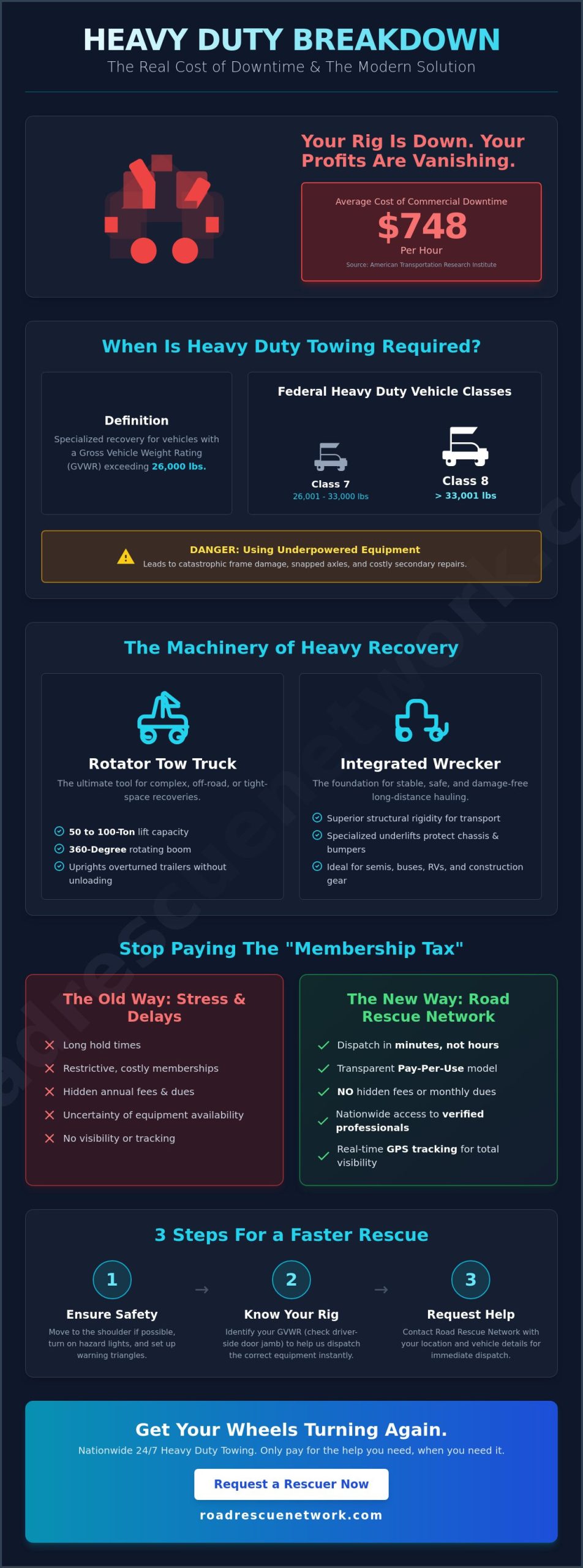
It is 3:00 AM on a Tuesday, and your 80,000-pound rig is dead on the shoulder of I-80. Every minute those wheels aren't turning costs your fleet an average of $748 per hour according to the American Transportation Research Institute. You need heavy duty towing that doesn't involve a two-hour hold time or a restrictive membership barrier. Don't stress yourself out searching through directories for a provider that actually owns a 50-ton rotator while your profits vanish.
We know that the complexity of finding high-tonnage equipment shouldn't be your burden during an emergency. You deserve a partner who moves with confidence and offers a simple solution when things go wrong. Our network provides immediate, nationwide access to high-capacity recovery services without any hidden fees or monthly dues. You only pay for the help you need, exactly when you need it. It is about getting you back to work with speed and reliability.
This article shows you how to get a professional Rescuer dispatched to your location in minutes, not hours. We will cover our transparent, pay-per-use pricing model and how real-time tracking gives you total visibility over your recovery process from start to finish.
Key Takeaways
- Learn how to identify when your vehicle’s GVWR requires specialized recovery and why standard equipment is insufficient for heavy rigs.
- Discover the power of 50-ton to 100-ton rotators and how this advanced machinery handles the most complex accident scenes with precision.
- Save on overhead by switching to an on-demand model for heavy duty towing, eliminating the "membership tax" and hidden annual fees.
- Master the essential safety steps and dispatcher details needed to get a Rescuer to your interstate location in minutes, not hours.
- See how nationwide GPS tracking instantly connects you to the nearest verified professional for 24/7 recovery anywhere in the United States.
Table of Contents
- What is Heavy Duty Towing and When Do You Need It?
- The Machinery of Heavy Recovery: Rotators, Wreckers, and Cranes
- Pay-Per-Use vs. Subscription: The End of the Membership Tax
- Emergency Steps: What to Do When Your Rig Breaks Down
- Nationwide Heavy Duty Towing with Road Rescue Network
What is Heavy Duty Towing and When Do You Need It?
Heavy duty towing is a specialized recovery service designed for vehicles with a Gross Vehicle Weight Rating (GVWR) exceeding 26,000 lbs. This isn't your standard roadside assistance. It requires massive torque, reinforced frames, and specialized rigging to move vehicles like semi-trucks, motorcoaches, and heavy construction equipment. When your fleet hits a standstill, you don't just need a tow; you need a Rescuer who understands the physics of heavy recovery.
The difference between standard and heavy recovery is a matter of safety and structural integrity. Attempting to move a Class 8 vehicle with underpowered equipment often leads to catastrophic frame damage or snapped axles. Professional heavy duty towing utilizes heavy-duty tow truck types such as 50-ton rotators and integrated wreckers. These machines provide the stability needed to upright overturned trailers or pull a loaded bus out of a ditch without compromising the vehicle's chassis. Using the wrong class of truck is a gamble that usually ends in expensive repairs.
Understanding Vehicle Weight Classes
The Department of Transportation classifies vehicles into eight categories. Heavy-duty intervention starts at Class 7 (26,001 to 33,000 lbs) and extends through Class 8 (anything over 33,001 lbs). Before you call for help, check the plate on your driver-side door jamb to identify your GVWR. Providing this specific data helps us deploy the correct equipment instantly. Whether it's a cement mixer or a sleeper cab, knowing your class ensures the recovery is handled with precision. It's about matching the right tool to the job to keep your equipment safe.
The High Cost of Commercial Downtime
For fleet managers and owner-operators, a breakdown is more than a mechanical failure. It's a financial emergency. Industry data shows that commercial vehicle downtime can cost between $448 and $760 per day per vehicle in lost revenue. The psychological stress of sitting on a shoulder with high-value cargo adds to the burden. We operate on a promise of "minutes, not hours" because we know your livelihood is on the line. Our network moves with urgency to get your wheels turning again. Don't stress yourself out; we're on the way to turn a potential disaster into a managed solution.
- Semi-Trucks: Full recovery for tractor-trailers, bobtails, and reefers.
- Buses and RVs: Specialized wheel-lift and under-reach transport for large passenger vehicles.
- Construction Gear: Moving excavators, pavers, and loaders to the next job site.
Professional heavy duty towing ensures your assets are protected from the moment we arrive. We provide nationwide support so you can move with confidence, knowing that expert help is always available when you need it most. No memberships and no hidden fees; just fast help to get you back on the road.
The Machinery of Heavy Recovery: Rotators, Wreckers, and Cranes
Heavy recovery is a game of precision engineering where every pound of lift capacity matters. When dealing with vehicles in the Federal Highway Administration vehicle weight classes 7 and 8, which include everything over 26,000 pounds, standard equipment won't cut it. Professional heavy duty towing requires a specialized fleet designed to manage extreme weight while protecting the integrity of the vehicle's frame and cargo. Our network utilizes a combination of integrated wreckers and high-capacity rotators to ensure that even the most complex recovery is handled with calm authority.
Stability is the foundation of a successful long-distance haul. Integrated wreckers combine the boom and wheel-lift into a single, heavy-duty unit. This design provides the structural rigidity needed to transport a fully loaded semi-truck across state lines without swaying or losing balance. For transit agencies and motorcoach operators, specialized underlifts are essential. These attachments reach under the front axle or tires to lift the vehicle safely, ensuring that expensive fiberglass bodies and low-clearance bumpers remain untouched during the process.
The Power of the Rotator Tow Truck
The rotator is the undisputed heavyweight champion of the recovery world. These machines feature booms that offer 360-degree rotation, allowing Rescuers to operate in tight spaces where a traditional wrecker cannot maneuver. A 100-ton rotator can upright an overturned trailer without the need to unload the cargo first, which often saves the owner thousands in labor and prevents secondary damage. By working from the side of the road rather than blocking the entire highway, these trucks minimize lane closures and can reduce traffic disruption by as much as 40 percent during major incidents.
Specialized Equipment for Semi-Trucks and Trailers
Modern trucks are filled with sensitive electronics that require a gentle touch. We utilize air-ride suspension tow trucks to provide a smooth journey that mimics the vehicle's natural driving state, preventing vibration damage to onboard computers. When the machinery is too large for a standard trailer, heavy-duty lowboys are deployed to keep the center of gravity low and clear height-restricted overpasses. Every Rescuer in our network is trained specifically for these high-tonnage maneuvers, ensuring your assets are secured in minutes, not hours. If you find yourself in a difficult situation, count on us to provide the heavy-duty support you need to move with confidence again.
Pay-Per-Use vs. Subscription: The End of the Membership Tax
Traditional roadside clubs were built for a different era of transportation. Today, fleet managers and owner-operators are moving away from annual contracts that demand payment regardless of service usage. This shift toward on-demand platforms reflects a need for agility and transparency. You shouldn't have to pay for a "just in case" safety net that fails when a real emergency strikes. Modern heavy duty towing requires a model that values performance over plastic membership cards.
The Hidden Costs of Traditional Roadside Clubs
The "member-first" promise often results in a "member-last" reality during peak hours. Traditional clubs frequently prioritize passenger vehicles, leaving commercial drivers stranded for hours. These delays aren't just frustrating; they're expensive. Every hour a rig sits idle, it loses revenue. Many memberships also feature significant coverage gaps, often excluding vehicles over a certain weight class or specialized commercial equipment. Paying an annual fee for a service that doesn't cover your specific truck is the definition of the "Membership Tax."
Wait times often exceed 180 minutes in high-traffic corridors because club dispatchers must cycle through a limited list of contracted providers. The Towing and Recovery Association of America (TRAA) emphasizes the importance of using properly rated equipment for recovery, yet many club-affiliated tow trucks aren't equipped for complex heavy duty towing scenarios. You're left waiting for a Rescuer who might not even have the tools to help you.
Economic Advantages of On-Demand Dispatch
On-demand models leverage GPS technology to connect you with the closest vetted Rescuer instantly. There's no middleman slowing down the process. You get a direct connection and a clear, flat-rate intervention fee. This transparency makes accounting simple. Instead of managing complex annual renewals, you handle one-time payments for specific mechanical interventions. It's a scalable solution that grows with your business. If you add ten trucks to your fleet tomorrow, you don't have to worry about ten new membership fees or high overhead costs.
This model allows for better financial predictability. You only pay when a Rescuer is actually on the way to your location. It eliminates the wasted overhead that drains your maintenance budget. Pay-per-use is the most efficient model for modern logistics because it replaces static costs with dynamic, high-speed solutions.
Emergency Steps: What to Do When Your Rig Breaks Down
A breakdown on a busy interstate isn't just a delay; it's a safety crisis. You need to act fast to protect yourself and your cargo while waiting for heavy duty towing experts. Your first priority is visibility. Roadside emergencies require a calm head and immediate action to prevent secondary accidents. Don't stress yourself out; follow these protocols to stay safe while we get a Rescuer to your location.
Safety First on the Shoulder
The "Move Over" law exists in all 50 states to protect drivers and responders. When you pull over, try to get as far from the white line as possible. You should place your reflective triangles at specific intervals: one 10 feet behind the rig, one at 100 feet, and the final one at 200 feet. If you're on a divided highway, these markers give oncoming traffic enough time to shift lanes. Stay in your cab with your seatbelt on if the shoulder is narrow. Data from the CDC shows that traffic-related incidents are a leading cause of on-the-job fatalities for motor vehicle operators. Only exit the vehicle if there's an immediate fire risk or if you can move safely behind a guardrail.
Information the Dispatcher Needs Now
Precision matters when you call for help. A dispatcher needs more than just your truck color to send the right equipment. Provide the Gross Vehicle Weight Rating (GVWR) and confirm if you're carrying a full 80,000-pound load or running empty. This determines if a standard wrecker or a 50-ton rotator is required. Clearly state the nature of the failure; a seized transmission requires different prep than a simple air leak or a blown tire.
- Exact Location: Provide mile markers or the nearest exit number.
- GPS Coordinates: In rural areas, long-press your location in a map app to find the exact latitude and longitude.
- Landmarks: Mention bridge names, weigh stations, or specific mile posts if signs are sparse.
- Vehicle Condition: Note if the vehicle is leaking fluids or if the wheels are locked.
Before the heavy duty towing unit arrives, secure your cabin and ensure your paperwork is accessible. If your rig is in a live lane, don't attempt to fix it yourself. Our Rescuers are trained to manage high-speed recovery scenes with professional precision. We aim to get you off the shoulder in minutes, not hours, so you can get back to business.
Don't stay stranded on the shoulder. GET HELP NOW and our network will move with confidence to rescue your rig.
Nationwide Heavy Duty Towing with Road Rescue Network
Road Rescue Network operates across all 50 states, providing a 24/7 safety net for the logistics industry. Breakdowns don't follow a schedule, so our reliability covers every mile of the United States. We focus on heavy duty towing solutions that keep supply chains moving. Our platform is built for speed and simplicity. You won't find hidden fees or complex membership requirements here. We provide instant access to a massive network of professionals ready to respond to your emergency.
The Advanced GPS Dispatch Advantage
Our platform uses precision GPS to find the closest verified Rescuer to your exact location. This technology removes the traditional middleman, a step that typically adds 15 to 20 minutes to your wait time in a standard dispatch environment. You get real-time tracking directly on your mobile device. You can see your Rescuer moving toward you and receive an accurate ETA down to the minute. This technology is a lifeline in rural areas where landmarks are scarce but GPS coordinates remain precise. It bridges the gap between a remote breakdown and professional intervention, ensuring you aren't left guessing in the dark.
Vetted and Verified Rescuers
We maintain rigorous standards for every service provider in our network. A standard tow truck won't work for a 40-ton rig, so we verify that each Rescuer has the specific tonnage capacity and specialized equipment needed for heavy duty towing and recovery. Commercial fleets trust us because we vet for quality, insurance, and mechanical capability. This ensures that when a Rescuer arrives, they can handle mobile truck and trailer repairs or complex winching operations safely and efficiently. We don't just send the closest truck; we send the closest truck that is actually equipped to solve your specific problem.
Getting help is a simple three-step process designed for high-pressure situations:
- Click "Get Help": Access our platform from any smartphone.
- Enter Your Info: Tell us your location and what kind of vehicle needs assistance.
- We're On the Way: A verified Rescuer is dispatched instantly to your side.
We provide help in minutes, not hours. Don't let a mechanical failure or a roadside emergency derail your entire week. Get heavy-duty help now—no membership required.
Move Forward with a Partner You Can Trust
When your rig is down, every second counts against your bottom line. You've learned that heavy duty towing requires more than just a big truck; it demands specialized machinery like 75 ton rotators and precision wreckers to handle complex recoveries safely. Road Rescue Network eliminates the burden of the membership tax by providing professional recovery services without any monthly fees or hidden costs. We utilize advanced GPS dispatch technology to locate your exact position across all 50 states, ensuring a qualified Rescuer reaches you in minutes, not hours.
Don't let a breakdown stall your business or leave you stranded in an unsafe location. Our network operates 24/7 to provide nationwide coverage whenever and wherever you need it most. We're ready to handle the heavy lifting so you can focus on getting back to work. Click below to connect with our dispatch team immediately.
GET HELP NOW: Dispatch a Heavy Duty Rescuer Instantly
Stay safe out there and know that professional help is always just a few clicks away.
Frequently Asked Questions
Is heavy duty towing covered by standard roadside assistance?
Standard roadside assistance plans rarely cover heavy duty towing for commercial vehicles. Most basic consumer policies limit coverage to passenger cars weighing under 10,000 pounds. You typically need a specialized commercial policy or an on-demand service like Road Rescue Network to handle semi-trucks and buses. We connect you with a Rescuer instantly so you don't have to worry about membership limitations or hidden fees during an emergency.
How much does heavy duty towing typically cost per mile?
Industry reports from 2023 show that heavy duty towing typically costs between $5 and $10 per mile in addition to a base hookup fee. These rates vary based on the vehicle's weight class and the complexity of the recovery. We provide transparent pricing upfront through our platform. You'll know the cost before a Rescuer arrives, ensuring there are no hidden fees or surprises while you're stranded.
Can you tow a fully loaded semi-truck and trailer together?
Yes, a heavy duty tow truck can move a fully loaded semi-truck and trailer together using specialized underlift technology. These recovery vehicles are engineered to handle Gross Vehicle Weight Ratings (GVWR) exceeding 80,000 pounds. This capability allows our Rescuers to clear the road quickly and safely. It prevents the need to decouple the trailer, which saves you time and keeps your cargo moving toward its destination without extra delay.
What is the difference between a wrecker and a rotator?
A rotator features a crane-like boom that rotates a full 360 degrees, while a standard wrecker has a fixed boom. Rotators are essential for complex recoveries where space is limited, such as uprighting a flipped tractor-trailer on a narrow highway. They can lift up to 75 tons in some configurations. Our network provides the right equipment for your specific situation, ensuring a fast and safe recovery every single time.
How long does it take for a heavy-duty tow truck to arrive?
We aim for our Rescuers to reach your location in minutes, not hours. Our advanced nationwide platform identifies the closest available heavy duty tow truck to your GPS coordinates instantly. This technology reduces wait times by 30 percent compared to traditional dispatch methods. You can track your Rescuer in real-time, giving you peace of mind while you wait for professional help to arrive at your exact location.
Do I need a membership to use Road Rescue Network for heavy towing?
You don't need a membership or any monthly subscription to access our heavy duty towing services. We believe in providing help when you need it without the burden of recurring fees or long wait periods. Just click "Get Help Now" to start the process. This on-demand model ensures that every driver and fleet owner can move with confidence, knowing expert help is always available without a contract.
What vehicles are considered "heavy duty" for towing purposes?
Vehicles with a Gross Vehicle Weight Rating (GVWR) over 26,001 pounds fall into the heavy duty category. This includes Class 7 and Class 8 vehicles such as semi-trucks, cement mixers, tour buses, and mobile cranes. Our Rescuers use specialized equipment designed specifically for these massive loads. Whether you're hauling 40,000 pounds or 80,000 pounds, we have the heavy duty towing capacity to manage your recovery safely and professionally.
Can heavy duty towing companies perform on-site mechanical repairs?
Many heavy duty towing providers offer on-site mechanical repairs for common issues like blown air lines or fuel delivery. Approximately 60 percent of roadside calls involve minor mechanical failures that don't require a full tow. If a Rescuer can't fix the issue on the shoulder, they'll perform a tow to the nearest qualified repair facility. This approach gets your truck back in service as quickly as possible to minimize downtime.


