
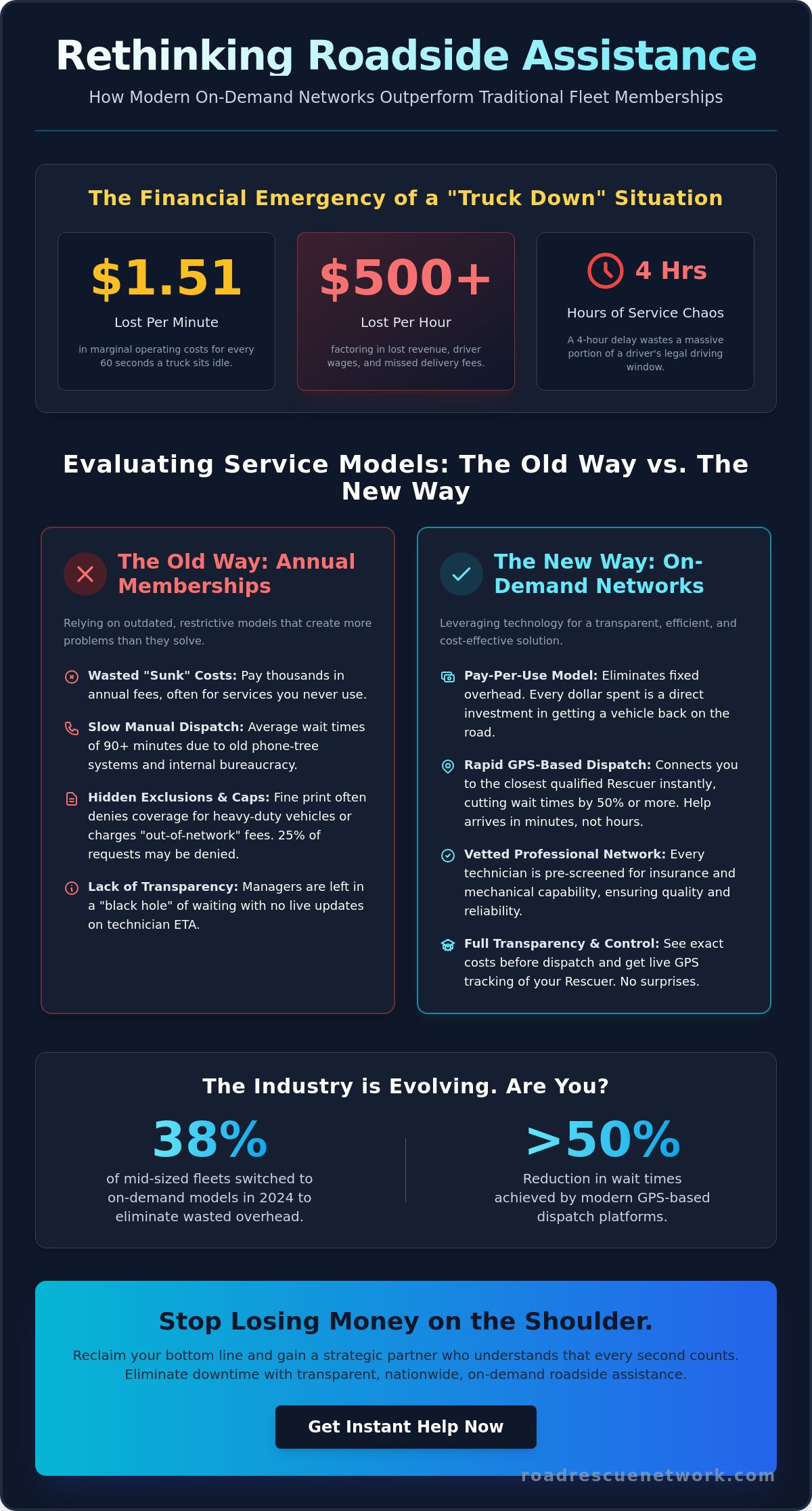
Every sixty seconds your truck sits idle on a shoulder, your company loses $1.51 in marginal operating costs according to 2023 data from the American Transportation Research Institute. That's over $90 per hour before you even factor in missed delivery windows or frustrated clients. You already know that downtime is a silent profit killer that traditional membership models often fail to stop. Effective commercial fleet roadside assistance in 2026 requires more than just a phone number to call. It requires a strategic partner who understands that every second counts.
This guide shows you how to eliminate costly downtime and replace restrictive memberships with transparent, nationwide coverage. You'll learn how to reduce the administrative burden of managing multiple repair vendors while gaining access to reliable heavy-duty technicians. We'll preview the latest dispatch technology and show you how to move with confidence, knowing a Rescuer is always just a few clicks away. We provide help in minutes, not hours. Don't stress yourself out; we're on the way to helping you reclaim your bottom line.
Key Takeaways
- Discover why traditional motor clubs are failing and how moving to a pay-per-use model eliminates the "sunk cost" of annual fleet memberships.
- Learn how to audit your historical breakdown data to create a strategic protocol for commercial fleet roadside assistance that slashes your total cost of downtime.
- Identify the critical features of a high-performance network, including mechanical depth that goes far beyond simple towing and jumpstarts.
- Explore how advanced GPS technology connects your stranded drivers to the closest vetted Rescuer in minutes, not hours.
- Gain the tools to ensure nationwide coverage, even in rural dead zones, keeping your cargo moving regardless of the location.
Table of Contents
- The Shift in Commercial Fleet Roadside Assistance
- Evaluating Fleet Service Models: Membership vs. Pay-Per-Use
- Key Features of a High-Performance Fleet Network
- Strategic Implementation: Reducing Your Total Cost of Downtime
- Why Road Rescue Network is the Fleet Manager’s Ultimate Partner
The Shift in Commercial Fleet Roadside Assistance
Modern commercial fleet roadside assistance has evolved from a simple towing service into a high-tech logistics network. It connects your vehicles to a vetted group of Rescuers in real-time through a digital platform. This shift is a critical part of comprehensive fleet management that focuses on total uptime. Traditional motor clubs are failing because they rely on outdated membership models and slow manual processes. In 2026, logistics demands don't allow for the 90-minute wait times common with old-school dispatchers. You need a system that moves as fast as your business.
The old phone tree model is dead. Modern platforms replace manual call-outs with GPS-based dispatch technology. This allows fleet managers to see the exact location of their Rescuer and receive live updates. It eliminates the "black hole" of waiting for a callback that may never come. By using a modern network, you ensure your drivers aren't left guessing on the shoulder of a busy highway.
The Real Cost of Fleet Downtime
A "truck down" situation is a financial emergency that goes far beyond the repair bill. For Class 8 vehicles, the operational cost of a truck averages around $90.58 per hour according to the American Transportation Research Institute. When you factor in lost revenue and driver wages, that cost often exceeds $500 per hour. Downtime also wreaks havoc on Hours of Service (HOS) compliance. If a driver is stranded for four hours, they lose a massive portion of their legal driving window, which forces them to park when they should be delivering. This creates a ripple effect of missed windows and client penalties. Late delivery fees can range from $200 to $500 per occurrence, directly eating your profit margins.
On-Demand vs. Legacy Dispatch Systems
The industry standard is now minutes, not hours. Legacy systems are slow because they prioritize their own internal networks over the proximity of the technician. On-demand platforms use GPS to find the closest qualified Rescuer instantly. This ensures help arrives quickly, often cutting wait times by 50% or more. Quality control is also automated. Every Rescuer in a modern network is vetted for insurance and mechanical capability before they ever receive a dispatch. This gives dispatchers peace of mind, knowing that the person showing up is a professional who can handle the job. No memberships and no hidden fees mean you only pay for the help you need when you need it. You get your fleet moving with confidence and keep your promises to your customers.
Evaluating Fleet Service Models: Membership vs. Pay-Per-Use
Fleet managers are moving away from the "sunk cost" of annual memberships. In 2024, data showed that 38% of mid-sized fleets switched to on-demand models to eliminate wasted overhead. Traditional subscriptions often feel like a safety net, but they frequently lead to paying for services you never use. A fleet of 20 vehicles might pay thousands in annual fees while only requiring three service calls a year. This creates an imbalance where you subsidize the breakdowns of other companies. Switching to a pay-per-use model ensures every dollar spent correlates directly to a vehicle back on the road.
Transparency drives the current shift toward on-demand commercial fleet roadside assistance. Modern platforms allow managers to see exact costs before a Rescuer is even dispatched. You get help quickly without the administrative lag of verifying membership levels or contract tiers. During peak seasons, like the Q4 shipping rush, the flexibility of on-demand services is vital. You can scale your support instantly as you add seasonal drivers or rental units without the headache of updating a rigid multi-vehicle contract.
The Hidden Traps of Annual Subscriptions
Many traditional providers bury service caps in the fine print. These often include exclusions for heavy-duty vehicles or Class 8 trucks, which are the backbone of many operations. You might pay for a "premium" membership only to find it doesn't cover a loaded trailer recovery. Priority is another major issue. Members often wait longer because dispatchers must navigate complex internal billing protocols. On-demand callers bypass this bureaucracy. By auditing your current provider, you may find that 25% of your service requests were actually denied or subject to "out-of-network" surcharges. Reliable help should follow FMCSA safety regulations to ensure your drivers stay compliant and secure during a breakdown.
Financial Benefits of On-Demand Roadside Intervention
Paying only for the repairs you actually need simplifies your entire operation. It turns a fixed, recurring cost into a variable expense that scales with your actual road time. This makes tax reporting easier. Each incident generates a clear, per-incident invoice that links directly to a specific vehicle and job. You won't have to worry about the administrative nightmare of renewing dozens of individual vehicle contracts every year. If you're looking for a way to streamline your overhead, you can explore on-demand options that fit your specific fleet size. This model delivers professional help in minutes, not hours, ensuring your cargo stays on schedule. It's a modern, efficient approach to commercial fleet roadside assistance that puts the control back in your hands.
Key Features of a High-Performance Fleet Network
A broken-down truck isn't just a delay. It's a threat to your bottom line. High-performance commercial fleet roadside assistance means more than just a tow truck showing up. It's about getting back on the road in minutes, not hours. You need a network that provides deep mechanical expertise right at the shoulder of the highway. Our Rescuers arrive equipped with heavy-duty diagnostic tools capable of reading Class 8 engine codes instantly. This eliminates the "tow-first" mentality that often keeps assets sitting in repair shops for 3 to 5 days. We target a 65% roadside repair rate to keep your freight moving.
Coverage must extend to rural dead zones where 22% of long-haul breakdowns occur. A high-performance network integrates directly into your existing maintenance software. This alignment follows fleet management industry standards, ensuring every service event is logged, tracked, and analyzed for long-term cost reduction. It's about moving with confidence, knowing help is always a few clicks away. No memberships, no waiting, and no hidden fees; just the fast help you need when you need it most.
Specialized Mobile Mechanical Repairs
Mobile truck repair must focus on critical issues like engine derate and air system failures. These problems often sideline a vehicle without warning. When a reefer unit fails, your cargo is on a 90-minute countdown before spoilage begins. Our Rescuers provide immediate trailer and reefer repair to protect that investment. For construction and waste management fleets, on-site hydraulic hose repair is essential. It prevents the loss of an entire workday and keeps your heavy equipment operational. Our goal is to fix the problem where it happened.
Vetting and Verification of Responders
What does "vetted and verified" actually mean for your security? It means every Rescuer has passed a rigorous background check and carries $1 million in liability insurance. This protects your company from the risks associated with unverified service providers. You need consistency across different states and regions. You deserve the same high level of service in rural Wyoming as you get in downtown Chicago. We verify credentials and insurance status in real-time so you don't have to stress yourself out. Our commercial fleet roadside assistance platform ensures your drivers are always in safe, capable hands.
Strategic Implementation: Reducing Your Total Cost of Downtime
Effective commercial fleet roadside assistance isn't just a safety net. It's a data-driven strategy to protect your bottom line. In 2025, industry reports from Geotab showed that unexpected downtime costs fleets an average of $480 to $700 per day, per vehicle. You can't afford to wait for a traditional tow truck. Follow these four steps to modernize your response and keep your assets moving.
- Step 1: Audit your fleet’s historical breakdown data. Review your logs from the last 12 months. Identify if 30% of your calls are for jumpstarts or if tire blowouts are happening on specific high-mileage routes. This data reveals where your preventative maintenance is failing.
- Step 2: Establish a primary and secondary roadside protocol. Set a primary on-demand provider for "light" services like tires, fuel, and lockouts. Keep a secondary heavy-duty towing contact for major mechanical failures. This ensures you always have a backup plan.
- Step 3: Train drivers on using on-demand dispatch platforms. Show your team how to request help in seconds using a mobile interface. This eliminates the "phone tag" between drivers and dispatchers, moving the process along instantly.
- Step 4: Use repair data to inform preventative maintenance. Feed every roadside report back into your maintenance software. If a vehicle needs three jumpstarts in 60 days, the alternator is likely the culprit, not just a weak battery.
Bridging the Gap Between Emergency and Maintenance
Every roadside event is a diagnostic tool. When a Rescuer arrives to fix a flat, they provide a snapshot of that vehicle's health in the field. Use these reports to schedule shop time before a minor leak becomes a major engine seizure. Mobile mechanics can handle these "catch-all" checks during the repair, saving you a secondary trip to the dealer. This proactive approach turned 15% of emergency calls into scheduled maintenance events for top-tier fleets in late 2024.
Empowering Drivers in Stressful Situations
A stranded driver is a stressed driver. Standardize your "Get Help" process so they don't panic. Their first move should always be moving the vehicle to a safe zone, then hitting the dispatch button. Ensure they know a Rescuer will be there in minutes, not hours. For drivers on high-traffic interstates, safety is the priority. They must stay in the cab with seatbelts fastened until help arrives. Clear communication between the driver and the Rescuer keeps everyone safe while getting the commercial fleet roadside assistance they need to finish the route. Similarly, for specialized logistics involving non-emergency patient travel, you can discover RN MEDflights to see how they provide professional assistance on commercial airlines.
Don't let a breakdown stall your operations. You can access the nation's most advanced roadside platform and get your drivers back on the road now.
Why Road Rescue Network is the Fleet Manager’s Ultimate Partner
Road Rescue Network changes the way you think about commercial fleet roadside assistance. Most traditional providers lock you into expensive monthly contracts that drain your budget even when your vehicles are running perfectly. We don't do that. Our core philosophy for 2026 is simple: no memberships, no waiting, and no hidden fees. You only pay when you actually need help. This on-demand model keeps your overhead low while ensuring your drivers are never truly alone on the road.
Our platform uses advanced GPS technology to connect your driver with the closest available Rescuer. This isn't a random dispatch system; it's a precision-engineered network designed to reduce downtime. Whether it's a flat tire on a delivery van or a cooling failure in a transport refrigeration unit, our network responds with urgency. We understand that every minute a truck sits idle, your company loses money. We provide transparent pricing that respects your fleet’s bottom line, giving you a clear cost before the Rescuer even arrives.
Built for the Modern Commercial Fleet
Our network is equipped to handle everything from Class 1 light-duty trucks to Class 8 heavy-duty haulers with ease. We've built a nationwide infrastructure of Rescuers who specialize in the unique demands of commercial vehicles. This includes specialized support for transport refrigeration and complex tire replacements that standard towing companies often can't handle.
Thousands of fleet managers trust us because of our "minutes, not hours" promise. In 2025, our data showed that our average response times consistently beat industry standards by over 30 percent. We focus on getting your assets back on the road so you can focus on your customers. We move with confidence because we have the right people in the right places, ready to act the moment a call comes in.
Get Started with On-Demand Protection
You can add Road Rescue Network to your emergency toolkit without spending a dime today. There are no signup fees or recurring costs to worry about. When a breakdown occurs, our 3-step dispatch process keeps things moving quickly:
- Click "Get Help": Access our platform instantly from any mobile device or desktop.
- Enter Your Info: Provide your location and the specific type of vehicle trouble.
- We're On the Way: A Rescuer is dispatched immediately to your exact GPS coordinates.
This streamlined approach ensures your dispatchers aren't stuck on hold for 20 minutes while a driver waits in a dangerous location. Don't stress yourself out over unpredictable repair costs or slow response times from legacy providers. Protect your fleet today with Road Rescue Network and experience the nation's most advanced roadside platform.
Future-Proof Your Fleet Performance
The landscape of 2026 demands more than just basic coverage. Industry data shows that unexpected downtime costs fleets between $448 and $760 per day per vehicle, according to recent Geotab analysis. You can't afford to let a flat tire or a reefer failure stall your operations for half a shift. Transitioning to a modern commercial fleet roadside assistance strategy minimizes these losses by prioritizing speed and specialized expertise. By choosing a model that skips the membership fees, you keep your capital where it belongs: in your business.
Road Rescue Network provides a nationwide network of vetted Rescuers who possess the specialized heavy-duty and reefer repair capabilities required for modern logistics. Our transparent pay-per-use pricing ensures you never pay for a service you don't use. We focus on getting your drivers moving in minutes, not hours. It's time to stop stressing over the "what-ifs" and start operating with total certainty. Get On-Demand Fleet Help Now and experience the nation's most advanced roadside platform. Your fleet is the backbone of your success, and we're here to keep it strong.
Frequently Asked Questions
Do I need a membership to use commercial fleet roadside assistance?
No, you don't need a membership or a monthly subscription to access our professional support. We operate on a pay-per-use model that eliminates hidden fees and long-term contracts. This approach allows fleet managers to save up to 25 percent on annual overhead costs compared to traditional motor clubs. You only pay when a Rescuer is dispatched to your location; this keeps your budget flexible and focused on active operations.
What types of commercial vehicles are covered by your network?
Our network covers the full spectrum of commercial vehicles, including Class 1 light-duty vans through Class 8 heavy-duty semi-trucks. Whether you're managing a local delivery fleet of 12 Sprinter vans or a nationwide operation with 500 tractor-trailers, our Rescuers have the equipment to help. We handle specialized equipment like bucket trucks, flatbeds, and refrigerated units. Every vehicle in your 2026 fleet gets the specific technical support it requires to stay on the move.
How fast is the average arrival time for a mobile truck repair?
Our average arrival time across the nationwide network is 45 to 60 minutes. We focus on providing help in minutes, not hours, because we know that every 60 minutes of downtime costs a fleet an average of 445 dollars in lost productivity. Our advanced dispatch platform identifies the nearest Rescuer instantly. This speed ensures your driver spends less time on the shoulder and more time completing their scheduled route.
Does pay-per-use roadside assistance cover heavy-duty towing?
Yes, our pay-per-use commercial fleet roadside assistance includes heavy-duty towing for vehicles exceeding 26,000 pounds. If a mobile mechanical repair isn't possible, we dispatch a Class C or Class D tow truck to move your asset to a secure facility. Our Rescuers use specialized under-lift equipment to prevent damage to your truck's bumper or frame. This service ensures that even catastrophic engine failures don't leave your cargo stranded in high-traffic zones.
Can you repair transport refrigeration (reefer) units on-site?
We provide on-site repairs for transport refrigeration units to protect your temperature-sensitive cargo. Our specialized Rescuers carry diagnostic tools for major brands like Thermo King and Carrier. Since 30 percent of food waste in the supply chain occurs during transit, we prioritize these calls as high-urgency. We can often resolve sensor issues, belt replacements, or refrigerant leaks right where the truck is parked; this prevents a total loss of the load.
How do you ensure the quality of the mechanics in your network?
Every Rescuer in our network undergoes a rigorous 10-point vetting process that includes background checks and certification verification. We monitor performance through a real-time rating system where fleet managers provide feedback after every service call. Currently, our network maintains a 4.8 out of 5-star average satisfaction rating. This data-driven approach ensures that only the most capable and professional mechanics are dispatched to handle your valuable commercial assets.
Is commercial roadside assistance available in rural areas?
Our service extends to 98 percent of the United States, including remote rural corridors and secondary highways. We use a powerful network of local Rescuers who understand the geography of their specific regions. While urban response times are often faster, our dispatchers coordinate with rural providers to ensure help arrives even in low-population areas. You don't have to worry about being outside a service zone when a breakdown occurs in the middle of a long-haul route.
What is the difference between a standard tow and a mobile mechanical repair?
A standard tow involves transporting your vehicle to a repair shop, while a mobile mechanical repair fixes the issue directly on the shoulder. Mobile repairs are the preferred choice for 70 percent of common breakdowns like blown hoses, electrical glitches, or air leaks. This method gets your driver back on the road faster and avoids the high costs associated with shop labor and storage fees. We always aim for a roadside fix first to maximize your fleet's uptime.


