Refrigerated trailer repair and cold-chain support.
Multi-temp and single-temp trailers, reefer straight trucks, and the tractor pulling the load. Routed to rescuers who actually work refrigeration, not to whoever is nearest.
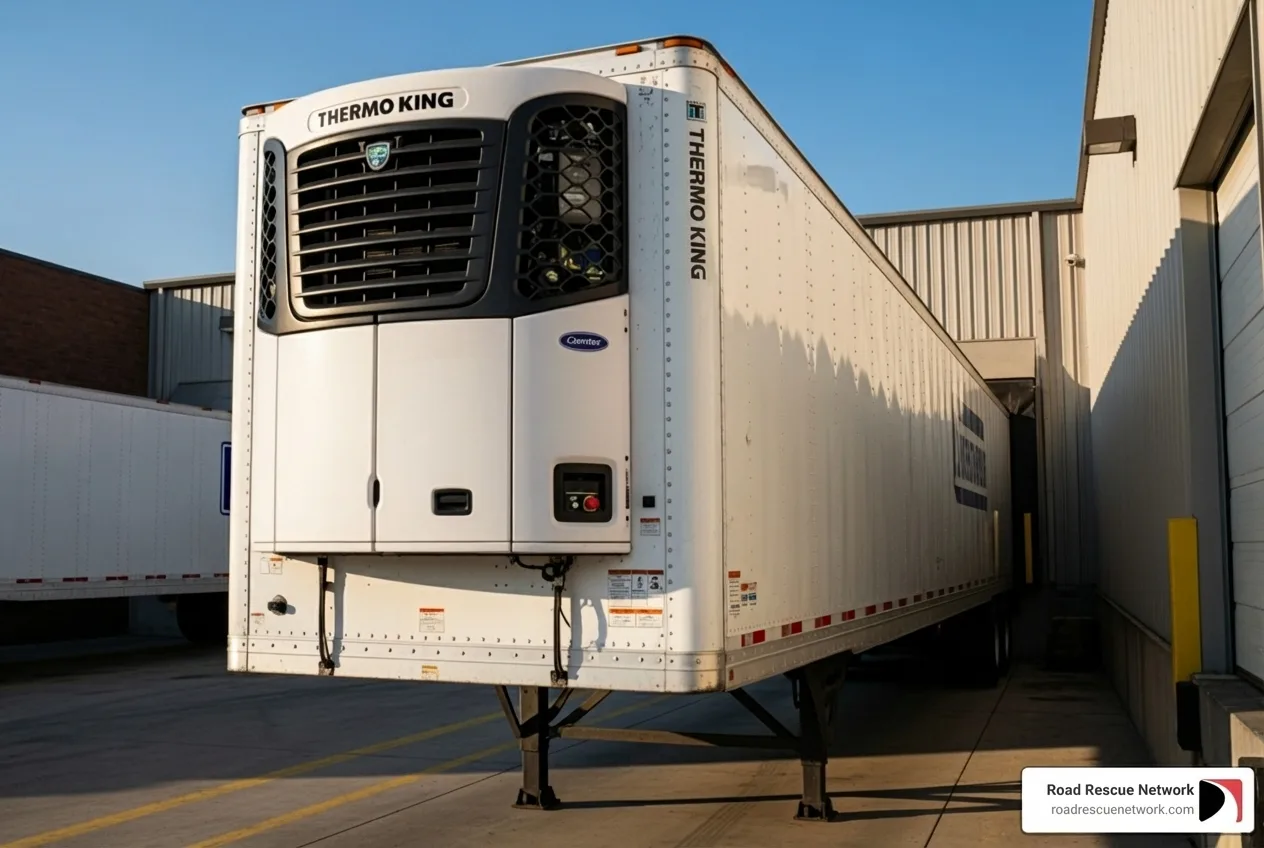
On a reefer call the load is worth more than the truck, and the clock started before the phone rang.
A refrigeration failure is the one roadside event where the wrong answer is expensive even when the repair is cheap. Product temperature has a documented tolerance, FSMA has a paper trail, and a receiver has a right to reject on arrival. That means the useful metric is not how fast someone arrives but how fast someone who can actually diagnose the unit arrives — a general mechanic standing next to a Thermo King is not progress.
Routing on this network is by capability first, which matters more here than in any other vertical. Refrigeration specialists carry the diagnostic interfaces, know the common fault trees on Carrier and Thermo King units, and can tell the difference between a unit that will hold to the receiver and one that will not. That judgement call — keep running or reload — is often worth more than the repair itself.
The trailer around the refrigeration unit still fails in ordinary ways, and food-grade lanes are unforgiving about it. Door seals, bulkheads, brakes, lighting and tire work all sit inside the same call, and a unit that cannot legally roll is as stopped as one that cannot cool. Keeping trailer DOT compliance current without pulling equipment out of temperature-controlled lanes is a scheduling problem that on-site inspection solves.
What actually goes wrong in refrigerated.
Spoilage and FSMA exposure while a unit sits unresolved
The load has a documented temperature tolerance and a paper trail. Hours matter in a way they do not on a dry van.
A driver alone with a perishable load and no technical read
Drivers can describe symptoms but not diagnose a refrigeration fault. Getting a specialist on it early is what avoids a guess that costs the load.
Trailer and brake defects found at a receiver dock
Far from home base, at the worst moment, with an appointment window closing. On-site repair at the dock beats a shop across town.
Roadside tire failure with a full temperature-controlled load
Tire work on a loaded reefer is a timed event, not a routine one. Commercial tire capability has to arrive with the call.
Keeping DOT compliance current without leaving the lane
Refrigerated equipment is hard to spare for a shop day. Inspection visits at the yard keep units legal without a gap in coverage.
How a refrigerated call runs.
Lead with the unit and the setpoint
Make and model of the refrigeration unit, the alarm code on the display, the setpoint, and the current box temperature. That is what tells dispatch how much time the load has.
Routed to a refrigeration specialist
Refrigeration is a distinct skill set with its own diagnostic interfaces. The request goes to someone who works these units, not to the nearest available truck.
Hold-or-reload called early
The first useful output is often not a repair. It is a straight answer about whether the load will make the receiver, while there is still time to act on it.
Repaired at the trailer
Belts, sensors, refrigerant faults, electrical and door seals get worked where the trailer sits, including at a receiver dock.
Documented for the cold chain
The work order records the fault, the fix and the temperatures, which is the record you need when a receiver asks.
Operations we serve in refrigerated.
- Refrigerated LTL & TL carriers
- Produce & perishable distributors
- Frozen food manufacturers & processors
- Pharmaceutical & cold-chain logistics
- Floral & specialty perishable shippers
- Grocery distribution & food service fleets
Vehicles and equipment covered.
- Refrigerated trailers (multi-temp & single-temp)
- Reefer-equipped straight trucks & box trucks
- Trailer brake & air system components
- Trailer lighting & electrical systems
- Fifth-wheel & coupling components
- Trailer door seals & bulkhead assemblies
Where to go next.
Thermo King and Carrier units, diagnosed on-site.
Learn more →Brakes, lighting, seals and bulkheads.
Learn more →Loaded-trailer tire work, done at the trailer.
Learn more →Service history per trailer, invoicing in one place.
Learn more →Delivery stops here — breakdowns don't.
Learn more →Big iron deserves mechanics who show up.
Learn more →5,241 towns with their own repair, towing and roadside pages.
Learn more →Browse verified rescuers by service and service area.
Learn more →Answers before you call.
Yes. Refrigeration specialists in the network carry the diagnostic interfaces for both. Give the unit make, model and alarm code when you call so the routing is right the first time.
Refrigeration requests are treated as timed calls because the load has a tolerance. You get an arrival window on the phone, and if the window will not save the load you hear that instead of finding out later.
That is usually the first thing the specialist gives you, ahead of the repair. It is the call that decides whether you run, reload or divert, and it is worth more than the wrench time.
Yes. Dock and yard calls are normal for this vertical, including at facilities far from your home base.
Yes. On-site inspection visits at your yard keep units legal without taking them out of temperature-controlled lanes for a shop day.
Service-call fees typically run $150 to $235 depending on hour, location and service type. Refrigeration diagnostics and parts are quoted on top, and settled before work starts.
Cold unit down? Get a specialist on it, not a guess.
Dispatching 24 hours · 7 days a week