Roadside truck repair for owner-operators.
Class 8 sleepers, hotshot rigs, flatbeds and vocational trucks. No fleet account required, no membership, and the price is settled on the phone before anyone rolls.
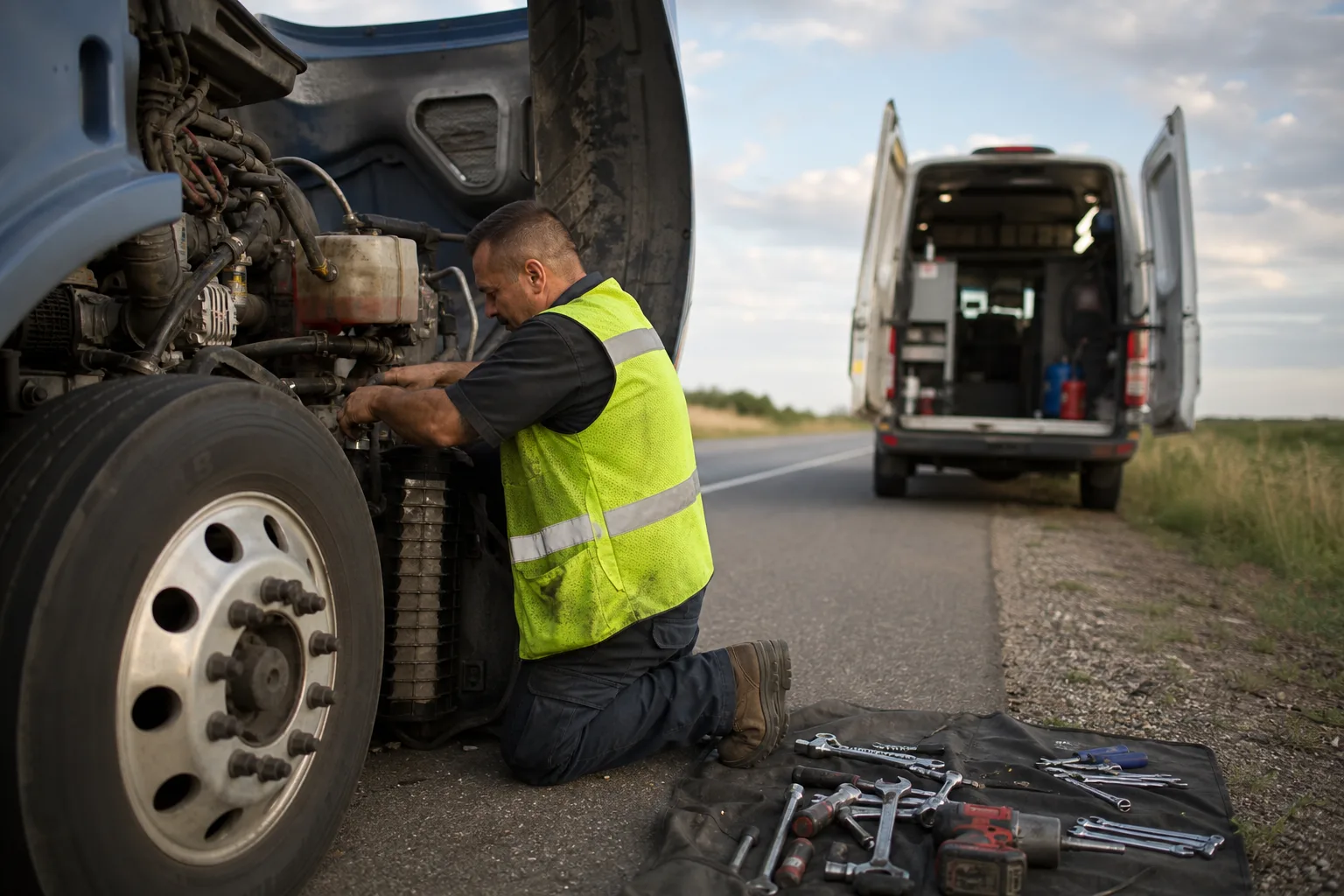
A fleet with a hundred trucks loses a percent of capacity. You lose all of it.
Owner-operators carry a risk profile that no fleet does: there is no spare unit, no shop, and no maintenance department absorbing the failure. Every breakdown is a total revenue stop, and it usually arrives with the truck loaded and the clock running on the delivery. The thing that matters most is not a discount programme — it is that the person who shows up can actually fix what broke, first time, so the day is not lost to a second call.
Routing on this network does not care how many trucks you run. A solo operator's request goes through the same capability match as a national carrier's, because the match is on the failure and the location, not the size of the account. That is the practical difference between this and a roadside programme that treats small operators as the bottom of a priority list.
Cash flow is the other half of it, and it is why the pricing is settled before dispatch rather than after the work. You hear the service-call rate on the phone, and you decide whether to run the call, wait for daylight, or handle it another way — with the number in front of you instead of behind you. There is no after-hours surcharge, so a 3 a.m. failure is quoted the same as a 3 p.m. one.
What actually goes wrong in owner-operators.
No backup unit — every failure is a total stop
There is no reallocating the load to another truck. The repair is the only path back to revenue.
Programmes that cannot promise a qualified tech
Being sent someone who cannot do the job costs the whole day, not just the call. Capability routing is the difference.
Cash flow that turns a repair into a crisis
A surprise four-figure bill with a load undelivered is a different problem than the same bill inside a fleet budget. Knowing the number first is most of the fix.
No maintenance staff catching problems early
Nobody is inspecting the truck but you, between loads, tired. Small faults become roadside events because there is no second set of eyes.
Night and weekend failures far from home
The hours with the fewest options are the hours most likely to strand you. Coverage has to be real at 3 a.m. or it is not coverage.
How a owner-operators call runs.
Call it in — no account needed
Dial 1-800-673-1060. There is no membership, no fleet agreement and no sign-up standing between you and a dispatch.
Same routing a carrier gets
The match is on the failure and the location, not the size of the account. One truck routes exactly like a hundred.
Price before the roll
You hear the service-call rate on the phone. If it does not work, you say no with the number in front of you instead of after the fact.
Fixed where you sit
Air leaks, hoses, belts, electrical, batteries and tires close on the shoulder. A tow happens only when the failure genuinely requires one.
Paid and documented
Card on the spot, work order in writing. You have the record for your own maintenance file and for whoever you lease onto.
Operations we serve in owner-operators.
- Independent owner-operators (single truck)
- Small fleets (2-10 units)
- Lease-on operators with carriers
- Hotshot & expedited freight operators
- Flatbed & specialized haulers
- Owner-operated dump & aggregate trucks
Vehicles and equipment covered.
- Class 8 sleepers & day cabs
- Owner-operated flatbed & step-deck trailers
- Hotshot trucks & gooseneck trailers
- Owner-operated tankers & specialty trailers
- Medium-duty owner-operator trucks (Class 5-7)
- Dump trucks & vocational trucks
Where to go next.
The core call — fixed on the shoulder.
Learn more →Blowouts and slow leaks, handled roadside.
Learn more →Out of fuel, out of DEF, back moving.
Learn more →Browse verified rescuers in the lanes you run.
Learn more →Keep every load moving, every mile.
Learn more →Public assets. Zero tolerance for downtime.
Learn more →5,241 towns with their own repair, towing and roadside pages.
Learn more →Browse verified rescuers by service and service area.
Learn more →Answers before you call.
No. Call 1-800-673-1060 and a rescuer is dispatched. There is no sign-up, no monthly fee and no minimum fleet size.
No. Routing is on the failure and the location. A single truck goes through the same capability match a national carrier's request does.
Service-call fees typically run $150 to $235 depending on hour, location and service type. You hear the rate on the phone and decide before anyone is dispatched. There is no after-hours surcharge.
Yes. Payment is settled at the truck and you get the work order in writing for your own records and for whoever you lease onto.
The rescuer tells you early rather than billing hours to find out, documents what was done, and handles the tow if that is the right call.
Yes. Hotshot trucks, goosenecks, medium-duty Class 5 to 7 and vocational trucks are all inside the network's coverage alongside Class 8.
One truck down is one hundred percent down. Call it in.
Dispatching 24 hours · 7 days a week